

The United Nations Office at Geneva
Multimedia Newsroom
Press Conferences | OHCHR , UNICEF , UNHCR , WHO , UNOG , UNITED NATIONS , WFP , UNCTAD , ILO
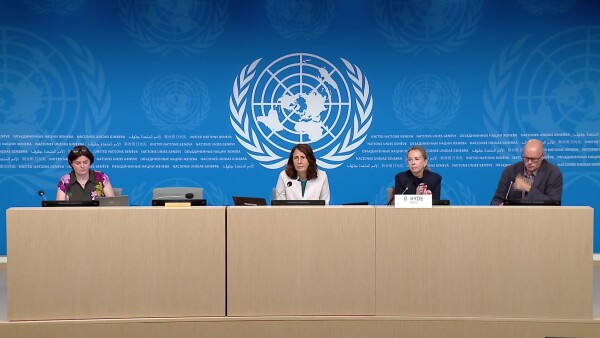
UNOG Bi-weekly press briefing 11 June 2021
Dire food situation in Tigray, Ethiopia
Tommy Thompson, Emergency Coordinator of the World Food Programme (WFP), stated that Tigray was in an absolute crisis, with a catastrophic food situation, from which people had already started to die. There were three food operators working in Tigray – a government consortium, a US humanitarian NGO-led group, and the World Food Programme. WFP had reached about 2.1 million people in the last round of distributions and was hoping to scale up and reach the total of 2.6 million in the coming weeks. Unrestricted access for humanitarian actors to Tigray had not been made possible yet. It was an incredibly dangerous environment for the humanitarians, nine of whom had been killed thus far. Both access and protection were major issues of concern, stressed Mr. Thompson. This crisis was going to continue unless there was a “sea change” in the Government’s attitude. About 25 percent of the region’s territory could not be reached, which was why it was close to impossible to properly estimate the situation. WFP was asking for an unimpeded access, which could be facilitated by a cessation of hostilities. Funding was paramount: a total of USD 203 million were needed until the end of the year.
James Elder, for the United Nations Children’s Fund (UNICEF), said that unless there was imminent massive assistance, there would be a crisis not seen in more than a decade. Calls for a cessation of hostilities had not been heeded. UNICEF Executive Director stated that more and more young children and babies were close to dangerously low levels of nutrition; children in highly inaccessible areas were particularly vulnerable. Having seen the sheer lack of support reaching people in parts of Tigray, Mr. Elder stressed that people were dying of hunger, and that the devastation to crops and livestock meant that hundreds of thousands of people had lost their access to livelihood. There was a real risk of deaths of tens of thousands of children, warned Mr. Elder.
Margaret Harris, for the World Health Organization (WHO), stressed that food security crises were, by definition, public health crises. Between malnutrition and death, there was almost always disease. Acute malnutrition was a major public health emergency. Malnourished children were more likely to contract an infectious disease – such as pneumonia, diarrhoea, malaria and measles - and then to die of that disease. Ms. Harris emphasized the importance of access. WHO teams with mobile clinics were ready, but many were being turned away by warring parties. It was a public health emergency. The previous week only, over 350 cases of severe acute malnutrition of children under 5 had been recorded. Without an end to the conflict and unhindered access, the situation would only further deteriorate.
Responding to questions, Mr. Elder said that the UN had been asking the African Union and other international partners to address the issue of access to Tigray, as well as for funding. If there existed full unrestricted access, the UN agencies had the capacity to stave off hunger. There were signs that large numbers of Eritrean soldiers were still on the ground. Given the gravity of the situation, said Mr. Elder, he had not yet seen statements he would expect to see by the African Union to its host, Ethiopia, and to Eritrea regarding the Ethiopia Defence Forces or the Eritrean troops. Mr. Thompson reiterated that a cessation of hostilities would be needed; the current funding gap for the WFP activities stood at USD 70 million. On another question, Dr. Harris said that Tigray was known as a place with cholera outbreaks in the past, which was why a regular cholera vaccination campaign was starting.
Further escalation of violence in Myanmar
Ravina Shamdasani, for the Office of the High Commissioner for Human Rights (OHCHR), informed that UN High Commissioner for Human Rights Michelle Bachelet had warned today that a further escalation in violence was unfolding across Myanmar and had to be halted to prevent an even greater loss of life and a deepening humanitarian emergency. Reports indicated a military build-up, particularly in the Kayah State in the east and the Chin State in the west of the country.
There appeared to be no efforts towards de-escalation but rather a build-up of troops in key areas, contrary to the commitments the military made to ASEAN to cease the violence. Credible reports indicated that security forces had used civilians as human shields, shelled civilian homes and churches in Loikaw, Phekon and Demoso in Kayah State and blocked humanitarian access, including by attacking humanitarian actors. Myanmar’s military had a duty to protect civilians. The international community needed to unify in its demand that the Tatmadaw cease the outrageous use of heavy artillery against civilians and civilian objects and respect the principle of distinction. The High Commissioner appealed for hospitals, schools and places of worship to be protected throughout the country.
High Commissioner’s full statement is here.
Replying to questions, Ms. Shamdasani said that there had been a proliferation of the so-called “people’s defence forces” around Myanmar, which numbered more than 100 by now. She reminded that the protests against the 1 February coup had started peacefully; since then the repression by the army and the resistance had radicalized. For the military to be attacking civilian targets was clearly a violation of the international law.
Answering a question, Alessandra Vellucci, for the United Nations Information Service (UNIS), reminded that the UN Special Envoy to Myanmar, Christine Schraner Burgener, was continuing to actively pursue her mission to find a pathway back towards a democratically representative government in Myanmar.
Insecurity in northern Mozambique
Babar Baloch, for the United Nations Refugee Agency (UNHCR), stated that the UNHCR remained gravely concerned for the safety of civilians in northern Mozambique as armed conflict and insecurity in the coastal city of Palma continued to displace thousands of people, two and a half months after a brutal attack by non-state armed groups. People were fleeing daily in a desperate search for safety both in Mozambique and across the border in Tanzania. Some 70,000 people had fled Palma since 24 March, bringing the total number of displaced in Cabo Delgado province to nearly 800,000 according to humanitarian estimates.
UNHCR continued to advocate for the internally displaced to receive protection and assistance in Mozambique and for vulnerable people seeking safety in neighbouring Tanzania to access asylum. UNHCR reiterated its call for those fleeing the conflict to have access to territory and asylum, and, in particular, for the principle of non-refoulement to be respected.
UNHCR briefing note is here.
That the 9,600 desperate people seeking refuge in Tanzania were being forced to come back to Mozambique was a terrible development, said Mr. Baloch in a response to a question. UNHCR was repeating its call on all sides, including Tanzania, not to return refugees to the situations of danger.
James Elder, for the United Nations Children’s Fund (UNICEF), said that climate, conflict and COVID were the three factors at play in northern Mozambique. Women and children were particularly in need of support, and children on the ground were experiencing serious trauma. There were stories of alleged killing and maiming, with girls and women subjected to reported rapes, and some girls kidnapped and turned into “wives” for militants, etc. Hundreds of schools and water systems had been damaged. UNICEF did not have a full picture of what was happening to children because of the problems with access – a fundamental obligation under the international humanitarian law.
COVID-19
In a response to a series of questions, Margaret Harris, for the World Health Organization (WHO), said that vaccines were good at preventing severe disease or death if one got infected with the virus. However, what was also needed was to reduce the transmission; it was not yet known that the vaccines actually did that, for which masks were particularly useful. Wearing a mask, avoiding crowds and closed spaces were all still needed, as it could not be confirmed that the vaccines actually and effectively prevented the transmission of the virus.
Dr. Harris said that it was very heartening to see that countries with access to large numbers of doses were responding to the WHO’s calls to share doses. WHO wanted to see 250 million doses used, by September, to vaccinate high-risk people in less developed parts of the world. Some 1.9 billion doses had been administered globally thus far; of these, only 81 million doses had been shipped to 129 countries through COVAX, which was far from enough. Shipping the doses was not enough; many countries also needed support with securing the necessary logistics, paying their vaccinators, etc. The longer the virus roamed freely, the more likely it was to develop variants against which vaccines were not effective. It was important to be able to vaccinate people with both doses of the vaccine within the prescribed 12 weeks.
Geneva announcements
Alessandra Vellucci, for the United Nations Information Service (UNIS), informed that the Secretary-General was in the UK. He was meeting with the UK Chair of COP 26 today and other senior officials, and would be in Cornwall to attend the G7 Summit over the weekend.
Catherine Huissoud, for the United Nations Conference on Trade and Development (UNCTAD), reminded that the UN Trade Forum would start on 14 June at 10 a.m. with an opening statement by Isabelle Durant, Acting Secretary-General of UNCTAD. The discussion would follow with a high-level event under the theme Towards a green and inclusive recovery: Trade after the crisis. On 15 June, the Forum would hold a discussion on Towards a more inclusive world. What can trade do, while a Prebisch Lecture would be given by Esther Duflo from 4 to 6 p.m.
Ms. Huissoud said on 17 June at 12 noon, Isabelle Durant, Acting Secretary-General of UNCTAD, and James Zhan, Director of the Investment Division, would present the 2021 World Investment Report entitled "Investing in Sustainable Recovery", under embargo until 21 June 7 a.m. Geneva time.
Rosalind Yarde, for the International Labour Organization (ILO), stated that on 15 June, the ILO would publish a new report on the situation of domestic workers around the world. It coincided with the adoption exactly ten years earlier of the landmark Domestic Workers’ Convention. The report contained regional estimates for the Americas, Asia and the Pacific, Europe and Central Asia, Arab States and Africa, and included regional, sub-regional and country data. An embargoed press conference would be held on 15 June at 9 a.m.; the embargo would lift at 2 p.m. Journalists interested in attending the press conference should inform the ILO.
Margaret Harris, for the World Health Organization (WHO), said that Dr. Tedros’s usual press conference would not happen today, as he would be addressing the G7, and there would be a press conference afterwards.
The following week, there would be a new report on children and digital waste; the embargo would lift on 15 June at 8 a.m. A virtual press conference with Maria Neira, WHO Director of Department of Environment, Climate Change and Health, would be held on 15 June at 4:30 p.m.
Ms. Vellucci informed that the WHO, with UN Geneva, was organizing ‘VERSUS’ exhibition on the essential theme of resilience, specifically related to the crisis of COVID-19. The public would be able to identify and engage 20 art initiatives/programmes over the world. The opening ceremony would streamed LIVE from the Palais des Nations on 15 June 15 2021at 4 p.m.: https://bit.ly/2SBeD1C
On 11 June at 3 p.m., a virtual UNHCR conference would be held to provide an expert briefing updating on the exodus of refugees and migrants from Venezuela ahead of an urgent Donors’ Conference. Speakers would be Michael Grant, Assistant Deputy Minister for the Americas at Global Affairs Canada, and Eduardo Stein, Joint UNHCR-IOM Special Representative for Venezuelan refugees and migrants.
On 15 June at 3:30 p.m., a hybrid press conference would be held to launch the Global Assessment Report (GAR) Special Report on Drought 2021, which would be under embargo until 17 June 3 p.m. Speakers would be Mami Mizutori, Special Representative of the Secretary-General for Disaster Risk Reduction, and Dr. Roger Pulwarty, Senior Scientist, US National Oceanic and Atmospheric Administration.
Ms. Vellucci also informed that on 17 June at 10 a.m., a hybrid press conference would be held by Ambassador Nazhat Shameem Khan (Fiji), President of the Human Rights Council, on the upcoming 47th regular session of the HRC.
Speaking on behalf of the Food and Agriculture Organization (FAO), Ms. Vellucci said that the FAO had released the Food Outlook Biannual Report on Global Food Markets on 10 June. The report noted that trade flows continued to reach new highs during the ongoing COVID-19 pandemic.
The 42nd Session of the FAO Conference would be held from 14 to 18 June virtually starting 9:30 a.m. The Conference would be opened with the traditional McDougall Memorial Lecture by Bill Gates you can watch on FAO webcast. More details were available on the FAO website.
Finally, Ms. Vellucci informed that the FAO, in co-operation with the Italian Presidency of the G20, had opened Rome's first garden yesterday dedicated to the concept of sustainable development, evocatively sited in the Parco dell'Appia Antica - an archeologically rich expanse connecting modern Rome to its sylvan past.
Similar Stories
1
1
1
Press Conferences | CITES
Wildlife trade and conservation policy discussions at the 81st meeting of the CITES Standing Committee (SC81)
1
1
1
Press Conferences | UNHCR , UNCTAD , WMO , OCHA , UNICEF , WHO
UNHCR Hungary’s 1956 Refugee Crisis: 70 Years On, UNCTAD World Investment Forum 2026, Doha, WMO Greenhouse Gas Bulletin and Climate Update for COP31, OCHA Afghanistan: Malnutrition, Girls’ Education and Recovery, UNICEF Yemen: Child Malnutrition and Unsafe Water in Taiz, WHO Inequalities in Noncommunicable Diseases and Risk Factors
1
1
1
Press Conferences | UNHCR
End of UNHCR's 77th Annual Executive Committee (ExCom) meeting week
1
1
1
Press Conferences | UNICEF , IOM , UNHCR
UN Special Assistant to the Personal Envoy Office (SUDAN): Peace Initiatives and Efforts in Sudan; UNICEF: Dire situation of children in Gaza; IOM: Damaged Homes and Energy Attacks Risk Displacing Ukrainians for this winter; UNHCR: update on EXCOM week
1
1
1
Press Conferences | IOM , UNDRR
UN stresses importance of household preparedness for disaster risk reduction.
1
1
1
Statements , Press Conferences | OHCHR
1
1
1
Press Conferences | UNHCR , UNICEF , IFRC , OHCHR , UN WOMEN , IOM , OCHA , WHO
UNHCR – ExCom Meeting, UNICEF – Nepal Recovery, IFRC – Flash Floods, WHO – Mental Health, IOM – South Sudan Floods, OCHA – DRC Humanitarian aid, UNHCR – Sahel Displacement, UNICEF – Yemen Update, IOM – Gaza Shelter, UN Women – Gaza Women, OHCHR – Arrests and detentions of Syrians by Israeli force
2
1
2
Press Conferences | UNCTAD
Presentation of the Trade and Developement Report 2026
Embargoed until 9 October 2026 at 11 a.m. (Geneva Time)
UNCTAD: UNCTAD’s flagship report finds that governments increasingly use industrial, trade, financial and technology policies to pursue economic and national security objectives. Market access and the ability to move into higher-value activities now depend more heavily on technology, finance and geopolitics.
1
1
1
Press Conferences | UPU
Release of the State of the Postal Sector Report 2026
1
1
1
Press Conferences | IOM , ITU , UNECE , UNICEF , WHO , WMO
UNICEF: Ebola, DRC - children orphans or separating them from parents and caregivers; IOM: Humanitarian needs in Djibouti amid arrivals from Yemen and increased migrant movements; WHO: Darfur, scale of health needs far exceeds available resources; WMO co-sponsored Global Heat Forum, Bangkok, monthly Global Seasonal Climate Update; UNECE: UN Forum of Mayors; ITU Plenipotentiary Conference 2026; WHO: child and adolescent obesity guidelines and new global roadmap to tackle pregnancy hypertension, a leading cause of maternal mortality
1
1
1
Press Conferences | OCHA , UN WOMEN , UNHCR , WFP , WHO , WTO , UNEP
OCHA – $160M CERF allocation to 12 underfunded crises; UNHCR – 5.8M refugee children remain out of school amid funding cuts; UN Women – Middle East escalation and food security among women/girls; WHO – Gaza supplies and overall situation; WFP – Yemen food insecurity and impact on global hunger ; UNEP - First International Conference of the Global Framework on Chemicals in Geneva | 16-20 November 2026
1
1
1
Press Conferences | UNHCR , WHO
Yemen's health system nears collapse amid conflict, causing rising casualties and medicine shortages.