

The United Nations Office at Geneva
Multimedia Newsroom
Press Conferences | OHCHR , UNHCR , WHO , UNOG , UNITED NATIONS , WFP
UNOG Bi-weekly press briefing 12 February 2021
Special session of the Human Rights Council
Rhéal LeBlanc, speaking on behalf of the Human Rights Council (HRC), informed that the Human Rights Council was currently holding a special session on the human rights situation in Myanmar. The meeting had started at 10 a.m. in the Assembly Hall, while most speakers were participating virtually. The meeting was webcast at webtv.un.org. The Council was expected to act on the draft resolution at 3 p.m. today.
Understanding of post COVID-19 condition
Dr. Janet Diaz, Team Lead, Health Care Readiness, at the World Health Organization (WHO), said the post COVID-19 condition, also known as the “long COVID”, was a heterogonous group of symptoms that could happen up to six months after the illness. Some reports were showing that among the most common symptoms were fatigue, malaise, and cognitive disruption, sometimes described as “brain fog”. Shortness of breath, cough, mental health and neurological complications were also sometimes reported. Unfortunately, some people with the post COVID-19 condition were not able to go back to work.
Dr. Diaz explained that patients experiencing this condition could be those who had been hospitalized, but also those with the mild illness, who were treated in ambulatory settings. There was still a need to better understand many things on this condition. It was not yet clear who was most at risk, and why it was happening in the first place. Other questions included whether there were regional variants and how common it was.
The main message from the WHO was: to prevent COVID-19, continue with public health measures, including observing physical distancing, wearing a mask and hand washing. WHO called for a coordinated global approach so the post COVID-19 condition would be researched as thoroughly as possible, and that as much standardized data as possible should be collected. Health systems ought to get ready to treat people with the post COVID-19 condition, which required a multidisciplinary, coordinated approach. A preliminary clinical description would be shared soon.
Fadela Chaib, also for the World Health Organization, said that the WHO would hold a press conference today at 4:30 p.m., which would address the international mission to China.
Food insecurity in Yemen
Tomson Phiri, for the World Food Programme (WFP), stated that a joint press release by the World Health Organization (WHO), the Food and Agriculture Organization (FAO), the World Food Programme (WFP), and the United Nations Children’s Fund (UNICEF), had just been shared presenting the Integrated Food Security Phase Classification (IPC) Acute Malnutrition report. Yemen was teetering on the brink of a major catastrophe. Half of all children under five, some 2.3 million, were projected to face acute malnutrition in 2021. They risked becoming a “lost generation” and were facing long-term consequences at no fault on their own. The armed conflict and the economic decline had caused almost half of the population, some 16 million people, to become unable to meet their basic nutrition needs. Malnutrition could have enormous health and economic consequences for generations, warned Mr. Phiri.
WFP was providing assistance in 332 of Yemen’s 333 districts, but its staff were reportedly saying that access was very difficult in the frontline areas, where the highest levels of malnutrition were reported. Since April 2020, the WFP had been providing reduced rations to some eight million people because of the funding challenges. WFP needed USD 519 million to cover its essential needs for the first half of 2021 in Yemen, stressed Mr. Phiri; only one third of its amount was available. The world needed to act now.
Responding to questions, Mr. Phiri said that 24 million people needed assistance in Yemen; 16 million people of those were food insecure. Hindered access and inadequate funding remained the largest challenges.
Luca Russo, Senior Food Crises Analyst and Strategic Advisor on Resilience at the Food and Agriculture Organization (FAO), said the humanitarian crisis in Yemen remained the worst in the world, but there was also a general sense of fatigue around it. Yemen was one of the most dangerous places in the world for children to grow up, and the effects of malnutrition on children under five were irreversible. People were already dying in Yemen even without famine. Stopping the conflict was the most essential thing; without it there was no easy way out of the current situation.
According to the latest IPC findings, between January and June 2021, the number of people facing high levels of acute food insecurity classified in Crisis (IPC Phase 3 or above) would increase by nearly three million to 16.2 million (54 per cent of the total population analysed). Out of those, an estimated 11 million people would likely be in Crisis (IPC Phase 3), five million in Emergency (IPC Phase 4) and the number of those in Catastrophe (IPC Phase 5) would likely increase to 47,000.
Full IPC report can be accessed here.
Humanitarian access in the Central African Republic
Boris Cheshirkov, for the United Nations Refugee Agency (UNHCR), said that UNHCR was appealing for humanitarian access to reach tens of thousands of people in dire need after they had fled escalating violence, clashes, and military operations in the country, where almost one third of the population was now forcibly displaced.
Increasing attacks against humanitarian workers and blocked key supply routes were hampering UNHCR and other humanitarian organizations’ ability to assist internally displaced Central Africans. The humanitarian situation had deteriorated, increasing the suffering of an already vulnerable population. Since December when the crisis had begun, it was estimated that more than 100,000 people had been displaced inside CAR. Most were living in deplorable conditions in the bush for fear of fresh attacks on their villages.
UNHCR teams had reported recurrent violations of the humanitarian principles of the IDP sites. UNHCR reiterated its call for meaningful dialogue to de-escalate tensions, as well as sustained and robust support from the international community to ensure that the effective humanitarian response is resumed and prospects for solutions are strengthened.
UNHCR press release is here.
Geneva announcements
Catherine Huissoud, for the United Nations Conference on Trade and Development (UNCTAD), informed that UNCTAD would publish on 17 February the annual update of its B2C E-commerce index, which described some changes in the top rankings, globally and by categories of countries. The spotlight would be put on Latin America and the Caribbean.
On 15 February, UNCTAD’s Deputy Secretary-General Isabelle Durant would take over as the acting head of UNCTAD, following the resignation of Mukhisa Kituyi.
Rhéal LeBlanc, for the United Nations Information Service (UNIS), informed that the Conference on Disarmament would hold a public plenary meeting today at 3 p.m.
The Committee on the Elimination of Discrimination Against Women would open its seventy-eighth, virtual, session on 15 February. The Committee would review the report of Denmark.
Similar Stories
1
1
1
Press Conferences | WMO , UNHCR , WHO , ILO
WMO: Greenhouse Gas Bulletin; UNHCR: As attacks intensify UNHCR urges support for war ravaged Ukrainians; WHO: Clinical trials in DRC: vaccines and beyond; ILO: New global and regional estimates on domestic work, informality and working conditions
1
1
1
Press Conferences | UN WOMEN , WFP , WHO
UN WOMEN: Sudan Women and girls one year after the fall of El Fasher; increasing drone attacks across the country; WFP: DRC - Ebola spreads to eighth DRC province as WFP delivers food, builds treatment centres and keeps supplies moving; WHO - Update on Ebola (Bundibugyo Virus Disease)
1
12
1
1
Press Conferences , Images | UNOG
Closing Press Conference following the Sixth Consultative Meeting on Enhancing Coordination of Peace Initiatives and Efforts in Sudan

2
17
1
2
Edited News , Press Conferences , Images | OCHA , WMO
Two UN agencies teamed up on Wednesday to issue an appeal for immediate assistance to help communities already being impacted by the strongest El Niño on record.
1
1
1
Press Conferences | CITES
Wildlife trade and conservation policy discussions at the 81st meeting of the CITES Standing Committee (SC81)
1
1
1
Press Conferences | UNHCR , UNCTAD , WMO , OCHA , UNICEF , WHO
UNHCR Hungary’s 1956 Refugee Crisis: 70 Years On, UNCTAD World Investment Forum 2026, Doha, WMO Greenhouse Gas Bulletin and Climate Update for COP31, OCHA Afghanistan: Malnutrition, Girls’ Education and Recovery, UNICEF Yemen: Child Malnutrition and Unsafe Water in Taiz, WHO Inequalities in Noncommunicable Diseases and Risk Factors
1
1
1
Press Conferences | UNHCR
End of UNHCR's 77th Annual Executive Committee (ExCom) meeting week
1
1
1
Press Conferences | UNICEF , IOM , UNHCR
UN Special Assistant to the Personal Envoy Office (SUDAN): Peace Initiatives and Efforts in Sudan; UNICEF: Dire situation of children in Gaza; IOM: Damaged Homes and Energy Attacks Risk Displacing Ukrainians for this winter; UNHCR: update on EXCOM week

1
1
1
Press Conferences | IOM , UNDRR
UN stresses importance of household preparedness for disaster risk reduction.
1
1
1
Statements , Press Conferences | OHCHR
1
1
1
Press Conferences | UNHCR , UNICEF , IFRC , OHCHR , UN WOMEN , IOM , OCHA , WHO
UNHCR – ExCom Meeting, UNICEF – Nepal Recovery, IFRC – Flash Floods, WHO – Mental Health, IOM – South Sudan Floods, OCHA – DRC Humanitarian aid, UNHCR – Sahel Displacement, UNICEF – Yemen Update, IOM – Gaza Shelter, UN Women – Gaza Women, OHCHR – Arrests and detentions of Syrians by Israeli force
2
1
2
Press Conferences | UNCTAD
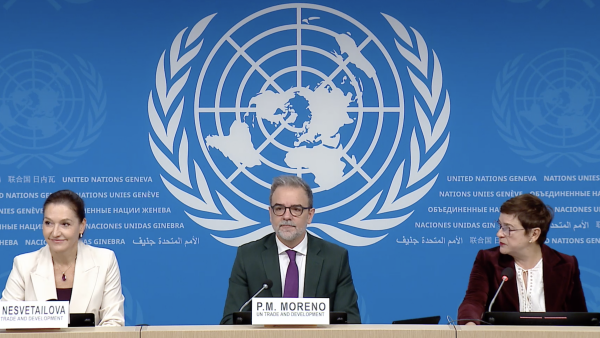
Presentation of the Trade and Developement Report 2026
Embargoed until 9 October 2026 at 11 a.m. (Geneva Time)
UNCTAD: UNCTAD’s flagship report finds that governments increasingly use industrial, trade, financial and technology policies to pursue economic and national security objectives. Market access and the ability to move into higher-value activities now depend more heavily on technology, finance and geopolitics.