

The United Nations Office at Geneva
Multimedia Newsroom
Press Conferences | OHCHR , UNOG , UNITED NATIONS , WMO
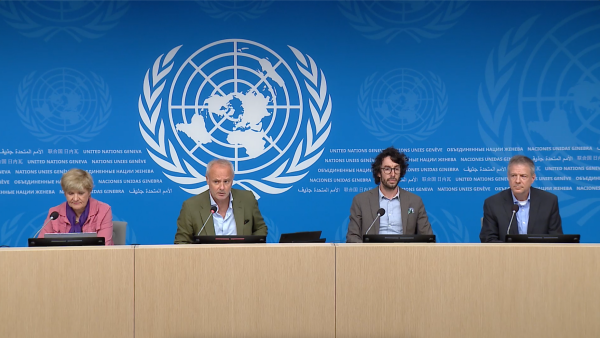
UNOG Bi-weekly press briefing 09 February 2021
La Niña update
Clare Nullis, for the World Meteorological Organization (WMO), said that the 2020-2021 La Niña event had passed its peak, but its impacts lingered and land temperatures were expected to be above normal for most parts of the globe in February-April 2021. There was a 70 per cent chance that the tropical Pacific would return to ENSO-neutral conditions by the April-June 2021 season. El Niño and La Niña were major, but not the only, climate drivers. WMO’s Global Seasonal Climate Update incorporated the influences of all other major climate drivers, such as the North Atlantic Oscillation, the Arctic Oscillation and the Indian Ocean Dipole. It should be recalled that all naturally occurring climate events now took place in the context of human-induced climate change.
The full press release can be found here.
Human Rights Council announcements
Rolando Gomez, for the Human Rights Council (HRC), said that the Human Rights Council would be holding a special session on the human rights implications of the crisis in Myanmar on Friday, 12 February. The special session was being convened following an official request submitted by the United Kingdom and the European Union, which had been supported by 47 States thus far. The meeting would take place in the Assembly Hall; however, due to COVID-19 measures, the majority of interventions would be virtual, and the media were encouraged to follow the meeting via the webcast, which would be available in six languages. More details, including the draft resolution, would be announced after the preparatory meeting on 11 February.
Mr. Gomez also said that some 30 draft resolutions were expected to be submitted for consideration at the forty-sixth session of the Human Rights Council, to be held from 22 February to 23 March.
Mr. Gomez drew attention to the remarks of the President of the Human Rights Council, Ambassador Khan of Fiji, regarding the stated intention of the United States of America to re-engage with the Council, in which she had welcomed the United States announcement and recalled that constructive engagement by all members of the international community at the Council was vital to the Council’s ability to deliver on its mandate of promoting and protecting all human rights.
Mr. Gomez also referred to Ambassador Khan’s inaugural address, in which she had stated that the Council, and the constructive and inclusive nature of the dialogue it was able to host, were crucial to building fairer, resilient societies built on human dignity and equality. Thus, the Council took on a role capable of transforming social, national and global relationships.
Lastly, Mr. Gomez said that Ambassador Khan would be hosted the traditional pre-session breakfast meeting with the media on 17 February. Details were forthcoming.
Geneva announcements
Alessandra Vellucci, for the United Nations Information Service, on behalf of Jenifer Fenton, of the Office of the Special Envoy of the Secretary-General for Syria, said that the Special Envoy for Syria, Mr. Geir O. Pedersen, would be briefing the Security Council at a closed meeting today, at 10 a.m. EST. After the briefing, at a time to be confirmed, Mr. Pedersen intended to give brief remarks to the media, which could be viewed on UNTV. Time permitting, Mr. Pedersen would also answer a few questions.
Ms. Vellucci announced that the Conference on Disarmament would hold its next public plenary meeting on 10 February, at 10 a.m., still under the presidency of Ambassador Marc Pecsteen de Buytswerve of Belgium.
Ms. Vellucci also announced that the theme for International Day of Women and Girls in Science, on 11 February, was women scientists at the forefront of fight against COVID-19. The Secretary-General and the President of the General Assembly would participate in a virtual commemoration entitled “Beyond the Borders: Equality in Science for Society”, hosted by the Royal Academy of Science International Trust and a number of permanent missions. In addition, UN-Women would be hosting a live Instagram conversation with teenage scientists and inventors and the Times 2020 Kid of the Year, Gitanjali Rao. The full programme of events would be announced shortly.
Responding to a question, Ms. Vellucci said that a total of 219 Secretariat staff had tested positive for COVID-19 since March 2020.
Similar Stories
1
12
1
1
Press Conferences , Images | UNOG
Closing Press Conference following the Sixth Consultative Meeting on Enhancing Coordination of Peace Initiatives and Efforts in Sudan

2
17
1
2
Edited News , Press Conferences | OCHA , WMO
Two UN agencies teamed up on Wednesday to issue an appeal for immediate assistance to help communities already being impacted by the strongest El Niño on record.
1
1
1
Press Conferences | CITES
Wildlife trade and conservation policy discussions at the 81st meeting of the CITES Standing Committee (SC81)
1
1
1
Press Conferences | UNHCR , UNCTAD , WMO , OCHA , UNICEF , WHO
UNHCR Hungary’s 1956 Refugee Crisis: 70 Years On, UNCTAD World Investment Forum 2026, Doha, WMO Greenhouse Gas Bulletin and Climate Update for COP31, OCHA Afghanistan: Malnutrition, Girls’ Education and Recovery, UNICEF Yemen: Child Malnutrition and Unsafe Water in Taiz, WHO Inequalities in Noncommunicable Diseases and Risk Factors

1
1
1
Press Conferences | UNHCR
End of UNHCR's 77th Annual Executive Committee (ExCom) meeting week

1
1
1
Press Conferences | UNICEF , IOM , UNHCR
UN Special Assistant to the Personal Envoy Office (SUDAN): Peace Initiatives and Efforts in Sudan; UNICEF: Dire situation of children in Gaza; IOM: Damaged Homes and Energy Attacks Risk Displacing Ukrainians for this winter; UNHCR: update on EXCOM week

1
1
1
Press Conferences | IOM , UNDRR
UN stresses importance of household preparedness for disaster risk reduction.

1
1
1
Statements , Press Conferences | OHCHR

1
1
1
Press Conferences | UNHCR , UNICEF , IFRC , OHCHR , UN WOMEN , IOM , OCHA , WHO
UNHCR – ExCom Meeting, UNICEF – Nepal Recovery, IFRC – Flash Floods, WHO – Mental Health, IOM – South Sudan Floods, OCHA – DRC Humanitarian aid, UNHCR – Sahel Displacement, UNICEF – Yemen Update, IOM – Gaza Shelter, UN Women – Gaza Women, OHCHR – Arrests and detentions of Syrians by Israeli force

2
1
2
Press Conferences | UNCTAD
Presentation of the Trade and Developement Report 2026
Embargoed until 9 October 2026 at 11 a.m. (Geneva Time)
UNCTAD: UNCTAD’s flagship report finds that governments increasingly use industrial, trade, financial and technology policies to pursue economic and national security objectives. Market access and the ability to move into higher-value activities now depend more heavily on technology, finance and geopolitics.

1
1
1
Press Conferences | UPU
Release of the State of the Postal Sector Report 2026
1
1
1
Press Conferences | IOM , ITU , UNECE , UNICEF , WHO , WMO
UNICEF: Ebola, DRC - children orphans or separating them from parents and caregivers; IOM: Humanitarian needs in Djibouti amid arrivals from Yemen and increased migrant movements; WHO: Darfur, scale of health needs far exceeds available resources; WMO co-sponsored Global Heat Forum, Bangkok, monthly Global Seasonal Climate Update; UNECE: UN Forum of Mayors; ITU Plenipotentiary Conference 2026; WHO: child and adolescent obesity guidelines and new global roadmap to tackle pregnancy hypertension, a leading cause of maternal mortality