

The United Nations Office at Geneva
Multimedia Newsroom
Press Conferences | UNHCR , WHO , UNOG , UNITED NATIONS
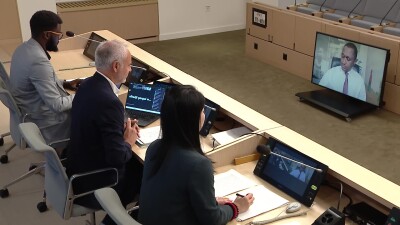
UNOG Bi-weekly press briefing 29 January 2021
Humanitarian situation in northwest Syria
Jens Laerke, for the Office for the Coordination of Humanitarian Affairs (OCHA), said that heavy rainfall and floods in north-west Syria in recent weeks had had a devastating impact on displaced people living in self-made camps, and the situation was going from bad to worse.
Mark Cutts, Deputy Regional Humanitarian Coordinator for the Syria Crisis, said in a statement that more than 120,000 people living in some 300 displacement sites had been badly affected, when torrential rain and strong winds had damaged or destroyed the tents in which they had been living. Humanitarian staff were now struggling to reopen access roads to reach the displaced in the north-west with emergency shelter, food, clean water and other supplies. It was a massive undertaking, and the work would continue for months. Unfortunately, less than half of the USD 49 million needed for winterisation had been received thus far.
The full statement by Mark Cutts is available here.
Responding to questions, Mr. Laerke said that the ceasefire was by and large holding, but there were sporadic breaches and hostilities going on.
Displacement in the Central African Republic
Boris Cheshirkov, for the United Nations Refugee Agency (UNHCR), said that, as insecurity in the Central African Republic had displaced more than 200,000 people within the country and in neighbouring states in less than two months, UNHCR was warning that tens of thousands were facing dire conditions. Refugee arrivals to the Democratic Republic of the Congo had reached 92,000 according to local authorities and some 13,240 people had crossed into Cameroon, Chad, and the Republic of Congo, since the eruption of violence in December 2020, ahead of CAR’s general elections. Refugees continued to arrive.
Some 100,000 people remained internally displaced inside CAR, informed Mr. Cheshirkov. The continuing volatility had hampered the humanitarian response and made access to the internally displaced more difficult. The main road used to bring supplies had also been forced shut. Armed groups were reportedly present in the Batangafo and Bria sites, where displaced communities were sheltering. Such presence posed a grave protection risk for those displaced, from risk of forced recruitment to restriction of movement to extortion or threats.
Most refugees were living in dire conditions in remote, hard-to-reach areas close to the rivers without basic shelter and facing acute food shortages. They were dependent on catching fish and on what the local villagers could spare. UNHCR was urgently appealing to the international community to mobilize funds, so humanitarian organizations could deliver life-saving assistance to the Central African refugees and their hosts.
Press briefing note is available here.
Responding to questions, Mr. Cheshirkov said that at the start of the new situation around the 27 December 2020 elections, some 185,000 people were estimated to have moved within the country; many of them had subsequently returned home. He explained there were currently some 105,000 refugees from CAR in the Democratic Republic of the Congo, Cameroon and other countries. UNHCR was reiterating its appeals for the violence to stop.
Displacement in Darfur, Sudan
Tomson Phiri, for the World Food Programme (WFP), said the WFP was ramping up assistance to displaced people following a spate of inter-communal violence in West and South Darfur, forcing over 100,000 people to flee in search of safety. An estimated 70,000 of the displaced people were gathered in over 70 centres across Geneina city in West Darfur. Additional gathering points had been identified as people continue to arrive where the WFP and Sudan Humanitarian Aid Commission joint population assessments were being planned.
WFP had started distributions of emergency food assistance to people inside Geneina so far reaching 40,000 people in 30 of the 71 centres. Food distributions to reach the remainder of the affected population were currently ongoing within the city, while food distributions outside of Geneina would start upon completion of the verification exercise. WFP was extremely concerned with the continued violence, as even a momentary burst of violent disruption of livelihood activities could have a long-lasting impact. The biggest loser were the poor households whose food security situation was further compromised.
In response to questions, Mr. Phiri said some people were moderately and others severely affected by malnutrition. The UN renewed its calls to the parties to stop the violence, which was having severe adverse effects on the local population.
Essential diagnostics list
Adriana Velazquez Berumen, Senior Advisor at the World Health Organization (WHO), said that the third edition of the WHO essential diagnostics list would be published today. The WHO put the list together based on evidence; a group of experts, through an established process, had reviewed all the inputs submitted to the list. The purpose and format of the test were looked at in the process, among other factors.
This year, the list included a total of 175 tests, including newly added tests, such as sickle cell test, made possible by new technologies. Every year technologies were evolving, and the list was accordingly updated. Donors, governments and insurance companies could refer to this authoritative list. Two COVID-19 tests – PCR and antigen test – had been added to the new list, for example. On the other hand, some older tests, such as for HIV and tuberculosis, were no longer included in the list.
Ms. Velazquez, in an answer to a question, said the essential diagnostics list contained types of tests, while individual manufacturers could then produce their own specific tests. Not all submitted requests were accepted, she explained. The essential diagnostics list was a policy document primarily targeted at national health ministries. The list would be published online as well. Safety and quality came before anything else when preparing the list, said Ms. Velasquez.
COVID-19
Margaret Harris, for the World Health Organization (WHO), responding to questions, said Dr. Tedros would be addressing the World Economic Forum’s Davos Agenda after 5:30 pm today. She elaborated on the quarantine regulations in China and said she expected that the WHO investigative team in Wuhan would continue to work over the weekend, looking for all the relevant evidence. On the COVAX meeting the previous day, Ms. Harris explained that countries had submitted their requests and were getting ready for the rollout. The selection and use of essential in vitro diagnostics - TRS 1031
Geneva announcements
Rhéal LeBlanc, for the United Nations Information Service (UNIS), informed that today at 4:45 p.m., there would be a hybrid press conference in Room XVI by the Office of the Special Envoy for Syria, following the conclusion of the fifth round of the Small Body of the Syrian Constitutional Committee. Geir O. Pedersen, UN Special Envoy for Syria, would address the media. Live webcast at webtv.un.org, with Arabic interpretation, would be provided.
Rhéal LeBlanc, speaking on behalf of the Human Rights Council (HRC), informed that the Human Rights Council’s Universal Periodic Review continued to meet at the Palais des Nations and would today adopt reports for Myanmar, Rwanda, Georgia and São Tomé and Principe. The session would carry over to 2 February to review Nauru.
Mr. LeBlanc said the Libyan Political Dialogue Forum (LPDF) would convene in Switzerland next week from 1 to 5 February, with the facilitation of the Acting Special Representative of the Secretary-General, Stephanie Williams. During the meeting, the LPDF would vote on the positions of a three-member Presidency Council and the Prime Minister in accordance with the roadmap adopted by the Forum in Tunis in mid-November. This new interim, unified executive authority would be primarily tasked to lead Libya to national elections set for 24 December 2021 and to reunify state institutions. More details were provided in UNIS’s note to correspondents.
Mr. LeBlanc also informed that The Conference on Disarmament should have its next public plenary meeting on 4 February, at 10 a.m., still under the presidency of Ambassador Marc Pecsteen of Belgium, to discuss a revised version of the draft package proposed by the President.
The Committee on the Rights of the Child, currently holding its virtual 85th session, was not reviewing any country reports. It would hold its next public meeting on 4 February, in the afternoon, around 5 pm, for the public closure of its session.
Responding to a question about UN Geneva’s operations during Covid-19, Mr. LeBlanc explained that the general directive to UN Geneva staff was to telework as much as possible, and that the presence at the Palais des Nations currently stood at around 20 per cent. UN Geneva would continue to follow current health measures and guidelines.
Similar Stories
1
1
1
Press Conferences | UNHCR
End of UNHCR's 77th Annual Executive Committee (ExCom) meeting week
1
1
1
Press Conferences | UNICEF , IOM , UNHCR
UN Special Assistant to the Personal Envoy Office (SUDAN): Peace Initiatives and Efforts in Sudan; UNICEF: Dire situation of children in Gaza; IOM: Damaged Homes and Energy Attacks Risk Displacing Ukrainians for this winter; UNHCR: update on EXCOM week
1
1
1
Press Conferences | IOM , UNDRR
UN stresses importance of household preparedness for disaster risk reduction.
1
1
1
Statements , Press Conferences | OHCHR
1
1
1
Press Conferences | UNHCR , UNICEF , IFRC , OHCHR , UN WOMEN , IOM , OCHA , WHO
UNHCR – ExCom Meeting, UNICEF – Nepal Recovery, IFRC – Flash Floods, WHO – Mental Health, IOM – South Sudan Floods, OCHA – DRC Humanitarian aid, UNHCR – Sahel Displacement, UNICEF – Yemen Update, IOM – Gaza Shelter, UN Women – Gaza Women, OHCHR – Arrests and detentions of Syrians by Israeli force
2
1
2
Press Conferences | UNCTAD
Presentation of the Trade and Developement Report 2026
Embargoed until 9 October 2026 at 11 a.m. (Geneva Time)
UNCTAD: UNCTAD’s flagship report finds that governments increasingly use industrial, trade, financial and technology policies to pursue economic and national security objectives. Market access and the ability to move into higher-value activities now depend more heavily on technology, finance and geopolitics.
1
1
1
Press Conferences | UPU
Release of the State of the Postal Sector Report 2026
1
1
1
Press Conferences | IOM , ITU , UNECE , UNICEF , WHO , WMO
UNICEF: Ebola, DRC - children orphans or separating them from parents and caregivers; IOM: Humanitarian needs in Djibouti amid arrivals from Yemen and increased migrant movements; WHO: Darfur, scale of health needs far exceeds available resources; WMO co-sponsored Global Heat Forum, Bangkok, monthly Global Seasonal Climate Update; UNECE: UN Forum of Mayors; ITU Plenipotentiary Conference 2026; WHO: child and adolescent obesity guidelines and new global roadmap to tackle pregnancy hypertension, a leading cause of maternal mortality
1
1
1
Press Conferences | OCHA , UN WOMEN , UNHCR , WFP , WHO , WTO , UNEP
OCHA – $160M CERF allocation to 12 underfunded crises; UNHCR – 5.8M refugee children remain out of school amid funding cuts; UN Women – Middle East escalation and food security among women/girls; WHO – Gaza supplies and overall situation; WFP – Yemen food insecurity and impact on global hunger ; UNEP - First International Conference of the Global Framework on Chemicals in Geneva | 16-20 November 2026
1
1
1
Press Conferences | UNHCR , WHO
Yemen's health system nears collapse amid conflict, causing rising casualties and medicine shortages.
1
1
1
Press Conferences | HRC
Update by the Expert Mechanism to Advance Racial Justice and Equality in Law Enforcement
1
1
1
Press Conferences | WIPO , WHO , UNICEF , UNHCR , IOM , WFP , FAO
WIPO Global Innovation Index 2026 launch and press conference, WHO Composition of influenza vaccines for the 2027 Southern Hemisphere flu season, UNICEF Yemen hunger and malnutrition; UNHCR Sudan displacement into Chad; IOM Ebola and population movements in DRC; WFP emergency food assistance in Nepal; and FAO food loss and waste.