

The United Nations Office at Geneva
Multimedia Newsroom
UN General Assembly
Rhéal LeBlanc, for the United Nations Information Service (UNIS), informed that the United Nations General Assembly would start its general debate at 3 p.m. Geneva time today, with a direct webcast at webtv.un.org. The Secretary-General would deliver a major speech, to be followed by those of Heads of State. The list of speakers could be found on the website of the General Assembly and the UN Journal. Among today’s speakers would be the Heads of State of Brazil, the United States, Russia, and France. A ceremony to mark the 75th anniversary of the UN had been held the previous day; the Secretary-General had delivered a speech highlighting the success of the Organization and the challenges ahead. The UN75 report had been launched and was available online.
45th Human Rights Council
Rolando Gomez, for the Human Rights Council (HRC), said that today at 10 a.m. the Council would discuss the negative impact of unilateral coercive measures (sanctions). The President of the Economic and Social Council (ECOSOC) would then present his annual report to the Council, to be followed by the presentations of thematic reports, covering capital punishment, indigenous peoples, the human rights of migrants, etc. Some 12 reports would be addressed in one statement by the Deputy High Commissioner for Human Rights. The general debate on item 3 would then commence, with 100 States and 100 NGOs as speakers. An oral update on the situation in Myanmar would be heard this afternoon, to be followed by an interactive discussion; the report on Syria would then be presented, and also be followed by an interactive discussion. On 23 September, Burundi, South Sudan, and Venezuela would all be addressed.
The detailed Human Rights Council’s agenda can be found here.
COVID-19
Margaret Harris, for the World Health Organization (WHO), said that a new WHO report showed that 20 per cent of all cardiovascular diseases were attributable to tobacco use, while as many as 67 per cent of COVID-19 fatalities in Italy, for example, had been suffering from high blood pressure. The links were very strong between cessation of smoking and the battle against COVID-19. A press release would be shared shortly.
Ms. Harris informed that every year, experts decided which strains needed to be put in the seasonal influenza vaccine. The process was currently under way for 2020, and the result would be duly communicated.
Ms. Harris said that the COVID-19 Explorer App was a new app that provided detailed information on statistics, visualizations on testing and policies, and regional breakdowns on trends. The app had been used internally at the WHO, but now it was now available to the general public here.
Answering questions, Ms. Harris explained that it was unlikely that the WHO would any time soon be holding physical/open press conferences given the current coronavirus trend in Europe.
WHO would not endorse any vaccine until it had been proven to be absolutely safe and effective, stressed Ms. Harris. WHO’s position on how COVID-19 primarily spreads had not changed: it was through droplets, which was why masks, social distancing and hand hygiene were strongly recommended. In crowded indoor spaces, with poor ventilation and a lot of shouting or singing, there had been cases of aerosol transmission. While one meter was the minimum recommended distance, the more the distance, the safer it was. The duration of the exposure was also important, explained Ms. Harris.
Regarding COVAX facilities, Ms. Harris said it was still a work in progress; the fact that two-thirds of countries had already signed up was encouraging. It was all about solidarity; about vaccinating appropriate people at an appropriate time around the world.
Ms. Harris stressed that the WHO’s recommendation for quarantine remained at 14 days, as it had been proven that incubation of the virus could last as long as 12 days.
Rhéal LeBlanc, for the United Nations Information Service (UNIS), added that on 30 September, there would be a high-level event at the General Assembly on COVID-19 vaccines and ACT Accelerator. The Secretary-General was expected to participate.
Food situation in Mozambique
Tomson Phiri, for the World Food Programme (WFP), said that the WFP was extremely concerned about the escalating conflict and deteriorating food security situation in Cabo Delgado, Mozambique, where over 310,000 people had fled their homes and villages, abandoning their crops and leaving them completely reliant on humanitarian assistance.
The humanitarian crisis had worsened due to the increased insecurity; thousands had also fled, as refugees, to neighbouring Tanzania. Cabo Delgado currently had the second highest number of registered COVID-19 cases in Mozambique. Cabo Delgado was a farming area, producing crops, and when there was violence, farmers hardly put any seeding in the ground; the next harvest season could therefore already be compromised. More than half of the children under five were chronically malnourished. Despite significant operational challenges, WFP, in collaboration with the Government, planned to reach 310,000 people each month in the provinces of Cabo Delgado, Nampula and Niassa with food, vouchers and nutrition support.
Ms. Phiri emphasized that the WFP urgently required USD 4.7 million per month to assist those internally displaced in northern Mozambique. Without additional funding the WFP would be forced to reduce food rations as early as December.
More information is available here.
Greek alphabet for hurricane names
Clare Nullis, for the World Meteorological Organization (WMO), reiterated that the 2020 hurricane season had been so active that there was now a need to start using the Greek alphabet for new names. This week, Alpha, a subtropical storm, had been registered over Portugal, while Beta was having an impact over the Texas coast. This was only the second time for the need to use the Greek alphabet.
Arctic sea ice levels
Clare Nullis, for the World Meteorological Organization (WMO), said the General Assembly this week would hold a debate on climate action. Overnight, the WMO had received figures showing that the Arctic sea ice had reached the lowest level this year, which was the second lowest summer sea ice extent; only 2012 had seen a lower level. What was seen this year confirmed a long-term trend over the last 14 years. Ms. Nullis quoted a veteran Arctic ice observer, who said the threshold meant that “the Arctic was more ocean than ice”. The Siberian heatwave from above and warmer waters from below were both melting the ice, said Ms. Nullis. An information note with details would be sent out to the media shortly.
Geneva announcements
Catherine Huissoud, for the United Nations Conference on Trade and Development (UNCTAD), informed about the launch of the Economic Development in Africa Report 2020 entitled Tackling illicit financial flows for sustainable development in Africa. The report would be published on 28 September; the embargo would be lifted at 7 p.m. Geneva time. The report provided a very comprehensive analysis of those outflows which included illicit capital flight, tax and commercial practices like misinvoicing of trade shipments and criminal activities such as illegal markets, corruption or theft. Curbing illicit financial flows could hugely help reduce the financing gap to achieve the SDGS on the African continent; the report explained how.
Rosalind Yarde, for the International Labour Organization (ILO), announced an embargoed press conference on the 6th edition of ILO Monitor on COVID-19 and the World of Work, which would be held virtually on 23 September at 11 a.m. The speakers would be Guy Ryder, ILO Director-General, and Sangheon Lee, Director, ILO Employment Policy Department. The embargo on the report and the press release, which would be shared today, would be lifted at 1 p.m. on 23 September.
Clare Nullis, for the World Meteorological Organization (WMO), informed that later today there would be a press release on a new low temperature record for northern hemisphere.
Rhéal LeBlanc, for the United Nations Information Service (UNIS), informed that on, 24 September at 10 a.m., the Permanent Mission of Uzbekistan would hold a press conference on the speech of the President of the Republic of Uzbekistan, H.E. Mr. Shavkat Mirziyoyev, at the 75th session of the United Nations General Assembly
The Committee on Enforced Disappearances was currently holding an online session; the interactive dialogue with Iraq would now take place on 5 and 7 October.
The Committee on the Rights of the Child was also holding its 85th session virtually and would hold its next public meeting for the closure of the session on 1st October at 5 p.m.
Similar Stories

1
1
1
Press Conferences | UNHCR
End of UNHCR's 77th Annual Executive Committee (ExCom) meeting week

1
1
1
Press Conferences | UNICEF , IOM , UNHCR
UN Special Assistant to the Personal Envoy Office (SUDAN): Peace Initiatives and Efforts in Sudan; UNICEF: Dire situation of children in Gaza; IOM: Damaged Homes and Energy Attacks Risk Displacing Ukrainians for this winter; UNHCR: update on EXCOM week

1
1
1
Press Conferences | IOM , UNDRR
UN stresses importance of household preparedness for disaster risk reduction.

1
1
1
Statements , Press Conferences | OHCHR
1
1
1
Press Conferences | UNHCR , UNICEF , IFRC , OHCHR , UN WOMEN , IOM , OCHA , WHO
UNHCR – ExCom Meeting, UNICEF – Nepal Recovery, IFRC – Flash Floods, WHO – Mental Health, IOM – South Sudan Floods, OCHA – DRC Humanitarian aid, UNHCR – Sahel Displacement, UNICEF – Yemen Update, IOM – Gaza Shelter, UN Women – Gaza Women, OHCHR – Arrests and detentions of Syrians by Israeli force
2
1
2
Press Conferences | UNCTAD
Presentation of the Trade and Developement Report 2026
Embargoed until 9 October 2026 at 11 a.m. (Geneva Time)
UNCTAD: UNCTAD’s flagship report finds that governments increasingly use industrial, trade, financial and technology policies to pursue economic and national security objectives. Market access and the ability to move into higher-value activities now depend more heavily on technology, finance and geopolitics.
1
1
1
Press Conferences | UPU
Release of the State of the Postal Sector Report 2026
1
1
1
Press Conferences | IOM , ITU , UNECE , UNICEF , WHO , WMO
UNICEF: Ebola, DRC - children orphans or separating them from parents and caregivers; IOM: Humanitarian needs in Djibouti amid arrivals from Yemen and increased migrant movements; WHO: Darfur, scale of health needs far exceeds available resources; WMO co-sponsored Global Heat Forum, Bangkok, monthly Global Seasonal Climate Update; UNECE: UN Forum of Mayors; ITU Plenipotentiary Conference 2026; WHO: child and adolescent obesity guidelines and new global roadmap to tackle pregnancy hypertension, a leading cause of maternal mortality
1
1
1
Press Conferences | OCHA , UN WOMEN , UNHCR , WFP , WHO , WTO , UNEP
OCHA – $160M CERF allocation to 12 underfunded crises; UNHCR – 5.8M refugee children remain out of school amid funding cuts; UN Women – Middle East escalation and food security among women/girls; WHO – Gaza supplies and overall situation; WFP – Yemen food insecurity and impact on global hunger ; UNEP - First International Conference of the Global Framework on Chemicals in Geneva | 16-20 November 2026
1
1
1
Press Conferences | UNHCR , WHO
Yemen's health system nears collapse amid conflict, causing rising casualties and medicine shortages.
1
1
1
Press Conferences | HRC
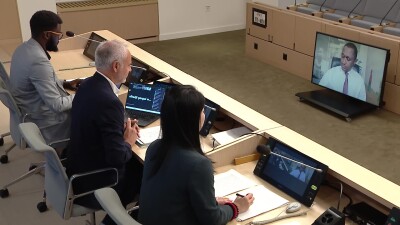
Update by the Expert Mechanism to Advance Racial Justice and Equality in Law Enforcement
1
1
1
Press Conferences | WIPO , WHO , UNICEF , UNHCR , IOM , WFP , FAO
WIPO Global Innovation Index 2026 launch and press conference, WHO Composition of influenza vaccines for the 2027 Southern Hemisphere flu season, UNICEF Yemen hunger and malnutrition; UNHCR Sudan displacement into Chad; IOM Ebola and population movements in DRC; WFP emergency food assistance in Nepal; and FAO food loss and waste.