

The United Nations Office at Geneva
Multimedia Newsroom
Press Conferences | IOM , OHCHR , UN WOMEN , UNFPA , UNHCR , UNOPS , WHO
UN Geneva Press Briefing - 18 September 2026
UN INFORMATION SERVICE GENEVA PRESS BRIEFING
18 September 2026
Alessandra Vellucci, Director of the United Nations Information Service in Geneva, chaired a hybrid press briefing, which was attended by the spokespersons and representatives of the United Nations Refugee Agency, the International Organization for Migration, the United Nations Population Fund, the United Nations Office for Project Services, UN Women, the Office of the High Commissioner for Human Rights, and the World Health Organization.
Displacement in Yemen
Alessandra Vellucci, for the United Nations Information Service (UNIS) in Geneva, said that more than 22 million people – nearly half of the population – across Yemen needed humanitarian aid, and with the current escalation that number was rising. She reiterated that the actions taken by the Houthi de facto authorities, including the arbitrary detention of UN personnel, the death of a colleague while in detention, the forcible entry and occupation of UN premises, and the seizure of UN assets, had made the delivery of UN humanitarian assistance in Houthi-controlled areas untenable, limiting millions of people’s access to life-saving assistance. As of today, 73 UN personnel remained arbitrarily detained by the Houthi de facto authorities, some of them since 2021. In addition, five former UN personnel and dozens of personnel from non-governmental organizations, civil society organizations, and diplomatic missions remained detained. UN reiterated its call on the Houthi de facto authorities for immediate and unconditional release of all arbitrarily detained personnel.
Shabia Mantoo, for the Office of the High Commissioner for Human Rights (OHCHR), said that OHCHR had documented 110 casualties since the escalation of hostilities, of whom 28 killed. The actual number was likely to be higher because of limited information flows and restricted access. OHCHR called on all parties and those with influence on them to de-escalate, protect civilians, and allow unrestricted humanitarian access.
Abdusattor Esoev, Chief of Mission of the International Organization for Migration (IOM) in Yemen, speaking from Aden, said that the humanitarian situation had deteriorated sharply, with families escaping the escalating conflict along the West Coast and South Taiz, forced to make an impossible choice between staying in danger or fleeing into uncertainty. Families were leaving with almost nothing, many for the second or third time in 12 years of war. They needed urgent help. The roads remained inaccessible, communications were disrupted, and humanitarian access severely limited. He gave an example of a woman who had had to give birth in open air, without shelter, medical care or any assistance. Displaced people needed safety and protection, and satisfying basic necessities. The IOM’s Displacement Tracing Matrix was providing information for all humanitarian partners, but the overall stocks of humanitarian aid were becoming rapidly depleted. There was a need for the international community to come through and provide necessary finance. Yemen could not overcome this crisis alone. Displaced families needed to be helped and protected without delay, stressed Mr. Esoev.
Francesco Galtieri, Country Representative of the United Nations Population Fund (UNFPA), connecting from Aden, stressed that for women and girls, this was a crisis upon a crisis. UNFPA estimated that nearly 2,000 pregnant women were among the newly displaced, and more than 200 might give birth this month. Insecurity, impassable roads and closed health facilities were dismantling the systems on which their survival depended. When a woman could not reach a skilled provider in time, a preventable emergency could become a tragedy. Women needed antenatal and postnatal care, emergency obstetric and newborn care, blood transfusions and treatment for severe neonatal complications. These were not optional services. Years of meagre progress in women’s health, safety, dignity and rights were now being eroded. UNFPA was on the ground, leading the UN’s first-line response through the UN Rapid Response Mechanism, in coordination with partners. UNFPA had assisted more than 60,000 displaced people with emergency relief within 72 hours of displacement. Mr. Galtieri stressed that the international community had to act with the urgency this moment demanded: to keep services open, reach displaced families, protect survivors and ensure that no woman was forced to give birth without the care she needed. This was a life-and-death test. Yemen could not wait.
Tarik Jašarević, for the World Health Organization (WHO), said that health facilities had already been operating under severe constraints. Of the 5,415 health service delivery units assessed for functionality, only 60 percent were fully functioning, while 35 percent were partially functioning and four percent were non-functioning. The current escalation was adding further pressure through increased trauma and emergency care needs, rising displacement and greater demand for already limited services, supplies and referral capacity. Trauma care was available as a full-service package in only six percent of assessed facilities, particularly concerning as trauma needs rose sharply with the escalation. The main constraints were lack of health workers, equipment, financing and medical supplies, rather than damage to health infrastructure alone.
Sandrine Desamours, United Nations Refugee Agency (UNHCR) Representative in Yemen, speaking from Djibouti, said that nearly 3,000 people had arrived in Djibouti in less than a week, entering through four official points, after dangerous journeys in small vessels. More people were trying to flee Yemen, but there was a shortage of fuel. New arrivals spoke of having to flee for their lives under increased fighting. Some were arriving without their family members. UNHCR and its partners had been working to integrate new refugee children in Djibouti’s schools, while families across Djibouti had also been doing their best, welcoming refugees. However, the capacities of local communities were being stretched, with growing pressures on water, sanitation, housing and education facilities. UNHCR and partners were on the ground, providing temporary shelter and other necessities, while supporting local and national authorities. Djibouti had already been hosting a large number of refugees, reminded Ms. Desamours, and the arrival of new Yemeni refugees put additional pressure on limited capacities. Meanwhile, she said, the crisis inside Yemen was getting worse, with over 100,000 recently displaced, and very limited humanitarian access. UNHCR urgently required USD 5.1 million to ensure thar refugees arriving from Yemen to Djibouti had basic support; at the same time, USD 14 million was urgently needed for UNHCR’s operations in Yemen.
UNHCR’s full briefing note is available here.
Alexandre Coissac, Chief of Mission of the International Organization for Migration (IOM) in Djibouti, calling in from Djibouti, spoke about having seen people exhausted, frightened and uncertain about what would come next, but also relieved to have reached safety. Many had travelled for hours in dangerous, overcrowded boats, with very limited food and water. Some required immediate medical and psychosocial support after experiencing conflict, displacement and separation from their families. Many of those arriving from Yemen had already been displaced more than once. A lot of them were women and children, including infants, as well as pregnant women and women who had given birth shortly before leaving or during their displacement. The Government of Djibouti, said Mr. Coissac, had responded swiftly, mobilizing national authorities under the leadership of ONARS and the Ministry of Social Affairs and Solidarity, and working closely with humanitarian partners and United Nations agencies. This national response had been matched by remarkable generosity from the people of Obock. Many refugees are being hosted by local families. IOM had immediately mobilized its existing presence and capacity in Obock, providing safe transportation from landing sites to the Markazi village, as well as drinking water, hot meals, food assistance and immediate protection support.
This was a rapidly evolving refugee situation that required a collective humanitarian response. No organization could respond to it alone. IOM would continue working closely with the Djiboutian authorities, with UNHCR, other UN agencies and humanitarian partners, including the Red Crescent Society of Djibouti, to support this highly vulnerable population.
Even with this mobilization, the pace of arrivals was outpacing local capacities. The most urgent needs remained food, water, shelter, healthcare and protection, particularly for women, children and other vulnerable people. Djibouti could not be left to respond to this crisis alone, concluded Mr. Coissac.
Replying to questions, Ms. Desamours, for UNHCR, said that there had been several waves of arrivals: fishermen arriving with their families first, then people coming with some of their possessions, and then refugees arriving with more possessions, including solar panels and livestock. Inside Yemen, explained Zoe Brennans, for IOM, over 112,000 people had been displaced, and about 3,000 people had arrived in Djibouti. Mr. Esoev, for IOM, added that not all areas were accessible to humanitarians on the ground. Mr. Jašarević, for WHO, said that cholera, while it had declined from its peak in 2025, was still present, and disease surveillance was now a challenge. On another question, he explained that every time there was an armed conflict, there was an increase in trauma cases, and only six percent of health facilities had full trauma packages available, while referral corridors were also a challenge on the west coast of Yemen. He stressed the need for both access and funding. Mr. Galtieri, for UNFPA, said that those health facilities that had changed control from government to the Houthis were slowly reopening. Mr. Esoev, for IOM, said that at the moment there was no direct contact between the UN and the Houthi de facto authorities.
Sexual violence amid Russia’s full-scale armed attack of Ukraine
Shabia Mantoo, for the Office of the High Commissioner for Human Rights (OHCHR), presented a new report which showed that sexual violence had been used against civilians and prisoners of war in Ukraine in a shocking pattern of torture, intimidation and coercion since the start of the Russian Federation’s full-scale armed attack on Ukraine more than four years earlier. Some 1,004 cases of sexual violence had been documented from 24 February 2022, when Russia’s attack on Ukraine had begun, through to the end of July this year. Of these cases, 89 percent were attributed to Russian authorities, including members of the armed forces, the prison service and the national security service. The remaining 11 percent were attributed to Ukrainian authorities. Most of the victims of sexual violence were men, particularly in places of detention, but women and children were also affected, primarily in occupied territory of Ukraine. The violations committed include gang rape, rape, genital mutilation, electric shocks and beatings to the genitals, and other degrading acts of a sexual nature. The youngest documented rape survivor was a four-year-old-girl and the oldest an 82-year-old woman, with both cases perpetrated by Russian authorities.
The report is available here.
Danielle Bell, Head of UN Human Rights Monitoring Mission in Ukraine, connecting from Kyiv, said that the risks for civilians were escalating across Ukraine. More civilians had been killed and injured in the first eight months of 2026 than in the entire 2025. Today’s report shed light on a less visible aspect of the war, and highlighted sexual violence against prisoners of war and civilians. The key finding was that sexual violence against Ukrainian prisoners of war and civilian detainees was widespread. Almost three-quarters of prisoners of war (POWs) and one-half of civilian detainees had experienced sexual violence at least once, said Ms. Bell. Sexual violence would often happen throughout captivity, from the first moment until the release, and across different facilities, and would take different forms. The report identified the conditions that enabled these violations to take place, such as absence of safeguards and accountability. The report also covered sexual violence against civilians outside of detention facilities, mostly women and girls. Violations by the Ukrainian authorities were also reported – they were serious and required accountability, she said. Ukraine had allowed the OHCHR Mission unfettered access to detention facilities, said Ms. Bell.
Taking questions from the media, Ms. Bell said that 1,004 cases represented only a fraction of the total cases. OHCHR had interviewed approximately ten percent of released Ukrainian POWs and ten percent of detained Russian POWs. Ukrainian civilian detainees who had been released could only be interviewed if they returned to the government-controlled areas. The recommendations of the report had been developed with the survivor community. It was hoped the report would trigger additional support for the survivors. Facts had to be put on public record about sexual violence, which was systematic and widespread against Ukrainian POWs and civilian detainees. Ms. Bell said that advocacy efforts around the report were also foreseen. The copy of the report had been shared with the Russian Federation, but no response had been received. It was hoped that this report would receive due attention. Accountability was something OHCHR would continue to push for, but the prospects for it were limited for the time being. Russian armed forces, penitentiary authorities, police, guards were all involved, she explained.
Recovery in Nepal
Sara Netzer, Director of the Asia Pacific Region at the United Nations Office for Project Services (UNOPS), speaking from Bangkok, who had just returned from Nepal, spoke of the immense and total devastation she had witnessed. She had seen debris five to eight meters high, showing remnants of life in the mud, be it blankets, clothes, eyeglasses, or schoolbooks. Displaced people had sought shelter in “holding centres”. There was an urgent need for those that had been displaced, including additional temporary shelters so that schools could reopen and children who had experienced this trauma could return to some normalcy.
UNOPS Nepal had helped in the immediate aftermath by supporting other UN agencies to deliver lifesaving humanitarian supplies to holding centres where those displaced sought shelter. The UNOPS expert response team had also supported the World Bank’s Global Rapid Post-Disaster Damage Estimation, which calculated the direct physical and economic damage of the floods, which would be essential in supporting reconstruction planning. Ms. Netzer stressed that recovery and reconstruction would be difficult. It was incredibly difficult to operate, as access was difficult because roads and bridges had been washed away. Some communities remained cut off from assistance and had to be reached by helicopters.
Unaccounted death toll of women in the Ebola epidemic
Dr. Setcheme Mongbo, UN Women Representative in the Democratic Republic of the Congo (DRC), speaking from Kinshasa, had just returned from Bunia, the Ebola epidemic epicenter. The fastest growing outbreak on record put women and girls on the frontline, carrying for the sick, whether young or old, not only as health workers, but also as caregivers in communities and homes. They were also washing dead bodies, collecting and providing water and food to family members. UN Women noted that distribution of care responsibilities mirrored the chain of transmission, which was why women and girls paid the highest price, with children under five being also affected. More than 54 percent of confirmed cases in the DRC were among women, while girls accounted for 51 percent of those between 10 and 16 years old, and girls under ten years of age represented 60 percent of cases in that age group.
Dr. Mongbo said that when people became sick and died outside the formal health system, there was a risk that their deaths and the circumstances surrounding them would not be adequately captured in the official response. Women put the health of their children and family members first, often taking care of them without protective equipment. For women, the fear of going to health facilities was made worse by concerns about stigma, harassment, separation from their children, and, in some cases, their safety. At the same time, the health systems were overwhelmed, and women were losing access to maternity care, reproductive health services, and other essential care, putting them at additional risk. Women made up around three-quarters of traders in the affected areas. Restrictions on movement and border closures had stripped many women of their income. At the end, Dr. Mongbo stressed that women and women-led organizations played a critical role in stopping the Ebola epidemic.
More information can be accessed here.
The humanitarian coordination team was meeting regularly, explained Dr. Mongbo responding to a question, but developments on the ground required deployment of an even more integrated, comprehensive response.
Sudan emergency aid running out
Zoe Brennan, for the International Organization for Migration (IOM), warned that with less than two weeks Sudan’s emergency relief supply via the IOM Common Humanitarian Pipeline would run out. This shared logistics mechanism helped humanitarian organizations deliver critical shelter, non-food items and hygiene kits to people in need quickly and efficiently across Sudan, and since July 2023, had reached 2.84 million people. The Pipeline operated with a network of more than 100 registered partners. She informed that today, 8.6 million people remained internally displaced, alongside 4.9 million returnees. Nearly 70 per cent of internally displaced people were living with host families or in informal settlements.
Shelter aid through the Pipeline would run out in two weeks. The Pipeline’s warehousing and operational capacity could currently be sustained only until December. If that operational capacity was lost, it could not simply be switched back on when funding became available. Re-establishing it would be costly and time-consuming, which was why funding now mattered. IOM required USD 15 million to maintain the Common Humanitarian Pipeline at its minimum 2026 capacity for 12 months, supporting 305,000 people. USD 27 million would restore assistance to approximately 2025 levels and reach 570,000 people; USD 42 million would allow the Pipeline to scale up and provide immediate lifesaving support to as many as one million people. IOM called on donors’ support to ensure life-saving assistance continued.
Answering questions from the media, Mohammed Refaat, Chief of Mission of IOM in Sudan, speaking from Port Sudan, said that no secure funding had been confirmed thus far, but talks were continuing with a number of potential donors. In-kind donations and cash assistance were both being looked into. Places like Khartoum were massively impacted.
New data on global health workforce
Dr. Khassoum Diallo, Acting Unit Head of Health Workforce Policies and Data, World Health Organization (WHO) Academy, presented the findings of the National Health Workforce Accounts in 2026, the most comprehensive dataset on the global health workforce obtained from Member States. More than 90 percent of WHO Member States had actively reported health workforce data in 2025. The data showed that in the past two decades, health workforce density had increased by 52 percent globally, from 44.8 per 10,000 population in 2006 to 67.9 in 2025. There were now more than 70 million health and care workers worldwide.
However, despite gains in workforce production and data reporting, uneven distribution and severe shortages of health and care workers remained, and health worker density remained strongly correlated with national economic status. This report also revealed that in many countries both populations and health workers were ageing at the same time, which could increase the projected global shortage of 11.1 million health workers by 2030. Data from 122 countries showed that nearly one in four medical doctors was above the age of 55 years on average and would retire in the next ten years. In high-income countries, this would increase to nearly one in three. By 2030, 67 countries might not have enough health workers to provide the same level of health services as in 2024, especially as their populations grew and more people lived to older ages. Dr. Diallo stressed that ageing was the hidden health workforce crisis that required urgent attention. There was a need for more health workers, he said. Migration of health workers from low-income countries to high-income countries was another challenge, and WHO and partners were working to ensure that this was managed in an ethical way and through bilateral agreements and investment between high and low income countries.
The full data set can be accessed here.
Announcements
Alessandra Vellucci, for the United Nations Information Service (UNIS), informed that on 22 September at 9:30 am, Mariana Katzarova, Special Rapporteur on Human Rights in the Russian Federation, would hold a press conference to provide an update.
On 22 September at 2 pm, an update on the human rights situation in Nicaragua would be presented by the UN Group of Human Rights Experts on Nicaragua.
On 24 September at 2 pm, United Nations Trade and Development (UNCTAD) would present its 2026 report on the developments in the economy in the occupied Palestinian territory. Pedro Manuel Moreno, UNCTAD’s Acting Secretary-General, would speak at the press conference.
Today at 3 pm, the Committee on Enforced Disappearances was going to conclude the review of Belize.
Also today, the Committee on the Rights of the Child would review of the report submitted by Tajikistan this morning.
Finally, Ms. Vellucci reminded that the high-level segment of the 81st UN General Assembly in New York was starting on 18 September. All information could be found here, while the sessions could be watched live at UNTV.
***
- UNHCR Eujin Byun with, Sandrine Desamours, Representative in Djibouti - Yemen/Djibouti displacement situation.
NEPAL:
UKRAINE:
CONGO:
- UN WOMEN Dr. Setcheme Mongbo, UN Women Representative in the Democratic Republic of the Congo (DRC) - Women’s care work fuels an unaccounted death toll in the fastest growing Ebola outbreak on record
SUDAN:
OTHER TOPICS
Similar Stories
1
1
1
Press Conferences | IOM , ITU , UNECE , UNICEF , WHO , WMO
UNICEF: Ebola, DRC - children orphans or separating them from parents and caregivers; IOM: Humanitarian needs in Djibouti amid arrivals from Yemen and increased migrant movements; WHO: Darfur, scale of health needs far exceeds available resources; WMO co-sponsored Global Heat Forum, Bangkok, monthly Global Seasonal Climate Update; UNECE: UN Forum of Mayors; ITU Plenipotentiary Conference 2026; WHO: child and adolescent obesity guidelines and new global roadmap to tackle pregnancy hypertension, a leading cause of maternal mortality
1
1
1
Press Conferences | OCHA , UN WOMEN , UNHCR , WFP , WHO , WTO , UNEP
OCHA – $160M CERF allocation to 12 underfunded crises; UNHCR – 5.8M refugee children remain out of school amid funding cuts; UN Women – Middle East escalation and food security among women/girls; WHO – Gaza supplies and overall situation; WFP – Yemen food insecurity and impact on global hunger ; UNEP - First International Conference of the Global Framework on Chemicals in Geneva | 16-20 November 2026
1
1
1
Press Conferences | UNHCR , WHO
Yemen's health system nears collapse amid conflict, causing rising casualties and medicine shortages.
1
1
1
Press Conferences | HRC
Update by the Expert Mechanism to Advance Racial Justice and Equality in Law Enforcement
1
1
1
Press Conferences | WIPO , WHO , UNICEF , UNHCR , IOM , WFP , FAO
WIPO Global Innovation Index 2026 launch and press conference, WHO Composition of influenza vaccines for the 2027 Southern Hemisphere flu season, UNICEF Yemen hunger and malnutrition; UNHCR Sudan displacement into Chad; IOM Ebola and population movements in DRC; WFP emergency food assistance in Nepal; and FAO food loss and waste.
2
1
2
Press Conferences | UNCTAD
Gaza reconstruction needs reach $71.5 billion as Palestinian economy and public finances face severe strain. Latest UNCTAD report documents the loss of decades of development gains, economic collapse in Gaza and tightening economic constraints in the West Bank.
The report identifies three immediate priorities: transferring withheld Palestinian revenues, safeguarding the banking system and aligning reconstruction support with the documented scale of damage and economic losses.
1
1
1
Press Conferences | HRC
Press conference on the situation of human rights in Nicaragua by the UN Group of Human Rights Experts
1
1
1
Press Conferences | ITU , UNHCR , WHO , WMO
YEMEN - UNHCR: Escalating conflict in Yemen could fuel more displacement, refugee movement
CLIMATE - WHO / WMO: Health and Climate impact of El Niño
1
1
1
Press Conferences | HRC , OHCHR
Mariana Katzarova discusses human rights in Russia as a UN Special Rapporteur.
1
1
1
Press Conferences | HRC
Press conference on the latest report of the Independent International Fact-Finding Mission on the Bolivarian Republic of Venezuela to the UN Human Rights Council
1
1
1
Press Conferences | OHCHR
Victims Still Waiting: A Global Briefing on Transitional Justice Around the World
2
1
2
Edited News , Press Conferences | WMO
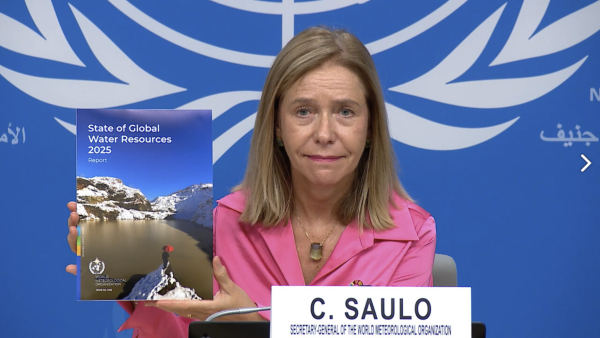
As world’s water reserves change, countries must prepare for a new reality: WMO
New data showing that rivers were at their lowest level for decades last year provides further evidence that the climate crisis is real and countries must act immediately to protect themselves from the increasing threat to communities and livelihoods, the UN World Meteorological Organization (WMO) said on Thursday.
The key findings from WMO’s State of Global Water Resources 2025 report covering the hydrological cycle and extreme events in the five-year period to last year:
- 2025 was one of driest years for river discharge in 35 years
- Past seven years have seen abnorfmal river flows
- Water storage on Earth’s land surface has decreased in past decade
- Widespread glacier loss across all regions for fourth consecutive year
- Asia and Africa are regions most affected by water-related disasters
- Water data availability has improved, but gaps remain in hard-hit areas
Highlighting the long-term decline in the Earth’s freshwater storage and glacier melt, WMO Secretary-General Celeste Saulo explained that the planet’s water reserves used to act as a planetary “savings account” that absorbed the occasional dry season, avoiding a water crisis. “One of the central stories of the 2025 report is what is happening to that savings account? And the simple answer is that we are depleting it,” she told journalists in Geneva.
Groundwater reserves are equally stretched and have been in decline since 2014, WMO’s report states, with nearly two-thirds of monitored wells worldwide showing levels lower than the historical norm and indicating a shift “further toward deficit…not recovery”.
“At the same time, we are seeing more water-related disasters,” Ms. Saulo said, while also stressing that the currently strengthening El Niño “will increase the risk of drought in some areas, and flooding in others”.
Glaciers disappearing
In 2025, for the fourth consecutive year, every major glaciated region on Earth lost ice mass, leading to short-term hazards including floods and long-term water insecurity, according to WMO.
Responding to a question about whether the changing global water cycle might have contributed to the deadly Nepal-China flooding disaster, Ms. Saulo explained that melting ice and rock was just one factor in the chain of events that ultimately sent a massive and deadly wall of water and debris downstream on 26 August, killing at least 1,367 people.
“You asked if it could happen again? Absolutely; the problem in this region is that there’s 63,700 glaciers at the last count,” she told a Press Conference in Geneva. “Even if you’re looking with remote sensing with satellites at these glaciers, you might see some faults, you might see some slight shifting, that does not mean necessarily catastrophic collapse. So, in order to plan for this, it’s very, very difficult. But the international community is looking very hard at ways in which we can bring people together to solve some of these monitoring issues.”
Data indicates that glaciers shrank between 2023 and 2025 with cumulative losses of 1,400 gigatonnes of water – or about one third of annual fresh water needs.
Every major glacier region on Earth lost ice for the fourth consecutive year.
“All 19 glacier regions around the globe lost ice; in Central Asia, Iceland, the Russian Arctic and western Canada and the United States, it was among the three worst years on record,” said Wayne Jenkinson, WMO’s Director of Hydrology and Cryosphere.
Some regions with smaller glaciers such as Central Europe, the Caucasus, the western Canada and the United States may already have reached “peak water”, Mr. Jenkinson warned.
“After this point, the glacier gives less meltwater each year simply because there is less ice left to melt. That matters for every community downstream that relies on water during hot, dry summers,” he explained.
Narelle van der Wel, WMO’s Head of Cryosphere Monitoring, Predictions and Services, stressed that while some further glacier loss is unavoidable, the eventual scale of the decline is not predetermined.
“Some glacier loss is inevitable, but total loss of glaciers is not yet inevitable,” she said, pointing to emissions reductions as central to limiting future losses.
Preparing for moving baselines
The report does not attribute every observed change to climate change alone. WMO says pressure on water resources and natural variability also contribute.
Mr. Jenkinson said governments need to prepare for “moving baselines” as historical patterns become less reliable.
“The situation 30 years ago is not where we are today,” he said. Countries, he added, need to prepare “for those changes that have really already arrived”.
ends