

The United Nations Office at Geneva
Multimedia Newsroom
Press Conferences | WMO , OCHA , WHO , UNICEF , UN WOMEN , OHCHR , IOM , UNHCR
UN Geneva Press Briefing - 15 September 2026
UN INFORMATION SERVICE GENEVA PRESS BRIEFING
15 September 2026
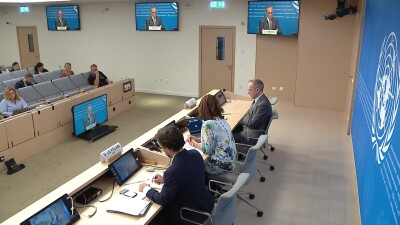
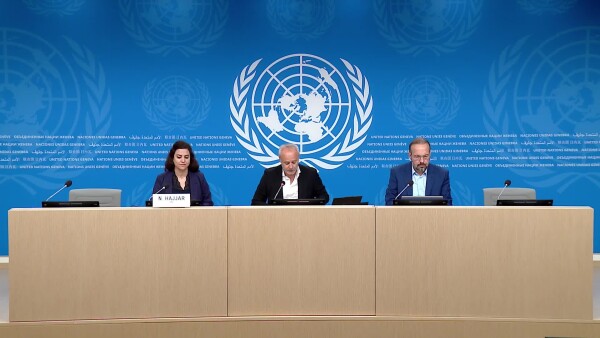
Alessandra Vellucci, Director of the United Nations Information Service in Geneva, chaired a hybrid press briefing, which was attended by the Assistant Executive Director of the World Food Programme, the Special Ebola Coordinator, as well as spokespersons and representatives of UN Women, the World Health Organization, the Office of the High Commissioner for Human Rights, the United Nations Children’s Fund, the United Nations Refugee Agency, and the International Organization for Migration.
Worsening food situation in South Sudan
Matthew Hollingworth, World Food Programme (WFP) Assistant Executive Director for Programme Operations, stated that South Sudan today was facing a collision of crises as humanitarian resources were running out. Since his departure as the WFP Country Director in 2022 until the previous week, the situation in the country had deteriorated enormously. Millions of people were being pushed deeper into vulnerability, while all humanitarian actors’ assistance was rapidly declining in scale. More than half of the population were struggling to find food, with over 2.2 million children and over 1.2 million pregnant and breastfeeding women needing immediate support. South Sudan was also bearing the consequences of the conflict in neighbouring Sudan, with many returnees and refugees from Sudan crossing over. They were arriving at communities which were already struggling to feed themselves, noted Mr. Hollingworth.
Women and girls in South Sudan were facing impossible choices looking for food and water, including serious safety risks. Protection risks and vulnerabilities for displaced families were immense, stressed Mr. Hollingworth. Over the last three years, the World Food Programme and partners had provided food and cash and nutrition assistance to refugees and an increasing number of South Sudanese returnees going into already vulnerable communities. The assistance had been a lifeline, but today, it was at risk. In Malakal, an important logistics hub in the northern part of South Sudan, WFP had significantly less food in stock than in the past years, not because there was less need, but rather because the humanitarian agencies could no longer afford it. Shipments along the Nile faced illegal checks and taxation, adversely affecting both humanitarians and traders. They reduced WFP’s ability to move the goods swiftly. Mr. Hollingworth said that if a family was eating something other than locally grown tomatoes, chillis, okra, and onions, that something had been flown into the region because other modes of transport were too cumbersome, risky or expensive. In addition, the repeated weather shocks were having a major impact on food security, he warned.
WFP was committed to keep doing all it could, but it urgently needed resources. WFP was experiencing a USD 86 million gap right now, and USD 416 were missing over the coming six months. Without those funds, WFP could not serve refugees, displaced communities and those living in fear of famine. The Government of South Sudan had to start mobilizing its own funds to help its people; the humanitarian community could not supplant the national authorities in this regard. While South Sudan had faced many challenges in its short life as an independent nation, it was now going off the financial cliff when the needs were as high as ever.
Replying to questions from the media, Mr. Hollingworth said that super El Niño was already having visible impact in South Sudan. Parts of the country which had never experienced food insecurity were now struggling because of the dryness. The regional impact was of big concern, as several countries in the region on which South Sudan had relied for imports were also affected. WFP was still supporting over three million people, while it would ideally be able to help all 7.8 million food insecure people. Without the missing resources, warned Mr. Hollingworth, the number of people WFP could help in the coming months would go down to only one million. The needs were great and immediate, he stressed.
Ebola outbreak in the Democratic Republic of the Congo
Julien Harneis, Special Ebola Coordinator, said that the ongoing Ebola outbreak in the DRC remained deadly and massive. There were some areas of progress, but the growth in cases continued. More needed to be done, and further international solidarity was necessary. The area covered by cases of Ebola covered two time zones, and it took over 2.5 hours to fly between these zones; it included, among others, Bunia, Ituri, and Sud-Ubangi. This was a vast and heterogenous environment, with weak infrastructure and violence against responders. While most Congolese citizens were supportive of the response, a minority, mostly young men, were attacking health workers and responders. In Ituri and Bunia, there was some progress, with certain areas under control, while in North Kivu, on the other hand, case numbers were going up. Mr. Harneis spoke of excellent coordination between the authorities, humanitarian organizations, and Africa’s Centre for Disease Control. This integrated response, for example, had led to an increase in the number of beds. Cooperation was under way when it came to prophylaxis and vaccines. More funding was needed for both the Ebola response and the humanitarian response, which was currently 49 percent funded. With Ebola, one could not take their foot of the gas. The time was to intensify the response and provide all the necessary resources to continue the fight.
Dr. Olivier le Polain, Unit Head for Epidemiology and Analytics for Response at the World Health Organization (WHO), said that the epidemic remained intense and geographically spread out. So far, there had been 7,200 recorded cases, of which 3,500 deaths across seven provinces covering a vast geographic area. The response had been unprecedented in its scale, but the epidemic continued to expand. Cases were picking up rapidly in North Kivu, for example, while in other provinces the epidemiological situation remained mixed: no new cases in South Kivu since May, and one case now reported in Sud-Ubangi. In Haut-Uele closer to the border with South Sudan, there had been 30 to 40 new cases per week, he informed. Efforts needed to continue and strengthen, including in the areas not reporting cases at the moment. WHO was supporting national authorities in multiple fields. Dr. le Polain stressed the importance of keeping the momentum of the epidemic response in the months to come.
The epidemical situation across the country remained very mixed, explained Dr. le Polain responding to a question. Some areas were more under control than others, and it would be appropriate to consider them as separate epidemics rather than one single challenge. Mr. Harneis added that if the epidemic response was not adequately funded, the epidemic would return. What happened in the future depended on what was being done with the response now. Epidemics could sometimes show early signs of improvement, only to scale up later on again, added Dr. le Polain. He reminded that the number of daily reported cases remained the highest in the history of the country. With the volume of cases and the geographical expansion, it would take many months to bring the epidemics under control. While there had been no new cases in South Kivu since the month of May, surveillance and detection activities were continuing, explained Dr. le Polain. If one looked at the consequences of not investing in the response, early investment in the Ebola response was a wise choice. Africa’s CDC and the DRC Government were tracking the funding of the response, said Mr. Harneis. Speaking of positive aspects, he explained that the Government was publicly declaring new cases, which was the right approach. The health system across the country was paying attention and looking for cases even in parts far away from the ongoing outbreaks.
Education of children in war conditions in Ukraine
Ricardo Pires, for the United Nations Children’s Fund (UNICEF), speaking from Sumy, said that children’s right to education remained under attack in Ukraine, with consequences that would define an entire generation. Just 15 days into the new school year there had been over 1,000 air raid alerts across the country – the highest number for this period in the last five years and nearly double the same period in 2025. That amounted to over 100 alerts every single day and at least four every hour.
In Sumy, specifically, essentially one in every two education facilities had been damaged or destroyed by the conflict. It was heartbreaking to see what should be a place of learning and protection turned into rubble. According to government estimates, between January and August this year hundreds more educational institutions had been damaged, taking the overall toll in Ukraine to over 4,200 since the start of the war. The cost to children was measured beyond broken walls, psychological scars and loud sirens. Results from the latest OECD PISA, released the previous week, showed that a significant proportion of 15-year-olds in Ukraine who had undertaken the test had not yet reached a level of competency in the subject matters that would allow them to keep building on their education. When compared to the overall OECD average, it was equivalent to a gap of two years of study for reading and 1.5 years of study for math and science.
Mr. Pires stressed that, despite the war, Ukraine had demonstrated incredible resilience in sustaining the education system as verified by the stability of results between 2022 and 2025. After almost five years of war, school was one of the few places where a child could find some sense of normality: friends, teachers, routine, a place to feel safe. That mattered because this war was taking an enormous psychological toll on them. As a testament to parents, the Government and humanitarian partners, nearly 4.2 million children had returned to learning this September, including over 712,000 preschoolers. More than 366,000 teachers had also returned to their classrooms.
With winter approaching, attacks on infrastructure would cause electricity and heating disruption. In 2025, nearly two million children had suffered in extreme winter conditions after being left without heat, electricity and water. Power cuts had disrupted online lessons too, with the frontline areas like Sumy being hardest hit. UNICEF’s 2026–2027 winter response was aiming to reach three million people, including 540,000 children. Mr. Pires said that UNICEF was doing everything it could to keep children learning, but no amount of support could shield their education from the consequences of continued attacks.
Recovery of human remains in Gaza
Thameen Al-Kheetan, for the Office of the High Commissioner for Human Rights (OHCHR), said that the painstaking recovery of extensive human remains in Gaza, mostly of children and women, almost three years after their homes had been heavily bombed by Israeli forces, underscored serious concerns over compliance with international law, and the possibility that serious violations, including war crimes, might have been committed. The remains of what appeared to be entire families were now being unearthed at locations that were pulverized by Israeli attacks. It was heartbreaking that the loved ones of those missing for so long were only now having their worst fears confirmed. The remains recovered so far might only be the tip of the iceberg, however. It was critical that evidence of violations – including at destroyed sites – be preserved, given ongoing legal proceedings regarding the conduct of hostilities in Gaza. International investigators ought to be allowed into all parts of Gaza to assist with evidence-gathering.
OHCHR had expressed grave concerns that Israel's choices of methods and means of conducting hostilities, including through the extensive use of explosive weapons with wide area effects in densely populated areas, failed to ensure that they effectively distinguish between civilians and fighters. The discovery of extensive remains under the rubble in Gaza City resurfaced these concerns of war crimes and other atrocity crimes. Israel had clear obligations under international law to take all measures to search and account for missing persons, as well as to search, collect and evacuate the dead. In areas where the Israeli ground forces were deployed, remains had to be recovered in a dignified manner, identified and all potential evidence preserved. Recovering and burying the victims does not substitute for establishing the circumstances in which they were killed. The reported killing of large numbers of family members, including children, women and persons with disabilities, in attacks on residential buildings raised grave concerns regarding compliance with the rules governing the conduct of hostilities. These attacks had to be effectively investigated.
Ajith Sunghay, Head of OHCHR's office in the Occupied Palestinian Territory, connecting from Amman, informed that this month, Palestinian Civil Defence teams said they had recovered 96 bodies and human remains at one site in Az Zeitoun, southeast of Gaza City, allegedly struck in November 2023. Of the bodies and remains recovered, 58 were children and 23 women. Most of the remains have been recovered using bare hands. The sheer explosive power of heavy munitions sometimes left no recovered recoverable remains, and it was increasingly difficult to distinguish rubble from remains as the years pass. A survivor of the attack on the Malaka family's homes told us that for nearly three years he had felt buried beneath layers of grief and pain, the pain of knowing they still in ruins, the pain of being unable to recover and bury them, and the ultimate pain of losing them.
Mr. Sunghay said that the Palestinian Civil Defence reports that more than 630 bodies and other human remains have been recovered from beneath destroyed buildings across Gaza between November 2025 and September 2026. It estimated the total number of missing under the rubble at over 8,000. At this pace, recovering the remaining bodies would take at least ten more years. It was Israel's obligation under the international law to do everything possible to ensure these remains were found, identified and body with dignity in accordance with families religious and cultural beliefs. Instead, the collective impact of Israel's conduct was making any systematic, large-scale search, recovery and identification effort nearly impossible. There was only one excavator available to the Palestinian Civil Defence, and often they had to use their hands to go through the rubble.
If a natural disaster caused the scale of crisis, international mechanisms, deployment of specialized search and forensic teams, and massive resources to support large scale operations of search, recovery and identification would all be triggered. Yet the needs in Gaza, despite the human causes, were just as grave and OHCHR urged similar kind of joint response here. Passing time and rubble clearance increased the risk of the loss of evidence needed to ensure every individual responsible for atrocity crimes was held accountable. It also prolonged the anguish of thousands of families already living in perpetual fear, insecurity in what they had a right to know. They deserved to know the full truth.
Answering questions, Mr. Sunghay said that nobody had full unimpeded access to these places. There was no coordinated effort to recover the bodies in the 70 percent of Gaza controlled by the Israeli Defence Forces (IDF). There were reports of the IDF clearing rubble under which there could be human remains. OHCHR was continuously in contact with the Palestinian Civil Defence, which had only one workable piece of equipment right now. The figure of 8,000 was a low, conservative estimate, based on families’ reporting their missing members.
Women in the occupied West Bank increasingly cut off from daily life
Sofia Calltorp, Chief of Humanitarian Action at UN Women, stated that settler violence, Israeli military operations and movement restrictions across the occupied West Bank had left many women living in fear and increasingly cut off from daily life. As of 31 January 2026, more than 1,050 Palestinians had been killed by the Israeli security forces since October 2023, the vast majority of them men and boys. More than 22,300 people had been detained, most of them men and boys. Behind every one of these figures, however, was a family in grief: a mother waiting for news of her son, a wife left without her partner, and children facing immense loss. For women who were suddenly left heading households, they had to find ways to earn an income, secure assistance, and protect their families under conditions that made even the most basic responsibilities extraordinarily difficult. They faced heightened risks of poverty, exclusion, and violence.
Latest estimates suggest that 83,200 households in the occupied West Bank were headed by women, representing one in eight households, with this figure likely an underestimate. UN Women’s analysis found that fear for one’s safety and security was everywhere. Three-quarters of Palestinians interviewed said that they did not feel safe in their daily life. Half of women heading households said that they were skipping meals to cope with food shortages. Two thirds said they were taking out loans to make ends meet, making any recovery much harder to reach. Movement obstacles, including staffed checkpoints, road barriers, and trenches, were another major driver of daily hardship in the occupied West Bank. There were now an estimated 925 such obstacles, the highest number recorded in two decades. The consequences were severe: women responsible for feeding their families, securing assistance, and meeting basic needs were being prevented from moving freely to reach food, aid, essential services, and employment, said Ms. Calltorp.
UN Women called for dedicated support for women-headed households, support that was disability-inclusive, and combines livelihoods, social protection, health, shelter, and protection services. Despite the immense suffering imposed on them, Palestinian women continued to show extraordinary strength, leadership, and determination. UN Women called on the international community to stand with them in strength and in leadership to protect civilians, respect international law, ensure freedom of movement for people to go about their daily lives, and ensure accountability for the violence.
UN Women’s latest analysis is available here.
Displacement in Yemen
Responding to questions, Eujin Byun, for the United Nations Refugee Agency (UNHCR), said that UNHCR was extremely worried about the rapidly escalating hostilities along Yemen’s west coast, which had now displaced at least 94,000 people, a rapidly increasing figure. Yemen was the country that had suffered the 12 years of conflict and already had 4.8 million internally displaced persons in the country. The hostilities were forcing more than 2,400 people to seek safety across the strait in Djibouti. UNHCR was also concerned about the safety of over 65,000 refugees and asylum seekers in Yemen, who were mostly from Somalia and Ethiopia. UNHCR had colleagues on the ground in Djibouti, but due to the funding cuts, its presence there was lower than before.
Omondi Okoth, for the International Organization for Migration (IOM), confirmed that the situation was very fluid. The number of people currently displaced within Yemen, especially on the west coast, was increasing day by day. So far, Taizz was one of the most affected areas, with about 50,000 people being displaced from that location.
UNHCR and IOM said they were planning to cover the situation in Yemen and Djibouti in depth at the UN Geneva press briefing on 17 September.
Announcements
Alessandra Vellucci informed that an embargoed press conference on State of Water Resources report would be held at 2 pm today with the World Meteorological Organization (WMO) Secretary-General Celeste Saulo.
On 17 September at 12 noon, Bernard Duhaime, Special Rapporteur on the promotion of truth, justice, reparation and guarantees of non-recurrence, would hold a press conference to present his report “Victims Still Waiting: A Global Briefing on Transitional Justice Around the World”.
The same day at 3:30 pm, the Independent International Fact-Finding Mission on Venezuela, would present its latest report.
16 September would be World Ozone Day, and WMO had sent out its annual ozone bulletin under embargo. Interviews were available upon request.
Alessandra Vellucci, for the United Nations Information Service (UNIS), informed that today, the Committee on Enforced Disappearances would review the report of Lesotho, and the following day, the Committee would review additional information submitted by Gabon pursuant to article 29(4) of the Convention.
This morning, the Committee on the Rights of the Child would end the review of the report of Slovenia, after which it would review Kazakhstan.
Finally, Ms. Vellucci informed that the High-Level Week of the 81st session of the UN General Assembly would commence in New York on 18 September. The Secretary-General would address the media on 16 September and 5 pm Geneva time, to be broadcast live at UNTV.
***
TOPICS
EBOLA
- OCHA - Julien Harneis, Special Ebola Coordinator: Update on the Ebola outbreak in the DRC, including plans to contain the epidemic along the Congo River and a mission to the DRC/South Sudan border.
OPT
Yemen
- IOM - Omondi Okoth and UNHCR - Eujin Byun on the new wave of displacement in Yemen
Similar Stories
1
1
1
Press Conferences | UN WOMEN , WFP , WHO
UN WOMEN: Sudan Women and girls one year after the fall of El Fasher; increasing drone attacks across the country; WFP: DRC - Ebola spreads to eighth DRC province as WFP delivers food, builds treatment centres and keeps supplies moving; WHO - Update on Ebola (Bundibugyo Virus Disease)
1
12
1
1
Press Conferences , Images | UNOG
Closing Press Conference following the Sixth Consultative Meeting on Enhancing Coordination of Peace Initiatives and Efforts in Sudan

2
17
1
2
Edited News , Press Conferences , Images | OCHA , WMO
Two UN agencies teamed up on Wednesday to issue an appeal for immediate assistance to help communities already being impacted by the strongest El Niño on record.
1
1
1
Press Conferences | CITES
Wildlife trade and conservation policy discussions at the 81st meeting of the CITES Standing Committee (SC81)
1
1
1
Press Conferences | UNHCR , UNCTAD , WMO , OCHA , UNICEF , WHO
UNHCR Hungary’s 1956 Refugee Crisis: 70 Years On, UNCTAD World Investment Forum 2026, Doha, WMO Greenhouse Gas Bulletin and Climate Update for COP31, OCHA Afghanistan: Malnutrition, Girls’ Education and Recovery, UNICEF Yemen: Child Malnutrition and Unsafe Water in Taiz, WHO Inequalities in Noncommunicable Diseases and Risk Factors
1
1
1
Press Conferences | UNHCR
End of UNHCR's 77th Annual Executive Committee (ExCom) meeting week
1
1
1
Press Conferences | UNICEF , IOM , UNHCR
UN Special Assistant to the Personal Envoy Office (SUDAN): Peace Initiatives and Efforts in Sudan; UNICEF: Dire situation of children in Gaza; IOM: Damaged Homes and Energy Attacks Risk Displacing Ukrainians for this winter; UNHCR: update on EXCOM week

1
1
1
Press Conferences | IOM , UNDRR
UN stresses importance of household preparedness for disaster risk reduction.
1
1
1
Statements , Press Conferences | OHCHR
1
1
1
Press Conferences | UNHCR , UNICEF , IFRC , OHCHR , UN WOMEN , IOM , OCHA , WHO
UNHCR – ExCom Meeting, UNICEF – Nepal Recovery, IFRC – Flash Floods, WHO – Mental Health, IOM – South Sudan Floods, OCHA – DRC Humanitarian aid, UNHCR – Sahel Displacement, UNICEF – Yemen Update, IOM – Gaza Shelter, UN Women – Gaza Women, OHCHR – Arrests and detentions of Syrians by Israeli force
2
1
2
Press Conferences | UNCTAD
Presentation of the Trade and Developement Report 2026
Embargoed until 9 October 2026 at 11 a.m. (Geneva Time)
UNCTAD: UNCTAD’s flagship report finds that governments increasingly use industrial, trade, financial and technology policies to pursue economic and national security objectives. Market access and the ability to move into higher-value activities now depend more heavily on technology, finance and geopolitics.
1
1
1
Press Conferences | UPU
Release of the State of the Postal Sector Report 2026