

The United Nations Office at Geneva
Multimedia Newsroom
UN INFORMATION SERVICE GENEVA PRESS BRIEFING
4 September 2026
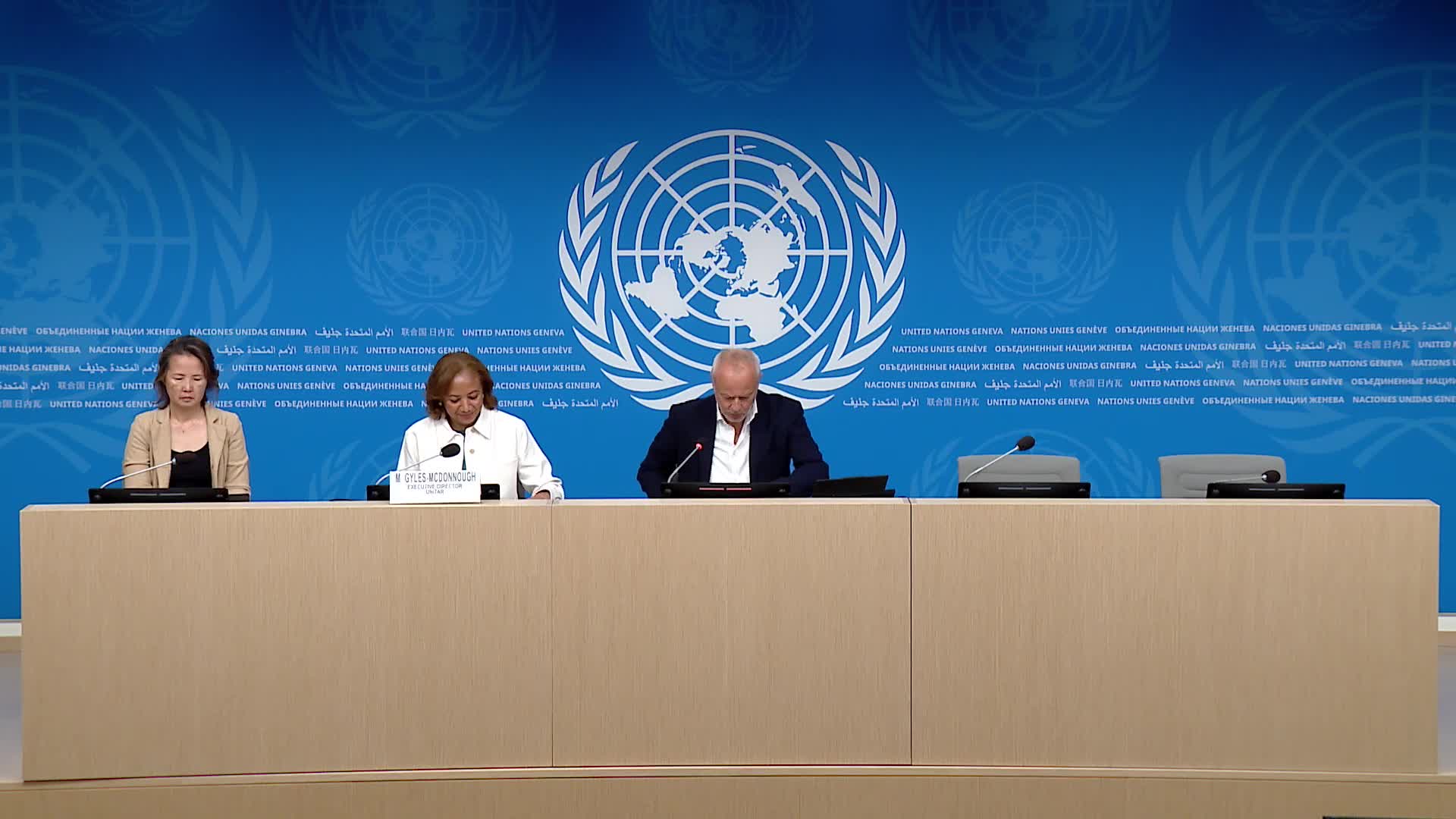
Rolando Gómez, Chief of the Press and External Relations at the United Nations Information Service in Geneva, chaired a hybrid press briefing, which was attended by the Executive Director of the United Nations Institute for Training and Research, and the spokespersons of the World Meteorological Organization and the World Health Organization.
Merger of the UN System Staff College and the UN Institute for Training and Research
Michelle Gyles-McDonnough, Executive Director of the United Nations Institute for Training and Research (UNITAR), briefed about the decision taken by the UN General Assembly: the approval to merge the UN System Staff College, UNSSC, into the UN Institute for Training and Research (UNITAR), and to establish the new United Nations Institute for Capability and Learning Innovation, or UNICLI. The decision formed part of the broader UN80 Initiative, which was fundamentally about making the UN better able to deliver – by aligning mandates, structures, resources, and capabilities around results.
Ms. Gyles-McDonnough further explained that the rationale for this move was straightforward: Member States and the UN were facing increasingly complex and interconnected challenges — from conflict and humanitarian crises to climate change, technological disruption and slow progress on the Sustainable Development Goals. Responding effectively required people and institutions to continuously develop new skills, adapt and turn knowledge into action. The future UNICLI would bring together the complementary strengths of UNITAR and UNSSC: UNITAR’s leadership in capacity development for Member States, public institutions, diplomats, and development practitioners would be combined with UNSSC’s expertise in learning, leadership, and organizational transformation. The aim was not simply to bring two organizations together, but to create a more coherent and accessible platform for learning and capability development.
Ms. Gyles-McDonnough emphasized that this would be a phased transition. Until the end of 2026, UNITAR and UNSSC would continue to operate as separate entities, and its programmes, services, partnerships and existing commitments would continue. UNICLI would then be formally established on 1 January 2027, with the integration of structures, systems and capabilities continuing throughout 2027. The priority throughout this process was continuity — for Member States, UN personnel, learners, donors and partners.
Rolando Gómez, for the United Nations Information Service (UNIS), informed that the Secretary-General had welcomed the GA decision to merge the UNSSC with UNITAR, replacing them with a new entity. This decision was an important step forward in his UN80 Initiative. The decision created a stronger, more integrated platform for learning and capability development, and institutional transformation.
Answering questions from the media, Ms. Gyles-McDonnough explained that the Secretary-General had proposed this merger, with an implementation plan, back in March 2025, following a four-month process of consultation. The potential merger had been on the table for almost 20 years, she explained, but given the urgency of the current moment and a detailed analysis, the merger was taking place now. Both UNITAR and UNSSC boards had studied the proposal and given it a green light. Savings of USD 5.5 to 7 million were expected, with one-time merger costs of USD 7 to 9 million. The merger had never been envisioned as a solely cost-cutting exercise, but the focus was on providing better service and avoiding duplication. Ms. Gyles-McDonnough said that the approved new structure foresaw the staffing of 153; there would be a 26 percent reduction compared to the existing staffing.
Attacks on WHO warehouses in Ukraine
Christian Lindmeier, for the World Health Organization (WHO), informed that in the past three months, three WHO humanitarian warehouses in different regions of the country had been damaged by air-strikes, destroying essential medical supplies intended for frontline and hard-to-reach areas. Just the previous night, an air attack in Kyiv oblast had affected one of WHO’s main warehouses storing humanitarian medical supplies. Access to the site remained restricted due to heavy smoke and safety concerns, while assessments of possible damage and stock losses were ongoing. No WHO personnel had been affected.
Mr. Lindmeier further said that the incident followed an attack two weeks earlier that had destroyed a WHO humanitarian warehouse in Dnipro, resulting in the loss of half of the medical supplies and equipment intended to support an estimated 225,000 people living in frontline and hard-to-reach areas. Another warehouse used by WHO in Kyiv oblast had been damaged during a large-scale wave of attacks on Kyiv and the region in July. These attacks were part of a broader pattern affecting humanitarian operations across the country. In 2026, at least 20 attacks had affected warehouses storing humanitarian supplies, including 15 attacks on warehouses holding health-related humanitarian supplies. Despite these challenges, said Mr. Lindmeier, WHO continued to work with health partners across Ukraine to ensure that essential medical supplies reached health facilities and communities in need. Alternative storage arrangements had already been identified following the latest incidents. WHO’s immediate priority was to establish which products had been damaged and determine how they could be replaced with the support of its partners.
All UN locations, including warehouses, had been communicated to both sides of the conflict, said Mr. Lindmeier responding to questions.
Announcements
Clare Nullis, for the World Meteorological Organization (WMO), informed that the WMO Air Quality and Climate Bulletin would be released on 6 September, the Clean Air for Blue Skies Day. Information under embargo should be shared with the media later today.
Christian Lindmeier, for the World Health Organization (WHO), said that on 8 September, WHO would publish a new study on the effects of smoking on fertility.
Rolando Gómez, for the United Nations Information Service (UNIS), informed that the previous day the Secretary-General had addressed the General Assembly on the implementation of the UN80 Initiative. His remarks can be found here.
The 81st session of the UN General Assembly would start in New York on 8 September under the presidency of Khalilur Rahman of Bangladesh.
On 8 September at 2 pm, the Independent International Commission of Inquiry on the Syrian Arab Republic would present an update on the human rights situation in the country.
This morning, the Committee on the Rights of the Child would end its review of Tanzania. The following week, the Committee would review the reports of Uganda and Burkina Faso.
Finally, Mr. Gómez informed that 7 September would be the International Day of Police Cooperation and the International Day of Clean Air for Blue Skies.
***
TOPICS
UNITAR Michelle Gyles-McDonnough, UN Assistant Secretary-General and Executive Director of the United Nations Institute for Training and Research (UNITAR)
-
The GA resolution on the merger of the United Nations System Staff College (UNSSC) into the United Nations Institute for Training and Research (UNITAR)
WMO Clare Nullis
-
WMO Air Quality and Climate Bulletin being released Monday
WHO Christian Lindmeier
Similar Stories

1
1
1
Press Conferences | IOM , UNDRR
UN stresses importance of household preparedness for disaster risk reduction.

1
1
1
Statements , Press Conferences | OHCHR

1
1
1
Press Conferences | UNHCR , UNICEF , IFRC , OHCHR , UN WOMEN , IOM , OCHA , WHO
UNHCR – ExCom Meeting, UNICEF – Nepal Recovery, IFRC – Flash Floods, WHO – Mental Health, IOM – South Sudan Floods, OCHA – DRC Humanitarian aid, UNHCR – Sahel Displacement, UNICEF – Yemen Update, IOM – Gaza Shelter, UN Women – Gaza Women, OHCHR – Arrests and detentions of Syrians by Israeli force

2
1
2
Press Conferences | UNCTAD
Presentation of the Trade and Developement Report 2026
Embargoed until 9 October 2026 at 11 a.m. (Geneva Time)
UNCTAD: UNCTAD’s flagship report finds that governments increasingly use industrial, trade, financial and technology policies to pursue economic and national security objectives. Market access and the ability to move into higher-value activities now depend more heavily on technology, finance and geopolitics.

1
1
1
Press Conferences | UPU
Release of the State of the Postal Sector Report 2026
1
1
1
Press Conferences | IOM , ITU , UNECE , UNICEF , WHO , WMO
UNICEF: Ebola, DRC - children orphans or separating them from parents and caregivers; IOM: Humanitarian needs in Djibouti amid arrivals from Yemen and increased migrant movements; WHO: Darfur, scale of health needs far exceeds available resources; WMO co-sponsored Global Heat Forum, Bangkok, monthly Global Seasonal Climate Update; UNECE: UN Forum of Mayors; ITU Plenipotentiary Conference 2026; WHO: child and adolescent obesity guidelines and new global roadmap to tackle pregnancy hypertension, a leading cause of maternal mortality
1
1
1
Press Conferences | OCHA , UN WOMEN , UNHCR , WFP , WHO , WTO , UNEP
OCHA – $160M CERF allocation to 12 underfunded crises; UNHCR – 5.8M refugee children remain out of school amid funding cuts; UN Women – Middle East escalation and food security among women/girls; WHO – Gaza supplies and overall situation; WFP – Yemen food insecurity and impact on global hunger ; UNEP - First International Conference of the Global Framework on Chemicals in Geneva | 16-20 November 2026
1
1
1
Press Conferences | UNHCR , WHO
Yemen's health system nears collapse amid conflict, causing rising casualties and medicine shortages.
1
1
1
Press Conferences | HRC
Update by the Expert Mechanism to Advance Racial Justice and Equality in Law Enforcement
1
1
1
Press Conferences | WIPO , WHO , UNICEF , UNHCR , IOM , WFP , FAO
WIPO Global Innovation Index 2026 launch and press conference, WHO Composition of influenza vaccines for the 2027 Southern Hemisphere flu season, UNICEF Yemen hunger and malnutrition; UNHCR Sudan displacement into Chad; IOM Ebola and population movements in DRC; WFP emergency food assistance in Nepal; and FAO food loss and waste.
2
1
2
Press Conferences | UNCTAD
Gaza reconstruction needs reach $71.5 billion as Palestinian economy and public finances face severe strain. Latest UNCTAD report documents the loss of decades of development gains, economic collapse in Gaza and tightening economic constraints in the West Bank.
The report identifies three immediate priorities: transferring withheld Palestinian revenues, safeguarding the banking system and aligning reconstruction support with the documented scale of damage and economic losses.
1
1
1
Press Conferences | HRC
Press conference on the situation of human rights in Nicaragua by the UN Group of Human Rights Experts