

The United Nations Office at Geneva
Multimedia Newsroom
Press Conferences | IFRC , ITU , OCHA , OHCHR , UNCTAD , UNDRR , UNHCR , UNICEF , WHO , WMO
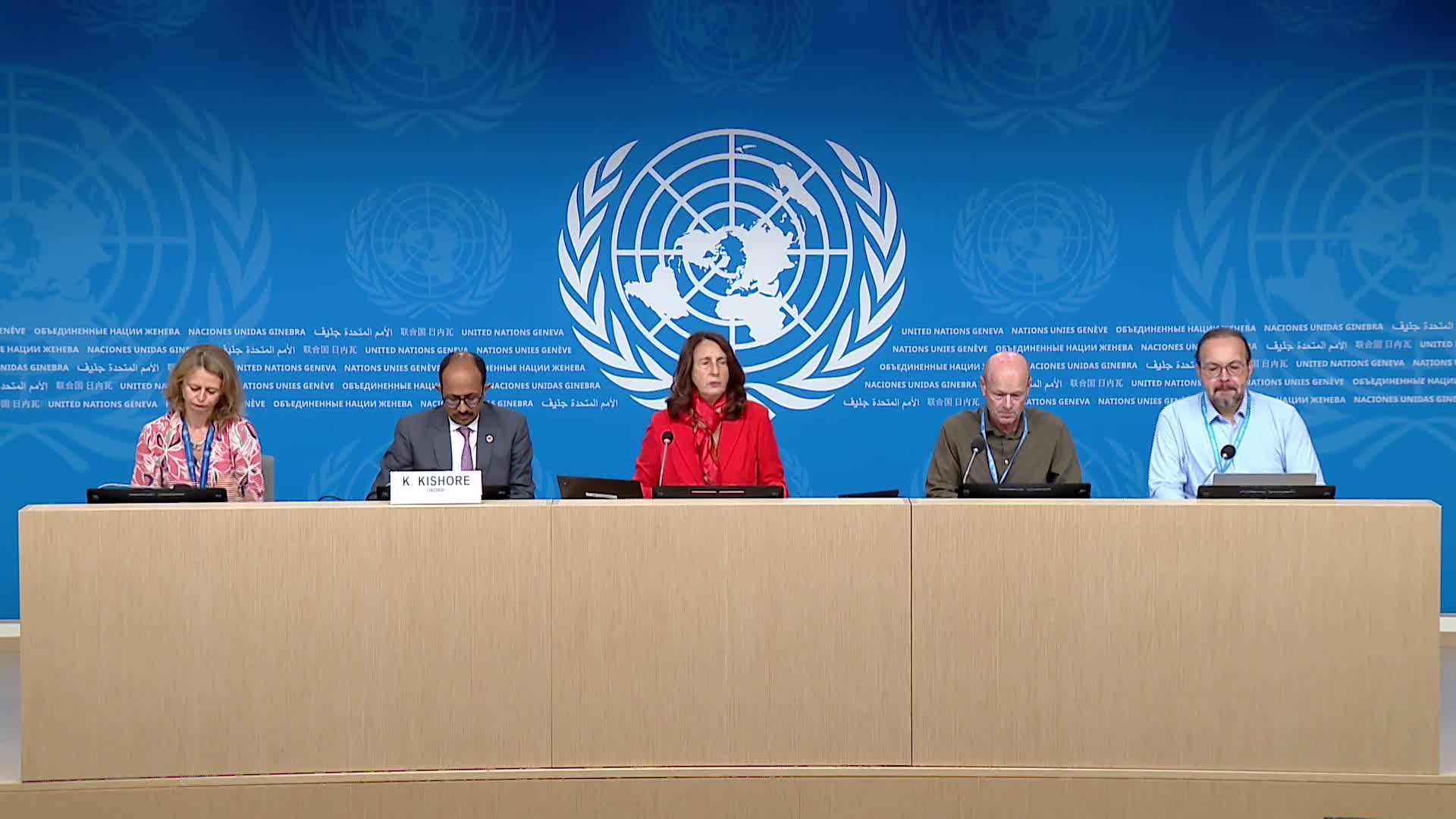
UN Geneva Press Briefing - 28 August 2026
UN INFORMATION SERVICE GENEVA PRESS BRIEFING
28 August 2026
Floods in Nepal
Lila Pieters Yahia, United Nations Resident Coordinator in Nepal, speaking on the move from Nepal, acknowledged the strong leadership of the Nepalese authorities with search and rescue efforts, which included a heavy, active military deployment. As of today, 464 people were confirmed as having lost their lives. There were still 977 people missing, of whom 517 were believed to be foreign. The damage was incredible: over 40 kilometers of roads had been completely destroyed. Search and rescue remained a priority, with the focus on saving lives. Help was being brought in by helicopters because certain areas were completely cut off. Electricity was also an issue, said Ms. Pieters Yahia. Over 30,000 military and security personnel had been mobilized in a massive operation run by the Government, and the UN was scaling up its own support and in close coordination with the Government, which was in the lead. Answering questions, Ms. Pieters Yahia confirmed that the search and rescue operations were well underway. Multiple teams were engaged in search and rescue on the ground, she reiterated, and they were putting an enormous effort around the clock to find survivors.
Kamal Kishore, Head of the United Nations Office for Disaster Risk Reduction (UNDRR), said that Nepal had not seen such a massive disaster in the living memory. This was a time to stand in solidarity with the people and the Government of Nepal. All the investment made by the Government and the international system was now being put to good use. The situation was very dynamic and constantly evolving; continued vigilance was needed for possible cascading hazards happening up in the mountains. Many hazards were transboundary, stressed Mr. Kishore, and mountains were a particularly challenging terrain for early warning systems. People of Nepal now needed to be helped to go on a path of sustainable recovery.
David Fisher, for the International Federation of Red Cross and Red Crescent Societies (IFRC), speaking from Kathmandu, said that the trauma from this event was enormous. The emotional impact and the initial needs were very high, and many areas were still accessible only by helicopter. One area could not even go through early damage and needs assessment because it was inaccessible. Current estimates suggested around 93,000 people might have been affected; the death toll was high and continued to rise. A big worry was secondary floods. IFRC was in contact with its volunteers who were working hand-in-hand with the authorities. IFRC had issued an appeal for CHF 25 million, to run for 12 months, and meant to cover shelter, water, sanitation and hygiene, psychosocial support, and recovery efforts. International solidarity should not focus only on immediate survival but also long-term recovery.
Ricardo Pires, for the United Nations Children’s Fund (UNICEF), said that at least 17,000 children were in urgent need of humanitarian assistance. Numbers of deceased and missing children were likely to go up. Many children had lost their family members and seen their schools and homes destroyed. For survivors, the emergency was far from over; the consequences for children could last for months or even years, especially when topography was so complex. Some of the hardest hit areas made it very difficult for humanitarians to reach affected communities. An estimated 10,000 children in the affected areas needed support to continue education, said Mr. Pires. UNICEF was appealing for USD 17.2 million to sustain its early emergency response.
Tarik Jašarević, for the World Health Organization (WHO), said that WHO staff had visited some affected areas today, but had to cut their visit short because of the continuing flooding. Six health facilities had been damaged: four fully damaged in Rasuwa and two partially damaged in Dhading; eight health workers were missing. Health authorities and partners were coordinating to manage patients, ensure blood availability, provide first aid and maintain emergency response capacity. Following a disaster of this scale, displacement, overcrowding and disruption to water, sanitation and health services could increase the risk of infectious diseases. Within hours, WHO had mobilized and dispatched essential emergency medical supplies, including an Interagency Emergency Health Kit that could cater to the health needs of nearly 10,000 people for three months, along with multipurpose tents and body bags. WHO was working closely with the Government and partners to identify the most urgent health needs and assess damage to health facilities.
Alessandra Vellucci, for the UN Information Service, recalled the expression by the Secretary-General of his strong sadness for the severe flooding in Nepal and China and his solidarity with all those affected. He had extended his condolences to the families of the victims and wished a swift recovery to those injured. Jens Laerke, for the Office for the Coordination of Humanitarian Affairs (OCHA), said that Tom Fletcher, the UN Humanitarian Coordinator, had just issued a statement on X, in which he praised the humanitarians saving lives after the ferocious floods and warned of risks of further disasters.
Answering questions from the media, Mr. Laerke, for OCHA, said that assessments were ongoing and there was no overall figure at the time being. Mr. Fisher, for IFRC, said that the 93,000 people in need was only an initial estimate, while an assessment by the national authorities was now underway. Mr. Kishore, for UNDRR, said that the situation in the affected areas was very fluid and high-risk, creating a unique challenge for the first respondents. Mr. Jašarević, for WHO, said that there was a challenge of not having access to clean water increasing risk of infectious diseases. The risk of respiratory diseases was also high, and people with traumas also needed to reach medical care without delay.
El Niño
Kamal Kishore, Head of the United Nations Office for Disaster Risk Reduction (UNDRR), explained that EL Niño by itself was not a disaster or even a hazard. It was a phenomenon with multiple facets, some of which were beneficial. Number of UN agencies came together to provide coordinated guidance in this regard to UN resident coordinators in affected areas. He stressed that dealing with the risks associated with El Niño was not a sprint – it was a marathon and would take several months. No two El Niños were alike, which meant thorough monitoring and anticipation were critical over the coming months. Often, the focus was on only one or two sectors, primarily agriculture, but the effects were in reality multisectorial, with energy repercussions, impacts on infrastructure, etc. Countries ought to take a multisectorial approach, supported by the UN. The focus should be on the local level, with most vulnerable communities identified. Making resources available at the local level was a critical element, emphasized Mr. Kishore. Finally, he informed that the upcoming Africa Early Warnings Forum 2026 would take place in-person on 2-4 September in Addis Ababa.
Clare Nullis, for the World Meteorological Organization (WMO), said that on 3 September at 10 am, WMO would be issuing next El Niño update. It was hoped that an embargoed information package would be sent out a day or two in advance. United Nations agencies were working very closely on this, she reiterated.
Health situation in Ukraine
Dr. Jarno Habicht, World Health Organization (WHO) Ukraine Representative, speaking from Kyiv, referred to the previous week’s daytime attack on a crowded shopping mall in Kryvyi Rih, far from the frontline, as families had been preparing for the new school year. As a result of two attacks, 140 people had been injured, including 23 children, and 16 people had lost their lives. This was just an example from past 4.5 years, which put civilians under daily risk and stress and at the same time tested the health system to provide care.
WHO had continued deliveries to the Donetsk Oblast, which had allowed us to reach 51 hard-to-reach communities with much-needed medicines, hospital equipment, and other medical supplies. WHO also continued to provide medical supplies to Health Cluster partners, to reach out to other communities. The WHO-supported primary health care teams had provided 13,130 consultations in the past eight months in seven regions, and WHO was progressing at the same pace as previous year. In hard-to-reach areas, where the pharmacies were closed, the WHO delivered over-the-counter medicine kits, reaching 28,400 people.
Mr. Habicht further said that, as of today, WHO had reported 3,205 attacks on health. 2026 had already seen 20 attacks on warehouses where humanitarian supplies were held, including 13 health-related supplies. WHO had experienced attacks in July in Kyiv and August in Dnipro, where it had lost a considerable number of medical supplies and equipment, intended to reach 225,000 people. He stressed that the toll on Ukraine’s health workforce was also becoming increasingly clear. Recent WHO national research showed that more than one in four doctors and nurses reported symptoms compatible with a major depressive disorder, while one in five healthcare workers reported signs of an anxiety disorder.
Finally, Dr. Habicht warned that we had to be prepared for another difficult winter and do everything possible to save lives. To help keep essential health services running, WHO had already installed 30 heating units in health facilities, with 22 more planned before winter. He informed that this was his last briefing in his role as WHO Representative in Ukraine. The most important lesson he took was that response, recovery and reform could not wait for one another; they had to happen together, simultaneously.
Violence in Haiti
Marta Hurtado, for the Office of the High Commissioner for Human Rights (OHCHR), stated that a recent armed attack in Kenscoff, a commune on the outskirts of Port-au-Prince, was a stark reminder of the persistent brutality of gang violence that is inflicted on local and displaced populations in Haiti. Based on information verified so far, at least 47 people had been killed in the 23 August attack, including three boys and two girls. More than 52 people had been abducted. Providing further details, Ms. Hurtado said that approximately 150 heavily armed gang members had stormed several localities near downtown Kenscoff and opened fire at residents attempting to flee through the streets, killing at least 13. The attackers had then subsequently pursued more than 50 residents who had sought refuge in a Protestant church. After forcing them out of the church premises, they had executed 22 of them in the church courtyard, and 12 others behind the church.
Illicit flows of firearms and ammunition into Haiti continued to bolster and empower armed gangs. On 24 August, another gang operating in Port-au-Prince appeared to display on social media what seemed to be a new shipment of weapons arriving from abroad, despite the United Nations arms embargo on Haiti, in place since 2022. This came as Haitians continued to endure horrific human rights violations and abuses. Between 1 April and 30 June this year, the Human Rights Service in the UN Integrated Office in Haiti had recorded 1,408 people killed and 656 injured in the context of gang-related violence. In the same period, 326 people had been subjected to sexual violence, although the figures were likely to be substantially higher. The High Commissioner urged all relevant actors to ensure strict application of both domestic and international regulations on arms control, as well as adherence to the UN arms embargoes on Haiti.
OHCHR statement is available here.
65 years of the Statelessness Convention
Elizabeth Tan, Director of International Protection and Solutions at the United Nations Refugee Agency (UNHCR), said that 65 years since the conclusion of the 1961 Convention on the Reduction of Statelessness, UNHCR was calling for renewed political commitment to ensure that everyone could enjoy the right to a nationality. At least 4.5 million people worldwide were known to be stateless or of undetermined nationality; millions more were affected but remained invisible in official data. For them, statelessness was a daily reality that could stop life in its tracks and often trapped generations into cycles of exclusion and uncertainty. It could mean being unable to obtain identity documents, go to school, access health care, or work legally. In many cases, it could prevent people from registering their child’s birth, marrying, owning property, opening a bank account or travelling freely.
Progress was possible: since 2014, more than 650,000 stateless people had acquired or confirmed their nationality, while 94 countries had strengthened their nationality laws to help prevent statelessness. In 2019, for example, Kyrgyzstan had become the first country to resolve all known cases of statelessness in its territory, followed by Turkmenistan in 2024. In Thailand, over 120,000 stateless people had secured nationality or permanent residence through accelerated procedures put in place in 2025. Yet, the drivers of statelessness remained deeply entrenched, including discrimination in nationality laws and practices, gaps in nationality legislation and arbitrary deprivation of nationality. In 24 countries, women still could not confer nationality on their children on an equal basis with men. Arbitrary deprivation of nationality was also a concern.
UNHCR called on States to translate commitments into results; protect stateless people and provide pathways to nationality, reform discriminatory nationality laws and practices creating new cases of stateless, accede to the UN Statelessness Conventions, and to join the Global Alliance to End Statelessness for collective action. Resolving statelessness was a solvable problem, concluded Ms. Tan.
The full statement is available here.
Announcements
David Hirsch, for the International Telecommunication Union (ITU), informed that on 2 September at 10:15 pm, ITU would release the Greening Digital Companies 2026 report with the World Benchmarking Alliance. The report evaluated the climate performance of 200 digital companies globally by tracking key measures such as greenhouse gas emissions, energy consumption, renewable energy use. For the first time, the 2026 report would also track climate transition planning. Embargoed versions of the report and press release could be requested by writing pressinfo@itu.int.
Marcelo Risi, for the United Nations Trade and Development (UNCTAD), said that UNCTAD would convene the ninth World Investment Forum in Doha from 25 to 27 October, under the theme “Investing in the Future.” The World Investment Forum was the UN’s leading platform for the global investment community, which brought together governments, investors, business leaders, investment promotion agencies, international organizations and financial institutions to look at how investment can better support development. The central question for Doha was: how could investment reach more economies, support sustainable development and help countries prepare for the future? The programme would include global leaders’ plenaries, ministerial roundtables, the Sustainable Stock Exchanges Dialogue, sessions on investment in the Gulf region, and discussions covering areas such as AI, critical minerals, energy, infrastructure, sustainable finance, tourism and culture, and the space economy.
Alessandra Vellucci, for the United Nations Information Service (UNIS), informed that the Committee on the Rights of the Child (CRC) would open its 101st session on 1 September, at 10 am. During this session, the Committee would review the reports of Lesotho, Timor-Leste, Tanzania, Uganda, Burkina Faso, Slovenia, Kazakhstan, and Tajikistan.
Finally, Ms. Vellucci reminded that 29 August would be the International Day against Nuclear Tests, 30 August would be the International Day of the Victims of Enforced Disappearances, and 31 August the International Day for People of African Descent.
***
Similar Stories
1
1
1
Press Conferences | IOM , ITU , UNECE , UNICEF , WHO , WMO
UNICEF: Ebola, DRC - children orphans or separating them from parents and caregivers; IOM: Humanitarian needs in Djibouti amid arrivals from Yemen and increased migrant movements; WHO: Darfur, scale of health needs far exceeds available resources; WMO co-sponsored Global Heat Forum, Bangkok, monthly Global Seasonal Climate Update; UNECE: UN Forum of Mayors; ITU Plenipotentiary Conference 2026; WHO: child and adolescent obesity guidelines and new global roadmap to tackle pregnancy hypertension, a leading cause of maternal mortality
1
1
1
Press Conferences | OCHA , UN WOMEN , UNHCR , WFP , WHO , WTO , UNEP
OCHA – $160M CERF allocation to 12 underfunded crises; UNHCR – 5.8M refugee children remain out of school amid funding cuts; UN Women – Middle East escalation and food security among women/girls; WHO – Gaza supplies and overall situation; WFP – Yemen food insecurity and impact on global hunger ; UNEP - First International Conference of the Global Framework on Chemicals in Geneva | 16-20 November 2026
1
1
1
Press Conferences | UNHCR , WHO
Yemen's health system nears collapse amid conflict, causing rising casualties and medicine shortages.
1
1
1
Press Conferences | HRC
Update by the Expert Mechanism to Advance Racial Justice and Equality in Law Enforcement
1
1
1
Press Conferences | WIPO , WHO , UNICEF , UNHCR , IOM , WFP , FAO
WIPO Global Innovation Index 2026 launch and press conference, WHO Composition of influenza vaccines for the 2027 Southern Hemisphere flu season, UNICEF Yemen hunger and malnutrition; UNHCR Sudan displacement into Chad; IOM Ebola and population movements in DRC; WFP emergency food assistance in Nepal; and FAO food loss and waste.
2
1
2
Press Conferences | UNCTAD
Gaza reconstruction needs reach $71.5 billion as Palestinian economy and public finances face severe strain. Latest UNCTAD report documents the loss of decades of development gains, economic collapse in Gaza and tightening economic constraints in the West Bank.
The report identifies three immediate priorities: transferring withheld Palestinian revenues, safeguarding the banking system and aligning reconstruction support with the documented scale of damage and economic losses.
1
1
1
Press Conferences | HRC
Press conference on the situation of human rights in Nicaragua by the UN Group of Human Rights Experts
1
1
1
Press Conferences | ITU , UNHCR , WHO , WMO
YEMEN - UNHCR: Escalating conflict in Yemen could fuel more displacement, refugee movement
CLIMATE - WHO / WMO: Health and Climate impact of El Niño
1
1
1
Press Conferences | HRC , OHCHR
Mariana Katzarova discusses human rights in Russia as a UN Special Rapporteur.
1
1
1
Press Conferences | IOM , OHCHR , UN WOMEN , UNFPA , UNHCR , UNOPS , WHO
UN Geneva briefing: Yemen crisis worsens, urgent aid needed across multiple sectors.
1
1
1
Press Conferences | HRC
Press conference on the latest report of the Independent International Fact-Finding Mission on the Bolivarian Republic of Venezuela to the UN Human Rights Council
1
1
1
Press Conferences | OHCHR
Victims Still Waiting: A Global Briefing on Transitional Justice Around the World