

The United Nations Office at Geneva
Multimedia Newsroom
UN INFORMATION SERVICE GENEVA PRESS BRIEFING
11 August 2026
Heatwaves, drought, fires, and extreme weather
Clare Nullis, for the World Meteorological Organization (WMO), said Western Europe had experienced its hottest June-July period on record, according to the Copernicus Climate Change Service [of the European Union]. Globally, the month had been the second warmest July on record, with sea surface temperatures the highest ever recorded for the same month. Japan and the Republic of Korea both had had record-breaking heat last week, as did other parts of Asia, the Middle East, and Latin America. Parts of West Africa were witnessing heavy monsoon rainfall and flooding. And, in its weekly Global Hydromet Scan, WMO had warned of heavy to locally very heavy rainfall, with the risk of flash floods and landslides, this week in Northeast and west India, eastern Pakistan, Nepal, Bangladesh, Bhutan, Myanmar and some parts of South East Asia. China had conducted mass evacuations ahead of this weekend’s landfall of Typhoon Dolphin, the 13th typhoon of this season.
These areas of high pressure affected both land and sea, with marine heatwaves recorded around Western Europe and in the Arctic, as well as in the North Pacific, away from areas experiencing land heatwaves. According to the U.S. Marine Environment Monitoring Service, between January and the end of June, approximately 82 per cent of the global ocean experienced marine heatwave conditions of varying intensity — the second-largest extent observed, after 2024.
Also, last month had seen exceptional wildfire activity across western Europe, in terms of the area burnt and emissions. Fire emissions data provided by Copernicus Atmosphere Monitoring Service (CAMS) showed that 2026 emissions for France were comparable or higher than the extreme fire years of 2023 and 2022; 2026 was on course to be one of the most extreme fire years of the past 24 years. Data for Spain showed fire emissions to be well above average for the time of year. Fires were also raging in part of the western USA and in Canada, where 43 active fires were classed as being out of control.
Not all of Europe was gripped by heat and drought: there had been lower than average temperatures and above average rainfall across eastern Europe and Scandinavia.
This extreme weather underscored the need for reliable forecasts and early warnings. That was why the Early Warnings for All initiative remained the priority for the World Meteorological Organization and its Members.
John Kennedy, World Meteorological Organization (WMO) Head of Climate Information, said that these events over the last few months were the combined effect of long-term warming with a persistent pattern of alternating high- and low-pressure systems stretching across the northern hemisphere. The high-pressure areas were more typically associated with high temperature and dry conditions, and the low-pressure areas were cooler and wetter. “The reason we see heat associated with high pressure,” Mr. Kennedy explained, “is that air accumulates and descends over an area of high pressure. The descending air warms and makes clouds less likely to form, letting in more sunlight. Both factors contribute to higher temperatures. The high pressure also tends to block incursions of cooler air from outside. These kinds of high-pressure patterns can last for (…) weeks.”
Extreme heat was becoming more frequent, more intense, was lasting longer and covered a wider area than in the cooler climate of the past. With El Niño now well established in the Pacific, WMO expected to see a bump in global temperature.
Answering questions from journalists, Mr. Kennedy said the heat over Europe now was driven by “background warming” from climate change combining with the weather patterns of high- and low-pressure systems. There was no clear link to El Niño for the temperatures over Western Europe during the summer. The Intergovernmental Panel on Climate Change had shown that the pattern of extreme heat increasing in intensity, duration, and frequency would persist as long as greenhouse gases continued to accumulate in the atmosphere.
Regarding the situation of the main navigable rivers in Europe, the deficit of rainfall had been building up since April 2026 and it would take much more than one summer storm to replenish river levels and soil moisture, Ms. Nullis noted. For instance, in Hungary, Serbia and the Adriatic Sea, between 250 mm and 350 mm of additional precipitation – which was a lot – would be needed to normalize the surface water balance deficit. Even with normal rainfall starting immediately, it would take a long time to redress that balance.
Answering questions on the impact of wildfires on health, Tarik Jašarević, for the World Health Organization (WHO), said wildfire smoke was a mixture of air pollutants of which particulate matter (PM) was the principal public health threat. Wildfire smoke was associated with premature deaths in the general population and could cause or exacerbate diseases of the lungs, heart, brain, nervous system, skin, gut, kidney, eyes, nose, and liver. It could also lead to cognitive impairment and memory loss. Firefighters and emergency response workers were greatly impacted by injuries, burns and smoke inhalation, particularly at a high concentration.
Ms. Nullis said WMO would be releasing, in early September, its annual Air Quality and Climate Bulletin, of which wildfires were a perennial feature.
OCHA Update on the Earthquake in Colombia
Jens Laerke, for the UN Office for the Coordination of Humanitarian Affairs (OCHA), said that according to initial official data 1,495 people had been injured and at least 126 had died in the earthquake that had struck Colombia. Nearly 5,000 homes had been damaged, 387 destroyed; more than 550 educational institutions and more than 350 community centers had been affected. Official reports indicated that there was limited access to essential services such as electricity, water supply, healthcare, and connectivity in various cities; and that 53 roads had been affected across the country.
The OCHA team was monitoring the situation very closely; the entire UN country team was meeting today to see how they could further support the national response of the Colombian authorities, in any way that may be requested or needed.
Answering questions, Mr. Laerke said that there had not been any official request for international assistance. Should that happen, the entire UN system and humanitarians were standing ready to lend support.
Tarik Jašarević, for the World Health Organization, said damage had been reported in 24 health facilities across 6 departments: Valle del Cauca has experienced the most significant health infrastructure impacts, particularly in Cali.
Although international assistance had not been requested, WHO had activated its emergency response mechanisms through its Country Office in Colombia and field teams. Teams had been deployed to affected areas, including Cali and Chocó, to support health sector assessments and coordination. The main needs that had been reported up to now were related to safe drinking water, hygiene kits, household kits, health care, and food assistance.
Vaccinations in the United States
A journalist asked for the World Health Organization's reaction to the US President Trump's signing of an executive order calling for fewer childhood vaccinations.
Tarik Jašarević, for the World Health Organization, explained that for more than 60 years, WHO and global health experts such as the SAGE (Strategic Advisory Group of Experts on Immunization), as well as national authorities, had intensively studied disease transmission, the safety of vaccines and the way they protected people from disease.
The immunization schedule showed when children, adolescents and adults should get their vaccines: it was developed by medical experts who assessed how diseases spread, who got sick most often and at what ages. This had shaped global guidance on what vaccines people needed.
Based on extensive reviews of scientific information, WHO issued vaccine position papers that explained key facts about each disease, the vaccines available to prevent the disease, including their safety evidence, and WHO's recommendations on the timing of each dose. Every vaccine was recommended at the time it offered the best protection against serious illness: one type of vaccine could be needed at birth, another one during adolescence.
In nearly all countries, National Immunization Technical Advisory Groups made policy recommendations and set national immunization schedules. These expert groups relied on guidance from the SAGE to inform their decisions at the national level. These experts rigorously assessed scientific data, deliberated on the evidence, and then developed recommendations that were free of industry and political influence.
Announcements
Rolando Gómez, for the United Nations Information Service, informed that the Committee on the Elimination of Racial Discrimination (CERD) would review, this week, reports submitted by Kuwait (this morning), India (11-12 August), and Honduras (12-13 August).
The Committee on the Rights of Persons with Disabilities (CRPD) would open its 35th session next Wednesday, 12 August, at 10 a.m. The Committee would review the reports of Qatar (12-13 August), Sri Lanka (14 August), Lithuania (17-18 August), Chili (18-19 August), and Slovakia (20 August).
The Conference on Disarmament was holding a plenary meeting in Room XII this morning, on the following agenda items: “New types of weapons of mass destruction and new systems of such weapons; radiological weapons – Comprehensive programme of disarmament – Transparency in armaments.”
The Security Council was meeting today, at 4 p.m. Geneva time, to discuss the situation in the Middle East.
Tomorrow 12 August would be International Youth Day, under the theme “Different contexts, common aspirations”. “This is an opportunity to celebrate the creativity, dynamism, and leadership of young people everywhere,” Mr. Gómez quoted the Secretary-General as saying in a message sent for the occasion.
Ahead of tomorrow's Youth Day, the Department of Global Communications had issued an issue brief on “Children, youth, and information integrity”: this brief followed up to the Secretary-General's recent call for an “AI child safety pledge”.
Responding to a question, Mr. Gómez confirmed that the AI for Developing Countries Forum was taking place from tomorrow, 12 August, through Friday, 14 August, in the Assembly Hall of the Palais des Nations. The event was public and open to media with valid media credentials. More information and the programme for the event could be found on the event webpage.
***
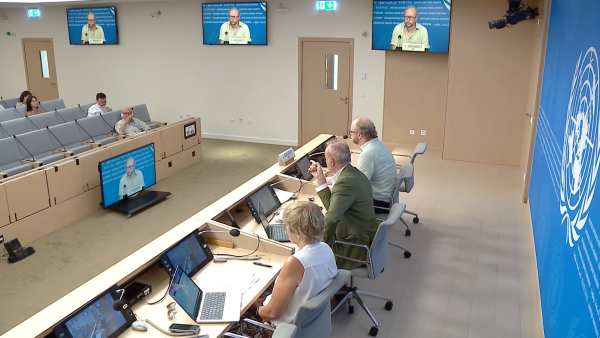
WMO Clare Nullis with John Kennedy, head of climate information
· Heatwaves, drought, fires and extreme weather.
Similar Stories

1
1
1
Statements , Press Conferences | OHCHR

1
1
1
Press Conferences | UNHCR , UNICEF , IFRC , OHCHR , UN WOMEN , IOM , OCHA , WHO
UNHCR – ExCom Meeting, UNICEF – Nepal Recovery, IFRC – Flash Floods, WHO – Mental Health, IOM – South Sudan Floods, OCHA – DRC Humanitarian aid, UNHCR – Sahel Displacement, UNICEF – Yemen Update, IOM – Gaza Shelter, UN Women – Gaza Women, OHCHR – Arrests and detentions of Syrians by Israeli force

2
1
2
Press Conferences | UNCTAD
Presentation of the Trade and Developement Report 2026
Embargoed until 9 October 2026 at 11 a.m. (Geneva Time)
UNCTAD: UNCTAD’s flagship report finds that governments increasingly use industrial, trade, financial and technology policies to pursue economic and national security objectives. Market access and the ability to move into higher-value activities now depend more heavily on technology, finance and geopolitics.
1
1
1
Press Conferences | UPU
Release of the State of the Postal Sector Report 2026
1
1
1
Press Conferences | IOM , ITU , UNECE , UNICEF , WHO , WMO
UNICEF: Ebola, DRC - children orphans or separating them from parents and caregivers; IOM: Humanitarian needs in Djibouti amid arrivals from Yemen and increased migrant movements; WHO: Darfur, scale of health needs far exceeds available resources; WMO co-sponsored Global Heat Forum, Bangkok, monthly Global Seasonal Climate Update; UNECE: UN Forum of Mayors; ITU Plenipotentiary Conference 2026; WHO: child and adolescent obesity guidelines and new global roadmap to tackle pregnancy hypertension, a leading cause of maternal mortality
1
1
1
Press Conferences | OCHA , UN WOMEN , UNHCR , WFP , WHO , WTO , UNEP
OCHA – $160M CERF allocation to 12 underfunded crises; UNHCR – 5.8M refugee children remain out of school amid funding cuts; UN Women – Middle East escalation and food security among women/girls; WHO – Gaza supplies and overall situation; WFP – Yemen food insecurity and impact on global hunger ; UNEP - First International Conference of the Global Framework on Chemicals in Geneva | 16-20 November 2026
1
1
1
Press Conferences | UNHCR , WHO
Yemen's health system nears collapse amid conflict, causing rising casualties and medicine shortages.
1
1
1
Press Conferences | HRC
Update by the Expert Mechanism to Advance Racial Justice and Equality in Law Enforcement
1
1
1
Press Conferences | WIPO , WHO , UNICEF , UNHCR , IOM , WFP , FAO
WIPO Global Innovation Index 2026 launch and press conference, WHO Composition of influenza vaccines for the 2027 Southern Hemisphere flu season, UNICEF Yemen hunger and malnutrition; UNHCR Sudan displacement into Chad; IOM Ebola and population movements in DRC; WFP emergency food assistance in Nepal; and FAO food loss and waste.
2
1
2
Press Conferences | UNCTAD
Gaza reconstruction needs reach $71.5 billion as Palestinian economy and public finances face severe strain. Latest UNCTAD report documents the loss of decades of development gains, economic collapse in Gaza and tightening economic constraints in the West Bank.
The report identifies three immediate priorities: transferring withheld Palestinian revenues, safeguarding the banking system and aligning reconstruction support with the documented scale of damage and economic losses.
1
1
1
Press Conferences | HRC
Press conference on the situation of human rights in Nicaragua by the UN Group of Human Rights Experts
1
1
1
Press Conferences | ITU , UNHCR , WHO , WMO
YEMEN - UNHCR: Escalating conflict in Yemen could fuel more displacement, refugee movement
CLIMATE - WHO / WMO: Health and Climate impact of El Niño