

The United Nations Office at Geneva
Multimedia Newsroom
UN GENEVA PRESS BRIEFING
9 June 2026
Update on the Ebola response in DR Congo
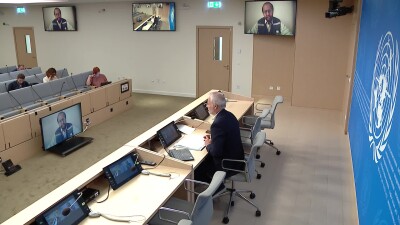
Dr. Abdirahman Mahamud, Director, Health Emergency Alert and Response Operations, World Health Organization (WHO), briefing from Bunia, Democratic Republic of the Congo, gave an update on the outbreak of Ebola disease caused by the Bundibugyo virus in the Democratic Republic of the Congo (DRC), which had been ongoing for over three weeks.
Dr. Mahamud said he arrived in Bunia 15 days ago and had witnessed incredible work and daily progress achieved by the national authorities and the health partners, frontline responders, and health workers to put a stop to the outbreak. He said he was impressed by the dedication and passion of frontline workers caring for suspected and confirmed cases.
As of 8 June, there had been 550 confirmed cases, with 101 deaths and 19 cumulative recoveries reported in the Democratic Republic of the Congo. The outbreak remained concentrated in Ituri Province, which accounted for 94 per cent of confirmed cases (487). Ituri hosted over 900,000 internally displaced persons. The Governor’s leadership approach of building trust with the community would be key to efforts to prevent the spread of the disease.
The increase in confirmed cases was due to the scale up of testing and contact tracing activities, and this was good news, although tracing efforts were still behind the curve of this outbreak and many challenges remained. There were also investigations ongoing to confirm or discard about a hundred suspected cases.
Uganda had reported 19 confirmed cases including two deaths, as well as one probable case who had died. There was no evidence of community transmission in Uganda so far. WHO Director-General Dr Tedros Adhanom Ghebreyesus was currently in Uganda, where he was meeting with officials, health workers and patients.
In the DRC, WHO continued to support national authorities and health partners to perform contact tracing and follow up. As of 6 June, 5,040 contacts had been identified and were under follow-up across Ituri, North Kivu, and South Kivu provinces.
WHO had deployed over 100 personnel to the DRC, including logisticians, epidemiologists, experts in clinical care and vaccine research to support the national response. It had also delivered 40 tonnes of equipment and medical supplies to keep the health workers safe, strengthen lab and testing capacities, and make sure hospitals had the means to maintain their operations.
WHO had helped set up Ebola treatment centres to accommodate and care for Ebola patients and had also set up field laboratories in five affected areas so that testing could now be done closer to the epicentre of the outbreak. The agency continued to work together with partners.
Last week, the Africa Centres for Disease Control and Prevention (Africa CDC) and WHO launched a six-month joint continental preparedness and response plan, with an ask of 518 million United States dollars to support countries and partners to prepare for, rapidly detect and respond to the outbreak. This unified “One Response” approach would be key to rapidly contain and stop this outbreak. WHO called on the international community to step up to support these efforts.
In response to questions, Dr. Mahamud said WHO had traced 62 per cent of contacts, but aimed to reach 90 per cent. It was making slow but steady progress. Its efforts relied on community trust. It was working with community care workers who identified cases and referred them to treatment centres. Ramping up of contact tracing was one of the most effective ways to prevent further spread of the disease.
WHO needed all donors to come together to support the Democratic Republic of the Congo and Uganda, and other neighbouring countries including Kenya, in preparing their lab diagnostic capacity and building their treatment centres.
In the Democratic Republic of the Congo, lab testing had intensified, and all suspected cases could now be tested within 24 hours in treatment centres. Labs had been set up in Bunia, North and South Kivu and Mongbwalu, and there were plans to set one up in Aru. There was thus no longer a major backlog of cases to be tested.
Community surveillance and working with communities was key to the response. WHO health zone teams, together with provincial teams, investigated cases and collected samples that were sent to labs. WHO had an end-to-end data system that recorded data from samples through to testing and treatment phases. There were places with limited internet, which was a challenge, but with lab decentralisation and scaling up of efforts, WHO was confident that testing and confirmation could be achieved as rapidly as possible. Ituri’s large size made the process difficult, but the decentralised approach helped to achieve a quick turn-around for sample collection and testing.
Tarik Jašarević for the World Health Organization said that yesterday evening, WHO had released its latest disease outbreak news on Ebola. The latest figures on Ebola published on the website of Ministry of Health of the Democratic Republic of the Congo showed that 64.4 per cent of contacts had been traced in the country.
WHO was issuing recommendations to all affected and neighbouring countries on how to carry out surveillance and make sure that when cases where identified, they were referred to medical centres and their contacts were traced. Ebola was a real disease.
Suspension of the Single-Dose Dengue Vaccine in Brazil
Responding to a question on the suspension of a single-dose dengue vaccine in Brazil, Tarik Jašarević for the World Health Organization said the dual dose “TAK-003” dengue vaccine produced by Takeda was the only dengue vaccine that had been licenced by WHO.
Announcements
Rolando Gómez, Chief of the Press and External Relations Section at the United Nations Information Service (UNIS) in Geneva, said the spokesperson of the United Nations Secretary-General António Guterres yesterday issued a statement on the situation in the Middle East, which said the Secretary-General was deeply alarmed by the renewed escalation in the Middle East. He called on all concerned parties to immediately stop attacks, exercise maximum restraint, and refrain from any action that could further inflame an already volatile situation. The Secretary-General urged all parties to fully abide by the ceasefires in Lebanon, Iran and Gaza, and to avoid any steps that could undermine ongoing diplomatic efforts.
The Secretary-General was also deeply concerned by the decision by Israel to close crossings into Gaza. He reiterated his call for the immediate reopening of all crossings to ensure the rapid, safe and unhindered passage of humanitarian assistance at scale throughout Gaza.
He underscored that the exercise of navigational rights and freedoms, in accordance with international law, needed to be respected. He further called on all parties to uphold their obligations under international law and to take all feasible precautions to protect civilians.
The Secretary-General reiterated that there was no military solution to the conflicts in the Middle East. The only way forward was through dialogue and negotiations. He therefore urged all concerned parties to work towards diplomatic solutions that advanced regional and international peace and security.
Mr. Gómez said the Secretary-General also delivered a statement yesterday at an annual memorial service honouring staff members who lost their lives in the line of duty. He paid tribute specifically to the 136 UN personnel who lost their lives in the line of duty last year, noting that of the 136, 97 were civilian personnel and 39 were uniformed peacekeepers, and 80 were working for the United Nations Relief and Works Agency for Palestine Refugees in the Near East (UNRWA).
Rosemary DiCarlo, Under-Secretary-General for Political and Peacebuilding Affairs, delivered a statement to the Security Council yesterday concerning Ukraine, in which she warned that warned that the war in Ukraine had entered an even more dangerous and deadly phase, with civilian casualties continuing to rise and recent large-scale attacks causing extensive loss of life and damage to civilian infrastructure.
Indrika Ratwatte, Acting Assistant Secretary-General for Humanitarian Affairs, also delivered a statementon Ukraine, in which she noted that the humanitarian situation in Ukraine was deteriorating as intensified attacks continued to kill and injure civilians, damage critical infrastructure, and hinder humanitarian operations. The UN called on all parties to protect civilians and aid workers to ensure humanitarian access and provide resources needed to assist the 10.8 million people requiring humanitarian support in Ukraine.
This morning, the Conference on Disarmament was holding an informal plenary meeting on the “improved and effective functioning of the Conference”, Mr. Gómez reported.
The Committee on the Protection of the Rights of All Migrant Workers and Members of Their Families was meeting in private today. It would close its forty-second session and issue concluding observations on the State parties reviewed at the end of the week.
Mr. Gómez said the United Nations High Commissioner for Refugees yesterday appointed several high-level positions: the Deputy High Commissioner, the Assistant High Commissioner for Operations, and the Assistant High Commissioner for Protection.
From 15 to 17 June, the United Nations Office of Disarmament Affairs would hold informal exchanges on artificial intelligence in the military domain in Tempus at the Palais des Nations. The informal exchanges were private, but there were many interesting side events, with experts available for interviews.
Tomorrow, Wednesday, 10 June, at 9:00 a.m., the President of the Human Rights Council, Ambassador Sidartho Suryodipuro, would hold a press briefing ahead of the Council’s 62nd session. The Council marked its twentieth anniversary this year. The briefing would take place in his office in Building A. For further information, please contact Pascal Sim (simp@un.org).
Tomorrow was the International Day for Dialogue among Civilizations. The Secretary-General, in his message for the day, noted that we were living through a period of turbulence and transformations, with conflicts raging and inequalities widening. He said evolving technologies, from artificial intelligence to clean energy, would present us with critical choices about the future we wanted to create. The path forward, he concluded, was dialogue.
***
TOPICS:
- WHO Tarik Jašarević with Dr. Abdirahman Mahamud, Director, Health Emergency Alert and Response Operations (From Bunia, DRC): Update on the Ebola response in DRC
Similar Stories
1
1
1
Press Conferences | UPU
Release of the State of the Postal Sector Report 2026
1
1
1
Press Conferences | IOM , ITU , UNECE , UNICEF , WHO , WMO
UNICEF: Ebola, DRC - children orphans or separating them from parents and caregivers; IOM: Humanitarian needs in Djibouti amid arrivals from Yemen and increased migrant movements; WHO: Darfur, scale of health needs far exceeds available resources; WMO co-sponsored Global Heat Forum, Bangkok, monthly Global Seasonal Climate Update; UNECE: UN Forum of Mayors; ITU Plenipotentiary Conference 2026; WHO: child and adolescent obesity guidelines and new global roadmap to tackle pregnancy hypertension, a leading cause of maternal mortality
1
1
1
Press Conferences | OCHA , UN WOMEN , UNHCR , WFP , WHO , WTO , UNEP
OCHA – $160M CERF allocation to 12 underfunded crises; UNHCR – 5.8M refugee children remain out of school amid funding cuts; UN Women – Middle East escalation and food security among women/girls; WHO – Gaza supplies and overall situation; WFP – Yemen food insecurity and impact on global hunger ; UNEP - First International Conference of the Global Framework on Chemicals in Geneva | 16-20 November 2026
1
1
1
Press Conferences | UNHCR , WHO
Yemen's health system nears collapse amid conflict, causing rising casualties and medicine shortages.
1
1
1
Press Conferences | HRC
Update by the Expert Mechanism to Advance Racial Justice and Equality in Law Enforcement
1
1
1
Press Conferences | WIPO , WHO , UNICEF , UNHCR , IOM , WFP , FAO
WIPO Global Innovation Index 2026 launch and press conference, WHO Composition of influenza vaccines for the 2027 Southern Hemisphere flu season, UNICEF Yemen hunger and malnutrition; UNHCR Sudan displacement into Chad; IOM Ebola and population movements in DRC; WFP emergency food assistance in Nepal; and FAO food loss and waste.
2
1
2
Press Conferences | UNCTAD
Gaza reconstruction needs reach $71.5 billion as Palestinian economy and public finances face severe strain. Latest UNCTAD report documents the loss of decades of development gains, economic collapse in Gaza and tightening economic constraints in the West Bank.
The report identifies three immediate priorities: transferring withheld Palestinian revenues, safeguarding the banking system and aligning reconstruction support with the documented scale of damage and economic losses.
1
1
1
Press Conferences | HRC
Press conference on the situation of human rights in Nicaragua by the UN Group of Human Rights Experts
1
1
1
Press Conferences | ITU , UNHCR , WHO , WMO
YEMEN - UNHCR: Escalating conflict in Yemen could fuel more displacement, refugee movement
CLIMATE - WHO / WMO: Health and Climate impact of El Niño
1
1
1
Press Conferences | HRC , OHCHR
Mariana Katzarova discusses human rights in Russia as a UN Special Rapporteur.
1
1
1
Press Conferences | IOM , OHCHR , UN WOMEN , UNFPA , UNHCR , UNOPS , WHO
UN Geneva briefing: Yemen crisis worsens, urgent aid needed across multiple sectors.
1
1
1
Press Conferences | HRC
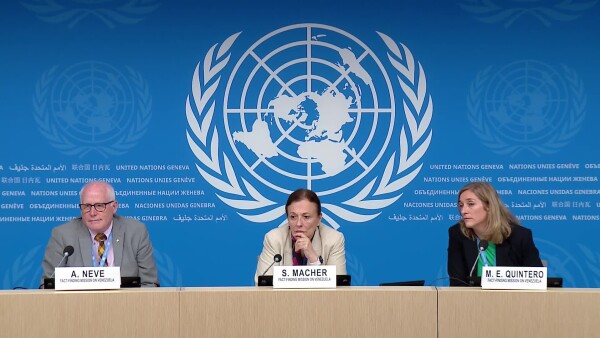
Press conference on the latest report of the Independent International Fact-Finding Mission on the Bolivarian Republic of Venezuela to the UN Human Rights Council