

The United Nations Office at Geneva
Multimedia Newsroom
Press Conferences | UNOG , WHO , UNRWA , UNHCR , OHCHR , UN WOMEN , IFRC , WMO
UN Geneva Press Briefing - 22 May 2026
UN GENEVA PRESS BRIEFING
22 May 2026
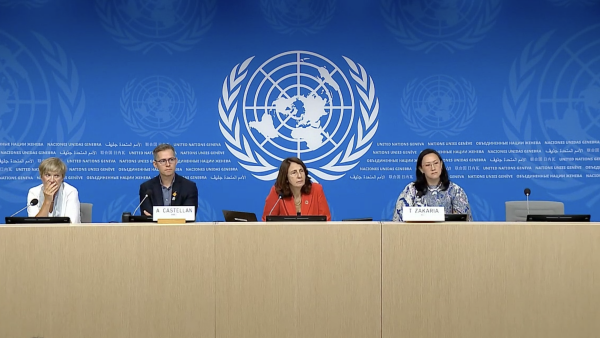
Rolando Gómez, Chief of the Press and External Relations Section at the United Nations Information Service (UNIS) in Geneva, chaired the hybrid briefing. In attendance were spokespersons and representatives of the United Nations Relief and Works Agency for Palestine Refugees in the Near East, the World Health Organization, the United Nations High Commissioner for Refugees, the Office of the United Nations High Commissioner for Human Rights, UN Women, and the World Meteorological Organization, as well as the International Federation of the Red Cross and Red Crescent Societies.
Situation in Gaza and the occupied Palestinian territory
Dr Akihiro Seita, Director of Health at the United Nations Relief and Works Agency for Palestine Refugees in the Near East (UNRWA), presented key aspects from UNRWA’s healthcare delivery work during 2025, ahead of the Health Annual Report to be published in the coming weeks by UNRWA.
It was important to note that UNRWA was still operating in Gaza and the West Bank, Lebanon and Syria. Last year, UNRWA had taken care of 4.5 million medical consultation in Gaza, or 40 percent of all consultations in Gaza. UNRWA had also taken care of 43,000 pregnant women, and 220,000 people with diabetes and hypertension. The vaccination coverage had reached 97 percent, a tremendous contribution to the stability of the region. It indicated that UNRWA was a very good public health platform for the country to support the Palestinian refugees and the host countries as well.
UNRWA continued to operate under tremendous pressure. UNRWA lost 391 staff in the world, including 20 health staff. The financial crisis was also serious. In February 2026, UNRWA had cut staff salary and work time by 20 percent. Many UNRWA staff in Gaza still lived in tents. UNRWA was not able to bring medicines inside Gaza and the West Bank.
There was a tremendous pressure on the population UNRWA served, and UNRWA really appreciated it for the international community to continue to support it to go back to 100 percent.
Dr Reinhilde Van De Weerdt, World Health Organization (WHO) Representative for the occupied Palestinian territory, said nobody could replace what UNRWA was doing. The World Health Assembly, she noted, had had a standing, mandated agenda item on the health of the people in the occupied Palestinian territories, East Jerusalem and occupied Golan for decades.
Despite the ceasefire, the violence continued in Gaza: at least 880 people had been killed and more than 2,600 injured since October 2025. The invisible “yellow line” –marking the limit beyond which active combat continued – had moved again: this meant that today, more than two million people lived on less than half of what the Gaza Strip was before the war. Also, in 2026 up to this date, WHO had reported 22 attacks on healthcare in Gaza, in which five people had died.
Health facilities in Gaza were not functioning due to critical shortages of medical supplies. Laboratory equipment and reagents were missing. Without these essential items, it was impossible to diagnose diseases and detect potential disease outbreaks, such as hantavirus and Ebola. There should be no bureaucratic processes nor access restrictions on essential medicines and essential supplies, Dr Van De Weerdt insisted.
A journalist asked whether Hamas was diverting the delivery of medical equipment. Dr Van de Weerdt explained that WHO brought in supplies also on behalf of UNRWA. These supplies went to WHO warehouses. On a request from Israel, there were now trackers on generators and medical supplies.
WHO could not bring in spare parts for armored vehicles, oxygen generators and laboratory equipment. Some 5,000 people with amputations could not get prosthetic limbs, some of which were considered “dual use items” and retained by Israel. Dr Seita noted that UNRWA ran a major physiotherapy hospital, which had been destroyed.
The key Rafah crossing point, through which patients could leave to and from Gaza into Egypt, was open again since February; another point of passage was Kerem Shalom, from where patients could go, through a very long and complicated way, to Jordan. Thousands of patients were still waiting for a medical evacuation from Gaza and did not have access to the specialized care they needed, Dr Van De Weerdt noted.
Dr Seita warned against not only the shortage of food in Gaza, but also against the risk of collapse due to a shortage of water, clean housing and medical supplies and equipment.
Rolando Gómez, Chief of the Press and External Relations Section at the United Nations Information Service (UNIS) in Geneva, said the UN had long been advocating for a lasting ceasefire, for peace and for the Palestinian people to exercise their right to self-governance.
UNHCR appalled by attacks on aid operations and rising civilian toll in Ukraine
Bernadette Castel-Hollingworth, United Nations High Commissioner for Refugees (UNHCR) Representative in Kyiv, briefed journalists on intensifying Russian attacks on Ukraine that were killing and injuring more and more civilians, and forcing more people to leave. There was also a worrying trend of attacks on humanitarians and humanitarian operations in the country.
Two days ago, a warehouse leased by UNHCR in Dnipro had been hit by a missile during a Russian strike on the city. The attack had claimed two lives, had injured many others,
and resulted in significant damages. The Refugee Agency had lost emergency shelter kits to be distributed after air attacks, sleeping mats, hygiene kits, blankets, and essential and emergency items. The lost value of the aid that was ready to be distributed to people who need it was over one million dollars.
This strike had come amid many others, including deadly strikes this week on the Sumy and Chernihiv regions in northern Ukraine; and a missile and drone attack on Kyiv less than a week ago, where 25 people had died. In 2026, according to human rights officers from the monitoring mission in Ukraine, already 815 civilians had been killed and more than 4,000 injured: this was 21 percent higher than in 2025, a year that had been the deadliest one for civilians in Ukraine since 2022.
Last week there were also three direct attacks on humanitarian convoys, including two on very clearly marked UN convoys. Attacks against humanitarians on duty were clear violations of international humanitarian law: civilians must be protected, and humanitarian must never be targeted either. (Press release here).
Involuntary returns of Afghan refugees to Afghanistan
Shabia Mantoo, for the Office of the United Nations High Commissioner for Human Rights (OHCHR), said the Office was warning against involuntary returns of Afghan refugees and asylum seekers from host countries to Afghanistan, in violation of international human rights and refugee law. Since the beginning of the year, almost 270,000 Afghans had been deported to Afghanistan, mainly from Iran and Pakistan. Fewer numbers have also been reported from Turkey and Tajikistan. These numbers were in addition to the more than 1.2 million Afghans who had been deported from Iran and 150,000 from Pakistan last year.
A report by the UN Assistance Mission in Afghanistan and the UN Human Rights Office last year found that many Afghans who had been involuntarily returned to Afghanistan had experienced a range of serious human rights violations, including arbitrary arrest, detention, torture and ill treatment at the hands of the de facto authorities. Women and girls, individuals affiliated with the former government and its security forces, media workers, civil society, and members of the LGBTIQ plus community were among those who remained at grave risk of reprisals and human rights violations and abuses.
OHCHR urged States to abide by their international legal obligations and protect Afghans by not taking any action that exposed them to irreparable harm upon return. The Office was also alarmed at mounting reports that some countries in Europe were considering or resuming deportations, despite the very severe human rights situation in Afghanistan.
The UN High Commissioner for Human Rights, Volker Turk, strongly cautioned against all involuntary returns to Afghanistan in the absence of individualized risk assessments, as required by international human rights and refugee law. (Press release here.)
Answering a question on the effect of the conflict between Iran and the United States, Ms Mantoo said deportations could surge during periods of heightened security pressures, as had happened after the 2025 escalation. Were tensions to escalate, the experience or patterns suggested that deportations could increase. Returnees and deportees arriving from Iran to Afghanistan were citing economic hardship, unemployment, high living costs, lack of documentation as reasons for leaving. Many had reported experiencing arrests and extortion, abuse and poor detention conditions.
Ebola outbreak
Sofia Calltorp, for UN Women, underlined the disproportionate impact of Ebola on women. Women were more likely than men to die during an Ebola outbreak, not because the disease was more deadly for women once they were infected, but because women were more likely to be infected in the first place. This had been evident during the 2018-2019 Ebola outbreak in the Democratic Republic of Congo, where women and girls had accounted for around two thirds of reported cases.
Ebola was more deadly to women than to men because Ebola transmission followed social realities: the virus spread along the lines of caregiving, domestic labour, frontline health work and burial practices. Women were caregivers, nurses, cleaners in hospital wards, birth attendants helping women deliver their babies; they were also the ones who cared for loved ones in death, preparing their bodies for a funeral.
At a time when humanitarian funding cuts were weakening frontline health and protection systems, UN Women called for sustained funding for women-led organizations so that they could continue their life-saving work in protecting communities, countering misinformation and supporting safe care practices. UN Women also called for increased financial support to primary health care programs that met the needs of women and girls, so that they had access to, among others, training in community-based Ebola awareness and prevention activities, which were critical investments in early detection, safe care, and community resilience. (Press release here.)
Gabriela Arenas, Regional Operations Coordinator for the International Federation of the Red Cross and Red Crescent Societies (IFRC) in the Africa Region, said Red Cross volunteers in Mongbwalu (Democratic Republic of Congo), a town which was considered to be the epicentre of the outbreak, were moving from door to door, speaking with families, answering questions, and helping communities understand how to protect themselves and when to seek care. Many people in these communities had lived through previous outbreaks before, and they remembered fear, rumours spreading to villages, neighbours disappearing into treatment centres and families being unable to bury loved ones. These memories were now returning.
History had shown that Ebola outbreaks could not be contained by a medical response only: they could be contained when communities trusted the response, when people had reliable information, and when local action was supported quickly and consistently. This week, the IFRC had launched an emergency appeal seeking 29 million Swiss francs to scale-up of community engagement, surveillance, safe and dignified burials, infection prevention, as well as cross-border coordination and readiness activities for neighbouring countries.
Answering a question from a journalist, Ms Arenas explained it was critical to get burials under control because the viral load was the highest on the dead bodies. Touching the bodies was extremely risky. Consequently, IFRC applied protocols to perform specialized burials, and had teams trained for it.
Hurricane season outlook
Clare Nullis, for the World Meteorological Organization (WMO), said the US National Oceanic and Atmospheric Administration (NOAA) had issued its Hurricane Outlook for the forthcoming 2026 season, which would begin on 1 June. NOAA was expecting a below-average hurricane season, with eight to 14 named storms. Of those, three to six were expected to become hurricanes and one to three major hurricanes. This was below average. One of the reasons was El Niño, which tended to suppress hurricane activity. However, there was a competing factor: increasing ocean temperatures favoured hurricane activity. Unfortunately, as we saw last year with the case of Hurricane Melissa, it only took one land falling storm to cause a huge amount of damage.
WMO would issue its next update on El Niño on 2 June.
Announcements
Sigrid Kranawetter, Director of Governing Bodies at the World Health Organization, gave an update on the proceedings of the 79th World Health Assembly (WHA).
Dr Tedros Adhanom Ghebreyesus, WHO Director-General, would speak to the media on hantavirus and Ebola during a press conference today at 2 p.m. Later today, the Assembly would examine, in plenary, the reports of Committees A and B, as well as draft resolutions on Ukraine; on the occupied Palestinian territories, including East Jerusalem and the occupied Syrian Golan; and on a continuing reporting requirement on the health situation in the occupied Palestinian territories, including East Jerusalem. Also this afternoon would be the election of the officers of the WHO Executive Board.
Committee B had started its work on a process that had been designed to look at reforming the current global health architecture in a very consultative and inclusive way, including not only Member States and global health institutions, but also civil society and non-state actors, as needed. There was overwhelming support from Member States for this new process.
Answering questions, Ms Kranawetter added that the Assembly would discuss today a draft resolution concerning a request made by Argentina to “denounce the Constitution” of the World Health Organization. WHO preferred not to use the term “withdrawal”: it was not legally correct. The decision to stop engagement and work with WHO was the prerogative of any sovereign State, Ms Kranawetter noted. Another resolution would be going in the direction of a continued cooperation with the country in the future, she added.
Rolando Gómez, Chief of the Press and External Relations Section at the United Nations Information Service (UNIS) in Geneva, noted that Monday and Tuesday, 25 and 26 May were UN holiday in Geneva and said the next press briefing would take place on Friday, 29 May, at 10:30 a.m.
***
ANNOUNCEMENTS
WHO Tarik Jašarević (PR) with Sigrid Kranawetter, Director, Governing Bodies
Update on WHA
TOPICS
UNRWA Dr Akihiro Seita, Director of Health (PR)
Key findings of UNRWA’s critical healthcare delivery work during 2025, ahead of
publishing the UNRWA’s Department of Health Annual Report 2025.
WHO Tarik Jašarević (PR) with Dr Reinhilde Van De Weerdt (PR)
Update on the health situation in Gaza
UNHCR Matthew Saltmarsh (Zoom) with Bernadette Castel-Hollingworth, Representative in
Kyiv (From Poland)
UNHCR appalled by attacks on aid operations and rising civilian toll in Ukraine
OHCHR Shabia Mantoo (PR)
Involuntary returns of Afghan refugees to Afghanistan
UN WOMEN Sofia Calltorp (PR)
The disproportionate impact of Ebola on women
IFRC Paolo Cravero (PR) with Gabriela Arenas, Regional Operations Coordinator for
IFRC Africa Region (From Nairobi)
Update on the IFRC response to the Ebola outbreak
WMO Clare Nullis (PR)
Hurricane season outlook.
Similar Stories
1
1
1
Statements , Press Conferences | OHCHR
1
1
1
Press Conferences | UNHCR , UNICEF , IFRC , OHCHR , UN WOMEN , IOM , OCHA , WHO
UNHCR – ExCom Meeting, UNICEF – Nepal Recovery, IFRC – Flash Floods, WHO – Mental Health, IOM – South Sudan Floods, OCHA – DRC Humanitarian aid, UNHCR – Sahel Displacement, UNICEF – Yemen Update, IOM – Gaza Shelter, UN Women – Gaza Women, OHCHR – Arrests and detentions of Syrians by Israeli force
2
1
2
Press Conferences | UNCTAD
Presentation of the Trade and Developement Report 2026
Embargoed until 9 October 2026 at 11 a.m. (Geneva Time)
UNCTAD: UNCTAD’s flagship report finds that governments increasingly use industrial, trade, financial and technology policies to pursue economic and national security objectives. Market access and the ability to move into higher-value activities now depend more heavily on technology, finance and geopolitics.
1
1
1
Press Conferences | UPU
Release of the State of the Postal Sector Report 2026
1
1
1
Press Conferences | IOM , ITU , UNECE , UNICEF , WHO , WMO
UNICEF: Ebola, DRC - children orphans or separating them from parents and caregivers; IOM: Humanitarian needs in Djibouti amid arrivals from Yemen and increased migrant movements; WHO: Darfur, scale of health needs far exceeds available resources; WMO co-sponsored Global Heat Forum, Bangkok, monthly Global Seasonal Climate Update; UNECE: UN Forum of Mayors; ITU Plenipotentiary Conference 2026; WHO: child and adolescent obesity guidelines and new global roadmap to tackle pregnancy hypertension, a leading cause of maternal mortality
1
1
1
Press Conferences | OCHA , UN WOMEN , UNHCR , WFP , WHO , WTO , UNEP
OCHA – $160M CERF allocation to 12 underfunded crises; UNHCR – 5.8M refugee children remain out of school amid funding cuts; UN Women – Middle East escalation and food security among women/girls; WHO – Gaza supplies and overall situation; WFP – Yemen food insecurity and impact on global hunger ; UNEP - First International Conference of the Global Framework on Chemicals in Geneva | 16-20 November 2026
1
1
1
Press Conferences | UNHCR , WHO
Yemen's health system nears collapse amid conflict, causing rising casualties and medicine shortages.
1
1
1
Press Conferences | HRC
Update by the Expert Mechanism to Advance Racial Justice and Equality in Law Enforcement
1
1
1
Press Conferences | WIPO , WHO , UNICEF , UNHCR , IOM , WFP , FAO
WIPO Global Innovation Index 2026 launch and press conference, WHO Composition of influenza vaccines for the 2027 Southern Hemisphere flu season, UNICEF Yemen hunger and malnutrition; UNHCR Sudan displacement into Chad; IOM Ebola and population movements in DRC; WFP emergency food assistance in Nepal; and FAO food loss and waste.
2
1
2
Press Conferences | UNCTAD
Gaza reconstruction needs reach $71.5 billion as Palestinian economy and public finances face severe strain. Latest UNCTAD report documents the loss of decades of development gains, economic collapse in Gaza and tightening economic constraints in the West Bank.
The report identifies three immediate priorities: transferring withheld Palestinian revenues, safeguarding the banking system and aligning reconstruction support with the documented scale of damage and economic losses.
1
1
1
Press Conferences | HRC
Press conference on the situation of human rights in Nicaragua by the UN Group of Human Rights Experts
1
1
1
Press Conferences | ITU , UNHCR , WHO , WMO
YEMEN - UNHCR: Escalating conflict in Yemen could fuel more displacement, refugee movement
CLIMATE - WHO / WMO: Health and Climate impact of El Niño