

The United Nations Office at Geneva
Multimedia Newsroom
UN GENEVA PRESS BRIEFING
1 May 2026
Middle East crisis ripple effects strain aid efforts beyond region
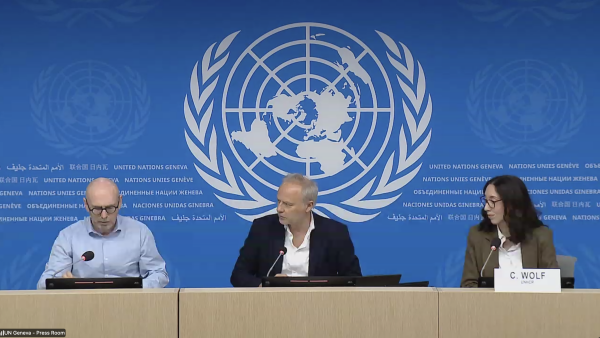
Carlotta Wolf, for the United Nations High Commissioner for Refugees (UNHCR), said the Middle East crisis had generated far reaching ripple effects well beyond the region, with growing consequences for global humanitarian supply chains and the delivery of aid. Spikes in transport costs and freight disruptions were forcing UNHCR to adapt its delivery strategy, while heightened insecurity and instability around key Gulf routes, including the Strait of Hormuz, were driving up prices of basic goods and delaying the delivery of critical UNHCR supplies. Rising transport, food and fuel costs disproportionately affected people already living in emergencies, including millions of refugees and displaced people, while also reducing the ability of aid agencies to deliver timely assistance. UNHCR had adapted quickly by rerouting sea cargo, for example, most recently around Aqaba and Jordan, and increasingly, relying on alternative land corridors, including tracking across the Arabian Peninsula and Türkiye from Dubai, where one of the global stockpiles was located.
The closure of key maritime routes had forced greater use of longer and more expensive alternatives, leading to increased transit times and operational complexity. Freight rates from key sourcing countries had risen to nearly 18 percent since the start of hostilities, while the capacity of some global transport providers had dropped from 97 to 77 percent from the start of the year. For some shipments, costs had more than doubled. Carrier suspensions, rising fuel prices, and higher war risk insurance premiums were further adding pressures. UNHCR was particularly worried about the situation in Africa, where many overlapping displacement crises were ongoing. In Kenya, where one of UNHCR global stockpiles was located, a recent fuel price increase of around 15 percent triggered delays and reduced availability for ships shipments to Ethiopia, the Democratic Republic of the Congo and South Sudan, which collectively hosted over 16 million people forced to flee. In Sudan, the largest displacement crisis in the world, the cost of delivering aid had doubled in recent months, while rerouting shipments around the Cape of Good Hope added up to 25 days in delivery times.
Amid the challenges, UNHCR was maintaining the continuity of life saving assistance, including seven global stockpiles, collectively capable of supporting up to one million people, along with more than 160 country level warehouses, standby arrangements for global procurement, as well as delivery of financial assistance to people forced to flee. Globally, UNHCR retained stocks of over 31,000 metric tonnes of relief items, including blankets, sleeping mats, and mattresses. UNHCR, with partners, had delivered relief items, to over 200,000 displaced people in Lebanon, mostly using items already pre-positioned in the country. Additional support to Lebanon included three airlifts with emergency supplies from donors, as well as 40 trucks carrying over 370 metric tonnes of critical aid from the global stockpiles. In Dubai, UNCHR was supporting up to 100,000 more people. If instability in the Middle East persisted, rising costs, delays and limited transport capacity would likely constrain humanitarian operations further, which would have serious consequences for the lives of millions of refugees and displaced people worldwide.
Rolando Gómez, Chief of the Press and External Relations Section, United Nations Information Service (UNIS) at Geneva, said the press remarks of the Secretary-General shared with the media yesterday spoke of the curtailment of navigational rights and freedoms in the area of the Strait of Hormuz, disrupting energy, transport, manufacturing and food markets.
Responding to a question from the media, Ms. Wolf said UNHCR was most concerned about rising costs of transportation, which meant each additional dollar spent was a dollar less to provide to people on the ground. The human impact for the people served was already evident. Increasing food prices and fertiliser issues meant those in emergencies were able to buy less. Africa was a region already being affected by several emergencies at the same time, and the increase of fuel had impacted operations in Nairobi, meaning people in dire need were receiving things later than needed. Delays were already happening, and the increasing costs of transportation were having an impact on the support which could be provided.
Answering other questions, Ms. Wolf said there was an almost 18 percent average increase on the freight rates in UNHCR’s source countries of India, Pakistan and China which were affected by the current situations. Currently UNHCR had solid stockpiles in seven locations, but the concern was how this would play out long term. There were currently not immediate shortages but rather delays in items arriving.
Responding to another question, Ms. Wolf said UNHCR had been able to provide assistance to people in need in all operations globally so far, but the rising costs were a long-term concern. In the countries most affected by the current Middle East situation, including Iran, Lebanon, and Afghanistan, operations were funded between only 11 and 30 percent, which meant that if more had to be spent on transportation, less could be done for the people.
Answering another question, Ms. Wolf said the reason for higher costs to Sudan was because the region relied on stock coming through the Gulf and Asia. There were seven global stockpiles, including Dubai, which was directly affected. There had been a 15 percent fuel price in Kenya which caused a strike and a lack of availability of trucks. In Sudan, a shipment had to be rerouted several times due to congestion, which was another concern.
Jeremy Laurence, for the Office of the High Commissioner for Human Rights (OHCHR), said
it was important not to forget the human rights impact when it came to a lack of fuel; unfortunately, it always impacted the most vulnerable first, for example a small farmer could not operate machinery on the plot land which sustained his family. Additionally, children may not be able to take the school bus due to a lack of fuel which denied them an education, while generators in poorer countries may not be able to operate. These had real impacts on everyone, and it started with the most vulnerable.
Rolando Gómez, Chief of the Press and External Relations Section, United Nations Information Service (UNIS) at Geneva, referring again to the press remarks of the Secretary-General shared with the media yesterday, noted that in the best-case scenario, the global economic growth would still drop from 3.4 to 3.1 percent, while inflation would climb from 3.8 to 4.4 percent. Conversely, the worst case was that inflation skyrocketed past 6 percent, while global growth plummeted at 2 percent and oil prices rose further.
Cambodia: Appeals court upholds prison sentences against Kem Sokha, 33 others
Jeremy Laurence, for the Office of the High Commissioner for Human Rights (OHCHR), said the United Nations High Commissioner for Human Rights Volker Türk was deeply concerned by the upholding of the conviction of Cambodian former opposition leader Kem Sokha and the convictions of 33 other opposition activists, human rights defenders and social media users. The Phnom Penh appeals court yesterday upheld the conviction and 27-year sentence against Kem Sokha, the former leader of the now-dissolved opposition Cambodia National Rescue Party, for treason, espionage and conspiracy, in connection with a speech he gave over a decade ago in Australia, in 2013, and four years before his arrest. In a separate case, on Wednesday the Phnom Penh first instance court imposed on 33 others sentences ranging from 18 months suspended to two years in prison, over public comments they made in 2024 about the Cambodia-Laos-Vietnam Development Triangle Area project, an issue of major public interest.
These convictions and sentences were clearly inconsistent with international human rights law; Kem Sokha and the other 33 individuals were all exercising their rights to freedom of expression. Their trials also raised concerns about violations of due process and fair trial rights. The High Commissioner urged authorities to promptly quash these latest convictions and sentences and unconditionally release Kem Sokha and all others arbitrarily detained for exercising their rights.
The full statement is available here.
Responding to questions from the media, Mr. Laurence, said the message on general repression had consistently been raised with the authorities of Cambodia by the Human Rights Office, particularly on the vital human rights issues of freedom of speech and assembly.
World Press Freedom Day
Jeremy Laurence, for the Office of the High Commissioner for Human Rights (OHCHR), said this morning the High Commissioner had issued a statement marking World Press Freedom Day, which fell on Sunday, in which he paid tribute to the courageous reporters and photographers who documented horrific atrocities, exposed corruption and scrutinized business operations by uncovering truth and making space for diverse perspectives. Despite all this, journalism today had become an insecure and at times dangerous profession. Media workers were being bombed in their cars, abducted from their offices, silenced behind bars and dismissed from their jobs. This year alone, at least 14 journalists had been killed over the past 20 years. Virtually no country was truly safe for those who spoke truth to power. Investigating corruption, environmental harm or organized crime carried grave risks for journalists, their sources and sometimes their families. OHCHR would continue to monitor and report on violations against journalists and media workers, advocate for their safety and support national protection mechanisms.
Rolando Gómez, Chief of the Press and External Relations Section, United Nations Information Service (UNIS) at Geneva, paid respect to the journalists for the immensely important work they did to raise alarm bells and put words into action on the ground. Mr. Gómez highlighted the Secretary-General’s message to mark the important day, including how far too often journalists risked everything to report that truth.
Responding to questions from the media, Mr. Laurence said there were many countries where it was difficult for a reporter to do their work; you only needed to look at conflict zones in the past three years, including Sudan, Gaza and Lebanon. It was galling to think of the strain the reporters were under, in challenging environment. Whether it was a war zone or a local court, the work had become more difficult. OHCHR and the United Nations were there to support journalists in their work and acknowledged the critical role they played in the world today.
Announcements
Rolando Gómez, Chief of the Press and External Relations Section, United Nations Information Service (UNIS) at Geneva, said today was the Day of Vesak where Buddhists around the world commemorated the birth, enlightenment and passing of Buddha. The Secretary-General’s remarks on this day had been shared with the media.
The Committee Against Torture would close its session today at 10am, and issue its final observations on Gabon, Italy, Pakistan and Tajikistan. Meanwhile the Committee on the Elimination of Racial Discrimination would close its sessions this afternoon, and issue concluding observations on Burkina Faso, Cuba, Cyprus, Serbia, Slovenia and Uzbekistan.
The 52nd session of the Universal Periodic Review Working Group of the United Nations Human Rights Council would take place in the Assembly Hall from 4 to 15 May 2026. During this session, the human rights records of fourteen States would be examined, including: Namibia, Niger, Mozambique, Estonia, Paraguay, Belgium, Denmark, Palau, Somalia, Seychelles, the Solomon Islands, Latvia, Sierra Leone and Singapore.
A press conference would be held ahead of the United Nations in Geneva press briefing on Tuesday May 5, starting at 10am, with the Special Representative of the UN Secretary-General for Disaster Risk Reduction, the head of the UN's office for Disaster Risk Reduction, and the Deputy Secretary general of the International Telecommunications Union, to launch a joint report “When Digital Systems Fail: the hidden risks of our digital world”.
Responding to a question, Mr. Gómez said the report would be shared in advance, as well as statistics ahead of World Press Freedom Day.
***
TOPICS
UNHCR Carlotta Wolf, Spokesperson
- Middle East crisis ripple effects strain aid efforts beyond region
OHCHR Jeremy Laurence
· Cambodia - Appeals court upholds prison sentences against Kem Sokha, 33 others
· World Press Freedom Day
ANNOUNCEMENTS
UNIS on behalf of HRC
Similar Stories
1
12
1
1
Press Conferences , Images | UNOG
Closing Press Conference following the Sixth Consultative Meeting on Enhancing Coordination of Peace Initiatives and Efforts in Sudan

2
17
1
2
Edited News , Press Conferences | OCHA , WMO
Two UN agencies teamed up on Wednesday to issue an appeal for immediate assistance to help communities already being impacted by the strongest El Niño on record.
1
1
1
Press Conferences | CITES
Wildlife trade and conservation policy discussions at the 81st meeting of the CITES Standing Committee (SC81)
1
1
1
Press Conferences | UNHCR , UNCTAD , WMO , OCHA , UNICEF , WHO
UNHCR Hungary’s 1956 Refugee Crisis: 70 Years On, UNCTAD World Investment Forum 2026, Doha, WMO Greenhouse Gas Bulletin and Climate Update for COP31, OCHA Afghanistan: Malnutrition, Girls’ Education and Recovery, UNICEF Yemen: Child Malnutrition and Unsafe Water in Taiz, WHO Inequalities in Noncommunicable Diseases and Risk Factors
1
1
1
Press Conferences | UNHCR
End of UNHCR's 77th Annual Executive Committee (ExCom) meeting week
1
1
1
Press Conferences | UNICEF , IOM , UNHCR
UN Special Assistant to the Personal Envoy Office (SUDAN): Peace Initiatives and Efforts in Sudan; UNICEF: Dire situation of children in Gaza; IOM: Damaged Homes and Energy Attacks Risk Displacing Ukrainians for this winter; UNHCR: update on EXCOM week

1
1
1
Press Conferences | IOM , UNDRR
UN stresses importance of household preparedness for disaster risk reduction.
1
1
1
Statements , Press Conferences | OHCHR
1
1
1
Press Conferences | UNHCR , UNICEF , IFRC , OHCHR , UN WOMEN , IOM , OCHA , WHO
UNHCR – ExCom Meeting, UNICEF – Nepal Recovery, IFRC – Flash Floods, WHO – Mental Health, IOM – South Sudan Floods, OCHA – DRC Humanitarian aid, UNHCR – Sahel Displacement, UNICEF – Yemen Update, IOM – Gaza Shelter, UN Women – Gaza Women, OHCHR – Arrests and detentions of Syrians by Israeli force
2
1
2
Press Conferences | UNCTAD
Presentation of the Trade and Developement Report 2026
Embargoed until 9 October 2026 at 11 a.m. (Geneva Time)
UNCTAD: UNCTAD’s flagship report finds that governments increasingly use industrial, trade, financial and technology policies to pursue economic and national security objectives. Market access and the ability to move into higher-value activities now depend more heavily on technology, finance and geopolitics.
1
1
1
Press Conferences | UPU
Release of the State of the Postal Sector Report 2026
1
1
1
Press Conferences | IOM , ITU , UNECE , UNICEF , WHO , WMO
UNICEF: Ebola, DRC - children orphans or separating them from parents and caregivers; IOM: Humanitarian needs in Djibouti amid arrivals from Yemen and increased migrant movements; WHO: Darfur, scale of health needs far exceeds available resources; WMO co-sponsored Global Heat Forum, Bangkok, monthly Global Seasonal Climate Update; UNECE: UN Forum of Mayors; ITU Plenipotentiary Conference 2026; WHO: child and adolescent obesity guidelines and new global roadmap to tackle pregnancy hypertension, a leading cause of maternal mortality