

The United Nations Office at Geneva
Multimedia Newsroom
Press Conferences | UNHCR , OCHA , WHO , WTO , UNDP
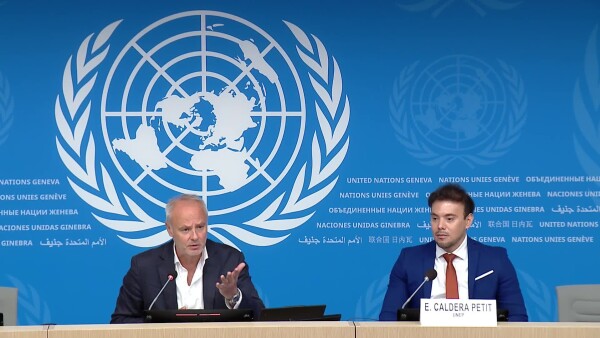
UNOG Bi-weekly press briefing 1 September 2020
Alessandra Vellucci, Director of the United Nations Information Service, chaired the hybrid briefing, attended by the spokespersons of the Office for the Coordination of Humanitarian Affairs, the United Nations Refugee Agency, the World Meteorological Organization, the United Nations Development Programme, the United Nations Conference on Trade and Development, and the World Health Organization.
Environmental impact of the Beirut explosion
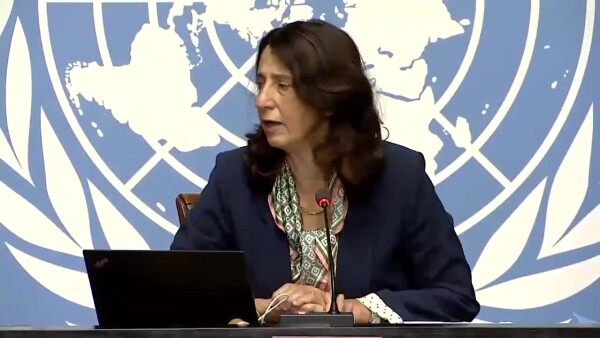
Jihan Seoud, Programme Manager at the Environment and Energy Programme of the United Nations Development Programme (UNDP) in Lebanon, speaking from Beirut, said that the impact on the environment of the recent explosion was a major concern, particularly when considering that the situation preceding the explosion had been already dismal. As a result of the destruction of the Port of Beirut, huge quantities of construction and demolition waste had been generated. Estimates varied between 100,000 and 800,000 tonnes.
The UN and the European Union were working together to ensure that debris removal and waste management was done properly and in an environmentally-sound manner, and not simply disposed in ways that would pose a threat to the environment or human health. The cost of environmental remediation and recovery resulting from the explosion was estimated at over USD 100 million, which was to be added to the Cost of Environmental Degradation in Lebanon, estimated at USD 2.35 billion in 2018. Reconstruction needed to be greener: integrating solar power, energy efficiency measures, insulating material and climate-resilient design in the reconstruction of buildings. A key aspect was that supplies necessary for reconstruction such as cement, tiles and glass were imported or donated from outside Lebanon since local supplies were limited and came at a high environmental cost since uncontrolled and illegal quarrying was a major concern in Lebanon.
So far, Ms. Seoud concluded, only small emergency funding had been secured from donors; much more is needed and fast.
More information on UNDP’s work in Lebanon can be found hereS
Sudan
Alessandra Vellucci, for the United Nations Information Service (UNIS), read the previous day’s statement by the Spokesman of the Secretary-General, in which the Secretary-General welcomed the initialing in Juba of a peace agreement between the Government of Sudan and the Sudan Revolutionary Front and Sudan Liberation Army led by Minni Minawi. The Secretary-General congratulated the people of the Sudan for that historic achievement and commends the parties to the negotiations for their political will and determination in working toward the common objective of peace. The full statement had been distributed to the media.
Full statement can be read here.
Jens Laerke, for the Office for the Coordination of Humanitarian Affairs (OCHA), said that heavy rains, mostly in Ethiopia, had triggered severe flooding in Sudan, where over the weekend the Nile had reached nearly 17.5 metres, the highest level in 100 years, according to the Sudanese authorities. In Khartoum state alone, more than 21,000 people had been affected by flooding and the Government had declared a state of emergency there. Across the country, as of 25 August, 380,000 people had been affected and 90 had been killed due to the floods.
Access to clean water - critical in the middle of the COVID-19 pandemic - had also been affected. Around 2,000 water sources were contaminated or non-functional, according to initial assessments.
A quick response had been possible because the Government, UN agencies and partners had pre-positioned supplies to respond to the needs of 250,000 people before the rains started. Overall, the Sudan Humanitarian Response plan, which asked for USD 1.4 billion, was 44 percent funded.
Shabia Mantoo, for the United Nations Refugee Agency (UNHCR), stated that heavy seasonal rains had caused flash floods and rivers to burst their banks, including the Nile in the capital Khartoum and its twin city Omdurman, and affected thousands of internally displaced people, refugees and host communities in Sudan. Homes and community buildings had been badly damaged and destroyed leaving many in desperate need of shelter. Some had lost all their previous possessions and had been left facing the prospect of starting over again from scratch.
An estimated 125,000 refugees and internally displaced people had been affected in total, particularly in East Sudan, White Nile, Darfur and Khartoum, many in urgent need of shelter and other emergency assistance. Rains had been particularly heavy in North Darfur, leaving an estimated 35,000 IDPs, locals and refugees in need of help. UNHCR and partners, in collaboration with the Government of Sudan, were providing emergency aid to affected populations in White Nile, including plastic sheeting to 3,500 refugees in Al Jameya camp and 65,000 other displaced and host community in the state.
Full statement is available here.
Detecting COVID-19 cases in Ecuador
Shabia Mantoo, for the United Nations Refugee Agency (UNHCR), said that refugee community networks were helping detect COVID-19 cases in Ecuador, as part of a Community Epidemiological Surveillance System (CESS) developed by the UNHCR.
The system was helping ensure the early detection and referral for treatment of COVID-19 cases among the country’s refugee population. Since the system had been launched a month earlier, more than 250 suspected cases had been referred to national health authorities. This innovative, community health referral strategy relies on UNHCR’s pre-existing humanitarian and refugee community networks to help identify COVID-19 cases among refugee and migrant communities. The network comprised partners, community organizations and civil society, complementing the Government’s existing Epidemiological Surveillance System to better reach refugees and migrants, who tended to move continuously within the country. Nationwide, six refugee and migrant-led community organizations had been trained by UNHCR to conduct epidemiological surveillance
Full statement is available here.
Ice melt in the Arctic, Alps and Himalayas
Clare Nullis, for the World Meteorological Organization (WMO), said that today was the start of the northern hemisphere autumn. Summer had had a major impact on ice shelves and glaciers. WMO’s Global Cryosphere Watchhad issued a summary, based on contributions from different partners, which showed that the summer of 2020 had hit the Arctic been marked by many new temperature records. On 20 June, the Siberian town of Verkhoyansk located above the Arctic circle at 67.55°N had experienced 38°C (100.4°F) for the first time. Further north, on the Svalbard archipelago, at 78°N, a new temperature measurement shattered a 41-year-old record, with 21.7°C (71°F) measured in the town of Longyearbyen on 25 July. Even further north, at Eureka station in Nunavut, the Canadian National Weather Service reported 21.4°C (78°F) on the 27 June. The heatwave across the Arctic had been accompanied by record-breaking wildfires in Russia, close-to record low sea ice extent, and the collapse of one of the last fully intact Canadian ice shelves.
Similar temperature trends were being observed in the European Alps, with similar consequences. Temperatures in the Alps had increased by 2°C during the twentieth century. This “amplification” was attributed to the decrease in snow ice cover revealing darker rocks that absorbed more solar radiation. Alpine glaciers suffered tremendously from above-normal summer temperatures. In the Tibetan region in China, persistent heavy precipitation, caused the Jinwuco moraine lake in the Qinghai-Tibetan Plateau to break on 25 June causing significant damage.
Ms. Nullis stressed that the floods resulting from the outburst of glacier lakes were becoming an increased factor of high-risk in many parts of the world, putting at risk people and infrastructure. That was a worrisome trend and emphasized the need for sustained risk management and adaptation measures supported by a good understanding of rapid changes in those environments.
COVID-19
Margaret Harris, for the World Health Organization (WHO), responding to questions, said that the WHO’s guidance, developed in cooperation with UNICEF, was for all children under 18 to be using face masks in schools. It was important to teach children how to wear masks appropriately, put them on and dispose of in a recommended way. WHO also recommended that people get vaccinated against seasonal influenza.
Geneva announcements
Catherine Huissoud, for the United Nations Conference on Trade and Development (UNCTAD), informed about a press conference on 7 September at 11 a.m. to present the 2020 Report on UNCTAD assistance to the Palestinian people. The report would be embargoed until 8 September at 5 p.m. Geneva time.
Alessandra Vellucci, for the UN Information Service (UNIS), informed that a press conference by Simonetta Sommaruga, the President of the Swiss Confederation, on the freedom of media would take place in Room XVII at 1:15 p.m. today, just after the ongoing event on the same topic in Room XX.
Ms. Vellucci also informed that a press conference to launch the “Global Innovation Index 2020 - Who Will Finance Innovation?” would take place in Press Room III on 1 September at 11 a.m. The speaker would be Francis Gurry, WIPO Director-General.
Ms. Vellucci said that the Fondation pour Genève and UNOG, with the support of the City of Geneva, Genève, would open the travelling exhibition #YouNeedToKnow on 17 Sustainable Development Goals. The exposition, which could be visited at the Place des Nations from 4 to 11 September, would be open on 4 September at 4 p.m. by UNOG Director-General Tatiana Valovaya, Alfonso Gomez, Administrative Councilor at the City of Geneva, and Ivan Pictet, President of the Fondation pour Genève. Journalists were kindly invited to the inauguration.
Similar Stories
1
17
1
1
Press Conferences | WMO , OCHA
WMO and OCHA urge early action as unprecedented El Niño is set to hit fragile communities hard
1
1
1
Press Conferences | CITES
Wildlife trade and conservation policy discussions at the 81st meeting of the CITES Standing Committee (SC81)
1
1
1
Press Conferences | UNHCR , UNCTAD , WMO , OCHA , UNICEF , WHO
UNHCR Hungary’s 1956 Refugee Crisis: 70 Years On, UNCTAD World Investment Forum 2026, Doha, WMO Greenhouse Gas Bulletin and Climate Update for COP31, OCHA Afghanistan: Malnutrition, Girls’ Education and Recovery, UNICEF Yemen: Child Malnutrition and Unsafe Water in Taiz, WHO Inequalities in Noncommunicable Diseases and Risk Factors
1
1
1
Press Conferences | UNHCR
End of UNHCR's 77th Annual Executive Committee (ExCom) meeting week
1
1
1
Press Conferences | UNICEF , IOM , UNHCR
UN Special Assistant to the Personal Envoy Office (SUDAN): Peace Initiatives and Efforts in Sudan; UNICEF: Dire situation of children in Gaza; IOM: Damaged Homes and Energy Attacks Risk Displacing Ukrainians for this winter; UNHCR: update on EXCOM week
1
1
1
Press Conferences | IOM , UNDRR
UN stresses importance of household preparedness for disaster risk reduction.
1
1
1
Statements , Press Conferences | OHCHR
1
1
1
Press Conferences | UNHCR , UNICEF , IFRC , OHCHR , UN WOMEN , IOM , OCHA , WHO
UNHCR – ExCom Meeting, UNICEF – Nepal Recovery, IFRC – Flash Floods, WHO – Mental Health, IOM – South Sudan Floods, OCHA – DRC Humanitarian aid, UNHCR – Sahel Displacement, UNICEF – Yemen Update, IOM – Gaza Shelter, UN Women – Gaza Women, OHCHR – Arrests and detentions of Syrians by Israeli force
2
1
2
Press Conferences | UNCTAD
Presentation of the Trade and Developement Report 2026
Embargoed until 9 October 2026 at 11 a.m. (Geneva Time)
UNCTAD: UNCTAD’s flagship report finds that governments increasingly use industrial, trade, financial and technology policies to pursue economic and national security objectives. Market access and the ability to move into higher-value activities now depend more heavily on technology, finance and geopolitics.
1
1
1
Press Conferences | UPU
Release of the State of the Postal Sector Report 2026
1
1
1
Press Conferences | IOM , ITU , UNECE , UNICEF , WHO , WMO
UNICEF: Ebola, DRC - children orphans or separating them from parents and caregivers; IOM: Humanitarian needs in Djibouti amid arrivals from Yemen and increased migrant movements; WHO: Darfur, scale of health needs far exceeds available resources; WMO co-sponsored Global Heat Forum, Bangkok, monthly Global Seasonal Climate Update; UNECE: UN Forum of Mayors; ITU Plenipotentiary Conference 2026; WHO: child and adolescent obesity guidelines and new global roadmap to tackle pregnancy hypertension, a leading cause of maternal mortality
1
1
1
Press Conferences | OCHA , UN WOMEN , UNHCR , WFP , WHO , WTO , UNEP
OCHA – $160M CERF allocation to 12 underfunded crises; UNHCR – 5.8M refugee children remain out of school amid funding cuts; UN Women – Middle East escalation and food security among women/girls; WHO – Gaza supplies and overall situation; WFP – Yemen food insecurity and impact on global hunger ; UNEP - First International Conference of the Global Framework on Chemicals in Geneva | 16-20 November 2026