

The United Nations Office at Geneva
Multimedia Newsroom
UN GENEVA PRESS BRIEFING
24 October 2025
Eightieth Anniversary of the United Nations
Ms. Vellucci first read out a message of the Secretary General for the 80th birthday of the United Nations:
“‘We the peoples of the United Nations...’ These are not just the opening words of the United Nations Charter – they define who we are. The United Nations is more than an institution. It is a living promise – spanning borders, bridging continents, inspiring generations. For eighty years, we have worked to forge peace, tackle poverty and hunger, advance human rights, and build a more sustainable world – together. As we look ahead, we confront challenges of staggering scale: escalating conflicts, climate chaos, runaway technologies, and threats to the very fabric of our institution. This is no time for timidity or retreat. Now, more than ever, the world must recommit to solving problems no nation can solve alone. On this UN Day, let’s stand together and fulfil the extraordinary promise of your United Nations. Let’s show the world what is possible when ‘we the peoples’ choose to act as one.”
Ms. Vellucci reminded that a ceremony would be held today at 12 p.m. at the Salle des Pas Perdus of the Palais des Nations, where the photo exhibition “Shared Lives, Shared Future” would open. Journalists were invited to attend the ceremony, led by Tatiana Valovaya, Director-General of the United Nations Office at Geneva. Two of the persons featured in the physical exhibition would be in attendance; 200 more testimonies could be watched on the UN Geneva website.
Ms. Vellucci also mentioned the launch of the 2024 Report of the UN Office at Geneva, “Restoring Trust”, reflecting on a year of resilience and commitment to multilateralism.
Update on the Health situation in Gaza
Dr Rik Peeperkorn, WHO Representative in the occupied Palestinian territory (speaking from Jerusalem), addressed the health situation in Gaza.
WHO was rapidly scaling up operations. Improved access had enabled the movement of supplies and increased reach to hospitals and medical points for assessments. The Kerem Shalom and Kissufim crossings were open, allowing supplies to flow into Gaza. However, Rafah crossing remained closed. Zikim and Erez crossings also remained closed, limiting direct access to the north and making it difficult to deliver critical support to health facilities at the scale required.
Only a fraction of Gaza’s health system remained in service: there were 2,107 inpatient beds for 2.1 million people. Only 14 of 36 hospitals, 64 of 181 primary health centers and 109 of 359 medical points remained partially functional across Gaza. Several key health facilities lying beyond the ceasefire line, including Kamal Adwan, Al-Awda, Indonesian, and European Gaza Hospital, were inaccessible and nonfunctional.
WHO’s global supply chain had the agility to respond to the evolving needs. Since the ceasefire, WHO had dispatched over 250 pallets of medical supplies to health facilities and 377 pallets of medical supplies had been received via Kerem Shalom. WHO had over 2000 pallets of medical supplies ready to dispatch via Jordan, Egypt, Dubai, West Bank and Jerusalem.
On 23 October, WHO had carried out the first medical evacuation since the ceasefire: 41 critical patients and 145 companions had been evacuated to various countries. Medevac was a flagship programme of WHO, which it aimed to scale-up up to a minimum of 50 patients per day plus companions. Around 15,000 people still needed medical evacuation.
Key prioriites were now: open up all medical corridors; open Rafah crossing into Egypt for daily medevacs while also continuing regular medevacs through Kerem Shalom to Ramon Airport and Jordan; more countries must step forward to receive patients. Re-opening of the West Bank, including East referral route, was vital given this was the most cost-effective route.
There had been no large-scale convoys into northern Gaza since the ceasefire took effect: this was the area where the Integrated Food Security Phase Classification (IPC) confirmed a famine in August. Opening of direct crossings to the north was vital to ensure that sufficient aid reached people as soon as possible. 411 people (including 109 children) had died in 2025 from effects of malnutrition in 2025.
Finally, Dr Peeperkorn mentioned WHO’s 60 Day Ceasefire Plan, by which WHO would scale up its efforts to address urgent health needs hand in hand with rehabilitation of the health system. The plan focused on maintaining and expanding life-saving essential health services; public health intelligence, early warning, and prevention and control of communicable diseases; health emergency coordination; and early recovery, rehabilitation and reconstruction.
Questions focused on access, including what was being done to open crossings; whether a recent vote of the Israeli Parliament, that raised a concern of annexation, would jeopardize WHO’s work in the West Bank; whether WHO was getting closer to a definitive death toll in Gaza; on the discovery, in the rubbles, of 80 bodies apparently belonging to the same family; on the situation of children with severe malnutrition; on unexploded ordinance; and on the use of Jewish or Israeli aid organisations as potential channels for aid.
In his answers, Dr. Peeperkorn insisted that all crossings should be open as quickly as possible not just for people, but also for goods. The UN and partners had been very clear that this should be implemented.
As a humanitarian partner, Dr. Peeperkorn noted, WHO was potentially extremely concerned about the West Bank and also, unfortunately, since 23 October, about escalations in the West Bank, which also affected health and limited access to health in many areas. WHO was assisting as much as possible the health sector and the health system in the West Bank.
The death toll did not include the thousands which were still under the rubble, Dr. Peeperkorn noted, nor the indirect mortality of people who had not been able to get access to their medication or treatment. It would likely take another ten years before an assessment could be made of all the casualties, Dr. Peeperkorn added.
There was now a downward trend regarding malnutrition, however slow that was. It was hoped that more diversified food would come in, including the specialized food needed for malnourished children and other malnourished people.
The UN and WHO had had a first meeting, last Monday, with representatives of the Civil Military Coordination Center. WHO had asked for the opening of more crossings and for the blanket approval of a list of essential medicines and consumables. WHO also hoped for a different approach to such equipment as CT scan and X-ray devices, and for the elimination of time-intensive procedures.
Outcomes of the World Meteorological Organization Congress
Clare Nullis, for the World Meteorological Organization (WMO), said she would soon issue a press release on the outcomes of the World Meteorological Congress that ended yesterday. One of the highlights of the Congress was the visit of the Secretary General, who had stated that “WMO [was] a barometer of truth”, Ms. Nullis noted.
The Congress had adopted resolutions on, among others, the Secretary General’s “Early Warning for All by 2027” initiative, stressing that it was possible to accelerate efforts in this domain using artificial intelligence and machine learning for forecasting.
The Executive Council was now looking at realigning budget priorities to reflect current financial challenges. The Organization was not facing a crisis at the moment; the goal was to avoid such a crisis. A restructuring was under way, involving reducing the number of positions at the senior level or moving staff to regional offices. Cost saving proposals had been submitted, such as WMO relying on State Members’ space capacity, rather than on its own space weather programme.
A journalist asked whether the WMO was under US pressure to cut back on climate monitoring. The United States, Ms. Nullis noted, were still a very active member of WMO, and their delegation was taking part in the Executive Council in a constructive and positive way. “Climate is long-term weather”, she remarked.
Announcements
Ms. Vellucci informed that the UN Environment Programme (UNEP) would hold a press conference on Monday, 27 October, 10:30 a.m., on the coming Sixth meeting of the Conference of the Parties to the Minamata Convention (Geneva, 3 to 7 November 2025). Speakers would be Monika Stankiewicz, Executive Secretary of the Minamata Convention, and Brenda Koekkoek, Senior Coordination Officer.
The Expert Mechanism on the Right to Development would open its 12th session next Monday morning (Room XVI). The session would last until Wednesday. Next, the Social Forum would then hold its 2025 session (Thursday 30 and Friday 31 October, Salle des Assemblées) on the theme “The contribution of education to the respect, promotion, protection and fulfilment of all human rights for all”.
***
TOPICS:
Similar Stories
1
1
1
Press Conferences | WMO , UNHCR , WHO , ILO
WMO: Greenhouse Gas Bulletin; UNHCR: As attacks intensify UNHCR urges support for war ravaged Ukrainians; WHO: Clinical trials in DRC: vaccines and beyond; ILO: New global and regional estimates on domestic work, informality and working conditions
1
1
1
Press Conferences | UN WOMEN , WFP , WHO
UN WOMEN: Sudan Women and girls one year after the fall of El Fasher; increasing drone attacks across the country; WFP: DRC - Ebola spreads to eighth DRC province as WFP delivers food, builds treatment centres and keeps supplies moving; WHO - Update on Ebola (Bundibugyo Virus Disease)
1
12
1
1
Press Conferences , Images | UNOG
Closing Press Conference following the Sixth Consultative Meeting on Enhancing Coordination of Peace Initiatives and Efforts in Sudan
2
17
1
2
Edited News , Press Conferences , Images | OCHA , WMO
Two UN agencies teamed up on Wednesday to issue an appeal for immediate assistance to help communities already being impacted by the strongest El Niño on record.
1
1
1
Press Conferences | CITES
Wildlife trade and conservation policy discussions at the 81st meeting of the CITES Standing Committee (SC81)
1
1
1
Press Conferences | UNHCR , UNCTAD , WMO , OCHA , UNICEF , WHO
UNHCR Hungary’s 1956 Refugee Crisis: 70 Years On, UNCTAD World Investment Forum 2026, Doha, WMO Greenhouse Gas Bulletin and Climate Update for COP31, OCHA Afghanistan: Malnutrition, Girls’ Education and Recovery, UNICEF Yemen: Child Malnutrition and Unsafe Water in Taiz, WHO Inequalities in Noncommunicable Diseases and Risk Factors
1
1
1
Press Conferences | UNHCR
End of UNHCR's 77th Annual Executive Committee (ExCom) meeting week
1
1
1
Press Conferences | UNICEF , IOM , UNHCR
UN Special Assistant to the Personal Envoy Office (SUDAN): Peace Initiatives and Efforts in Sudan; UNICEF: Dire situation of children in Gaza; IOM: Damaged Homes and Energy Attacks Risk Displacing Ukrainians for this winter; UNHCR: update on EXCOM week
1
1
1
Press Conferences | IOM , UNDRR
UN stresses importance of household preparedness for disaster risk reduction.
1
1
1
Statements , Press Conferences | OHCHR
1
1
1
Press Conferences | UNHCR , UNICEF , IFRC , OHCHR , UN WOMEN , IOM , OCHA , WHO
UNHCR – ExCom Meeting, UNICEF – Nepal Recovery, IFRC – Flash Floods, WHO – Mental Health, IOM – South Sudan Floods, OCHA – DRC Humanitarian aid, UNHCR – Sahel Displacement, UNICEF – Yemen Update, IOM – Gaza Shelter, UN Women – Gaza Women, OHCHR – Arrests and detentions of Syrians by Israeli force
2
1
2
Press Conferences | UNCTAD
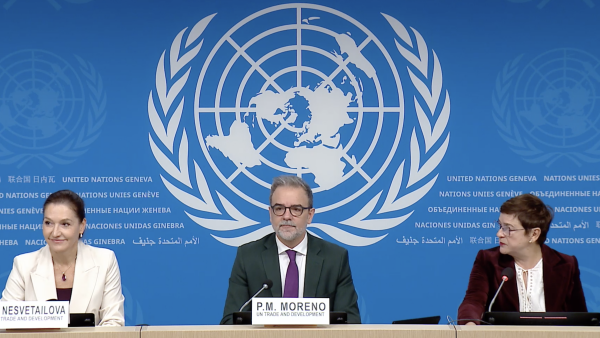
Presentation of the Trade and Developement Report 2026
Embargoed until 9 October 2026 at 11 a.m. (Geneva Time)
UNCTAD: UNCTAD’s flagship report finds that governments increasingly use industrial, trade, financial and technology policies to pursue economic and national security objectives. Market access and the ability to move into higher-value activities now depend more heavily on technology, finance and geopolitics.