

The United Nations Office at Geneva
Multimedia Newsroom
Press Conferences | UNCTAD , WMO , WFP , UN WOMEN , WHO , OCHA
UN Geneva Press Briefing - 17 October 2025
UN GENEVA PRESS BRIEFING
17 October 2025
Situation in Gaza following ceasefire
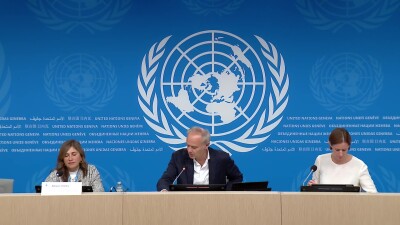
Abeer Etefa, Senior Regional Communications Officer and Spokesperson for the World Food Programme (WFP), said WFP was on the ground in Gaza, responding to one of the most complex and fragile humanitarian situations in recent memory. The ceasefire had opened a narrow window of opportunity, and WFP was moving quickly to scale up food assistance and reach families who had endured months of aid blockade, displacement and hunger. This was a cautious moment of hope. WFP had the supplies and systems, but now needed the sustained access, multiple crossings, safe routes and a commitment to facilitate aid on the ground in Gaza, without obstruction. Currently, WFP was able to use two operational crossings: Kerem Shalom in the south and Kissufim, in the central part of the Gaza Strip. Convoys had been able to cross safely over the past few days with no losses to commodities, reaching warehouses and distribution points, which was positive. However more capacity at crossings was needed, including for scanning and processing incoming supplies, to reach more people quickly.
WFP was hoping for the reopening of crossing points in the north, which were critical for communities who had been cut off for weeks. Yesterday two convoys of 57 trucks carrying wheat flour, arrived safely to WFP warehouses through Kerem Shalom. Since the ceasefire went into effect on October 11, around 230 trucks carrying around 2,800 tonnes of food supplies had crossed into Gaza, as of October 15. This was a daily average of around 560 tonnes of food but was still below what was needed. However, progress had been made operationally. Currently WFP had five food distribution points, up and running, closer to people, including vulnerable women and children, with the aim to expand to 145 distribution points across all of Gaza. Scale depended on trucks continuing to enter consistently. Distributions had started with ready-to-eat food rations, which were critical for families without access to cooking facilities. Food parcel distributions containing staple commodities were also being carried out at some sites.
A top priority for WFP was bakeries. As of October 15, nine bakeries were up and running, producing over 100,000 bread bundles. Work was being done to scale up bakeries to 30 across all of Gaza. Each bundle fed a family of five for a day, which right now stood at around half a million people every day. The smell of fresh bread in Gaza meant more than nourishment; it was a signal that life was returning. In recent days, WFP had reached pregnant and breastfeeding women and children under five with, preventive nutrition support, beginning distribution in Gaza City. This was a critical milestone because it had the highest rates of malnutrition and food insecurity and was classified by the Integrated Phase Classification (IPC) as in famine conditions back in August. WFP was also moving towards digital payments and electronic vouchers and hoped to have markets restarted soon, which was important to bring fresh produce to the people. WFP aimed to reach 200,000 of the most vulnerable people with electronic payments.
The biggest challenges were that only two crossings were operational, and the northern crossings had yet to be opened. Roads were blocked and destroyed, limiting transport, and 50 percent of warehousing capacity has been lost due to infrastructure damage. While the quantities of aid supplies were not yet at the scale needed, the WFP logistics machine was in gear. If the ceasefire continued to hold, WFP would continue to deliver. Due to donor support they were not starting from scratch; the organization had been prepared for this moment. Close to 60,000 tonnes of food supplies were prepositioned between Egypt, Jordan and from inside Israel, to take advantage of the cease fire. WFP hoped for continued donor support throughout the crisis.
Sofia Calltorp, for United Nations Women, said UN Women were in daily contact with women and girls in Gaza, who had expressed hope that the cease fire would last, and saw it as a moment of hope. Over the past week there had been the first signs of progress, including some food, medicine, and water now entering Gaza. Many women and girls could hope to seek care, receive aid, and sleep without the sound of airstrikes, for the first time in months. However, the ceasefire had not ended the crisis. For two years, women and girls in Gaza were killed at a rate of roughly two every hour. Today, the needs of women and girls in Gaza remained at an all-time high. Over one million women and girls required food aid, and nearly a quarter million needed urgent nutrition support. The ceasefire was the window to deliver fast, and to stop famine. Most women in Gaza had been displaced at least four times during the war. The ceasefire was their first chance to stop running, to find safety, and to rebuild. But winter was coming, and too many still had no shelter.
UN Women’s mission was to ensure that the ceasefire translated into safety, recovery, and rights for women and girls, placing them at the center of every humanitarian and reconstruction effort. UN Women was coordinating with UN and partners, to ensure every clinic, and food parcel reached women and girls safely, and met their needs. Every dollar invested in women-led aid, was a down payment on hope. The data stated that when we invest in women, every one dollar generated an eight dollar return for whole communities. If women’s organizations were not included in the recovery response, women would be excluded from the future of Gaza altogether. UN Women was working side-by-side with the UN system which was on the ground fully mobilized to scale-up life-saving assistance. All parties must uphold the ceasefire agreement, and Member States must step up funding now. Peace must be restored through women.
The full statement can be viewed here.
Responding to questions from the media, Abeer Etefa, for WFP, said until WFP teams on the ground could carry out assessments, they could not reflect on the numbers or progress made, including on the situation of famine. For now, WFP was reaching those most impacted by severe malnutrition with nutrition supplies. While this was not at the level they wanted, it was still early days of the cease fire. It would take some time to scale back the famine, but progress was being made. Bakeries and nutrition products were the top priority.
Jens Laerke, for the Office of the Coordination of Humanitarian Affairs (OCHA), said according to figures from the Coordinator of Government Activities in the Territories (COGAT) presented to mediators, on Wednesday a total of 716 trucks had entered Gaza, including 16 fuel and gas trucks, On Thursday, 950 trucks crossed, including eight fuel and three gas trucks. The majority were entering through the Karem Shalom crossing with the remainder coming through the Kissufim crossing. The number of trucks included the commercial sector, donations and UN trucks combined, with one third of trucks provided through the UN coordinated mechanisms. There was a website which provided these numbers.
Ms. Etefa said the conditions inside Gaza were extremely difficult, including the road conditions and communities being on the move. WFP was not yet able to get the food supplies they needed at scale. There had been 57 trucks through yesterday which was considered as a breakthrough, but not yet the level of 80 to 100 trucks per day which was required. There needed to be all five crossing points open to flood Gaza with distribution points, to return to the systems which were in place before the intensification of hostilities.
Responding to further questions, Ms. Etefa said WFP had not yet started any distributions in Gaza City, just small quantities of nutrition supplies, as access remained challenging. Logistics and the movement of convoys from the south to the north was one of the biggest challenges, as well as the security situation. Nutrition products could be placed on small trucks, but wheat and flour required bigger convoys.
Tarik Jasarevic, for the World Health Organization (WHO), said WHO needed to work on different health priorities, including getting as many supplies as possible to hospitals. WHO had deployed international medical teams to boost medical and trauma care and set up new operations in Al Shifa hospital. All the possible routes into Gaza needed to be open. Gaza and referral patients needed to be connected to Jordan, east Jerusalem and Egypt, and more countries needed to take patients. Any crossing opening was good news and would help medical evacuations.
Mr. Laerke in response to further questions, said the remaining crossings were closed because the Israeli authorities had not opened them. In some cases, there may be a need for road repairs and decontamination of unexploded ordinances before they could be used. It was important to open crossings in the north, as this was where the famine had taken hold and was in effect. The tide was turning regarding the famine, but it was important to have these openings functional.
Sofia Calltorp, for UN Women, said the organization was currently in the assessment phase, and there were two main messages: cautious optimism and overwhelming needs, including food and medicine. UN Women would revert soon with assessments and plans forward.
Responding to another question, Ms. Etefa said WFP was providing nutrition supplies to severely and acutely malnourished children. An update was being issued this afternoon with more detailed information on the operations and developments on the ground in recent days. Mr. Laerke said he would provide details about OCHA’s 60-day plan. Mr. Jarasevic said he believed there were four centres functioning for cases of severe and acute malnutrition, but he would confirm these numbers.
Responding to additional questions, Ms Etefa said she had not heard information about access to trucks being impeded. Responding to another question regarding aid trucks, Mr. Laerke said bilateral donors, including the commercial sector, made up two thirds of the trucks entering Gaza.
Responding to further questions, Ms Etefa said she did not have the exact location of the five distribution centers, but they were mainly located in the south of Gaza. She could send through these exact locations, as well as the number of people who had received food assistance up until now. These figures would be available in the operational update being released this afternoon.
Responding to further questions, Ms Etefa said WFP had 57,000 metric tonnes of supplies ready to be deployed, some of which had already been deployed. The plan was to scale up operations and reach 1.6 million people in Gaza in the next three months. The scale-up would also include electronic vouchers to allow markets to run against and give people access to fresh food and bakeries. There had already been support for donors, but the pipeline needed to be continued to be replenished after the three months. It was hoped donor support would continue; WFP had a longstanding donor partnership for all emergency operations.
UNCTAD 16 (20-23 October)
Amalia Navarro, for the United Nations Conference on Trade and Development (UNCTAD), said UNCTAD 16 was the UN’s most important conference on trade and development, which took place every four years. It began next Monday (October 20) and would run until Thursday (October 23). UNCTAD would welcome more than 100 delegations, including ministers, vice ministers and private sector leaders, from all over the world. This reflected UNCTAD’s unique role as a bridge between perspectives, interests and regions. The United Nations Secretary-General, António Guterres was expected to attend and address the Conference in person on Wednesday 22 October.
Announcements on concrete deliverables relating to trade, finance and debt would be delivered throughout the week. There would also be regular press stakeouts by UNCTAD Secretary-General Rebecca Grynspan, beginning with an opening media stakeout at 2pm on Monday, and ending with a closing session stakeout on Thursday at 1:30pm, as well as a daily media briefing at 8:30 am. All media stakeouts would take place in the stakeout position in Hall 14 of the Assembly Hall, and journalists were invited to attend. UNCTAD 16 would address critical issues such as global trade, finance and debt, and the digital economy. All sessions in the General Debate would be streamed live and could be followed by the media.
Rolando Gómez, Chief of Section, Public Information, said all journalists would have access to the fifth floor of the Assembly Hall. The United Nations Information Service (UNIS) would be in touch to provide assistance.
Resonding to another question, Amalia Navarro, for the United Nations Conference on Trade and Development (UNCTAD), said there would not be any heads of State attending the Conference, but there would be ministers of trade and finance. The full list was available on UNCTAD’s website.
Media coverage at WMO Extraordinary Congress
Clare Nullis, for the World Meteorological Organization (WMO), said WMO would hold their Extraordinary Congress next week, coinciding with the halfway point of the United Nations Secretary-General “Early warnings for all initiative” which aimed to ensure that everyone would be able to receive lifesaving early warnings for dangerous weather events by 2027. A lot of progress had been made, but the Conference would also look at what was needed to accelerate progress. The Congress would also mark WMO’s 75th anniversary.
A media advisory had been distributed earlier with key information. The opening session was being held on Monday morning, at 9:30am, exceptionally at the WTO, beginning with a high-level opening on early warnings. On Monday at 12:30 pm, there would be a special session looking at the WMO coordination mechanism, which provided weather forecasts to the humanitarian sector, including UNHCR. On Tuesday morning at 9am, there was an event on Artificial Intelligence for weather forecasting. The United Nations Secretary-General was expected to make an in-person address at 2pm on Wednesday. Media who wished to attend the opening and the Secretary-General’s appearance should notify Ms. Nullis. Everything would be livestreamed.
Responding to questions from the media, Ms. Nullis said on Thursday there would be an item addressing the budget and financial situation of the Organization at 9am. The State of the Climate update was still being discussed. The latest plan hoped to release the update on November 6, 2025, the first day of the Conference of Parties summit in Brazil. It was hoped there would be a parallel press conference held in Geneva. Ms. Nullis would keep the media updated and they would receive embargoed material.
Announcements
Rolando Gómez, Chief of Section, Public Information, referred to a statement on behalf of the Secretary-General in which he condemned the unconstitutional change of Government in Madagascar and called for return to the rule of law.
Mr. Gómez also said that today was the International Day for the Eradication of Poverty. The Secretary-General’s message on this day had been shared in multiple languages.
***
ANNOUNCEMENTS
- UNCTAD - Amalia Navarro: UNCTAD 16 (20-23 October) – Update for media coverage
TOPICS
Similar Stories
1
12
1
1
Press Conferences , Images | UNOG
Closing Press Conference following the Sixth Consultative Meeting on Enhancing Coordination of Peace Initiatives and Efforts in Sudan

2
17
1
2
Edited News , Press Conferences | OCHA , WMO
Two UN agencies teamed up on Wednesday to issue an appeal for immediate assistance to help communities already being impacted by the strongest El Niño on record.
1
1
1
Press Conferences | CITES
Wildlife trade and conservation policy discussions at the 81st meeting of the CITES Standing Committee (SC81)
1
1
1
Press Conferences | UNHCR , UNCTAD , WMO , OCHA , UNICEF , WHO
UNHCR Hungary’s 1956 Refugee Crisis: 70 Years On, UNCTAD World Investment Forum 2026, Doha, WMO Greenhouse Gas Bulletin and Climate Update for COP31, OCHA Afghanistan: Malnutrition, Girls’ Education and Recovery, UNICEF Yemen: Child Malnutrition and Unsafe Water in Taiz, WHO Inequalities in Noncommunicable Diseases and Risk Factors
1
1
1
Press Conferences | UNHCR
End of UNHCR's 77th Annual Executive Committee (ExCom) meeting week
1
1
1
Press Conferences | UNICEF , IOM , UNHCR
UN Special Assistant to the Personal Envoy Office (SUDAN): Peace Initiatives and Efforts in Sudan; UNICEF: Dire situation of children in Gaza; IOM: Damaged Homes and Energy Attacks Risk Displacing Ukrainians for this winter; UNHCR: update on EXCOM week

1
1
1
Press Conferences | IOM , UNDRR
UN stresses importance of household preparedness for disaster risk reduction.

1
1
1
Statements , Press Conferences | OHCHR

1
1
1
Press Conferences | UNHCR , UNICEF , IFRC , OHCHR , UN WOMEN , IOM , OCHA , WHO
UNHCR – ExCom Meeting, UNICEF – Nepal Recovery, IFRC – Flash Floods, WHO – Mental Health, IOM – South Sudan Floods, OCHA – DRC Humanitarian aid, UNHCR – Sahel Displacement, UNICEF – Yemen Update, IOM – Gaza Shelter, UN Women – Gaza Women, OHCHR – Arrests and detentions of Syrians by Israeli force

2
1
2
Press Conferences | UNCTAD
Presentation of the Trade and Developement Report 2026
Embargoed until 9 October 2026 at 11 a.m. (Geneva Time)
UNCTAD: UNCTAD’s flagship report finds that governments increasingly use industrial, trade, financial and technology policies to pursue economic and national security objectives. Market access and the ability to move into higher-value activities now depend more heavily on technology, finance and geopolitics.

1
1
1
Press Conferences | UPU
Release of the State of the Postal Sector Report 2026
1
1
1
Press Conferences | IOM , ITU , UNECE , UNICEF , WHO , WMO
UNICEF: Ebola, DRC - children orphans or separating them from parents and caregivers; IOM: Humanitarian needs in Djibouti amid arrivals from Yemen and increased migrant movements; WHO: Darfur, scale of health needs far exceeds available resources; WMO co-sponsored Global Heat Forum, Bangkok, monthly Global Seasonal Climate Update; UNECE: UN Forum of Mayors; ITU Plenipotentiary Conference 2026; WHO: child and adolescent obesity guidelines and new global roadmap to tackle pregnancy hypertension, a leading cause of maternal mortality