

The United Nations Office at Geneva
Multimedia Newsroom
Press Conferences | OCHA , UNHCR , UNICEF , UNOG , WHO , IPU
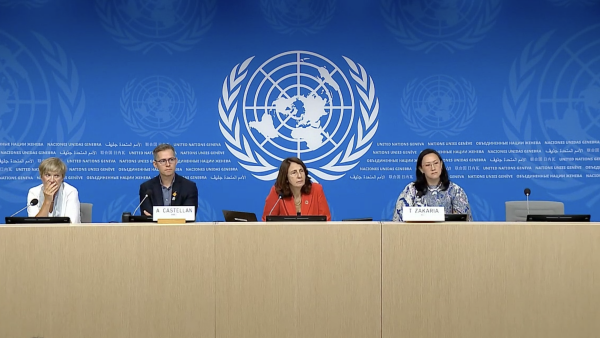
UN Geneva Press Briefing - 07 October 2025
United Nations Geneva Press Briefing
7 October 2025
Two years since the 7 October terror attacks
Alessandra Vellucci, Director of the United Nations Information Service at Geneva, read the message of the United Nations Secretary-General, António Guterres, marking two years since 7 October 2023, when Hamas and other Palestinian armed groups launched an abhorrent large-scale terror attack on Israel. The attackers brutally killed more than 1 250 Israelis and foreign nationals, recalled the Secretary-General. More than 250 others were abducted and taken into the Gaza Strip as hostages, including women, children and the elderly. On this day, the Secretary-General called everyone to remember all those who were killed and suffered horrific violence.
Two years later, hostages remain captive in Gaza in deplorable conditions. The Secretary-General said he had met with hostage families and survivors, who shared their unbearable pain. He had said it time and again and repeated it today with even greater urgency: release the hostages, unconditionally and immediately; end the suffering for all - this was a humanitarian catastrophe on a scale that defied comprehension; put an end to the hostilities in Gaza, Israel and the region now; stop making civilians pay with their lives and their futures.
After two years of trauma, we must choose hope, the Secretary-General said. The recent proposal by US President Donald J. Trump presented an opportunity that must be seized to bring this tragic conflict to an end. A permanent ceasefire and a credible political process were essential to prevent further bloodshed and pave the way for peace. International law must be respected. The United Nations remained unwavering in its commitment to support peace.
On this solemn anniversary, the Secretary-General urged all to honour the memory of all the victims by working for the only path forward: a just and lasting peace, in which Israelis, Palestinians, and all the peoples of the region live side by side in security, dignity and mutual respect.
Jens Laerke, Spokesperson for the Office for the Coordination of Humanitarian Affairs, read a statement on behalf of Tom Fletcher, Under-Secretary-General for Humanitarian Affairs and Emergency Relief Coordinator, saying two years on since Hamas and other armed groups carried out those abhorrent attacks in Israel, the pain was indescribable. The Under-Secretary-General renewed his call for the unconditional and immediate release of all the hostages - and until then, they must be treated humanely. Civilians everywhere had to be protected.
Tens of thousands of Palestinians had been killed. Hundreds of thousands endured starvation and displacement. USG Fletcher renewed the call for an immediate ceasefire in Gaza, for all civilians to be protected, and for humanitarian aid to flow freely at the scale needed. There was now a glimmer of hope that this could happen, and it had to be kept alive, Mr Fletcher’s statement concluded.
Mr Laerke added that regarding fatalities and hostages, the information was that as of 1 October, 48 hostages remained, and that included persons who were known or assessed as having been killed. The number of persons killed in Gaza was 66 288, of whom 18 430 were children. About 400 Palestinians had died of malnutrition. Humanitarian aid must flow freely and at the scale needed. Over the past two years, more than 8 000 coordinated mission and movement requests had been made, of which over more than a quarter had been denied and a combined 45% denied or impeded - either not allowed to start or held up, delayed, or forced to return when already on the road. 10% of requests put in had been withdrawn, usually as the situation changed, and 45% - less than half - had been facilitated by the Israeli authorities and reached their intended target.
Ricardo Pires, Deputy Spokesperson for UNICEF, said on this date were remembered those who had been killed or suffered unspeakable violence when Hamas launched its brutal attack. Many women and children had been taken or killed. UNICEF called for them to be released and condemned all such acts of violence, but also today called for Israel to stop the indiscriminate killing of children across the Gaza Strip. A staggering 61 000 children had been reportedly killed or maimed following Israel’s disproportionate response, which was still ongoing. This was one child every 17 minutes, which was unacceptable. Children had been suffering unimaginably, orphaned, displaced, and exposed to unprecedented disease and violence. Israel must cease the violence; there must be a ceasefire. The US proposal gave hope that there was a promise of a better future ahead, but the violence continued, with strikes and children dying. Children needed ventilators and incubators, and the requests to bring them in Gaza had been denied day in and day out. The horrors of 7 October could never be forgotten, but violence against children could never be condoned. These horrors needed to end, and needed to end now.
Alessandra Vellucci, reading the statement of Philippe Lazzarini, Commissioner-General of UNRWA on X (formerly Twitter), said that grief, suffering, deep and immense pain: this was the reality for far too many people since 7 October 2023. In Gaza for two long years, people have known nothing but destruction, displacement, bombardment, fear, death and hunger. He called once again for: the release of all hostages and Palestinian detainees; an immediate ceasefire; the unfettered delivery of basic humanitarian supplies – at scale- to Gaza, including through UNRWA; and for accountability and justice to hold all those accountable for atrocities committed on and after 7 October. There was no other way out of this abyss and mayhem, Mr Lazzarini’s statement concluded.
In response to a number of questions regarding the babies in Gaza who were having to share oxygen masks and incubators, Mr Pires said that in the north, there were over 20 babies in incubators as they were born prematurely, as one in five children was now born prematurely in Gaza. UNICEF had not managed to move these ventilators and incubators where needed, as it had been denied access, but it was still hoping that it would occur. He understood that the babies had been moved temporarily to an area where they could access the care required; however, the infrastructure was insufficient, and they were having to share incubators, and they were still in a combat zone in the north part of Gaza. The reason given by the authorities for not giving green light to move incubators and children was because of safety and military operations that were happening on the ground.
Responding to a question on whether the United Nations was still not part of the American peace plan, Mr Laerke said the United Nations was not part of drafting the plan, it was, however, part of the plan, and was mentioned within it. He underlined that the United Nations had its own plan to bring aid in Gaza, which was mostly logistics, but required a number of things, particularly from the Israeli side, before it could happen. It needed direct access routes to be opened, and life-saving items to not be banned.
Answering a question on recent reports that there had been some improvements, Mr Laerke said that when looking at the baseline situation, any aid that could get in, particularly food, was a good development. Of course these were positive developments, but they were not necessarily an indication of any major breakthrough in the provision of aid.
Mr Pires, answering a question on the number of children killed in Palestine since October 2023, said the Ministry of Health reported 20 000 children having been killed in Gaza since that date. Mr Laerke also noted that 998 Palestinians had been killed in the West Bank, of which 212 were children.
Responding to a question on how many people suffering from acute malnutrition were now fighting for their lives, and how many were children, Mr Laerke clarified that, since 7 October 2023, 400 Palestinians had died of malnutrition, of which one quarter (101) were children, 80 of whom were under 5 years old. Mr Pires said it was very difficult to keep track of the number of children suffering from acute malnutrition, as assessments were extremely difficult due to the situation on the terrain. Most indicators were worsening, and famine was extending.
Answering questions from the journalists, Christian Lindmeier, speaking for the World Health Organisation (WHO), said over half a million people were trapped in the famine in Gaza, with 640 000 people facing catastrophic levels of food insecurity. 1 050 children had been admitted or were under treatment at WHO stabilisation centres since March 2024, of which roughly half, or 594, were admitted in 2025. These official figures came from hospitals and clinics, but many people were unable to reach these health centres; thus the estimates were much lower than the actual situation. Over the last two months alone, 10 000 children had been diagnosed with acute malnutrition, and there was an acute risk that many could starve to death.
Responding to further questions, Mr Lindmeier said 14 out of 36 hospitals were partially functioning, with zero functioning in the north of Gaza, and 8 functioning in Gaza City. Most of the doctors had left due to fear for their lives. 10 out of 16 field hospitals were still partially functioning, and 62 of 76 health care centres were also partially functioning. Mr Pires, for UNICEF, added that the quantity of therapeutic feeding that was getting through was far from enough; children were suffering, their conditions worsening. When there was a ceasefire in early spring, the United Nations could bring in medicines and supplies; then a complete blockade came, malnutrition kicked in, and slowly the deaths from hunger increased. Malnutrition was difficult to define as cause of death – the latter could be due to a disease, but it was because the body was too weak to fight it off. There was now some food and medicine going in, but not enough had been brought in on a single day.
Responding to a question on the American peace plan, Ms Vellucci, for UNIS, said diplomatic efforts had to be made to reach an immediate cease-fire and to end the sufferings of the civilian population. The United Nations was in contact with all parties, and was calling for a ceasefire, the entry of humanitarian aid, and the freeing of the hostages. The Secretary-General had spoken of the US initiative as an opportunity to seize. A permanent ceasefire was essential to pave the way for peace; international law had to be respected.
Northern Mozambique
Xavier Creach, UNHCR Representative in Mozambique, said he was speaking from Pemba, with a deteriorating context and a humanitarian impact, with a newly-displaced population of 22 000 people. The intensity of the conflict was higher than in previous years, with extraordinary levels of human suffering.
Civilians were no longer collateral victims of the conflict, but direct targets, with children, as ever, the most affected, with accounts of forced recruitment and deliberate attacks by non-state armed groups. Women and girls were particularly exposed to domestic and sexual violence, especially when collecting water or firewood far from displacement sites. People with disabilities and elderly people had struggled to flee during attacks, and some had been left behind.
Resources were critically lacking, with a significant shortfall in funding: 22 humanitarian agencies had had to close shop and leave the province in 2025. This was a turning point: civilian populations were not any more traumatised or afraid, but were losing faith, and were saying they would not return, as 91% had already been displaced several times. Thousands of families have been displaced for years, rebuilding homes only to lose them again.
This was an invisible crisis, and UNHCR called on the international community to renew its support for Mozambique.
IPU Assembly
Thomas Fitzsimons, Director of Communications, Inter-Parliamentary Union (IPU), said Geneva would once again be the capital of global parliamentary diplomacy and dialogue from the 19th to the 23rd of October for the 151st IPU Assembly, which would take place at the International Conference Center, with some 120 countries expected to be represented, with hundreds of parliamentarians and experts addressing the theme Upholding Humanitarian Norms and Supporting Humanitarian Action in Times of Crisis. Peace and security would also be very much at the forefront of discussions between the parliamentarians, especially through dedicated mediation bodies, including the IPU Task Force for the Peaceful Resolution of the War in Ukraine and the IPU Committee on Middle East Questions, which also included representatives from Israel and from Palestine.
The IPU would also grow with the accession of the Brunei Parliament, which would be welcomed as the 182nd member Parliament. The winner of the 2025 Cremer-Passy Prize would also be announced - the MP (Member of Parliament) of the Year Award - which this year would be honouring a parliamentarian who showed exceptional leadership when it came to gender equality, which is the IPU theme of the year.
Responding to a question on what the IPU could do to help countries like France, which had discord in their parliament, to iron out differences, Mr Fitzsimons said the IPU would not intervene in any national situation. Its message was that Parliaments needed to be strong and representative, including women, different communities and generations: the more inclusive a parliament, the stronger the democracy and the better it could deliver for the population. The IPU would offer support and capacity-building, and facilitate meetings between parliamentarians around the world.
Yemen
Responding to questions regarding the United Nations staff arbitrarily detained in Yemen, Ms Vellucci said the Secretary-General’s spokesperson had sent out a statement overnight on additional United Nations personnel detained by Houthi de facto authorities in Yemen. On 15 September the Under-Secretary-General for Humanitarian Affairs and Relief Coordinator Tom Fletcher had informed the UN Security Council of 44 staff detained. Most recently, the de facto authorities had detained an additional 9 United Nations personnel, bringing the total number of United Nations staff arbitrarily detained to 53 since 2021. This was an evolving situation - the Houthi operations were ongoing, and the numbers changed all the time. In the areas controlled by the de facto Houthi authorities, all United Nations operations and agencies were impacted, and those with a larger footprint were impacted to a greater extent. It was very difficult to convey a lasting picture.
The United Nations and the Secretary-General were extremely concerned for the safety of staff, and would continue to work through all available channels to obtain the freedom of the staff, and to ensure that this did not happen again. Since last year’s detentions, the United Nations had restricted its operations in Houthi-controlled areas to life-saving assistance only. The Secretary-General had also taken the decision to suspend all operations in Saada governorate. All the detained staff were Yemenis. UN staff never had to live in fear of future actions by the de facto authorities. Their job was to support their fellow citizens, save lives, and provide life-saving assistance. They should never be penalised for that or live in fear. The United Nations was continuing to work relentlessly, using all available channels, both in and outside Yemen, to secure the release of all UN arbitrarily detained personnel, as well as the return of assets and property.
Announcements
Alessandra Vellucci, speaking for the Information Service, said the Human Rights Council would conclude its sixtieth regularly scheduled session tomorrow, on 8 October.
The UN Economic Commission for Europe would be holding a press conference on 8 October at 9 am on the upcoming Ministerial Meeting on Housing Affordability and Sustainability. Speakers would include Tatiana Molcean, United Nations Under-Secretary-General, UNECE Executive Secretary; Martin Tschirren, State Secretary, Director-General of the Federal Office for Housing, Switzerland, Chair of the Ministerial Meeting; Željko Uhlir, Secretary of State, Ministry of Physical Planning, Construction and State Assets, Croatia; and Susan Aitken, Leader (Mayor), Glasgow City Council, United Kingdom, and Chair of the United Nations Forum of Mayors.
Next week, Monday, 13 October at 2:30 p.m., UN Trade and Development (UNCTAD) would present its upcoming quadrennial conference, “UNCTAD 16 -Shaping the future: Driving economic transformation for equitable, inclusive and sustainable development” to be held on 20-23 October 2025 at the Palais des Nations. The speaker at the press conference would be Rebeca Grynspan, Secretary-General of UNCTAD.
***
ANNOUNCEMENTS
IPU Thomas Fitzsimons (PR) -- 151st IPU Assembly which will take place in Geneva from 19 to 23 October
UNIS: The Human Rights Council will close its 60th session tomorrow
TOPICS
OCHA Jens Laerke (PR) -- Statement on Gaza by Tom Fletcher
UNHCR Eujin Byun (PR) with Xavier Creach, UNHCR Representative in Mozambique (From Pemba)-- UNHCR: Violence flares anew in northern Mozambique, forcing 22,000 to flee in a week
Similar Stories
1
1
1
Statements , Press Conferences | OHCHR
1
1
1
Press Conferences | UNHCR , UNICEF , IFRC , OHCHR , UN WOMEN , IOM , OCHA , WHO
UNHCR – ExCom Meeting, UNICEF – Nepal Recovery, IFRC – Flash Floods, WHO – Mental Health, IOM – South Sudan Floods, OCHA – DRC Humanitarian aid, UNHCR – Sahel Displacement, UNICEF – Yemen Update, IOM – Gaza Shelter, UN Women – Gaza Women, OHCHR – Arrests and detentions of Syrians by Israeli force
2
1
2
Press Conferences | UNCTAD
Presentation of the Trade and Developement Report 2026
Embargoed until 9 October 2026 at 11 a.m. (Geneva Time)
UNCTAD: UNCTAD’s flagship report finds that governments increasingly use industrial, trade, financial and technology policies to pursue economic and national security objectives. Market access and the ability to move into higher-value activities now depend more heavily on technology, finance and geopolitics.
1
1
1
Press Conferences | UPU
Release of the State of the Postal Sector Report 2026
1
1
1
Press Conferences | IOM , ITU , UNECE , UNICEF , WHO , WMO
UNICEF: Ebola, DRC - children orphans or separating them from parents and caregivers; IOM: Humanitarian needs in Djibouti amid arrivals from Yemen and increased migrant movements; WHO: Darfur, scale of health needs far exceeds available resources; WMO co-sponsored Global Heat Forum, Bangkok, monthly Global Seasonal Climate Update; UNECE: UN Forum of Mayors; ITU Plenipotentiary Conference 2026; WHO: child and adolescent obesity guidelines and new global roadmap to tackle pregnancy hypertension, a leading cause of maternal mortality
1
1
1
Press Conferences | OCHA , UN WOMEN , UNHCR , WFP , WHO , WTO , UNEP
OCHA – $160M CERF allocation to 12 underfunded crises; UNHCR – 5.8M refugee children remain out of school amid funding cuts; UN Women – Middle East escalation and food security among women/girls; WHO – Gaza supplies and overall situation; WFP – Yemen food insecurity and impact on global hunger ; UNEP - First International Conference of the Global Framework on Chemicals in Geneva | 16-20 November 2026
1
1
1
Press Conferences | UNHCR , WHO
Yemen's health system nears collapse amid conflict, causing rising casualties and medicine shortages.
1
1
1
Press Conferences | HRC
Update by the Expert Mechanism to Advance Racial Justice and Equality in Law Enforcement
1
1
1
Press Conferences | WIPO , WHO , UNICEF , UNHCR , IOM , WFP , FAO
WIPO Global Innovation Index 2026 launch and press conference, WHO Composition of influenza vaccines for the 2027 Southern Hemisphere flu season, UNICEF Yemen hunger and malnutrition; UNHCR Sudan displacement into Chad; IOM Ebola and population movements in DRC; WFP emergency food assistance in Nepal; and FAO food loss and waste.
2
1
2
Press Conferences | UNCTAD
Gaza reconstruction needs reach $71.5 billion as Palestinian economy and public finances face severe strain. Latest UNCTAD report documents the loss of decades of development gains, economic collapse in Gaza and tightening economic constraints in the West Bank.
The report identifies three immediate priorities: transferring withheld Palestinian revenues, safeguarding the banking system and aligning reconstruction support with the documented scale of damage and economic losses.
1
1
1
Press Conferences | HRC
Press conference on the situation of human rights in Nicaragua by the UN Group of Human Rights Experts
1
1
1
Press Conferences | ITU , UNHCR , WHO , WMO
YEMEN - UNHCR: Escalating conflict in Yemen could fuel more displacement, refugee movement
CLIMATE - WHO / WMO: Health and Climate impact of El Niño