

The United Nations Office at Geneva
Multimedia Newsroom
UN GENEVA PRESS BRIEFING
26 September 2025
Current progress of the food and agriculture related Sustainable Development Goal (SDG) indicators
Jose Rosero Moncayo, Food and Agriculture (FAO) Chief Statistician and Director of the Statistics Division, said the FAO had released the latest edition of its biennial report, "Tracking progress on food and agriculture-related SDG indicators" which focused on progress made so far on the food and agriculture-related SDG targets. The findings presented in the report were troubling; only around one third of the 22 indicators under FAO custodianship had registered some improvement, and the world was close to achieving only one-quarter of the relevant targets, while another quarter remained far from completion.
The report highlighted that global food insecurity remained far above the 2015 level: around 28 percent of the global population were moderately or severely food insecure in 2024 compared to 21.4 percent in 2015, while an estimated 8.2 percent of the global population may have faced hunger. Between 2019 and 2023, only 65 percent of women of childbearing age achieved minimum dietary diversity, with the figure having deteriorated since 2015. Water stress was a major problem in certain regions, with Western Asia and Northern Africa grappling with severe water scarcity.
Given the results, efforts needed to be doubled to achieve food security, and improve nutrition and sustainable agriculture, while ensuring the sustainability of the natural resource base. With five years until the end of the 2030 sustainable development agenda, there continued to be calls to increase investment in data, which remained a key challenge. FAO was committed to making all efforts to rescue the SDGs and deliver on their collective promises for people and the planet.
More figures and information can be found here.
Responding to questions, from the media, Jose Rosero Moncayo, Food and Agriculture (FAO) Chief Statistician and Director of the Statistics Division, said FAO collected data from different sources, but gave prominence to data from country members. There were deeper indicators to measure food insecurity and hunger, including two SDG indicators: the prevalence of undernourishment; and food insecurity in levels beyond hunger. The organization received figures from countries on the volumes of food trade, levels of food stocks and the amount of food required to feed the population, as well as how readily people could access food. FAO also worked with all countries to introduce these types of questions into their household surveys.
Mr. Rosero Moncayo said food insecurity could be imagined on a scale, with different levels of food insecurity. The most severe case was hunger, when people did not have access to sufficient food to live a healthy life. However, even if a population was not suffering from hunger, there could still be issues for people to access food, resulting in them reducing the quality and quantity of their food. This was known as moderate food insecurity.
Responding to an additional question, regarding FAO’s input into the Integrated Food Security Phase Classification (IPC), Mr. Rosero Moncayo said the indicators around the SDGs measured one type of food insecurity, “chronic food insecurity”, while IPC measured a different type of food insecurity called “acute food insecurity”, related to emergencies. These were two different concepts. There were specific reports which covered food insecurity, including the IPC report, as well as the Global Report on Food Crisis.
Responding to a question on the situation of Mexico, Mr. Rosero Moncayo said the report contained information at a global, regional and country level. Information specific to Mexico could be found in the report.
Building Bridges Conferences
Following a request from the media, the information about the Building Bridges Conference taking place from 30 September to 2 October in Geneva can be found here.
Health Situation in Gaza
Responding to a question from the media on the situation of health in Gaza City and north Gaza, Tarik Jasarevic, for the World Health Organization (WHO), said there were displacement orders in place which had affected hundreds of health facilities. Since September 1, four hospitals in Gaza city and north Gaza had been shut down, bringing the total number of functioning hospitals in Gaza to 14, none of which were functioning at full capacity. The four hospitals that were rendered out of service were Al Rantisi Children's Hospital, Ophthalmic Hospital, and St. John Eye Hospital in Gaza city, and Hamad Hospital for Rehabilitation and Prosthetics in North Gaza. Hamad Hospital was one of the main three specialized rehabilitation facilities in the Gaza Strip, which was serving 250 outpatients
Between 7 and 17 September, 12 attacks on health had been reported, with the majority in Gaza City. More violence only meant more casualties, deaths and less access. There were shortages of medical supplies, and issues of access for humanitarians, health workers and for patients. 50,000 people needed to be evacuated for medical reasons, and this was happening very slowly. WHO continued to appeal for a ceasefire and for unhindered access to support what was left of the Gaza health care system.
Responding to an additional question, Mr. Jasarevic said he would provide an update on the available rehabilitation services in Gaza, as well as the needs.
Announcements
Michele Zaccheo, Chief of the Radio, TV and Webcast Section at the United Nations Information Service in Geneva, said today was the International Day for the Total Elimination of Nuclear Weapons, marked by a high-level meeting at 10am in New York, as part of the General Assembly Week. The meeting would begin with an opening statement by Annalena Baerbock, the President of the General Assembly, as well as a statement from the United Nations Secretary-General which would be sent to the media. In addition to day four of the general debate at the General Assembly, the Security Council would resume its high level, open debate on artificial intelligence, which began yesterday. Yesterday, the Secretary-General had spoken at the meeting of G20 foreign ministers, where he noted that “when violence erupts, capital flees, services collapse and poverty deepens. And when development falters, social contracts free, institutions weaken and instability follows, and climate change intensifies the pressure at every turn.”
Mr. Zaccheo also said the Committee on Economic, Social and Cultural Rights would conclude its 78th session this afternoon at 5.30pm today and issue its concluding observations on the six countries whose reports had been reviewed during the session: Russian Federation, Colombia, Chile, the Netherlands, Zimbabwe and Lao People’s Democratic Republic.
The Committee on Enforced Disappearances, whose 29th session was taking place from 22 September until 2 October, would review the report of Sri Lanka today.
***
Similar Stories

1
1
1
Press Conferences | IOM , UNDRR
UN stresses importance of household preparedness for disaster risk reduction.
1
1
1
Statements , Press Conferences | OHCHR
1
1
1
Press Conferences | UNHCR , UNICEF , IFRC , OHCHR , UN WOMEN , IOM , OCHA , WHO
UNHCR – ExCom Meeting, UNICEF – Nepal Recovery, IFRC – Flash Floods, WHO – Mental Health, IOM – South Sudan Floods, OCHA – DRC Humanitarian aid, UNHCR – Sahel Displacement, UNICEF – Yemen Update, IOM – Gaza Shelter, UN Women – Gaza Women, OHCHR – Arrests and detentions of Syrians by Israeli force
2
1
2
Press Conferences | UNCTAD
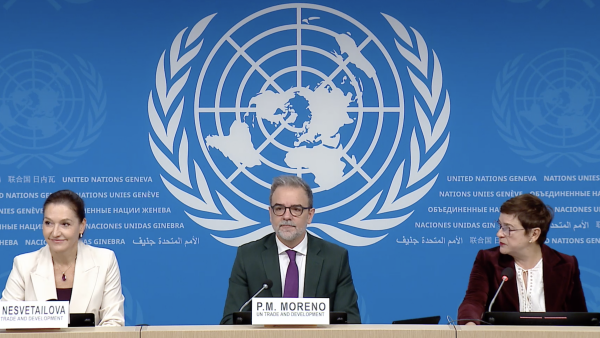
Presentation of the Trade and Developement Report 2026
Embargoed until 9 October 2026 at 11 a.m. (Geneva Time)
UNCTAD: UNCTAD’s flagship report finds that governments increasingly use industrial, trade, financial and technology policies to pursue economic and national security objectives. Market access and the ability to move into higher-value activities now depend more heavily on technology, finance and geopolitics.
1
1
1
Press Conferences | UPU
Release of the State of the Postal Sector Report 2026
1
1
1
Press Conferences | IOM , ITU , UNECE , UNICEF , WHO , WMO
UNICEF: Ebola, DRC - children orphans or separating them from parents and caregivers; IOM: Humanitarian needs in Djibouti amid arrivals from Yemen and increased migrant movements; WHO: Darfur, scale of health needs far exceeds available resources; WMO co-sponsored Global Heat Forum, Bangkok, monthly Global Seasonal Climate Update; UNECE: UN Forum of Mayors; ITU Plenipotentiary Conference 2026; WHO: child and adolescent obesity guidelines and new global roadmap to tackle pregnancy hypertension, a leading cause of maternal mortality
1
1
1
Press Conferences | OCHA , UN WOMEN , UNHCR , WFP , WHO , WTO , UNEP
OCHA – $160M CERF allocation to 12 underfunded crises; UNHCR – 5.8M refugee children remain out of school amid funding cuts; UN Women – Middle East escalation and food security among women/girls; WHO – Gaza supplies and overall situation; WFP – Yemen food insecurity and impact on global hunger ; UNEP - First International Conference of the Global Framework on Chemicals in Geneva | 16-20 November 2026
1
1
1
Press Conferences | UNHCR , WHO
Yemen's health system nears collapse amid conflict, causing rising casualties and medicine shortages.
1
1
1
Press Conferences | HRC
Update by the Expert Mechanism to Advance Racial Justice and Equality in Law Enforcement
1
1
1
Press Conferences | WIPO , WHO , UNICEF , UNHCR , IOM , WFP , FAO
WIPO Global Innovation Index 2026 launch and press conference, WHO Composition of influenza vaccines for the 2027 Southern Hemisphere flu season, UNICEF Yemen hunger and malnutrition; UNHCR Sudan displacement into Chad; IOM Ebola and population movements in DRC; WFP emergency food assistance in Nepal; and FAO food loss and waste.
2
1
2
Press Conferences | UNCTAD
Gaza reconstruction needs reach $71.5 billion as Palestinian economy and public finances face severe strain. Latest UNCTAD report documents the loss of decades of development gains, economic collapse in Gaza and tightening economic constraints in the West Bank.
The report identifies three immediate priorities: transferring withheld Palestinian revenues, safeguarding the banking system and aligning reconstruction support with the documented scale of damage and economic losses.
1
1
1
Press Conferences | HRC
Press conference on the situation of human rights in Nicaragua by the UN Group of Human Rights Experts