

The United Nations Office at Geneva
Multimedia Newsroom
UN GENEVA PRESS BRIEFING
16 September 2025
Worsening malnutrition and near collapse of all services in Gaza City
Tess Ingram, for the United Nations Children’s Fund (UNICEF), speaking from Al Mawasi in Gaza, reported that she was witnessing forced massive displacement of families from Gaza City, which was a deadly threat for the most vulnerable people. It was inhumane to expect half a million traumatized children to flee one hellscape just to end up in another. She spoke of meeting a family with small children walking for hours, some of them without shoes, and not knowing where they would end up. These people were being pushed to a so-called “humanitarian zone”, a sea of makeshift tents, insufficient services, and human misery. Meanwhile, as UNICEF had already warned, child malnutrition in Gaza was spiraling; some 26,000 children in Gaza currently required treatment for acute malnutrition today, of them 10,000 in Gaza City alone. In August, one out of eight children screened in Gaza had been malnourished – the highest level ever recorded; in Gaza City, this ratio had been one out of five. While needs continued to grow, basic services were continued to collapse. UNICEF was there to keep helping, but it was becoming more and more difficult with every bombardment and every displacement. Ms. Ingram appealed to those with the power to act to finally do so, as it had been known for a long-time what needed to be done.
Responding to a question from the media, Ms. Ingram said that the numbers of displaced people had definitely increased in recent days. There had been an almost one million people in Gaza City on 14 August, at the start of the escalation. Since then, over 150,000 people were recorded to have moved to the south. People in Gaza City had no good options – stay in danger, move to another part of the City, or flee to other areas of Gaza Strip, which were also unsafe. Some families were even returning to Gaza City after doing a reconnaissance mission and realizing that there was nowhere safe for them to go.
Overlapping crises in Afghanistan
Mihyung Park, Chief of Mission of the International Organization for Migration (IOM) in Afghanistan, said that about half of Afghanistan’s 49 million people had already depended on humanitarian assistance in recent years. On the top of such dire situation, the country was being shaken by a triple crisis. Firstly, this year alone, two million people had been forcibly returned from Pakistan and Iran, with another million expected within a year. The scale of the return was massive, with three million people already forcibly returned in previous years, and the conditions were dire. Majority of returnees had been living abroad for a long time, they had no financial resources, and they did not own any land in Afghanistan. An estimated five million people had been returned to Afghanistan by now, or ten percent of the population. Secondly, Afghanistan had been very heavily hit by the climate crisis, which was particularly manifesting through consecutive droughts. That, in turn, was pushing people from rural to urban areas to look for jobs. According to IOM assessments, every year, some 700,000 to 900,000 new internal displacements happened due to natural disasters. The recent earthquake near the Pakistan border had affected the region which had already had a high percentage of recent returnees and IDPs. The third crisis was the funding crisis, which forced people into negative copying mechanisms, such as child labour, early marriage, indebtedness, and risky, irregular migration. With the competing crises in the world, Ms. Park appealed to the international community not to forget Afghanistan, especially the women and girls there.
Alessandra Vellucci, for the United Nations Information Service (UNIS), informed that on 17 September, the Secretary-General’s Special Representative for Afghanistan Roza Otunbayeva and the High Commissioner for Human Rights Volker Türk, and a civil sector representative would brief the Security Council on the situation in Afghanistan.
Ms. Park, replying to questions, said that the UN community in Afghanistan would not replace its female staff with male staff, and it would continue to provide support to its female employees. Right now, IOM’s female staff were working from home with the logistical support to make sure they could continue to work. Negotiations were continuing with the de facto authorities to make it possible for them to return to offices and the field.
Announcements
Alessandra Vellucci, for the United Nations Information Service (UNIS), informed that today at 12 noon Geneva time, the Secretary-General would hold his regular pre-General Assembly press briefing in New York.
On 17 September at 2 pm, Alena Douhan, UN Special Rapporteur on the negative impact of unilateral coercive measures on the enjoyment of human rights, would hold a press conference on impact of unilateral coercive measures on economic, labour and social rights.
On 18 September at 11:30 am, the World Meteorological Organization (WMO) would present its State of Global Water Resources Report 2024. Speakers would be WMO Secretary-General Celeste Saulo; WMO Director of Hydrology, Water and Cryosphere Division Stefan Uhlenbrook; and Sulagna Mishra, WMO Scientific Officer.
On 22 September at 9:30 am, Mariana Katzarova, UN Special Rapporteur on the situation of human rights in the Russian Federation, would present her latest findings.
On 22 September at 1 pm, the Independent International Fact-Finding Mission on the Bolivarian Republic of Venezuela would hold a press conference its latest report to the Human Rights Council.
The Committee on Economic, Social and Cultural Rights was concluding this morning the review of the report of Chile. It would begin this afternoon the review of the report of the Netherlands.
***
ANNOUNCEMENTS
- UNIS on behalf of OSE: The UN Special Envoy for Syria will brief the Security Council at 10a New York/4pm Geneva on Thursday. His remarks will be distributed after.
TOPICS
- UNICEF Ricardo Pires with Tess Ingram, UNICEF Communication Manager for North Africa and the Middle East (From Al Mawasi): Worsening malnutrition and displacement crisis amid ongoing military escalation and nearly collapse of lifesaving services in Gaza City
- IOM Kennedy Omondi with Park Mihyung, IOM Chief of Mission, Afghanistan: The overlapping crises in Afghanistan
Similar Stories

1
1
1
Statements , Press Conferences | OHCHR
1
1
1
Press Conferences | UNHCR , UNICEF , IFRC , OHCHR , UN WOMEN , IOM , OCHA , WHO
UNHCR – ExCom Meeting, UNICEF – Nepal Recovery, IFRC – Flash Floods, WHO – Mental Health, IOM – South Sudan Floods, OCHA – DRC Humanitarian aid, UNHCR – Sahel Displacement, UNICEF – Yemen Update, IOM – Gaza Shelter, UN Women – Gaza Women, OHCHR – Arrests and detentions of Syrians by Israeli force
2
1
2
Press Conferences | UNCTAD
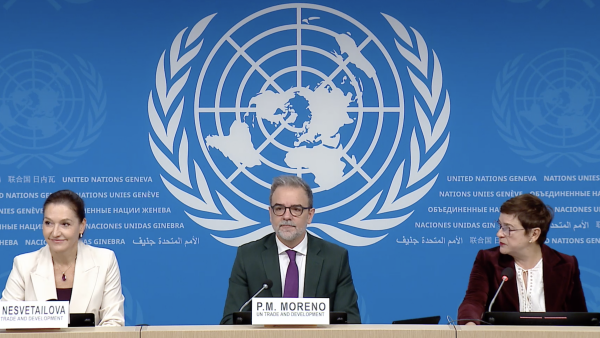
Presentation of the Trade and Developement Report 2026
Embargoed until 9 October 2026 at 11 a.m. (Geneva Time)
UNCTAD: UNCTAD’s flagship report finds that governments increasingly use industrial, trade, financial and technology policies to pursue economic and national security objectives. Market access and the ability to move into higher-value activities now depend more heavily on technology, finance and geopolitics.
1
1
1
Press Conferences | UPU
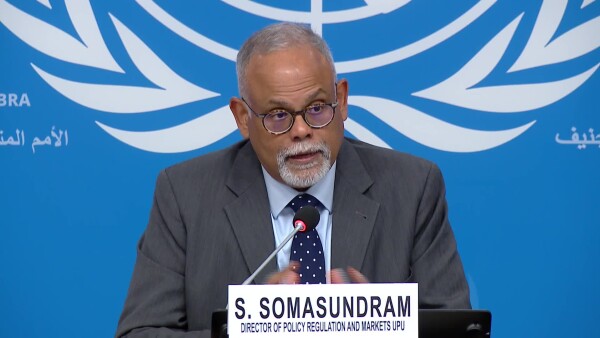
Release of the State of the Postal Sector Report 2026
1
1
1
Press Conferences | IOM , ITU , UNECE , UNICEF , WHO , WMO
UNICEF: Ebola, DRC - children orphans or separating them from parents and caregivers; IOM: Humanitarian needs in Djibouti amid arrivals from Yemen and increased migrant movements; WHO: Darfur, scale of health needs far exceeds available resources; WMO co-sponsored Global Heat Forum, Bangkok, monthly Global Seasonal Climate Update; UNECE: UN Forum of Mayors; ITU Plenipotentiary Conference 2026; WHO: child and adolescent obesity guidelines and new global roadmap to tackle pregnancy hypertension, a leading cause of maternal mortality
1
1
1
Press Conferences | OCHA , UN WOMEN , UNHCR , WFP , WHO , WTO , UNEP
OCHA – $160M CERF allocation to 12 underfunded crises; UNHCR – 5.8M refugee children remain out of school amid funding cuts; UN Women – Middle East escalation and food security among women/girls; WHO – Gaza supplies and overall situation; WFP – Yemen food insecurity and impact on global hunger ; UNEP - First International Conference of the Global Framework on Chemicals in Geneva | 16-20 November 2026
1
1
1
Press Conferences | UNHCR , WHO
Yemen's health system nears collapse amid conflict, causing rising casualties and medicine shortages.
1
1
1
Press Conferences | HRC
Update by the Expert Mechanism to Advance Racial Justice and Equality in Law Enforcement
1
1
1
Press Conferences | WIPO , WHO , UNICEF , UNHCR , IOM , WFP , FAO
WIPO Global Innovation Index 2026 launch and press conference, WHO Composition of influenza vaccines for the 2027 Southern Hemisphere flu season, UNICEF Yemen hunger and malnutrition; UNHCR Sudan displacement into Chad; IOM Ebola and population movements in DRC; WFP emergency food assistance in Nepal; and FAO food loss and waste.
2
1
2
Press Conferences | UNCTAD
Gaza reconstruction needs reach $71.5 billion as Palestinian economy and public finances face severe strain. Latest UNCTAD report documents the loss of decades of development gains, economic collapse in Gaza and tightening economic constraints in the West Bank.
The report identifies three immediate priorities: transferring withheld Palestinian revenues, safeguarding the banking system and aligning reconstruction support with the documented scale of damage and economic losses.
1
1
1
Press Conferences | HRC
Press conference on the situation of human rights in Nicaragua by the UN Group of Human Rights Experts
1
1
1
Press Conferences | ITU , UNHCR , WHO , WMO
YEMEN - UNHCR: Escalating conflict in Yemen could fuel more displacement, refugee movement
CLIMATE - WHO / WMO: Health and Climate impact of El Niño