

The United Nations Office at Geneva
Multimedia Newsroom
UN GENEVA PRESS BRIEFING
28 February 2025
Escalating attacks on education in Haiti
Geetanjali Narayan, United Nations Children’s Fund (UNICEF) Representative in Haiti, said in January this year, armed groups destroyed 47 schools in Haiti’s capital. With 284 schools destroyed in 2024, the relentless attacks on education were accelerating, leaving hundreds of thousands of children without a place to learn. On the back of such attacks, displacement and deepening poverty, UNICEF estimated one in seven children in Haiti were now out of school, with almost one million more at risk of dropping out. Last year, child recruitment into armed groups surged by 70 per cent, with up to half of all armed group members now being children, some as young as eight years old. Without access to education, children were more vulnerable to exploitation and recruitment by armed groups. Education was one of the most effective tools to break the cycle.
Despite systemic challenges, literacy was a highly valued achievement in Haiti, and families took great pride in investing in their children's education. UNICEF was at their side, delivering formal and non-formal education interventions, including by rehabilitating schools damaged during attacks, by setting up temporary learning spaces, and by reintegrating displaced children into schools. UNICEF and partners were conducting catch-up classes to compensate for the time lost during school closures, as well as providing school kits and cash transfers to help families cope with the financial strain, and were coordinating mental health and psychosocial support interventions. UNICEF was asking for US 38 million dollars to ensure 600,000 children could continue their education, despite the crisis. However, such critical interventions were five percent funded. Presently more than half a million children were not getting the education support they needed, not due to armed groups, but a lack of donor support.
Responding to questions from the media, Ms Narayan said the damage experienced by children in armed groups was indescribable. At the age of eight, children’s brains were still forming, and to be part of an armed group where you were surrounded by violence had a profound effect on the child. It also meant children were not in school, and were therefore not exposed to learning or correct socialization, including on how to resolve conflict without violence. In an armed group, children were not with their families, could not access health services, were constantly on the move and were exposed to dangers including from the police and the army. These had incredibly long-lasting impacts on children’s physical, mental and social wellbeing.
Responding to another question, regarding funding cuts by the United States, Ms. Narayan said the United States had been a major supporter of Haiti and of UNICEF’s work in Haiti. The current situation was having a devastating impact on thousands of children in Haiti, with services already being reduced. Activities, including post-natal care could no longer be supported. The impact on a country like Haiti, which was so stricken with poverty and violence, was immediate.
James Elder for the United Nations Children’s Fund (UNICEF), said UNICEF had received termination notices for US grants covering humanitarian and development programming, although some grants had received lifesaving waivers. The organization was assessing the impact on programmes for children, but already the initial pause had impacted millions of children in countries where UNICEF worked. Without urgent action and funding, more children would suffer malnutrition, a lack of education access, and preventable illnesses would claim more lives. The reduction in funding was putting children’s lives at risk in a time when they needed support more than ever. Mr. Elder said UNICEF was working on compiling a list of all programmes which had been affected by the US decisions.
Responding to another question, Ms. Narayan said UNICEF estimated that half a million children were not able to access education and learning due to the armed violence in the country. UNICEF did not have the exact number of children involved in armed groups, but estimated that it was in the hundreds. There were more than 300 armed groups in Haiti and numbers had increased in the past year.
In a response to another question, Ms. Narayan said cholera in Haiti remained an ongoing concern with regular outbreaks. UNICEF and the Government of Haiti worked closely with community and civil society partners to ensure communities could access clean water. In the sites with displaced communities, UNICEF were trucking in clean water and ensuring connection to the municipal water point. Work was also being done with communities on hygiene and hand washing. Ms. Narayan said UNICEF were looking at all options to address this issue, including vaccination against cholera.
Responding to further questions, Ms. Narayan said monitoring showed children were used in different ways by the armed groups. Children between the ages of eight and ten were used as messengers or informers, with younger girls tending to carry out domestic labour. As they got older, children were playing more active roles in participating in acts of violence, including carrying weapons and carrying out killings and attacks. UNICEF were working actively to support the release, demobilization and reintegration of children who had been in armed groups. One of the most important things done last year was a handover protocol signed between UNICEF and the Government of Haiti, which identified the procedures that needed to be in place to ensure a child was treated not as a criminal but as a child. This involved many partners throughout Haiti. UNICEF had been successful in releasing, demobilizing, and reintegrating over 100 children last year and would continue the work this year. This was absolutely critical to the peace and stability in Haiti.
Responding to additional questions, Ms. Narayan said UNICEF participated in monitoring and reporting on violations on grave child rights in Haiti with partners. The information was received from different partners on the ground and was aggregated, based on quantitative and qualitative observations.
Ms. Narayan said gangs received funds from multiple sources, both inside and outside Haiti. Many armed groups controlled populations and territories and this was also where their revenue streams came from, including via looting, pillaging and extortion. There were also bigger regional dynamics, including trafficking, which were contributing to the situation in Haiti.
Alarming findings of a new UNICEF survey that looks at the toll on children
Ettie Higgins, United Nations Children’s Fund (UNICEF) Deputy Representative in Lebanon, speaking from Beirut, shared alarming findings of the new UNICEF survey conducted, in January 2025, after more than a year of war and bombardment. The report exposed the profound toll of war on children in Lebanon. The assessment had revealed a very grim picture of children's nutritional status, particularly in the Baalbek and Beqaa Governorates, which remained densely populated when they were repeatedly targeted by airstrikes last year. In these regions in the east of the country, more than half of children under the age of two were experiencing severe food poverty, more than double the number a year ago. Nearly 72 percent of caregivers and their children interviewed were anxious or nervous during the war, while 62 percent said they were depressed or sad.
For background, hostilities in Lebanon had escalated very sharply in September of last year after 11 months of cross-border strikes following the declaration of a ceasefire in November. Over 310 children had been killed and over 1500 wounded. The conflict also compounded Lebanon's challenging education situation. After years of economic strife, teacher strikes and the impact of the Covid pandemic, there were now more than half a million children who were out of school, with 25 percent of children still out of school at the time of the survey. The assessment also showed that nearly 80 percent of the families interviewed urgently needed some form of support.
As the humanitarian situation was worsening, children as young as five were being forced to work and early marriage was increasing. Despite this, UNICEF in Lebanon had seen a decrease in humanitarian funding over the past few years, and currently was only 26 percent funded, and there had also been further aid cuts announced by governments since the launch of the report. More than half a million children and their families risked losing critical subsistence cash support from UN agencies this month, which would leave them unable to afford even the most basic necessities.
Responding to media questions, Ms Higgins clarified that 45 percent of children in the Baalbek and Beqaa Governorates were experiencing food poverty, a large increase from the 2023 data. Many of these children had been forced to shelter in place and had been hard to reach. UNICEF had been forced to suspend, reduce and cutback programmes including the nutrition ones. This included water sanitation, delivery of vaccines and trucking deliveries, as well as education programmes. This was not just because of financial cuts by the United States, but by countries right across the board. Children as young as the age of five were working, due to many families’ desperation. Families were waiting for their monthly cash assistance but were unsure if it would arrive.
Responding to other questions, Ms. Higgins said UNICEF were working on supporting and tracking the number of injured children in the country. The work was conducted with the Ministry of Health and with specialized non-governmental organizations and offered support packages to children with long-term injuries, including burns and loss of limbs, as well as psychosocial support and psychological support. UNICEF were committed to providing support to 1,000 children who needed it. UNICEF had not currently seen injuries from phosphorus but hoped to reconnect water stations which were unsafe to use – and this required massive investment, particularly in the south of the country. UNICEF were doing what they could with the resources available but much more was needed.
Responding to further questions, Ms. Higgins said the report had recently been made public in Lebanon; it contained disaggregated data between Lebanese and Syrian children.
Democratic Republic of Congo
Responding to a question from the media, James Elder for the United Nations Children’s Fund (UNICEF), said he could not compare the Democratic Republic of Congo (DRC) and Haiti in terms of the numbers of children in armed groups. He would revert to journalists with the numbers of child recruitment within M23. It could already be said that the DRC had seen a dramatic rise in cases of sexual violence committed against children, as well as killing and maiming, and he would share these numbers. UNICEF was a stay-and-deliver organization. Funding cuts made it difficult for everyone on the ground, but UNICEF remained in the DRC; they had not left.
WFP forced to pause food distributions in Sudan’s Zamzam camp
Leni Kinzli, World Food Programme (WFP) Communications Officer for Sudan, speaking from Nairobi, said intense fighting in Zamzam camp in Sudan's north Darfur region had forced WFP to temporarily pause the distribution of life saving food and nutrition assistance, and had left partners with no choice but to evacuate their staff safely. The recent violence in Zamzam had also left the central market destroyed meaning that the half a million residents of the camp, were even further away from accessing essential food items and other supplies. Even before this recent spate of violence, the situation in Zamzam was extremely dire and it had been for months. Famine was confirmed last August and people were resorting to extreme measures to be able to survive, including eating peanut shells, grass, leaves, and animal waste. Without immediate assistance, thousands of desperate families in Zamzam could starve in the coming weeks. People, particularly children, were already dying of hunger in Zamzam camp and the fact that WFP were forced to suspend operations would make this worse.
In February, WFP and partners managed to provide 68,000 people with food vouchers,
allowing families to purchase essential food supplies directly from local markets which WFP helped to keep stocked through the local private sector retail network. WFP were continuously finding alternative ways of providing support to communities who were cut off by conflict, and recently launched an online self-registration link to provide cash-based assistance in some remote locations like North Darfur. Through this, people would soon start to receive digital cash transfers via a mobile money app, providing them critical assistance until conditions permitted the safe passage of humanitarian personnel and convoys. WFP needed to resume the delivery of life-saving aid in and around Zamzam safely, quickly and at scale. To do this, the fighting must stop and humanitarian organizations must be granted security guarantees. In 2024, two out of every three people in famine or at risk of famine received WFP assistance. But this was far from enough. Regular monthly deliveries to starving communities were the only way to push back famine in Sudan. Right now, access to the hardest hit areas remained sporadic and inconsistent. Two million people in 27 locations across Sudan were currently experiencing or were on the brink of famine.
Alessandra Vellucci, for the United Nations Information Services (UNIS), said that yesterday, the Resident and Humanitarian Coordinator for Sudan had shared her extreme concerns about the situation in the country. International humanitarian law had to be respected across Sudan. Humanitarian workers and civilians had to be protected.
Responding to questions, Ms. Kinzli said WFP had been working with retailers who were bringing local supplies in Zamzam. To understand what was happening on the ground was very difficult. There were traders on the ground who had been providing assistance to 60,000 people before the intensification of fighting.
Responding to further questions, Ms. Kinzli said there were a total of 27 areas in Sudan, facing or at risk of famine. Beyond that, the scale of the hunger crisis was enormous. the scale of the hunger crisis in Sudan was enormous. 25 million people were facing acute hunger, equivalent to the population of a country like Australia. Sudan was one of the largest hunger crises in the world today. Two weeks ago, the freeze on WFP assistance from US farmers was rescinded, and WFP had been able to resume regular operations under all the existing U.S. aid grants.
Alessandra Vellucci reminded the press that the United Nations was seeking 4.2 billion dollars to deliver life-saving aid to 21 million vulnerable people, and 1.8 billion dollars to support five million people, primarily refugees in neighboring countries.
World Hearing Day and the WHO-ITU Global standard on safe listening for video gameplay and esports
Dr. Shelly Chadha, Technical lead for ear and hearing care at the World Health Organization (WHO), said WHO’s research and analysis revealed that over one billion young people listened to loud sounds through their headphones or in music venues at levels that damaged their ears. While such hearing damage was mostly irreversible, it was also completely avoidable through the adoption of safe listening practices and hearing protection. To promote safe listening practices and change listening behaviors, WHO had developed the “Make Listening Safe initiative”, working to raise awareness about the topic of safe listening practices among adolescents and young adults, and develop technical standards that recommended evidence-based safe listening features for inclusion in smartphones, music players, headphones, music venues such as concerts and clubs. If the volume was too high, people received some notifications from their phone. This information was the outcome of the work that WHO and the International Telecommunications Union (ITU) had already done through its Global standard for safe listening devices and systems.
On the occasion of World Hearing Day, WHO were pleased to launch the latest safe listening standard, in collaboration with the ITU, that targeted video games and their devices. This standard aimed to promote safe listening practices among the nearly three billion people that played video games and to help them avoid hearing damage. Features included a system to track sound allowance and provide individualized messages on sound usage and risk to players. It also recommended safety features, allowing players to adjust levels and mute various sounds within the game, and encouraged video game developers to implement safe listening features that were most relevant to the genre of each game. WHO were providing clear messages on how music lovers and video game players could protect their hearing and called upon governments and manufacturers to heed and implement these standards.
Fifth United Nations Oceans Forum
Catherine Huissoud, for the United Nations Trade and Development (UNCTAD), said on Monday March 3rd, UNCTAD was organizing the fifth United Nations Oceans Forum at the Palais des Nations in Room XIX, which would run until March 5th. The Forum was a collective effort to align trade and economic policies with ocean sustainability and the sustainable use of marine resources. This was an in-person only event.
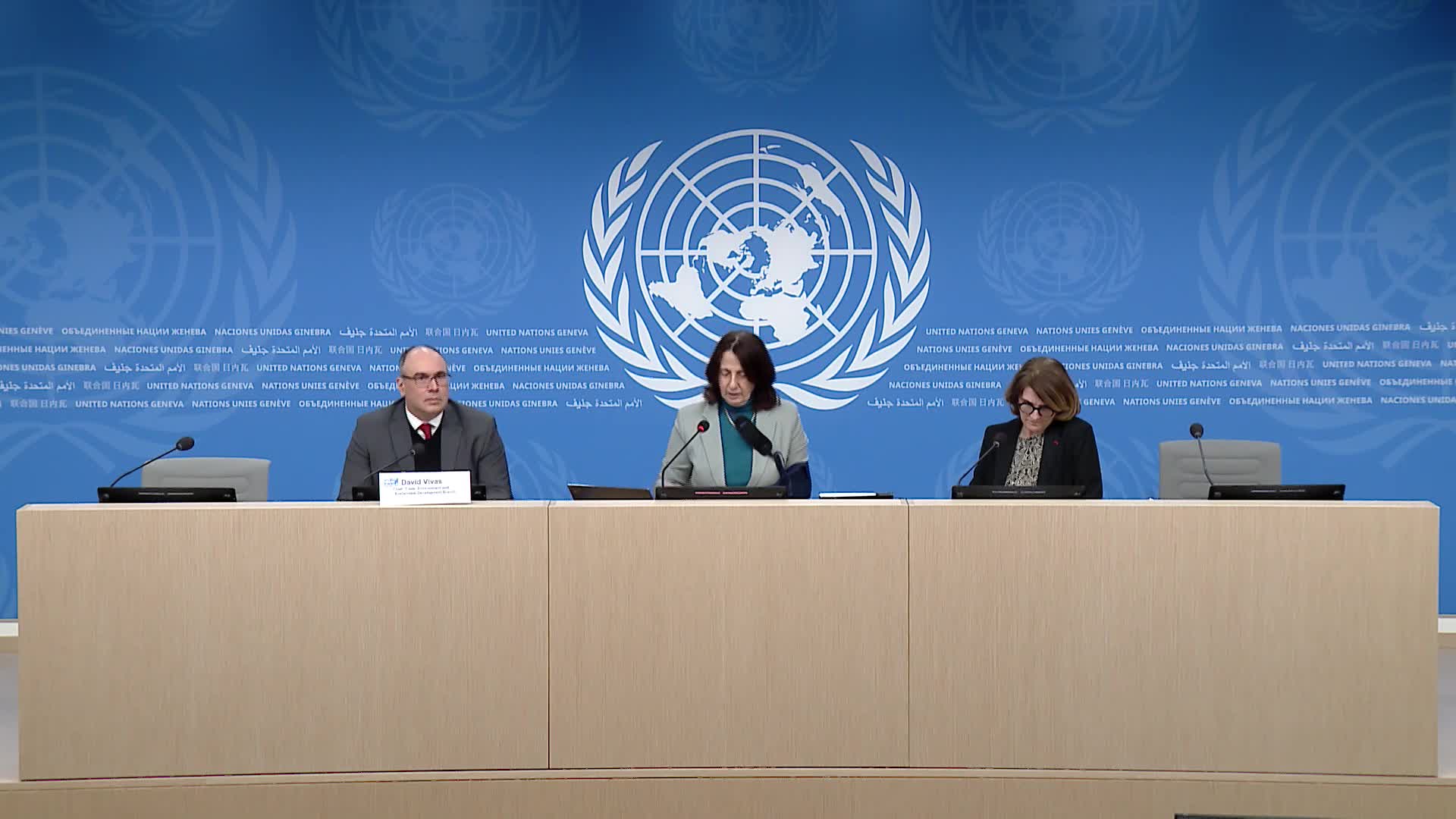
David Vivas, Chief, Trade, Environment and Sustainable Development at the United Nations Trade and Development (UNCTAD), said 2025 was going to be a blue year. Geneva was the highway to the Ocean Conference in Nice. The ocean economy was growing fast, expanding 2.5 times since 1995 compared to 1.9 times for the global economy. Goods and services
South-South trade in fisheries were surging, reaching 40 billion dollars in exports. The ocean was essential to protect the planet from climate impacts, and the contribution of oceans would be essential for mitigation and adaptation under the Paris Agreement in 2025.
While oceans represented 70 per cent of the biosphere only about four billion dollars had been allocated annually, when 175 billion annually was needed. Politicians were not putting their money where their mouth was. A huge part of the planet was invisible in terms of sustainable use and conservation for future generations.
Responding to questions from the media, Mr Vivas clarified that four billion dollars annually was allocated to oceans, which was equivalent to less than one percent of development assistance worldwide. Developed countries and other economies including China were responsible for these contributions. Half a billion dollars was also contributed by philanthropic foundations. Mr. Vivas said the private sector was the biggest financers, as well as non-profit and philanthropic foundations. Of the four billion, 60 percent went to sustainable activities, and some went to other business activities, such as maritime transport.
Announcements
Alessandra Vellucci, for the United Nations Information Service (UNIS), said on Monday, 3 March at 1 p.m., Dr. Alice Jill Edwards, Special Rapporteur on torture and other cruel, inhuman or degrading treatment or punishment, would hold a press conference on “Hostage-taking as torture”, embargoed until 4 March.
On Tuesday, 4 March at 9:45 a.m. IPU would hold a press conference on the “New report on Women in Parliament”, with speakers Martin Chungong, IPU Secretary-General and Mariana Mutzenberg, IPU gender programme.
Finally, on Wednesday, 5 March at 3 p.m. Balakrishnan Rajagopal, UN Special Rapporteur on the right to adequate housing, would hold a press conference on the “Manufactured migration crisis”, which would be embargoed until 7 March at 1 p.m.
Ms. Vellucci also said the Committee on Economic, Social and Cultural Rights would close its 77th session this afternoon, at 5.30pm.
The Human Rights Committee would open its 143rd session next Monday, at 10am, during which it would review the reports of Montenegro, Burkina Faso, Zimbabwe, Mongolia, Albania and Haiti.
The Committee on the Rights of Persons with Disabilities would also open next Monday, its 32nd session 21 March, during which it would review the reports of Tuvalu, Dominican Republic, Viet Nam, Canada, European Union, and Palau.
The Human Rights Council would continue its 58th session, and journalists could ask Pascal for more information.
The International Narcotics Control Board annual report 2024 would be launched on Tuesday, 4th of March at 11:00 a.m. in Vienna, and could be followed online. A media advisory had been distributed.
Finally, Ms. Vellucci said that today at 4:30pm in Geneva, 10.30am in New York, the Secretary-General would give a stakeout in New York, which would be streamed on UN WebTV. The Secretary-General had shared a warm message on the beginning of Ramadan to Muslims around the world.
The Secretary-General would travel to Bangladesh from 13 to 16 March and would go to Cox’s Bazar to join an Iftar and meet with Rohingya refugees who have been forcibly displaced from their homes in Myanmar, and also, of course, with the host Bangladeshi communities who have been generously hosting the refugees from Myanmar. During the trip he would also meet with Professor Muhammad Yunus, the Chief Adviser for the interim government, as well as with young women and men and representatives from civil society.
***
ANNOUNCEMENTS
UNCTAD Catherine Huissoud (PR) with David Vivas, Chief, Trade, Environment and
Sustainable Development Branch
5th United Nations Ocean Forum 3-5 March
TOPICS
UNICEF James Elder (PR) with Geetanjali Narayan, UNICEF Representative in Haiti (PR)
Escalating attacks on education in Haiti
James Elder (PR) with Ettie Higgins, UNICEF deputy representative in Lebanon
(From Beirut)
Alarming findings of a new UNICEF survey that looks at the toll on children
WFP Leni Kinzli, WFP Communications Officer for Sudan (From Nairobi)
WFP forced to pause food distributions in Sudan’s Zamzam camp
WHO Tarik Jašarević (PR) with Dr Shelly Chadha, Technical lead for ear and hearing
care at WHO (PR)
World Hearing Day and the WHO-ITU Global standard on safe listening for video
gameplay and esports
Similar Stories

1
1
1
Press Conferences | UNHCR
End of UNHCR's 77th Annual Executive Committee (ExCom) meeting week

1
1
1
Press Conferences | UNICEF , IOM , UNHCR
UN Special Assistant to the Personal Envoy Office (SUDAN): Peace Initiatives and Efforts in Sudan; UNICEF: Dire situation of children in Gaza; IOM: Damaged Homes and Energy Attacks Risk Displacing Ukrainians for this winter; UNHCR: update on EXCOM week

1
1
1
Press Conferences | IOM , UNDRR
UN stresses importance of household preparedness for disaster risk reduction.

1
1
1
Statements , Press Conferences | OHCHR

1
1
1
Press Conferences | UNHCR , UNICEF , IFRC , OHCHR , UN WOMEN , IOM , OCHA , WHO
UNHCR – ExCom Meeting, UNICEF – Nepal Recovery, IFRC – Flash Floods, WHO – Mental Health, IOM – South Sudan Floods, OCHA – DRC Humanitarian aid, UNHCR – Sahel Displacement, UNICEF – Yemen Update, IOM – Gaza Shelter, UN Women – Gaza Women, OHCHR – Arrests and detentions of Syrians by Israeli force

2
1
2
Press Conferences | UNCTAD
Presentation of the Trade and Developement Report 2026
Embargoed until 9 October 2026 at 11 a.m. (Geneva Time)
UNCTAD: UNCTAD’s flagship report finds that governments increasingly use industrial, trade, financial and technology policies to pursue economic and national security objectives. Market access and the ability to move into higher-value activities now depend more heavily on technology, finance and geopolitics.

1
1
1
Press Conferences | UPU
Release of the State of the Postal Sector Report 2026
1
1
1
Press Conferences | IOM , ITU , UNECE , UNICEF , WHO , WMO
UNICEF: Ebola, DRC - children orphans or separating them from parents and caregivers; IOM: Humanitarian needs in Djibouti amid arrivals from Yemen and increased migrant movements; WHO: Darfur, scale of health needs far exceeds available resources; WMO co-sponsored Global Heat Forum, Bangkok, monthly Global Seasonal Climate Update; UNECE: UN Forum of Mayors; ITU Plenipotentiary Conference 2026; WHO: child and adolescent obesity guidelines and new global roadmap to tackle pregnancy hypertension, a leading cause of maternal mortality
1
1
1
Press Conferences | OCHA , UN WOMEN , UNHCR , WFP , WHO , WTO , UNEP
OCHA – $160M CERF allocation to 12 underfunded crises; UNHCR – 5.8M refugee children remain out of school amid funding cuts; UN Women – Middle East escalation and food security among women/girls; WHO – Gaza supplies and overall situation; WFP – Yemen food insecurity and impact on global hunger ; UNEP - First International Conference of the Global Framework on Chemicals in Geneva | 16-20 November 2026
1
1
1
Press Conferences | UNHCR , WHO
Yemen's health system nears collapse amid conflict, causing rising casualties and medicine shortages.
1
1
1
Press Conferences | HRC
Update by the Expert Mechanism to Advance Racial Justice and Equality in Law Enforcement
1
1
1
Press Conferences | WIPO , WHO , UNICEF , UNHCR , IOM , WFP , FAO
WIPO Global Innovation Index 2026 launch and press conference, WHO Composition of influenza vaccines for the 2027 Southern Hemisphere flu season, UNICEF Yemen hunger and malnutrition; UNHCR Sudan displacement into Chad; IOM Ebola and population movements in DRC; WFP emergency food assistance in Nepal; and FAO food loss and waste.