

The United Nations Office at Geneva
Multimedia Newsroom
Press Conferences | OHCHR , UNHCR , WHO , UNOG , WFP , IOM
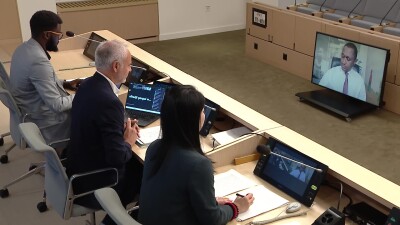
UNOG Bi-weekly press briefing 03 July 2020
Human Rights Council update
Rolando Gomez, for the Human Rights Council (HCR) informed that the Council had continued its discussions with the Special Rapporteur on trafficking in persons, this morning. It would be followed by a presentation of the impact of COVID-19 on the right to education.
Mr. Gomez added that the Council would continue discussions with the Special Representative of the Secretary-General on Children and Armed Conflict, Virginia Gamba. The Special Rapporteur on the right to health would then speak on the issue of mental health and COVID-19. The Council program also provided for discussions on discrimination against women in the world of work and on the rights of migrants.
Launch of a new UNEP report on the root causes of zoonotic diseases, and recommendations for preventing new pandemics
Mark Grassi, for the United Nations Environment Programme (UNEP), announced that on Monday 6 July there would be a new report coming out, titled Preventing the Next Pandemic: Zoonotic diseases and how to break the chain of transmission. The report would look at the root causes of the pandemic: deforestation, agricultural expansion, livestock intensification and habitat degradation were bringing wild animals into closer contact with people, resulting in the spillover of zoonotic diseases. Moreover, the climate crises, namely changes in temperature, humidity or rainfall patterns made it easier for diseases to spread into new areas. The new report would include 10 recommendations for preventing and controlling zoonotic diseases, including the reversal of land degradation, incentives for sustainable land management, and a ‘One Health’ approach, which was where public health, veterinary and environmental expertise combined.
Mr. Grassi added that the report was not only about COVID-19; every year, 2 million people, mostly in low and middle-income countries, died from neglected zoonotic diseases. The report would also document how Africa had dealt with many zoonotic diseases and could use that experience to prevent future outbreaks.
The embargoed report, press release and FAQ should have been received. Mr. Grassi reminded that the report was embargoed until 6 p.m. Geneva time on Monday 6 July and that the UNEP Europe Director was among the people available for interviews.
WHO: Information about the AIDS survey ahead of the International AIDS conference
Tarik Jašarević, for the World Health Organization (WHO), informed that the WHO would hold a press conference next Tuesday, 7 July at 6 p.m. This conference would look into how COVID-19 is impacting services for HIV and related health areas. The speakers would share data on essential service disruptions, supply chain challenges and stock-outs. There would also be findings on the associated risks and on the poor outcomes due to COVID-19 among people living with HIV, with a special focus on South Africa. A media advisory will be sent out.
Impact of COVID-19 on food security in West and Central Africa
Elisabeth Byrs, for the World Food Programme (WFP), said the socio-economic challenges generated by measures aimed at containing the spread of COVID-19 were heavily impacting food security in West and Central Africa. WFP estimated that the number of food insecure people in the region could more than double to 57.6 million by the end of the year.
Border closures and the suspension of weekly and open-air markets in countries across the region had led to reduced regional trade, and prevented farmers from selling their products, sometimes leading to localized food scarcity and increased prices. Price increases of between 15-25 percent were observed in April in the Central African Republic, Chad and Nigeria.
COVID-19 unfolded at the peak of the lean season when hunger and malnutrition were most severe. WFP and UNICEF estimated that 11.6 million children would be acutely malnourished in the region in 2020 due to the impact of the pandemic, an 18 percent increase on pre-COVID levels. WFP was planning on assisting 23 million people in the region with lifesaving food and nutrition support as well as through life-changing resilience and livelihoods projects. That was an 8.9 million increase from the initial plan at the start of the year.
China/Hong Kong SAR [Special Administrative Region] new law
Rupert Colville, for the Office of the United Nations High Commissioner for Human Rights (OHCHR), said the OHCHR was in the process of analyzing the contents of the new national security law for Hong Kong SAR, and its compliance with international human rights obligations. Mr. Colville said the OHCHR was alarmed that arrests were already being made under the law with immediate effect, when there was not full information and understanding of the scope of the offences.
On the basis of a preliminary analysis, the OHCHR was concerned that the definition of some of the offences contained in the law were vague and overly broad. This might lead to discriminatory or arbitrary interpretation and enforcement of the law, which could undermine human rights protection. Mr. Colville added that the OHCHR was also concerned about the provisions governing the offence of "collusion with a foreign country or with external elements to endanger national security" contained in article 29. This might lead to a restriction of civic space and hinder the possibility for civil society actors to exercise their right to participate in public affairs. These provisions could also lead to criminalizing human rights defenders and activists for the exercise of their right to freedom of expression, association and peaceful assembly.
Full statement can be found here
Ethiopia protests
Alessandra Vellucci, Director of the United Nations Information Service, read the 2 July statement of the Spokesman of the Secretary-General, where he said that the Secretary-General continued to follow closely developments in Ethiopia in the wake of the killing of prominent artist Haacaaluu Hundeessaa on 29 June. The Secretary-General extended his condolences to the family of Mr. Haacaaluu and to those who have lost relatives in the disturbances this week. He welcomed the commitment of the Government of Ethiopia to ensure that the perpetrators are swiftly brought to justice. The Secretary-General called for calm and for all stakeholders in Ethiopia to refrain from any action likely to fuel tension.
Rupert Colville, for the Office of the United Nations High Commissioner for Human Rights (OHCHR), said the OHCHR was also deeply concerned about violent events in Ethiopia this week where a prominent singer and activist from Oromia Region, Hachalu Hundessa, had been shot and killed in the capital Addis Ababa on Monday. The killing of Hundessa had sparked protests across the country, including in the capital and in Oromia Region. While some of the protests had been peaceful, a number had been violent from the outset. The authorities had responded to the spread of protests by shutting down the Internet in Oromia Region, as well as in Addis Ababa, making it extremely difficult to verify reports about the number of people killed and injured. According to the Government, around 50 people had been killed, while media sources indicated some 80 people had died, including three members of the security forces.
The OHCHR called on all, including young people, to stop carrying out ethnically motivated attacks and to stop inciting to violence. It urged the security forces to exercise restraint when managing protests and to refrain from using unnecessary or disproportionate force. Mr. Colville also said the shutting down of Internet services was of particular concern, as it disproportionately restricted the enjoyment of the right to freedom of expression, including freedom to seek, receive and impart information, and risked exacerbating tensions. Therefore, the OHCHR urged the authorities to restore Internet access without delay. Mr. Colville added that a prompt, thorough, independent, impartial and transparent investigation into Hundessa’s death was essential. In conclusion, he said the OHCHR stood ready to provide support to the Ethiopian Human Rights Commission in its investigation of potential human rights violations during these violent events.
More information can be read here
UNHCR urges investment in the Afghan displacement situation to achieve a decade of hope, not despair
Babar Baloch, for the United Nations Refugee Agency (UNHCR), stated that as the long-running crisis in Afghanistan entered its fifth decade, the UN Refugee Agency, was calling for targeted investments inside Afghanistan and in refugee-hosting Iran and Pakistan, warning that inaction could lead to further population flows, continued suffering and instability, and a deepening regional socio-economic crisis in the wake of the COVID-19 pandemic.
Some 2.7 million Afghan refugees were still living outside the country, while another 2.6 million were displaced within Afghanistan. Mr. Baloch said that since 2002, nearly 6 million Afghan refugees had returned home, including 5.3 million with UNHCR’s support. However, the pace of return had not been matched by investments in development. Voluntary returns to Afghanistan in 2019 were among the lowest recorded in years. Most refugees in Iran and Pakistan cited several main obstacles to their return and sustainable reintegration in Afghanistan. These included a lack of access to livelihoods, land, shelter and basic services, as well as continued insecurity in the country. Moreover, nearly half of the Afghan population of some 37 million were under the age of 15 years old, therefore the initiative was seeking strategic investments to expand education opportunities, skills training, youth empowerment and developing public infrastructure, including schools.
On Monday, 6 July, UNHCR would be joined by representatives from the Islamic Republics of Afghanistan, Iran and Pakistan in a virtual high-level meeting seeking investments from donor countries, bilateral and multilateral development actors, international financial institutions, United Nations agencies, the private sector, non-governmental organizations and civil society.
The full statement can be read here.
Alessandra Vellucci, Director of the United Nations Information Service, recalled that the UN Assistance Mission in Afghanistan (UNAMA) was also particularly concerned by a recent spate of violent incidents in which members of Afghanistan’s civil society had been targeted. As requested, she would send the information to the media.
IOM: Sudan prepares to receive returning nationals
Paul Dillon, for the International Organization for Migration (IOM), said the Government of Sudan last month had begun facilitating the return home of the first of an estimated 15,000 Sudanese nationals stranded overseas, many in urgent need of assistance. He said IOM was working with the World Health Organization in Sudan, to strengthen health surveillance measures at points of entry, including Khartoum International Airport, Port Sudan New International Airport and Swakin seaport. Mr. Dillon said the IOM had provided Personal Protective Equipment, terminal signage for physical distancing and COVID-19 awareness and prevention. Additional support to the Khartoum International Airport would include the rehabilitation of screening and isolation facilities, and the training of front-line border officers on infection prevention and control.
Mr. Dillon said IOM expected this pandemic would fundamentally reshape the migration, health and border management landscape in a way not seen since 9/11. He added that IOM was creating a toolkit of standardized border management and migration health tools and SOPs that would help states build operational capacities and provide timely information along the entire mobility continuum.
Mr. Dillon said all passengers would be tested before boarding and upon arrival in the country, to ensure the safety and health of everyone. The majority of the 15,000 people wishing to return home were in the Middle East, North Africa and Asia. Priority had been given to the elderly and those needing medical treatment.
More information can be found here.
Geneva announcements
Alessandra Vellucci, Director of the United Nations Information Service (UNIS), said that the plenary meeting of the Conference on Disarmament that was originally scheduled for the following week would not be held. She said more information on meetings in the third part of the session (3 August to 18 September) was to be expected and concluded saying that after Austria (whose presidency ended today), Bangladesh (6 to 10 July and 3 to 21 August) and Belarus (24 August to 18 September) would hold the presidency of the Conference for the rest of the session that year.
Similar Stories
1
1
1
Press Conferences | UNHCR
End of UNHCR's 77th Annual Executive Committee (ExCom) meeting week
1
1
1
Press Conferences | UNICEF , IOM , UNHCR
UN Special Assistant to the Personal Envoy Office (SUDAN): Peace Initiatives and Efforts in Sudan; UNICEF: Dire situation of children in Gaza; IOM: Damaged Homes and Energy Attacks Risk Displacing Ukrainians for this winter; UNHCR: update on EXCOM week
1
1
1
Press Conferences | IOM , UNDRR
UN stresses importance of household preparedness for disaster risk reduction.
1
1
1
Statements , Press Conferences | OHCHR
1
1
1
Press Conferences | UNHCR , UNICEF , IFRC , OHCHR , UN WOMEN , IOM , OCHA , WHO
UNHCR – ExCom Meeting, UNICEF – Nepal Recovery, IFRC – Flash Floods, WHO – Mental Health, IOM – South Sudan Floods, OCHA – DRC Humanitarian aid, UNHCR – Sahel Displacement, UNICEF – Yemen Update, IOM – Gaza Shelter, UN Women – Gaza Women, OHCHR – Arrests and detentions of Syrians by Israeli force
2
1
2
Press Conferences | UNCTAD
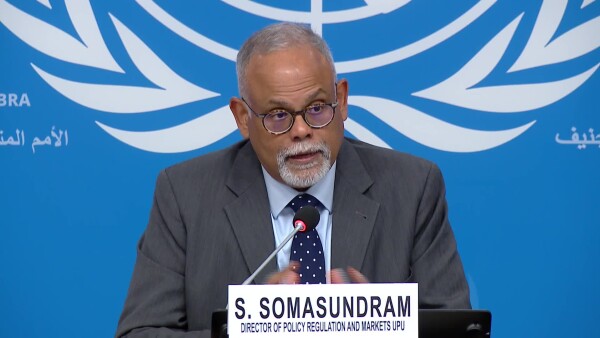
Presentation of the Trade and Developement Report 2026
Embargoed until 9 October 2026 at 11 a.m. (Geneva Time)
UNCTAD: UNCTAD’s flagship report finds that governments increasingly use industrial, trade, financial and technology policies to pursue economic and national security objectives. Market access and the ability to move into higher-value activities now depend more heavily on technology, finance and geopolitics.
1
1
1
Press Conferences | UPU
Release of the State of the Postal Sector Report 2026
1
1
1
Press Conferences | IOM , ITU , UNECE , UNICEF , WHO , WMO
UNICEF: Ebola, DRC - children orphans or separating them from parents and caregivers; IOM: Humanitarian needs in Djibouti amid arrivals from Yemen and increased migrant movements; WHO: Darfur, scale of health needs far exceeds available resources; WMO co-sponsored Global Heat Forum, Bangkok, monthly Global Seasonal Climate Update; UNECE: UN Forum of Mayors; ITU Plenipotentiary Conference 2026; WHO: child and adolescent obesity guidelines and new global roadmap to tackle pregnancy hypertension, a leading cause of maternal mortality
1
1
1
Press Conferences | OCHA , UN WOMEN , UNHCR , WFP , WHO , WTO , UNEP
OCHA – $160M CERF allocation to 12 underfunded crises; UNHCR – 5.8M refugee children remain out of school amid funding cuts; UN Women – Middle East escalation and food security among women/girls; WHO – Gaza supplies and overall situation; WFP – Yemen food insecurity and impact on global hunger ; UNEP - First International Conference of the Global Framework on Chemicals in Geneva | 16-20 November 2026
1
1
1
Press Conferences | UNHCR , WHO
Yemen's health system nears collapse amid conflict, causing rising casualties and medicine shortages.
1
1
1
Press Conferences | HRC
Update by the Expert Mechanism to Advance Racial Justice and Equality in Law Enforcement
1
1
1
Press Conferences | WIPO , WHO , UNICEF , UNHCR , IOM , WFP , FAO
WIPO Global Innovation Index 2026 launch and press conference, WHO Composition of influenza vaccines for the 2027 Southern Hemisphere flu season, UNICEF Yemen hunger and malnutrition; UNHCR Sudan displacement into Chad; IOM Ebola and population movements in DRC; WFP emergency food assistance in Nepal; and FAO food loss and waste.