

The United Nations Office at Geneva
Multimedia Newsroom
Press Conferences | UNHCR , OCHA , WHO , UNOG , WFP , ITU
UNOG Bi-weekly press briefing 30 June 2020 continuity
The pledging conference for Syria and the region
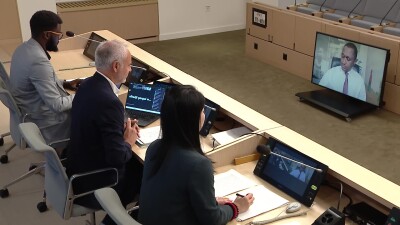
Jens Laerke for the United Nations Office for the Coordination of Humanitarian Affairs (OCHA), said the pledging conference for Syria and the region had started in Brussels and was being co-chaired by the European Union and the United Nations. Journalists would have received the opening remarks of the Under-Secretary General for Humanitarian Affairs and Emergency Relief Coordinator of the United Nations, Mark Lowcock, including a link to the press conference that would start at 12:30 p.m. The results of the pledges would be shared around 6 p.m.
One of the most tragic consequences of the last decade had been the robbing of millions of children of their right to a decent education. Currently, 2.45 million children were out of school and 1.6 million were at risk of dropping out. This would have major long-term consequences. Mr. Laerke highlighted that Mr. Lowcock thanked the neighbouring countries, including Turkey, Lebanon, Jordan, Iraq and Egypt for their generosity in supporting Syrians who had fled their country.
Answering questions Mr. Laerke said the USD 3.8 billion Humanitarian Response Plan for Syria had been funded at 30 percent, and a USD 6.04 billion refugee and resilience plan for countries in Syria’s neighborhood had been funded at 19 percent.
Launch of UNAIDS Global Report
Michael Hollingdale, for the United Nations Programme on HIV and AIDS (UNAIDS), informed that UNAIDS would hold two virtual press conferences on Monday, 6 July to present the UNAIDS Global Report 2020 on the state of the HIV epidemic. UN Executive Director Winnie Byanyima would present the updated country, regional and global data and the impact of COVID-19. The first press conference, in English, would be held at 10:30 a.m. and the second, in French, would start at 11:30 a.m. Geneva time. The report and supporting materials would be embargoed until Monday, 6 July at 4 p.m. and coincide with the opening of the 23rd International AIDS Conference, which would be held virtually this year.
Launch of the Global E-waste Monitor 2020
Jovana Miocinovic, for the International Telecommunication Union (ITU), announced that the virtual press conference to launch the Global E-waste Monitor 2020 would take place on Thursday 2 July 2020 at 4 p.m., with the report authors.
Ms. Miocinovic said the availability and widespread use of electrical and electronic equipment (EEE) had enabled much of the global population to benefit from higher standards of living. However, she pointed out that the way in which people produce, consume, and dispose e-waste was unsustainable. In 2019, the world had generated a record 53.6 million metric tons (Mt) of e-waste, up 21 percent in just five years. At the same time, only 17.4 percent of last year’s e-waste had been officially documented as properly collected and recycled.
Besides providing a global perspective, the 2020 report would include a national and regional analysis of e-waste quantities and legislative instruments. Ms. Miocinovic said the Global E-waste Monitor 2020 was a collaborative product of the Global E-waste Statistics Partnership (GESP), formed by UN University (UNU), the International Telecommunication Union (ITU), and the International Solid Waste Association (ISWA), in close collaboration with the UN Environment Programme (UNEP). The World Health Organization (WHO) and the German Ministry of Economic Cooperation and Development (BMZ) had also substantially contributed to the Global E-waste Monitor 2020.
More information can be found here.
Impact of COVID-19 on food security
Elisabeth Byrs, for the World Food Program (WFP), said 2.4 million people the Central African Republic – more than half the population – were facing acute food insecurity, according to the latest IPC food security analysis. The situation in the capital Bangui was particularly worrying. Food insecurity in the city had quadrupled within a year – rising to nearly 440,000 people compared to under 132,000 people in September 2019. Ms. Byrs added that the security situation was deteriorating, and more than 702,000 Central Africans had fled their homes. COVID-19 was compounding an already dire situation in one of the world's least developed countries with an extremely limited health care system. Disruptions in the transportation sector had also increased the cost of items imported from neighboring countries into a landlocked Central African Republic, causing spikes in food prices. Ms. Byrs said that WFP needed USD 92 million to provide food and nutrition assistance to 1.8 million women, men and children, and to stop vulnerable families from falling further into poverty and food insecurity.
WFP estimated that the number of acutely food insecure people could increase by 80 percent from 149 million pre-COVID-19, to 270 million before the end of 2020 - in the 79 countries where it worked. Ms. Byrs said the greatest impact was currently in Latin America, where there had been a 269 percent rise in people facing severe food insecurity. Spikes in food insecurity were already evident in West and Central Africa (135 percent increase) and Southern Africa (90 percent increase). She said WFP was mobilizing to meet the food needs of up to 138 million people in 2020 and was appealing for USD 4.9 billion over the next six months to carry out the lifesaving work.
Full statement can be found here.
Rising violence against displaced persons in eastern Democratic Republic of Congo
Babar Baloch, for the United Nations High Commissioner for Refugees (UNHCR), said the UN Refugee Agency was alarmed at the increasing number of violent attacks on displaced civilians by armed groups in eastern Democratic Republic of the Congo (DRC) and called on the authorities to strengthen the presence of police, military forces with support of the UN Organization Stabilization Mission in the DRC (MONUSCO) to improve the security situation and hold the perpetrators accountable.
In the last eight weeks, UNHCR and its partners had recorded multiple attacks by armed groups on displacement sites and villages, mainly in Djugu Territory, in Ituri, in Fizi and the Mwenga Territories in South Kivu province and Masisi and the Rutshuru Territories, North Kivu province. Violence had displaced more than one million people in the last six months in these areas.
Mr. Baloch said DRC had one of the highest rates of internal displacement in the world. Over five million people had been uprooted by insecurity within the country’s borders, while nearly a million Congolese had sought safety as refugees in neighbouring countries. The current attacks added up to an already complex displacement situation in eastern DRC and posed huge risks for the people who fled their homes. The new displacement also brought more pressure on the areas hosting internally displaced people, which lacked basic needs such as food, water and healthcare services. Mr. Baloch added that women and girls were among those most-at-risk; over the last month, more than 390 cases of sexual violence had been recorded in Ituri, North Kivu and South Kivu provinces.
Full statement can be read here.
IOM support to Rohingya refugees in Aceh, Indonesia.
Paul Dillon, for the International Organization for Migration (IOM), said IOM Indonesia continued to provide round-the-clock care to the 99 Rohingya rescued and allowed to disembark in North Aceh last week, as concerns were being raised about another boat currently at sea with an estimated 500 Rohingya on board, according to authorities in Jakarta.
Malaysian officials had also reported that at least 300 people were on a vessel off the coast of Koh Adang island in Thailand. Mr. Dillon said no further details were available, but roughly 1,400 Rohingya had been stranded at sea during the 2020 sailing season, which typically ends with the arrival of the monsoon in late May. According to various estimates, at least 130 people had died.
Mr. Dillon said that IOM was working alongside other partners and the local community to provide much-needed support to the rescued Rohingyas. In addition to food and water, IOM and partners were also providing WASH support through the provision of water tanks and personal hygiene kits. IOM had also ensured that the group had a high level of COVID-19 awareness and prevention information. He also mentioned that guardianship arrangements had been made for the unaccompanied children and IOM was assisting the ICRC to make family links where needed or possible.
Babar Baloch, for the United Nations High Commissioner for Refugees (UNHCR), added that the Refugee Agency was working hand in hand with the local authorities and partners to move these refugees to more permanent accommodation.
More information can be read here.
Geneva announcements
Rhéal LeBlanc, for the United Nations Information Service (UNIS), reminded journalists that the International Day of Parliamentarism was celebrated on 30 June. In his message for the Day, the Secretary-General’s recalled that Parliaments had a special duty to advance human rights and promote sustainable development. More than ever, the COVID-19 pandemic reminded everyone of these vital tasks, in order to ensure adequate health systems, robust social safety networks, and equitable economic growth that generates decent jobs. The full message is available here.
Christian Lindmeier, for the World Health Organization (WHO), said the WHO would hold a new research and development meeting on Thursday, 2 July, a follow-up to the one held in February. A press briefing would be organized after the meeting and a press release issued the same day. He said the meeting would not be open to media, so scientists could discuss and openly share their thoughts.
Responding to a question about reports that Chinese researchers had warned of a new virus in pigs with pandemic risk, Mr. Lindmeier said the WHO would read the paper carefully to understand what was new, as human infections with swine influenza A(H1) viruses had been documented before in Asia. A WHO statement highlighted that the world couldn’t let its guard down on influenza and needed to continue surveillance even during the COVID-19 pandemic, as well as monitor animal populations and collaborate with relevant health entities.
Rhéal LeBlanc, for the United Nations Information Service (UNIS), reminded journalists that the Human Rights Council’s 44th session had opened this morning in the Assembly Hall, with the UN High Commissioner for Human Rights providing a global update on recent human rights developments and on COVID-19 implications on human rights. She would also present reports on the Philippines and Myanmar. This afternoon the Council would discuss Eritrea.
The formal plenary meetings of the 2020 session of the Conference on Disarmament were also scheduled today, in the morning and the afternoon, with a mix of in-person and remote participation by delegates.
Mr. LeBlanc also reminded journalists who wished to participate in the online event “Conference on Disarmament meets civil society – Lessons of the Pandemic: Rethinking the nexus between disarmament and security”, to be held on 3 July 2020 from 10 a.m. to noon, to register beforehand. The virtual meeting would offer an opportunity to discuss the lessons learnt from the pandemic, its impact and the future of disarmament and non-proliferation efforts.
The International Labour Organization (ILO) would launch the fifth edition of the ILO Monitor on COVID-19 and the world of work, which tracks the impact of the pandemic on workers and businesses worldwide, during an embargoed virtual press briefing at 2 p.m. today. The new report would include revised estimates on the extent of labour market disruption created by the pandemic in the first half of 2020, and offer scenarios for the recovery phase.
On 1 July at 3 p.m, the United Nations Conference on Trade and Development (UNCTAD) would hold a virtual press briefing on COVID-19 and tourism: Assessing the economic consequences. The speakers would be Pamela Coke-Hamilton, Director, Division on International and Commodities, and Ralf Peters, Chief of the Trade Information Section, Division on International Trade and Commodities.
Similar Stories
1
1
1
Press Conferences | UNHCR
End of UNHCR's 77th Annual Executive Committee (ExCom) meeting week
1
1
1
Press Conferences | UNICEF , IOM , UNHCR
UN Special Assistant to the Personal Envoy Office (SUDAN): Peace Initiatives and Efforts in Sudan; UNICEF: Dire situation of children in Gaza; IOM: Damaged Homes and Energy Attacks Risk Displacing Ukrainians for this winter; UNHCR: update on EXCOM week
1
1
1
Press Conferences | IOM , UNDRR
UN stresses importance of household preparedness for disaster risk reduction.
1
1
1
Statements , Press Conferences | OHCHR
1
1
1
Press Conferences | UNHCR , UNICEF , IFRC , OHCHR , UN WOMEN , IOM , OCHA , WHO
UNHCR – ExCom Meeting, UNICEF – Nepal Recovery, IFRC – Flash Floods, WHO – Mental Health, IOM – South Sudan Floods, OCHA – DRC Humanitarian aid, UNHCR – Sahel Displacement, UNICEF – Yemen Update, IOM – Gaza Shelter, UN Women – Gaza Women, OHCHR – Arrests and detentions of Syrians by Israeli force
2
1
2
Press Conferences | UNCTAD
Presentation of the Trade and Developement Report 2026
Embargoed until 9 October 2026 at 11 a.m. (Geneva Time)
UNCTAD: UNCTAD’s flagship report finds that governments increasingly use industrial, trade, financial and technology policies to pursue economic and national security objectives. Market access and the ability to move into higher-value activities now depend more heavily on technology, finance and geopolitics.
1
1
1
Press Conferences | UPU
Release of the State of the Postal Sector Report 2026
1
1
1
Press Conferences | IOM , ITU , UNECE , UNICEF , WHO , WMO
UNICEF: Ebola, DRC - children orphans or separating them from parents and caregivers; IOM: Humanitarian needs in Djibouti amid arrivals from Yemen and increased migrant movements; WHO: Darfur, scale of health needs far exceeds available resources; WMO co-sponsored Global Heat Forum, Bangkok, monthly Global Seasonal Climate Update; UNECE: UN Forum of Mayors; ITU Plenipotentiary Conference 2026; WHO: child and adolescent obesity guidelines and new global roadmap to tackle pregnancy hypertension, a leading cause of maternal mortality
1
1
1
Press Conferences | OCHA , UN WOMEN , UNHCR , WFP , WHO , WTO , UNEP
OCHA – $160M CERF allocation to 12 underfunded crises; UNHCR – 5.8M refugee children remain out of school amid funding cuts; UN Women – Middle East escalation and food security among women/girls; WHO – Gaza supplies and overall situation; WFP – Yemen food insecurity and impact on global hunger ; UNEP - First International Conference of the Global Framework on Chemicals in Geneva | 16-20 November 2026
1
1
1
Press Conferences | UNHCR , WHO
Yemen's health system nears collapse amid conflict, causing rising casualties and medicine shortages.
1
1
1
Press Conferences | HRC
Update by the Expert Mechanism to Advance Racial Justice and Equality in Law Enforcement
1
1
1
Press Conferences | WIPO , WHO , UNICEF , UNHCR , IOM , WFP , FAO
WIPO Global Innovation Index 2026 launch and press conference, WHO Composition of influenza vaccines for the 2027 Southern Hemisphere flu season, UNICEF Yemen hunger and malnutrition; UNHCR Sudan displacement into Chad; IOM Ebola and population movements in DRC; WFP emergency food assistance in Nepal; and FAO food loss and waste.