

The United Nations Office at Geneva
Multimedia Newsroom
Press Conferences | OHCHR , UNICEF , UNHCR , OCHA , WHO , UNOG , WFP , ILO , WMO , UNECE , IOM
UNOG Bi-weekly press briefing 26 June 2020
Seventy-fifth anniversary of the United Nations Charter
Alessandra Vellucci stated that 75 years ago, 50 states had signed the Charter of the United Nations, thus establishing the world organization. The UN Secretary-General had held a press conference on that occasion, the transcript of which was available here. Ms. Vellucci reminded about the online survey for UN75: https://un75.online/.
Ms. Vellucci also informed about the first ever #UN75 all-female panel on megatrends, which would take place online today at 8 p.m. Geneva time, and the UN official Charter Day event, to take place online today at 3 p.m. Geneva time, and which could be watched at webtv.un.org.
Also on the occasion of the UN’s anniversary, today at 5 p.m., Switzerland would donate to the United Nations Office at Geneva an ephemeral piece of art by the artist Saype. An event would take place in the Ariana Park, where the media would have a chance to ask questions to Tatiana Valovaya, UNOG Director-General, and Ignazio Cassis, the Swiss Foreign Minister. Just before the event, Mr. Cassis would address the media from Press Room III at 4 p.m.
44th session of the Human Rights Council
Rolando Gomez, for the Human Rights Council (HRC), said that the forty-fourth regular session of the Council would commence on Tuesday, 30 June. It would be held in the Assembly Hall, in order to allow for necessary social distancing. The President of the Council would open the session, to be followed by a statement of the High Commissioner, at approximately 10:15 am, in which she would present an update on the activities of her Office and recent human rights developments around the globe. The High Commissioner would then present an oral update on the impact of COVID-19 on human rights, as requested by the Council in March. A report on the human situation in the Philippines would also be presented on 30 June. More details would be shared with the media by email shortly.
Mr. Gomez, responding to a question, said that whenever a State was singled out through a country report or an update, it would have a chance to speak as a concerned country. Several journalists asked about the report by the Special Rapporteur on Freedom of Expression, David Kaye, and about a possible press conference. Questions were also asked about his successor in this position. There would be no physical side events at the Palais des Nations this time, informed Mr. Gomez, while a number of virtual events were scheduled.
Elisabeth Throssell, for the Office for the High Commissioner for Human Rights (OHCHR), added that the High Commissioner’s opening speech would be global in nature; it would inevitably touch upon COVID-19 and the need to build back better.
Pledging event for Syria
Jens Laerke, for the Office for the Coordination of Humanitarian Affairs (OCHA), informed that on 30 June 2020, an online pledging conference for Syria would be co-chaired by the European Union and the United Nations. With the conflict entering its tenth year, the situation in Syria and the region remained highly critical: the dire humanitarian situation, with millions of Syrians internally displaced and having sought refuge in Syria’s neighbouring countries, was now being further compounded by the socio-economic consequences of the COVID-19 pandemic.
The event would start at 12 noon Geneva time, and the final pledge announcement was expected around 6 p.m. There were confirmations from more than 80 delegations, including States, regional organizations, and UN agencies. The Humanitarian Response Plan for Syria of USD 3.8 billion was currently only 30 percent funded.
Mr. Laerke stressed that the conflict in Syria had now lasted longer than the First and the Second World Wars combined. The economy was imploding across the region, and half of the pre-war population were internally or externally displaced. The civilians in Syria needed the humanitarian operations to continue.
More information on the pledging event can be found here.
Elisabeth Byrs, for the World Food Programme (WFP), added that Syria was facing an unprecedented food crisis. An estimated 9.3 million Syrians were now food insecure. Food prices were 20 times higher than they had been pre-crisis. Families in Syria were exhausted and could not cope anymore. WFP urgently required USD 200 million to continue to provide food assistance in Syria until the end of the year; otherwise the WFP would need to drastically cut rations and the number of recipients as of October 2020.
COVID-19: impact on food security in Afghanistan
Elisabeth Byrs, for the World Food Programme (WFP), stated that in Afghanistan, the COVID-19 pandemic had turned from a health emergency to a food and livelihood crisis. The socio-economic impact of COVID-19 was hitting the most vulnerable communities hardest, both in urban and rural areas. An estimated 12.4 million people were facing acute food insecurity, due to conflict, high food prices and the impact of COVID-19. Out of that number, four million were facing emergency level of food insecurity and needed urgent assistance. The shocks imposed by the pandemic would be particularly hard for a more than one in four Afghans (29 percent) who relied on day labour and low-income jobs to sustain their lives.
Afghanistan was facing a deficit of 1.5 million metric tons of wheat grains in 2020, similar to past years. It was thus crucial that the northern border with Central Asian countries remain open so that businesses could import wheat for milling in Afghanistan. An open border with Pakistan was equally important because most commercial and humanitarian cargo reached landlocked Afghanistan that way. WFP urgently required an additional USD 53 million in the second half of 2020 to provide lifesaving assistance for an extra three million people impacted by COVID-19.
Marixie Mercado, for the United Nations Children’s Fund (UNICEF), stated that the latest data showed that the number of children under five suffering from life-threatening malnutrition had increased from 690,000 in January to 780,000 in May. Such a rapid increase was incredibly alarming. Coping strategies had been stretched to the limit, hospitals were struggling, and even where services were available, families were afraid to bring children in for inpatient treatment due to fear of contagion. It was vital that nutrition services both at community and facility level be scaled up to prevent more children slipping into severe malnutrition and to make sure life-saving treatment was available for those that did.
COVID-19: World Health Organization
Christian Lindmeier, for the World Health Organization (WHO), responding to questions, said that the key for controlling COVID-19 was testing and surveillance. The better the authorities surveyed and knew the picture, the better they could impose specific, tailored measures. He said that when countries eased lockdowns, we could expect to see a raise in cases. The measures were primarily meant to flatten the curve and allow the health system to cope with both COVID-19 and all other health emergencies. Even after the relaxation of lockdown measures, safety procedures ought to be respected. We would need to live with COVID-19 until the vaccine was found, said Mr. Lindmeier. National authorities were provided with the guidance by the WHO, but it was up to them to decide on the thresholds and the exact nature of measures they would impose.
Killings of civilians in Mali
Elisabeth Throssell, for the Office for the High Commissioner for Human Rights (OHCHR), informed that 580 civilians had been killed so far this year in central Mali, as a deteriorating security situation and widespread impunity undermined efforts to protect civilians.
Violent disputes between the Peulh and Dogon communities had increased in recent months, with community-based militias, initially formed to defend communities becoming increasingly violent and involved in attacks against other communities. From 1 January to 21 June 2020, the Human Rights and Protection Division of the Multidimensional Integrated Stabilization Mission in Mali (MINUSMA) had documented 83 incidents of violence across communal lines in Mopti region. Those attacks across community lines had also been fuelled and instrumentalized by Al Qaeda in the Islamic Maghreb, the Islamic State in the Greater Sahara, the Group to Support Islam and Muslims and other similar or affiliated armed groups, which had used the intercommunal violence to recruit members into their ranks.
“The vicious cycle of retaliatory attacks between Dogon and Peulh militias, coupled with the violations and abuses committed by Malian Defence and Security Forces and armed groups, has created a situation of chronic insecurity for the civilian population, who are not able to count on the protection of the Malian forces. This needs to stop,” said Michelle Bachelet, the High Commission for Human Rights.
Full statement can be read here.
Rohingya refugees and Indonesian fishermen
Babar Baloch, for the United Nations Refugee Agency (UNHCR), informed about a group of 99 Rohingya who had landed, by boat, in the Ache region of Indonesia. The group had apparently been on the sea for more than four months. UNHCR had been present at the disembarkation point, together with the authorities, and was now working with the local authorities to provide any assistance needed by the group. UNHCR was deeply concerned about the health of the refugees. UNHCR also expressed appreciation to the Government and the local fishermen for allowing the refugees to land on the Indonesian shores.
Paul Dillon, for the International Organization for Migration (IOM), said that the IOM welcomed the fact that the 99 refugees (49 women, 33 children and 17 men) had been allowed to disembark in the Indonesian region of Ache. IOM Indonesia’s four-person advance team was providing medical and operational support with registration and the initial assessment of the group, as well as much-needed food, water and hygiene packages. The group representative said that they had set out from the Cox Bazaar more than four months earlier; they were originally from the Rakhine State in Myanmar. One woman had reportedly died on board. Roughly 1,400 Rohingya had found themselves stranded at sea during the 2020 sailing season, and at least 130 had died. Malaysian officials reported that at least 300 were on a vessel off the coast of Koh Adang island in Thailand.
Responding to questions, Mr. Baloch and Mr. Dillon said that more facts on the group’s ordeal should be established in the coming days, and that the focus now should be on their wellbeing. Mr. Baloch said that some vulnerable men, women, and children were still out on the sea, and the need to save lives was urgent.
Sand and dust storms
Clare Nullis, for the World Meteorological Organization (WMO), said that the WMO had issued its annual Airborne Dust Bulletin on the incidence and hazards of sand and dust storms, which had been highlighted by a massive Saharan plume which had blanketed many parts of the Caribbean. The dust plume had arrived from North Africa in the Eastern Caribbean on 17 June. It had since affected a wide spatial extent of the greater Caribbean area, from the southeast Caribbean just off the northern coast of South America and as far north and west as the Yucatan Peninsula of Mexico. The dust storm had darkened skies, contaminated rainwater and greatly reduced visibility; it also posed a significant health hazard. While African dust blew across the Atlantic every year, this year the event was particularly intense and extensive.
Martinique, Guadeloupe and Puerto Rico had classed air quality levels in the “hazardous” category with record values of PM10 – a particulate matter which could penetrate the lungs causing respiratory problems and disease.
Mega-flash lightening extreme
Clare Nullis, for the World Meteorological Organization (WMO), informed that a WMO committee of experts had established two new world records for the longest reported distance and the longest reported duration for a single lightning flash in, respectively, Brazil and Argentina. The new records for “mega-flashes”, verified with new satellite lightning imagery technology, more than doubled the previous values measured in the United States of America and France. The world’s greatest extent for a single lightning flash was a single flash that covered a horizontal distance of 709 km across parts of southern Brazil on 31 October 2018. That was equivalent to the distance between Boston and Washington D.C. The greatest duration for a single lightning flash was 16.73 seconds from a flash that had developed continuously over northern Argentina on 4 March 2019.
The previous record for the longest detected distance for a single lightning flash had been for 321 km on 20 June 2007 across the US State of Oklahoma. The previous record for duration had been for a single lightning flash that lasted continuously for 7.74 seconds on 30 August 2012 over Provence-Alpes-Côte d'Azur, France.
More information can be found here.
Ebola in eastern Democratic Republic of the Congo
Christian Lindmeier, for the World Health Organization (WHO), said that the second largest-ever Ebola outbreak in the World, in the Democratic Republic of the Congo, had come to an end. All full incubation periods had passed, and it could thus be considered that transmission had been stopped. There had been 3,470 cases, 2,287 deaths and 1,171 survivors. The response was not over, however, as flareups were expected, and the support for the survivors had to continue. The credit for ending the outbreak went, first and foremost, to the affected communities; their sacrifices had stopped Ebola from spreading globally. At the height of the outbreak, 16,000 local responders had been working alongside the WHO, national and international partners, said Mr. Lindmeier.
WHO press release is available here.
Mr. Lindmeier added that the WHO Emergency Committee was meeting today on the ongoing, eleventh, outbreak of Ebola in the Equateur Province of the DRC.
Ghana joins the Water and Watercourses Conventions
Jean Rodriguez, for the United Nations Economic Commission for Europe (UNECE), informed that Ghana had become the third African country (and the forty-forth Party) to accede to the Convention on the Protection and Use of Transboundary Watercourses and International Lakes (Water Convention), serviced by UNECE, and the thirty-seventh Party to the Convention on the Law of the Non-Navigational Uses of International Watercourses (Watercourses Convention).
Ghana’s transboundary river basins, namely the Volta River basin (shared with Benin, Burkina Faso, Côte d’Ivoire, Mali and Togo, home to over 23 million people, with a population projected to more than double by 2050), Bia and Tano Rivers (shared with Côte d’Ivoire) and Todzie-Aka basin (shared with Togo), covered over 75 percent of the country’s land surface and generated around 80 percent of freshwater flow. Those shared water resources provided water for drinking, sanitation, agriculture (which accounted for between 54 and 85 percent of employment in Volta basin countries), hydropower, and industrial needs. The basins linked the populations across borders, creating socioeconomic interdependencies between the riparian countries.
UNECE press release is available here.
Geneva announcements
Christian Lindmeier, for the World Health Organization (WHO), informed that a technical briefing, followed by a virtual press briefing, would be held today on the ACT-Accelerator. The technical briefing would take place at 2 p.m. today would be moderated by Dr. Bruce Aylward, Head of ACT-Accelerator Coordination Hub. Dr. Tedros would be one of the speakers. Updates were expected on all fronts, said Mr. Lindmeier.
Rosalind Yarde, for the International Labour Organization (ILO), informed about the launch of the fifth edition of the ILO Monitor on COVID-19 and the World of Work, which would be presented on 30 June. The report presented three scenarios for recovery until the end of the year. An embargoed virtual press briefing with the ILO Director-General, Guy Ryder, would take place on 30 June at 2 p.m.
Ms. Yarde also informed about the ILO Global Summit, the largest ever online gathering of workers, employers and governments which would discuss how to address the economic and social impacts of the pandemic. The ILO Global Summit would take place on 1-2 July (regional events) and 7-9 July (global events). The media would be able to follow the Summit online.
Alessandra Vellucci, for the United Nations Information Service (UNIS), informed that the Committee on the Elimination of Discrimination against Women (CEDAW) would open its seventy-sixth session, remotely, on 29 June, at 12:30 p.m. The session would last until 9 July.
The Human Rights Committee would also open its hundred twenty-ninth session on 29 June at 4 p.m. The session would last until 24 July.
The Conference on Disarmament would hold two plenary meetings on 30 June, from 10 a.m. to 1 p.m. and from 3 p.m. to 6 p.m.
Ms. Vellucci further informed that on 29 June at 2 p.m., the United Nations Population Fund (UNFPA) would hold a hybrid press conference to present the report “State of World Population Report 2020 - Against my will: defying the practices that harm women and girls and undermine equality”. The speaker would be Monica Ferro, Director, UNFPA Geneva.
On 1 July at 3 p.m, the United Nations Conference on Trade and Development (UNCTAD) would hold a virtual press briefing on COVID-19 and tourism: Assessing the economic consequences. The speakers would be Pamela Coke-Hamilton, Director, Division on International and Commodities, and Ralf Peters, Chief of the Trade Information Section, Division on International Trade and Commodities.
Similar Stories
1
1
1
Press Conferences | UNHCR
End of UNHCR's 77th Annual Executive Committee (ExCom) meeting week
1
1
1
Press Conferences | UNICEF , IOM , UNHCR
UN Special Assistant to the Personal Envoy Office (SUDAN): Peace Initiatives and Efforts in Sudan; UNICEF: Dire situation of children in Gaza; IOM: Damaged Homes and Energy Attacks Risk Displacing Ukrainians for this winter; UNHCR: update on EXCOM week
1
1
1
Press Conferences | IOM , UNDRR
UN stresses importance of household preparedness for disaster risk reduction.
1
1
1
Statements , Press Conferences | OHCHR
1
1
1
Press Conferences | UNHCR , UNICEF , IFRC , OHCHR , UN WOMEN , IOM , OCHA , WHO
UNHCR – ExCom Meeting, UNICEF – Nepal Recovery, IFRC – Flash Floods, WHO – Mental Health, IOM – South Sudan Floods, OCHA – DRC Humanitarian aid, UNHCR – Sahel Displacement, UNICEF – Yemen Update, IOM – Gaza Shelter, UN Women – Gaza Women, OHCHR – Arrests and detentions of Syrians by Israeli force
2
1
2
Press Conferences | UNCTAD
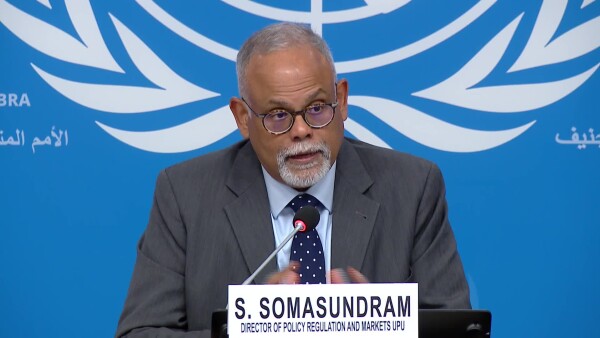
Presentation of the Trade and Developement Report 2026
Embargoed until 9 October 2026 at 11 a.m. (Geneva Time)
UNCTAD: UNCTAD’s flagship report finds that governments increasingly use industrial, trade, financial and technology policies to pursue economic and national security objectives. Market access and the ability to move into higher-value activities now depend more heavily on technology, finance and geopolitics.
1
1
1
Press Conferences | UPU
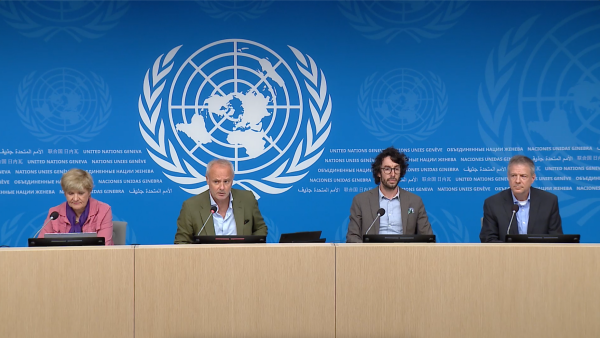
Release of the State of the Postal Sector Report 2026
1
1
1
Press Conferences | IOM , ITU , UNECE , UNICEF , WHO , WMO
UNICEF: Ebola, DRC - children orphans or separating them from parents and caregivers; IOM: Humanitarian needs in Djibouti amid arrivals from Yemen and increased migrant movements; WHO: Darfur, scale of health needs far exceeds available resources; WMO co-sponsored Global Heat Forum, Bangkok, monthly Global Seasonal Climate Update; UNECE: UN Forum of Mayors; ITU Plenipotentiary Conference 2026; WHO: child and adolescent obesity guidelines and new global roadmap to tackle pregnancy hypertension, a leading cause of maternal mortality
1
1
1
Press Conferences | OCHA , UN WOMEN , UNHCR , WFP , WHO , WTO , UNEP
OCHA – $160M CERF allocation to 12 underfunded crises; UNHCR – 5.8M refugee children remain out of school amid funding cuts; UN Women – Middle East escalation and food security among women/girls; WHO – Gaza supplies and overall situation; WFP – Yemen food insecurity and impact on global hunger ; UNEP - First International Conference of the Global Framework on Chemicals in Geneva | 16-20 November 2026
1
1
1
Press Conferences | UNHCR , WHO
Yemen's health system nears collapse amid conflict, causing rising casualties and medicine shortages.
1
1
1
Press Conferences | HRC
Update by the Expert Mechanism to Advance Racial Justice and Equality in Law Enforcement
1
1
1
Press Conferences | WIPO , WHO , UNICEF , UNHCR , IOM , WFP , FAO
WIPO Global Innovation Index 2026 launch and press conference, WHO Composition of influenza vaccines for the 2027 Southern Hemisphere flu season, UNICEF Yemen hunger and malnutrition; UNHCR Sudan displacement into Chad; IOM Ebola and population movements in DRC; WFP emergency food assistance in Nepal; and FAO food loss and waste.