

The United Nations Office at Geneva
Multimedia Newsroom
Press Conferences | OHCHR , WFP , WMO , UNECE
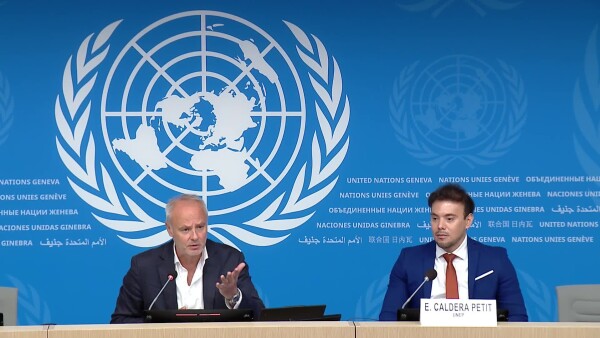
UNOG Bi-weekly press briefing 23 June 2020 continuity
Human Rights Council
Rolando Gomez, for the Human Rights Council (HRC), informed that the Council had adopted a total of 40 resolutions, the list of which had been shared with the media and was available on the HRC extranet. The Council was currently holding informal consultations so that the delegations could exchange views on what had gone well and what could be improved under the current extraordinary circumstances. The consultations would also discuss whether the forty-fourth session would commence the following week as proposed. Before concluding the forty-third session today, the Council would hear from observer States and NGOs, and then adopt the draft report of the forty-third session. A press conference with the President of the Council was also envisioned.
COVID-19: impact on children in South Asia
Simon Ingram, author of the report on the impact of COVID-19 on children in South Asia, for the United Nations Children’s Fund (UNICEF), said that the moment was very timely to highlight the impact of COVID-19 on some 600 million children across the region. Vaccination campaigns and many other vital health services had been suspended. More than 430 million children were locked out of their classrooms, and many of them could not follow classes online. Families were hard hit by losing their jobs and seeing their remittances reduced. The survey showed that more and more families were being forced to reduce their food intake; the number of children in poverty could quickly increase by half, Mr. Ingram warned. UNICEF, among other things, asked for a growth of low-tech learning technologies at homes, and stressed the importance of working with traditional and religious leaders to address the myths surrounding COVID-19.
Jean Gough, South Asia Regional Director of UNICEF, stated that there had been a big increase of calls to the helplines in eight countries across the region. Many children were reporting anxiety about their future; mental health support was thus urgently needed. In Cox Bazaar, for example, in spite of all the efforts, a majority of the Rohingya children feared getting infected and a significant number were afraid they would die of COVID-19. There was a reduction in demand for health services; in Bangladesh, for example, medical consultations for children under five had dropped dramatically. Immunization campaigns for polio in Pakistan and Bangladesh had been put on hold. The explosion of the virus was happening in densely populated cities in India, Pakistan, Bangladesh and Afghanistan; children were facing numerous challenges and were at a high risk of going hungry, stressed Ms. Gough.
Record temperatures in the Arctic
Clare Nullis, for the World Meteorological Organization (WMO), said that the WMO was seeking to verify reports of a new Arctic record temperature of 38° Celsius (100.4 F) in the Russian town of Verkoyansk amid a prolonged Siberian heatwave and increase in wildfire activity. The record had been reported to have occurred on 20 June. That region of Eastern Siberia had extremes both in winter and in summer so that temperatures above 30°C were not unusual in July, according to the Roshydromet.
Ms. Nullis said that the Weather and Climate Extremes Archive provided details of global, hemispheric, and continental extremes, but until now the WMO had not verified potential records for "highest temperature recorded north of Arctic Circle". WMO’s Special Rapporteur Randall Cerveny stated that “this has been an unusually hot spring in Siberia, and the coinciding lack of underlying snow in the region combined with overall global temperature increases, undoubtedly helped play a critical role in causing this extreme temperature observation. The Arctic was among the fastest warming regions in the world and was heating at twice the global average.” Ms. Nullis also informed about the statement by the Copernicus Atmospheric Monitoring Service that the number and intensity of wildfires in north-eastern Siberia and the Arctic circle had continued to increase over the last few days, and the daily total intensity was at similar levels to that observed in 2019.
Responding to questions, Ms. Nullis said that there was definitely a connection between climate change and heat. We had just had the five warmest years on record. There were a number of additional factors in play, though, when it came to wildfires.
World Food Programme’s activities for Syrian refugees
Elisabeth Byrs, for the World Food Programme (WFP), reminded that the war in Syria had driven the largest refugee crisis in the world. Most had fled to neighboring Turkey, Lebanon, Jordan, Iraq and Egypt, which hosted more than 5.5 million Syrians, the biggest refugee group in the world. The COVID-19 and the consequent economic downturn had pushed hundreds of thousands of Syrian refugees in the region deeper into need. Even prior to the pandemic, most refugee families had been living in extreme poverty.
WFP was assisting 1.8 million refugees and the communities hosting them, mostly through cash-transfer and e-food cards or vouchers. That was the largest humanitarian food voucher programme in the world. Ms. Byrs stressed that refugees were especially vulnerable to coronavirus and other diseases, due to high geographical mobility, instability, living in overcrowded conditions, insufficient hygiene and sanitation, and lack of access to decent healthcare. In 2019, Ms. Byrs reminded, the WFP had assisted nearly three million Syrian refugees. This year, the WFP was helping some 650,000 Syrian refugees in Lebanon, 470,000 in Jordan, 55,000 in Turkey, 77,000 in Egypt, 76,000 in Iraq.
More information of the WFP’s work on the Syria emergency can be found here.
Announcements
Monica Gehner, for the International Telecommunications Union (ITU), informed that the ITU would hold a press conference today at 1 p.m. via Zoom, on the occasion of the launch of the 2020 Child Online Protection Guidelines. The guidelines provided separate sets of recommendations for children, parents and educators, industry and policy-makers on how to develop a safe and empowering online environment for children and young people. That was especially important as children had now been far more online than usual during COVID-19; data showed that one out of three children in the world were online. The speakers would be Doreen Bogdan-Martin, Director, ITU Telecommunication Development Bureau; Najat Maalla M'jid, UN Special Representative on Violence Against Children; and David Wright, Director of the UK Safer Internet Centre.
Jean Rodriguez, for the United Nations Economic Commission for Europe (UNECE), stated that the World Forum for Harmonization of Vehicle Regulations would be meeting virtually on 24 June in the afternoon. Three new UN regulations were expected to be adopted: on cybersecurity, software updates, and automated lane keeping systems, which would allow the safe introduction of automated vehicles in certain traffic environments. Those would be the first internationally harmonized and binding norms in those three areas, which were crucial for the mass introduction of connected and automated vehicles. If adopted, the three UN Regulations would enter into force in January 2021. Given the widespread use of UN Regulations in the automotive sector around the world, it could be expected that a broad adoption of those regulations among and beyond the 54 Contracting Parties to UNECE’s 1958 Agreement.
Rosalind Yarde, for the International Labour Organization (ILO), said that the ILO would be holding an embargoed virtual press briefing on ILO assessment of impact of COVID-19 on migrant workers, on 24 June at 11 am. Among the speakers would be Manuela Tomei, Director Conditions of Work and Equality Department, ILO Geneva, and Michelle Leighton, Chief, Labour Migration, ILO.
On 30 June, the ILO would be launching the fifth edition of the ILO Monitor on COVID-19 and the World of Work. More details would be shared on 26 June.
Alessandra Vellucci, for the United Nations Information Service (UNIS), informed that due to technical reason, the two formal plenary meetings of the Conference on Disarmament that were scheduled for today in room XIX at the Palais des Nations had been cancelled.
On 25 June, from 12 noon to 1:30 p.m, a second UN 75 Geneva dialogue would take place virtually, with the focus on culture, tourism and sports. A number of heads of UN agencies would address the event; an interactive discussion with students would be held from the Graduate Institute in Geneva.
Also on 25 June, the UN Secretary-General would be launching the UN comprehensive response to COVID-19, which would set out a forward-looking policy agenda bringing together a series of policy briefs issued over the previous months. There would be a press conference in New York by the UN Secretary-General, who will also be speaking about the 75th anniversary of the United Nations, with reference to the signature of the UN Charter in San Francisco on 26 June 1945.
Ms. Vellucci also informed that the 2020 World Drug Report would be launched by the UN Office on Drugs and Crime at UN Vienna on 25 June. An invitation to the virtual press conference had been shared with Geneva accredited correspondents.
On 25 June at 3 p.m., the Office of the High Commissioner for Human Rights (OHCHR), would hold a press conference to present a report on the impact of new technologies on the promotion and protection of human rights in the context of assemblies, including peaceful protests. The report would be under embargo until 3 p.m. CET the same day. Speakers would be Peggy Hicks, Director of Thematic Engagement, and Mona Rishmawi, Chief of Rule of Law Branch, OHCHR.
On 29 June at 2 p.m., the United Nations Population Fund (UNFPA) would present a report
“State of World Population Report 2020 - Against my will: defying the practices that harm women and girls and undermine equality”, which would be under embargo until the following morning. The speaker would be Monica Ferro, Director of UNFPA Geneva.
Alessandra Vellucci added that on 26 June at 9:30 a.m., the World Health Organization (WHO) would hold a press conference to provide an update on health situation in Syria. The speakers would be Dr. Richard Brennan, Regional Emergency Director for WHO's Eastern Mediterranean Regional Office, and Dr. Akjemal Magtymova, WHO Representative in Syria.
Similar Stories
2
17
1
2
Edited News , Press Conferences | OCHA , WMO
Two UN agencies teamed up on Wednesday to issue an appeal for immediate assistance to help communities already being impacted by the strongest El Niño on record.
1
1
1
Press Conferences | CITES
Wildlife trade and conservation policy discussions at the 81st meeting of the CITES Standing Committee (SC81)
1
1
1
Press Conferences | UNHCR , UNCTAD , WMO , OCHA , UNICEF , WHO
UNHCR Hungary’s 1956 Refugee Crisis: 70 Years On, UNCTAD World Investment Forum 2026, Doha, WMO Greenhouse Gas Bulletin and Climate Update for COP31, OCHA Afghanistan: Malnutrition, Girls’ Education and Recovery, UNICEF Yemen: Child Malnutrition and Unsafe Water in Taiz, WHO Inequalities in Noncommunicable Diseases and Risk Factors
1
1
1
Press Conferences | UNHCR
End of UNHCR's 77th Annual Executive Committee (ExCom) meeting week
1
1
1
Press Conferences | UNICEF , IOM , UNHCR
UN Special Assistant to the Personal Envoy Office (SUDAN): Peace Initiatives and Efforts in Sudan; UNICEF: Dire situation of children in Gaza; IOM: Damaged Homes and Energy Attacks Risk Displacing Ukrainians for this winter; UNHCR: update on EXCOM week
1
1
1
Press Conferences | IOM , UNDRR
UN stresses importance of household preparedness for disaster risk reduction.
1
1
1
Statements , Press Conferences | OHCHR
1
1
1
Press Conferences | UNHCR , UNICEF , IFRC , OHCHR , UN WOMEN , IOM , OCHA , WHO
UNHCR – ExCom Meeting, UNICEF – Nepal Recovery, IFRC – Flash Floods, WHO – Mental Health, IOM – South Sudan Floods, OCHA – DRC Humanitarian aid, UNHCR – Sahel Displacement, UNICEF – Yemen Update, IOM – Gaza Shelter, UN Women – Gaza Women, OHCHR – Arrests and detentions of Syrians by Israeli force
2
1
2
Press Conferences | UNCTAD
Presentation of the Trade and Developement Report 2026
Embargoed until 9 October 2026 at 11 a.m. (Geneva Time)
UNCTAD: UNCTAD’s flagship report finds that governments increasingly use industrial, trade, financial and technology policies to pursue economic and national security objectives. Market access and the ability to move into higher-value activities now depend more heavily on technology, finance and geopolitics.
1
1
1
Press Conferences | UPU
Release of the State of the Postal Sector Report 2026
1
1
1
Press Conferences | IOM , ITU , UNECE , UNICEF , WHO , WMO
UNICEF: Ebola, DRC - children orphans or separating them from parents and caregivers; IOM: Humanitarian needs in Djibouti amid arrivals from Yemen and increased migrant movements; WHO: Darfur, scale of health needs far exceeds available resources; WMO co-sponsored Global Heat Forum, Bangkok, monthly Global Seasonal Climate Update; UNECE: UN Forum of Mayors; ITU Plenipotentiary Conference 2026; WHO: child and adolescent obesity guidelines and new global roadmap to tackle pregnancy hypertension, a leading cause of maternal mortality
1
1
1
Press Conferences | OCHA , UN WOMEN , UNHCR , WFP , WHO , WTO , UNEP
OCHA – $160M CERF allocation to 12 underfunded crises; UNHCR – 5.8M refugee children remain out of school amid funding cuts; UN Women – Middle East escalation and food security among women/girls; WHO – Gaza supplies and overall situation; WFP – Yemen food insecurity and impact on global hunger ; UNEP - First International Conference of the Global Framework on Chemicals in Geneva | 16-20 November 2026