

The United Nations Office at Geneva
Multimedia Newsroom
Press Conferences | OCHA , WHO , UNCTAD , UNECE , ILO
UN Geneva Press Briefing - 10 September 2024
UN GENEVA PRESS BRIEFING
10 September 2024
Alessandra Vellucci, Director of the United Nations Information Service in Geneva, chaired a hybrid briefing, which was attended by the spokespersons of the Office for the Coordination of Humanitarian Affairs, the Economic Commission for Europe, the World Health Organization, the International Labour Organization, and the United Nations Trade and Development.
Floods in Chad
Jens Laerke, for the Office for the Coordination of Humanitarian Affairs (OCHA), informed that the number of people affected by torrential rains and severe floods across Chad had skyrocketed to nearly 1.5 million people. At least 340 people had been killed in the floods, according to the Chadian authorities. Tens of thousands of houses had been destroyed; more than 250,000 hectares of crops were flooded; and more than 60,000 heads of livestock had perished thus far. With farmland flooded and livestock drowned, there would be a lot less food available now and in the future in a country where 3.4 million people already faced acute hunger - the highest level of food insecurity ever recorded in Chad, a country of 19 million people.
UN agencies and NGO partners were supporting the Chadian authorities’ and responding with food and nutrition supplies, vaccinating children, surveilling water-borne diseases, building shelters and delivering tents, tarpaulins, and blankets. OCHA was supporting the coordination of this response and making sure data was collected and shared with responders, so they had the facts that they need to focus the relief effort. OCHA had also immediately raised a previous allocation from the UN’s emergency fund from USD 5 million to USD 8 million to support the response. Given the scope and scale of the disaster, more financial support would be needed: the Government’s own flood response plan, asking for nearly USD 100 million, was just 10 per cent funded. The UN-coordinated annual Humanitarian Response Plan, which required USD 1.1 billion, was 35 per cent funded, concluded Mr. Laerke.
Thomas Croll-Knight, for the United Nations Economic Commission for Europe (UNECE), said that the floods in Chad were yet another example of water related disasters, which, exacerbated by climate change, were becoming increasingly frequent and intense.
In shared basins, working together across borders was fundamental to addressing these risks in the long term. Reinforcing transboundary cooperation helped countries to jointly develop and implement climate change adaptation strategies, which were key to reduce risks linked to flooding, drought, and other climate related events, which cost African countries between 2 percent and 9 percent of their GDP. The United Nations Water Convention supported this cooperation between countries, and Chad had been the first African country to join the UN Water Convention in 2018, which had since then been supporting the country to strengthen its water management at national level and across borders.
Zambia joins UN Water Convention
Thomas Croll-Knight, for the United Nations Economic Commission for Europe (UNECE), informed that Zambia was the 55th country, and 12th from Africa, to join the Convention on the Protection and Use of Transboundary Watercourses and International Lakes (UN Water Convention). Zambia followed closely the accessions of Cote D’Ivoire and Zimbabwe in July, which further consolidated the strong momentum for water cooperation in Africa, where more than 90 percent of freshwater rivers, lakes and aquifers were shared by two or more countries. Over one third of all 153 countries that shared water with their neighbours were today parties to the UN Water Convention.
Zambia’s accession came ahead of the key global meeting on water cooperation, the 10th session of the Meeting of the Parties to the Water Convention, to be held in Ljubljana, Slovenia (23-25 October), which was expected to further catalyse the momentum for accession to the Convention across the world. The Convention required Parties to prevent, control and reduce negative impacts on water quality and quantity across borders, to use shared waters in a reasonable and equitable way, and to ensure their sustainable management through cooperation. Parties bordering the same transboundary waters are obliged to cooperate by concluding specific agreements and establishing joint bodies. The Convention had already been supporting Zambia to do just that said Mr. Croll-Knight.
UNECE’s press release is available here.
Situation in Gaza
Responding to questions, Jens Laerke, for the Office for the Coordination of Humanitarian Affairs (OCHA), said that UNRWA had issued a statement related to an incident in Gaza the previous night, in which the Israeli Army had stopped a UN convoy on its way to northern Gaza for more than eight hours despite prior detailed coordination.
Also answering questions, Tarik Jašarević, for the World Health Organization (WHO), explained that the third phase of the polio vaccination campaign, in the north of Gaza, had started today. The previous day, a WHO mission carrying fuel for hospitals and vehicles for the polio campaign as well as campaign monitoring experts had been impeded. It had taken three hours for the mission to get greenlight to move followed by five hours at the holding point, after which the mission had to be aborted. WHO was trying to reach the north again today with fuel and for the medical evacuation of eight patients to the south. Over the previous week, the WHO had not been able to reach Al-Shifa in four consecutive days, with its requests being denied. There was no functioning deconfliction mechanism in place, he explained, which led to numerous missions being aborted. There was a lack of fuel in the north of Gaza; in the Indonesian hospital, for example, because of the lack of fuel, they had to stop certain services. Once again today, the WHO would try to bring fuel to Al-Shifa, said Mr. Jašarević, stressing the necessity of unrestricted, safe access. The number of denied access requests had doubled compared to previous months. WHO insisted that humanitarian pauses needed to be respected for the remainder of the polio vaccination campaign. Some 446,000 children had been vaccinated in the first two phases, which meant that some 200,000 more children, in the north of Gaza, remained to be vaccinated in the coming days. The second round of vaccination would then need to be conducted in four weeks.
Mr. Laerke, for OCHA, specified that in the month of August, there had been a total of 208 attempts to move convoys to the north of Gaza. Of those, 44 had been impeded (blocked or delayed on the ground), 72 had been flatly denied, and 18 had been withdrawn for logistical, security, or operational reasons.
Announcements
Catherine Huissoud, for the United Nations Trade and Development (UNCTAD), informed that on 12 September at 2:30 pm, UNCTAD would launch of its "Developments in the Economy of the Occupied Palestinian Territory" report. Speakers would be Pedro Manuel Moreno, UN Trade and Development Deputy Secretary-General, Mutasim Elagraa, UNCTAD Coordinator for Assistance to the Palestinian People, and Rami Alazzeh, Economist at UNCTAD. Data used in the report were from up to the end of June 2024.
Zeina Awad, for the International Labour Organization (ILO), informed that on 12 September at 10:30 am, the ILO would present its World Social Protection Report 2024-26: Universal social protection for climate action and a just transition. The report would include fresh data and analysis, including from the most vulnerable countries in the world. Speakers would be Mia Seppo, ILO Assistant Director-General, and Shahra Razavi, Director of the ILO’s Universal Social Protection Department. The executive summary of the report in several languages, link to the full report in English, and the press release would be shared today, all under embargo until 12 September at 11:30 am.
Alessandra Vellucci, for the United Nations Information Service (UNIS), informed that, ahead of the Summit of the Future, on 11 September, at 4:30 pm. Geneva time, there would be a hybrid press briefing with Guy Ryder, UN Under Secretary-General for Policy and lead for the Summit of the Future. Connection details had been shared with the journalists.
The Committee on the Rights of the Child would conclude on 13 September at 5 pm its 97th session and issue its concluding observations on the six countries reviewed during this session: Bahrain, Turkmenistan, Mexico, Argentina, Israel, and Armenia.
The Committee on Economic, Social and Cultural Rights was concluding this morning its review of the report of Iceland. This afternoon, it would begin consideration of the report of Poland.
The Conference on Disarmament was holding this morning a plenary public meeting. The Conference would officially close its annual session on 13 September and adopt its annual report.
Similar Stories
1
1
1
Press Conferences | UN WOMEN , WFP , WHO
UN WOMEN: Sudan Women and girls one year after the fall of El Fasher; increasing drone attacks across the country; WFP: DRC - Ebola spreads to eighth DRC province as WFP delivers food, builds treatment centres and keeps supplies moving; WHO - Update on Ebola (Bundibugyo Virus Disease)
1
12
1
1
Press Conferences , Images | UNOG
Closing Press Conference following the Sixth Consultative Meeting on Enhancing Coordination of Peace Initiatives and Efforts in Sudan

2
17
1
2
Edited News , Press Conferences , Images | OCHA , WMO
Two UN agencies teamed up on Wednesday to issue an appeal for immediate assistance to help communities already being impacted by the strongest El Niño on record.
1
1
1
Press Conferences | CITES
Wildlife trade and conservation policy discussions at the 81st meeting of the CITES Standing Committee (SC81)
1
1
1
Press Conferences | UNHCR , UNCTAD , WMO , OCHA , UNICEF , WHO
UNHCR Hungary’s 1956 Refugee Crisis: 70 Years On, UNCTAD World Investment Forum 2026, Doha, WMO Greenhouse Gas Bulletin and Climate Update for COP31, OCHA Afghanistan: Malnutrition, Girls’ Education and Recovery, UNICEF Yemen: Child Malnutrition and Unsafe Water in Taiz, WHO Inequalities in Noncommunicable Diseases and Risk Factors
1
1
1
Press Conferences | UNHCR
End of UNHCR's 77th Annual Executive Committee (ExCom) meeting week
1
1
1
Press Conferences | UNICEF , IOM , UNHCR
UN Special Assistant to the Personal Envoy Office (SUDAN): Peace Initiatives and Efforts in Sudan; UNICEF: Dire situation of children in Gaza; IOM: Damaged Homes and Energy Attacks Risk Displacing Ukrainians for this winter; UNHCR: update on EXCOM week

1
1
1
Press Conferences | IOM , UNDRR
UN stresses importance of household preparedness for disaster risk reduction.
1
1
1
Statements , Press Conferences | OHCHR
1
1
1
Press Conferences | UNHCR , UNICEF , IFRC , OHCHR , UN WOMEN , IOM , OCHA , WHO
UNHCR – ExCom Meeting, UNICEF – Nepal Recovery, IFRC – Flash Floods, WHO – Mental Health, IOM – South Sudan Floods, OCHA – DRC Humanitarian aid, UNHCR – Sahel Displacement, UNICEF – Yemen Update, IOM – Gaza Shelter, UN Women – Gaza Women, OHCHR – Arrests and detentions of Syrians by Israeli force
2
1
2
Press Conferences | UNCTAD
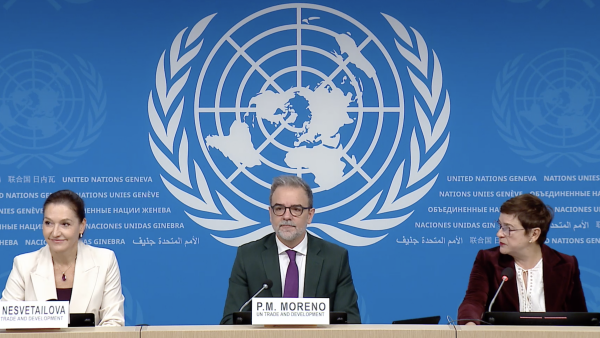
Presentation of the Trade and Developement Report 2026
Embargoed until 9 October 2026 at 11 a.m. (Geneva Time)
UNCTAD: UNCTAD’s flagship report finds that governments increasingly use industrial, trade, financial and technology policies to pursue economic and national security objectives. Market access and the ability to move into higher-value activities now depend more heavily on technology, finance and geopolitics.
1
1
1
Press Conferences | UPU
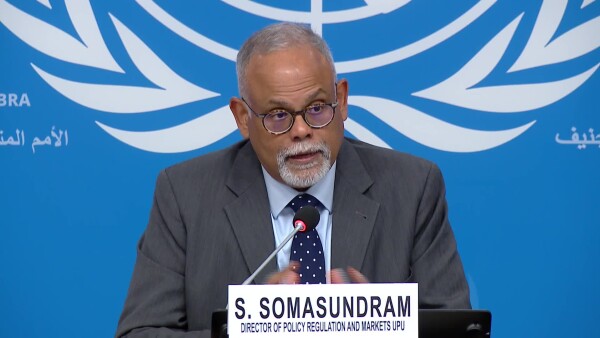
Release of the State of the Postal Sector Report 2026