

The United Nations Office at Geneva
Multimedia Newsroom
Press Conferences | UNHCR , OCHA , WHO , WFP , UNCTAD
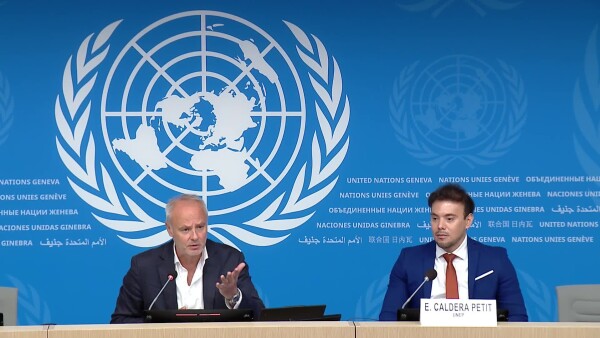
UNOG Bi-weekly press briefing 19 June 2020 continuity
43rd session of the Human Rights Council
Rolando Gomez, for the Human Rights Council (HRC), said that the current session, instead of finishing today, would continue on Monday, 22 June, which was due to the very long list of speakers at the urgent debate on racism and police brutality. The action on draft resolutions would take place today and on Monday. This morning, the Council was continuing discussion on the Central African Republic, after which it would discuss the situation in Afghanistan, and technical assistance and capacity building; in the afternoon the Council would start taking action on 40 draft resolutions, plus seven amendments. The resolution on people of African descent and police brutality should come up around 3 p.m. this afternoon; the voting would take place in Room XX, which was technically equipped for the voting procedure.
Responding to questions, Mr. Gomez could not yet confirm when the 44th session of the Council would take place; that was yet to be decided by the Member States, possibly on 22 June.
World Refugee Day
Babar Baloch, for the United Nations Refugee Agency (UNHCR), stated that one percent of humanity, or close to 80 million people, were currently forcibly displaced. On the occasion of the 20 June World Refugee Day, UNHCR’s High Commissioner had addressed the Security Council, sharing the expectations of the global humanitarian community for this body to perform its role and broker peace. More than 26 million refugees came from only five countries: Syria, Venezuela, Afghanistan, South Sudan, and Myanmar, stressed Mr. Baloch. He also emphasized that the refugee phenomenon was long-lasting, as some refugees, including many of those from Afghanistan, had been displaced for decades.
Alessandra Vellucci, for the United Nations Information Service (UNIS), reminded of the Secretary-General’s message on the World Refugee Day, which had been shared with the media.
COVID-19 and refugees
Fadela Chaib, for the World Health Organization (WHO), informed that Dr Tedros Adhanom Ghebreyesus, their Director-General, and Mr Filippo Grandi, United Nations High Commissioner for Refugees, would hold a joint press conference today at 5 pm. The conference was in the lead up to tomorrow’s World Refugee Day; the two leaders would reiterate how their organizations were working together. Ms. Chaib said that she would revert to the media on the number of questions she received.
COVID-19: World Food Programme’s services
Elisabeth Byrs, for the World Food Programme (WFP), stated that the WFP urgently needed funding to maintain its global network of passengers and cargo services in support of the humanitarian community. Unless a substantial injection of funds was provided by donors by the end of the first week of July, the WFP would have no choice but to ground most of its humanitarian air fleet by the end of July. The Common Services budget of USD 965 million to maintain the air service until the end of the year was only 14 per cent funded. Only USD 178 million had so far been confirmed or advanced, while USD 787 million was urgently required to sustain those essential cargo and passenger movement operations until the end of the year.
The common services provided by the WFP were vital in enabling the humanitarian response for the most vulnerable people in fragile and poor countries, stressed Ms. Byrs. Without the logistical support provided by those common services, global aid operations would be severely compromised. Ms. Byrs informed that thus far 375 passenger and cargo flights had flown to destinations across Africa, Asia, Latin America and the Middle East, and more than 2,500 responders from more than 80 aid organisations had flown to destinations where their assistance was urgently needed. Through cargo movement services, the WFP had delivered a total of 14,500 m3 of COVID-19 related cargo to 129 countries through Africa, Asia, the Middle East and Latin America.
Responding to questions, Ms. Byrs said that many people across different regions, from Africa to Latin America, would be dramatically affected if it was not possible to fly supplies to them. Ms. Byrs could not provide a precise projection of how many people would be affected. WFP would continue as far as it could with the money it had at hand.
Student exams in Syria
Jens Laerke, for the Office for the Coordination of Humanitarian Affairs (OCHA), referred to a joint statement by United Nations Resident Coordinator and Humanitarian Coordinator in Syria, Imran Riza, and Regional Humanitarian Coordinator for the Syria Crisis, Kevin Kennedy, on safe access for students to sit final examinations in Syria. Up to 23,000 students, largely from the northeast but also from the northwest, were expected to travel across front lines to government areas in Syria. They would join approximately 250,000 students across the country who would sit national examinations scheduled to commence on 21 June.
In at least two separate incidents, Mr. Laerke said, non-state armed group members had denied dozens of students safe transit through checkpoints in Idleb and Aleppo governorates while en route to examination centers. Other reports indicated that elsewhere, including in Ar-Raqqa governorate, students had been subject to harassment and intimidation. The UN emphasized that children in Syria, wherever they might live, had the right to finish and complete their education, including through national examinations.
Full statement can be read here.
Ebola in the Democratic Republic of the Congo
Fadela Chaib, for the World Health Organization (WHO), said that there was a new outbreak of Ebola in the Equateur Province in the Democratic Republic of the Congo, since 1 June. She informed that, building on lessons learnt in previous outbreaks, WHO was supporting health authorities to conduct ring vaccinations with people at high risk of Ebola. 9,200 vaccine doses had arrived in Kinshasa from Geneva on 17 June; 4,600 of those vaccine doses would be arriving in Mbandaka at the end of the week. This kind of vaccination effort had been effective in controlling the Ebola outbreak in eastern DRC. WHO had about 50 health experts on the ground, to respond to the outbreak in the Equateur Province; an additional 12 staff deployed from North Kivu to Equateur had arrived this week.
While the new outbreak represented a challenge, the WHO was ready to tackle it and use all of its previous experiences and lessons learned. As of 17 June, there were 18 cases (15 confirmed cases, 3 probable), 12 deaths, while 1,661 contacts were being followed. Some 3,648 people had been vaccinated. Ms. Chaib stressed that Ebola was a complex disease, and the outbreak in Equateur was different from the eastern part of the country. In the Mbandaka areas there were no same security challenges as in eastern DRC.
The latest on Ebola in the DRC can be found here.
Other announcements
Dan Tengo, for the United Nations Conference on Trade and Development (UNCTAD), informed that on 24 June, at 2 p.m. UNCTAD would launch a report on commodities. The report was a special issue on strategic battery raw materials, written in response to the growing importance of electric mobility and the batteries designed to power it
On 29 June, at 3 p.m. UNCTAD would launch a paper on the economic effects of COVID-19 in the tourism sector.
Jarle Hetland, for the International Trade Center (ITC), informed that on 22 June the ITC would release its 2020 SME Competitiveness Outlook. This year’s report was entitled “The Great Lockdown and its Impact on Small Business”. The report provided an overview and findings of how the COVID-19 pandemic had impacted small and medium-sized enterprises. It also provided a detailed forecast of how the lockdowns in China, Europe and the United States would affect international supply chains. As in previous years, the SME Competitiveness Outlook was launched in conjunction with International MSME Day on 27 June. An online broadcast would be held on 24 June. On 22 June, at 2 p.m, there would a hybrid press conference with Dorothy Tembo, acting ITC Executive Director, and Marion Jansen, Chief Economist and Director for Market Development, ITC.
Alessandra Vellucci, for the United Nations Information Service (UNIS), said that the Secretary-General had issued a policy brief on COVID-19 and its impact on the world of work. The brief had been shared with the media.
She further informed that the next formal plenary meetings of the 2020 session of the Conference on Disarmament were scheduled to take place on 23 June, from 10 a.m to 1 p.m, and from 3 p.m. to 6 p.m. in Room XIX, under the presidency of Ambassador Robert Müller of Austria. During this 2020 session, Bangladesh and Belarus were also planned to hold the presidency of the Conference.
Ms. Vellucci reminded that on 24 June at 9 a.m, the International Labour Organization would hold a virtual press conference on the impact of COVID-19 on migrant workers.
Finally, Ms. Vellucci informed that from next week on, there would be “hybrid” briefings at the Palais, meaning that some spokespeople and journalists would be in Press Room III while others would join virtually. The situation would be re-evaluated in a few weeks.
Similar Stories
2
17
1
2
Edited News , Press Conferences | OCHA , WMO
Two UN agencies teamed up on Wednesday to issue an appeal for immediate assistance to help communities already being impacted by the strongest El Niño on record.
1
1
1
Press Conferences | CITES
Wildlife trade and conservation policy discussions at the 81st meeting of the CITES Standing Committee (SC81)
1
1
1
Press Conferences | UNHCR , UNCTAD , WMO , OCHA , UNICEF , WHO
UNHCR Hungary’s 1956 Refugee Crisis: 70 Years On, UNCTAD World Investment Forum 2026, Doha, WMO Greenhouse Gas Bulletin and Climate Update for COP31, OCHA Afghanistan: Malnutrition, Girls’ Education and Recovery, UNICEF Yemen: Child Malnutrition and Unsafe Water in Taiz, WHO Inequalities in Noncommunicable Diseases and Risk Factors
1
1
1
Press Conferences | UNHCR
End of UNHCR's 77th Annual Executive Committee (ExCom) meeting week
1
1
1
Press Conferences | UNICEF , IOM , UNHCR
UN Special Assistant to the Personal Envoy Office (SUDAN): Peace Initiatives and Efforts in Sudan; UNICEF: Dire situation of children in Gaza; IOM: Damaged Homes and Energy Attacks Risk Displacing Ukrainians for this winter; UNHCR: update on EXCOM week
1
1
1
Press Conferences | IOM , UNDRR
UN stresses importance of household preparedness for disaster risk reduction.
1
1
1
Statements , Press Conferences | OHCHR
1
1
1
Press Conferences | UNHCR , UNICEF , IFRC , OHCHR , UN WOMEN , IOM , OCHA , WHO
UNHCR – ExCom Meeting, UNICEF – Nepal Recovery, IFRC – Flash Floods, WHO – Mental Health, IOM – South Sudan Floods, OCHA – DRC Humanitarian aid, UNHCR – Sahel Displacement, UNICEF – Yemen Update, IOM – Gaza Shelter, UN Women – Gaza Women, OHCHR – Arrests and detentions of Syrians by Israeli force
2
1
2
Press Conferences | UNCTAD
Presentation of the Trade and Developement Report 2026
Embargoed until 9 October 2026 at 11 a.m. (Geneva Time)
UNCTAD: UNCTAD’s flagship report finds that governments increasingly use industrial, trade, financial and technology policies to pursue economic and national security objectives. Market access and the ability to move into higher-value activities now depend more heavily on technology, finance and geopolitics.
1
1
1
Press Conferences | UPU
Release of the State of the Postal Sector Report 2026
1
1
1
Press Conferences | IOM , ITU , UNECE , UNICEF , WHO , WMO
UNICEF: Ebola, DRC - children orphans or separating them from parents and caregivers; IOM: Humanitarian needs in Djibouti amid arrivals from Yemen and increased migrant movements; WHO: Darfur, scale of health needs far exceeds available resources; WMO co-sponsored Global Heat Forum, Bangkok, monthly Global Seasonal Climate Update; UNECE: UN Forum of Mayors; ITU Plenipotentiary Conference 2026; WHO: child and adolescent obesity guidelines and new global roadmap to tackle pregnancy hypertension, a leading cause of maternal mortality
1
1
1
Press Conferences | OCHA , UN WOMEN , UNHCR , WFP , WHO , WTO , UNEP
OCHA – $160M CERF allocation to 12 underfunded crises; UNHCR – 5.8M refugee children remain out of school amid funding cuts; UN Women – Middle East escalation and food security among women/girls; WHO – Gaza supplies and overall situation; WFP – Yemen food insecurity and impact on global hunger ; UNEP - First International Conference of the Global Framework on Chemicals in Geneva | 16-20 November 2026