

The United Nations Office at Geneva
Multimedia Newsroom
UN GENEVA PRESS BRIEFING
13 August 2024
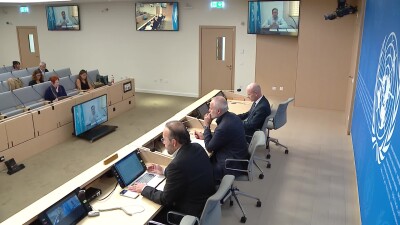
Alessandra Vellucci, Director of the United Nations Information Service in Geneva, chaired a hybrid briefing, which was attended by the spokespersons and representatives of the International Organization for Migration, the United Nations Children’s Fund, the United Nations Human Rights, and the Independent Investigative Mechanism for Myanmar.
Worsening situation in Sudan
Mohamed Refaat, Chief of the International Organization for Migration (IOM) Mission in Sudan, speaking from Port Sudan, stated that he had witnessed unimaginable suffering of the Sudanese people. War, massive displacement, hunger, disease outbreaks and now floods: it seemed that the situation in Sudan worsened by the hour. Millions of families were trapped in a living nightmare. Families were uprooted, homes shattered, and the breaking point of a catastrophic situation had now been surpassed. Over 10.7 million people were internally displaced and some 2.3 million had crossed the border. One out of every five people were internally displaced. Around 20 percent of the entire population had been uprooted from their homes, many displaced multiple times; more than half were children. Hunger had reached catastrophic levels on a scale not seen since the Darfur crisis in the early 2000s. Almost all people displaced across Sudan were in areas with acute food insecurity or worse. Over the next three months, an estimated 25.6 million people would face severe food insecurity as the conflict spread and coping mechanisms are exhausted. Food insecurity was also an issue among the Sudanese refugees in Chad.
Mr. Refaat said that Sudan faced new hardships now as heavy rains had flooded cities, villages, and towns, inflicting further suffering on communities already vulnerable from ongoing conflict.
Families were losing what little they had left. Meanwhile, the violence continued to intensify and spread, with new frontlines in east Sudan pushing over 700,000 people from their homes. A protection crisis was unfolding in front of everyone’s eyes. Despite the challenges, the IOM and partners had reached over 2.7 million people in Sudan and neighboring countries. IOM and partners had requested USD 317 million for Sudan and the neighbouring countries, of which 21 percent had been received until mid-year. Without a massive and coordinated global response, the dire conditions in the country would worsen. Sudan was at a breaking point. The international community was not doing enough: the people of Sudan needed more than just sympathy; they needed action and support. The time to act was now, so that people of Sudan would not stand alone in this dark hour.
James Elder, for the United Nations Children’s Fund (UNICEF), speaking from Atbara, Sudan, said that Sudan’s crisis for children was, by numbers, the largest crisis in the world. Just a few days before, a Sudanese boy football team had been playing in a UNICEF-supported child-friendly space in Khartoum, when a shell hit, killed two boys and injured the rest. Rape and sexual violence were prevalent, and child recruitment was on the rise. Five million people had fled their homes. Mr. Elder stressed that this was the world’s largest child displacement crisis. For more than a year, UNICEF had been saying that Sudan’s children could not wait. Without an unimpeded access to people in need, there would be a catastrophic loss of children’s lives in the coming months. Many children were already suffering from the most lethal levels of malnutrition. Without action, tens of thousands of Sudanese children might day in the coming months. Disease was the greatest fear for UNICEF, as the already terrifying outlook for the children in the country would further worsen.
International humanitarian law and human rights law had to be respected. An immediate ceasefire was needed, as well as scaling up of humanitarian response. UNICEF and partners had reached several million children and their families; with an unimpeded access, many more people in need could be assisted. Without immediate action, the dangerous apathy of the international community would continue.
Alessandra Vellucci, for the United Nations Information Service (UNIS), said that the Secretary-General was deeply alarmed at the evolving situation in El Fasher, where fierce fighting had been reported between the Sudanese Armed Forces, the Rapid Support Forces and elements of the Armed Struggle Movements. He called on all Parties to abide by their obligations under international humanitarian law to protect and allow safe passage for civilians and facilitate rapid, and unimpeded humanitarian access. The Secretary-General reiterated his call for an immediate cessation of hostilities and lasting ceasefire.
Responding to questions from the media, Mr. Refaat, for the IOM, said that there were civilians who were trapped in Khartoum and could not get out. Once free movement was allowed, another wave of displacement from Khartoum could be expected, said Mr. Refaat. Mr. Elder, for UNICEF, spoke of witnessing live fire in Khartoum this week. He spoke of dire conditions in hospitals, where medical workers continued to work for months without pay and often in unsafe circumstances. This was a crisis of neglect; the international community had more than a simple moral obligation to help the people of Sudan. The reason to help Sudan was pragmatic as well: if the famine were to spread across the country, it would be much more expensive to provide assistance that it were now. Mr. Refaat said that there was not sufficient media coverage from the field, which could be one of the reasons this crisis was neglected. He reiterated that a ceasefire was necessary; IOM and partners needed both more resources and unimpeded access. Neglecting Sudan would have cross-regional consequences. Ms. Vellucci, for UNIS, added that the humanitarian response plan for Sudan was currently only 32.8 percent funded, and the Regional Refugee Response Plan was only 21 % funded.
Annual report of the Independent Investigative Mechanism for Myanmar
Nicholas Koumjian, head of the Independent Investigative Mechanism for Myanmar (IIMM), informed that today the IIMM was launching the 6th Annual Report in which it highlighted its work over the past year and preliminary findings. IIMM had collected substantial evidence of an escalation in the frequency, intensity and brutality of war crimes and crimes against humanity committed by the Myanmar military, which came during a time when armed conflicts had increased across the country as challenges to military rule intensified. Civilians were bearing the brunt of more violent and intensive war crimes. Many crimes had been committed with an intent to punish and induce terror in the civilian population. The Mechanism had collected evidence of frequent aerial attacks on schools, religious buildings, hospitals, and displaced persons’ camps where there was no apparent military target, and with significant civilian casualties. IIMM was also investigating brutal acts of physical mutilation against people detained during the armed conflicts, which included beheadings and public displays of disfigured and sexually mutilated bodies.
The Report also outlined some of the Mechanism’s investigations into the unlawful imprisonment of perceived opponents of the military junta and crimes committed in detention.
There was abundant evidence of systematic torture in detention, including gang rape and other violent sexual crimes committed against people of all genders and ages, including children. While the Mechanism could not arrest or prosecute perpetrators, the Report outlined its commitment to ensuring justice for the victims of these crimes. The Mechanism had made considerable progress in building criminal cases against those most responsible for these crimes. IIMM was working towards the day that the evidence it had collected and analysed would be presented in a court of law, and the perpetrators would have to answer for their actions.
Full report can be access here.
Answering questions, Mr. Koumjian said that almost all crimes in detention had been conducted in the facilities run by the military junta. There was no doubt that the junta was becoming more desperate; it was increasingly using aerial bombing, the brunt of which was primarily borne by civilians. The desperation of the regime led to more brutality by the junta, but increased brutality was also being seen on the opposition side. Mr. Koumjian said that the Association of Southeast Asian Nations (ASEAN) should play a more proactive role in ending the violence. Evidence on the crimes had to be collected and accountability subsequently ensured.
Renewed call to release UN detained staff in Yemen
Ravina Shamdasani, for the United Nations Human Rights (OHCHR), informed that UN Human Rights Chief Volker Türk had strongly condemned the storming of the Office’s representation in Sana’a by the Ansar Allah de facto authorities and renewed his call for the immediate and unconditional release of all UN staff detained in Yemen. Entering a UN office without permission and seizing documents and property by force were wholly inconsistent with the Privileges and Immunities of the United Nations. This was also a serious attack on the ability of the UN to perform its mandate. Ansar Allah forces had to leave the premises and return all assets and belongings immediately.
At the same time, multiple calls for the release of the detained staff – from the High Commissioner and other high-level officials – had not been heeded. Türk appealed again for their immediate and unconditional release. One of the two staff detained earlier by Ansar Allah had appeared in videos published online, in which he had been forced to confess to allegations, including of espionage, in a clear violation of his basic human rights protected under international law. “All such claims are baseless,” Türk stressed. The UN Human Rights Office in Yemen worked to promote the human rights of all Yemenis without distinction. This had included monitoring the impact of armed conflict and violence on civilians – irrespective of the parties that may be responsible – including by documenting deaths, injuries, destruction of essential infrastructure and the capacity of the Yemeni people to earn their livelihoods. “It is crucial that the de facto authorities respect the United Nations and its independence, release all detained UN staff immediately, and create conditions in which my Office and other UN agencies can continue their critical work for people of Yemen without threats or hinderance,” the High Commissioner said.
Full statement is available here.
Ms. Shamdasani said, responding to a question, that in her recollection, this was the first time that the de facto authorities had stormed a OHCHR office. A lot was being done behind the scene, at various levels, to ensure the security and safety of the OHCHR staff. Thirteen UN staff had been detained in early June, and one of the OHCHR employees had been forced into admitting espionage on social media. The OHCHR had demanded an unconditional release of detained UN staff, informed Ms. Shamdasani.
Alessandra Vellucci, for the United Nations Information Service (UNIS), reminded that United Nations workers should never be targeted. On 19 August, UN Geneva would mark the World Humanitarian Day to pay tribute to fallen colleagues and emphasize that actors at all levels needed to do what they could to protect UN staff.
Arbitrary detentions in Venezuela
Ravina Shamdasani, for the United Nations Human Rights (OHCHR), stated that UN Human Rights Chief Volker Türk voiced his deep concern over the high and continuing number of arbitrary detentions, as well as disproportionate use of force reported in the aftermath of presidential elections in Venezuela, and the resulting climate of fear. According to official statements, over 2,400 people had been arrested since 29 July. This figure included the arbitrary detention of protesters, human rights defenders, adolescents, people with disabilities, members of the opposition or those perceived to be connected to them, as well as people who had served as electoral observers accredited by opposition parties in polling stations. The High Commissioner called for the immediate release of everyone who had been arbitrarily detained, and for fair trial guarantees for all detainees. The disproportionate use of force by law enforcement officials and the attacks on demonstrators by armed individuals supporting the government, some resulting in deaths, ought not be repeated. All deaths in the context of protests had to be investigated and those responsible held accountable, in line with due process and fair trial standards.
Lists of people wanted for allegedly promoting violence were said to be circulating on social media, including members of the opposition and journalists. There were also calls by the authorities to file complaints against those involved in alleged criminal acts, including legitimate activities, such as participating in public affairs, demonstrating peacefully, or exercising the right to freedom of expression. The High Commissioner urged the authorities to refrain from adopting these and any laws that undermine civic and democratic space in the country – in the interest of social cohesion and the future of the country. “The international community has a fundamental role to promote inclusive dialogue, with human rights of all Venezuelans at heart,” the High Commissioner added.
Full press release is here.
In response to questions, Ms. Shamdasani explained that the OHCHR was generally concerned about the impact of sanctions on the wellbeing of regular people. An inclusive dialogue, including people from all spheres of society, was what was needed in Venezuela. The international community was called upon to take action and bring this crisis to an end. OHCHR did not have staff in the country, she clarified, as there were no conditions for them to work from there; until that changed, 16 OHCHR staff continued to work from Panama. Since the election results had been announced, people were protesting in the streets; some had been killed and many others detained. OHCHR was focused on meaningful participation, freedom of assembly and expression. Without those, the climate of fear ruled. OHCHR remained engaged with the Venezuelan authorities, including at the High Commissioner’s level.
Situation in Russia
Protection of civilians and civilian infrastructure was a top priority, regardless of where military activities were taking place, stressed Ravina Shamdasani, for the United Nations Human Rights (OHCHR), responding to a question on the situation in Russia. She confirmed that the OHCHR had received information from the Russian authorities on the alleged casualties in the Kursk region of Russia. Given the lack of OHCHR access to Russia, it would take some time to verify the reports. OHCHR established that four civilians had been killed but had not yet been able to establish the circumstances. OHCHR always looked for access, especially in conflict situations, explained Ms. Shamdasani.
Announcements
Alessandra Vellucci, for the United Nations Information Service (UNIS), informed that the Committee on the Elimination of Racial Discrimination was concluding this morning its review of the report of Belarus. The Committee would then take up the reports of the United Kingdom, this afternoon at 3 pm, and Bosnia-Herzegovina on 15 August at 3 pm.
The Committee on the Rights of Persons with Disabilities was concluding its review of the report of Burkina Faso. The Committee would review the report of Benin on 14 August and that of the Netherlands on 15 August.
***
The webcast for this briefing is available here
The audio for this briefing is available here
TOPICS
IOM - Mohamed Refaat, IOM Sudan Chief of Mission (From Port Sudan):
- Update on Worsening Situation in Sudan as famine, floods add to massive displacement
UNICEF - James Elder (From Sudan):
- Sudan’s complex catastrophe for children, with a focus on famine, grave violations
- Wednesday’s peace talks
OHCHR - Ravina Shamdasani:
- Yemen: Renewed call to release UN detained staff
- Venezuela: Arbitrary detentions
IIMM - Nicholas Koumjian, Head of the Independent Investigative Mechanism for Myanmar (IIMM):
- Launch of the IIMM Annual Report
Similar Stories
1
1
1
Press Conferences | UN WOMEN , WFP , WHO
UN WOMEN: Sudan Women and girls one year after the fall of El Fasher; increasing drone attacks across the country; WFP: DRC - Ebola spreads to eighth DRC province as WFP delivers food, builds treatment centres and keeps supplies moving; WHO - Update on Ebola (Bundibugyo Virus Disease)
1
12
1
1
Press Conferences , Images | UNOG
Closing Press Conference following the Sixth Consultative Meeting on Enhancing Coordination of Peace Initiatives and Efforts in Sudan

2
17
1
2
Edited News , Press Conferences , Images | OCHA , WMO
Two UN agencies teamed up on Wednesday to issue an appeal for immediate assistance to help communities already being impacted by the strongest El Niño on record.
1
1
1
Press Conferences | CITES
Wildlife trade and conservation policy discussions at the 81st meeting of the CITES Standing Committee (SC81)
1
1
1
Press Conferences | UNHCR , UNCTAD , WMO , OCHA , UNICEF , WHO
UNHCR Hungary’s 1956 Refugee Crisis: 70 Years On, UNCTAD World Investment Forum 2026, Doha, WMO Greenhouse Gas Bulletin and Climate Update for COP31, OCHA Afghanistan: Malnutrition, Girls’ Education and Recovery, UNICEF Yemen: Child Malnutrition and Unsafe Water in Taiz, WHO Inequalities in Noncommunicable Diseases and Risk Factors

1
1
1
Press Conferences | UNHCR
End of UNHCR's 77th Annual Executive Committee (ExCom) meeting week

1
1
1
Press Conferences | UNICEF , IOM , UNHCR
UN Special Assistant to the Personal Envoy Office (SUDAN): Peace Initiatives and Efforts in Sudan; UNICEF: Dire situation of children in Gaza; IOM: Damaged Homes and Energy Attacks Risk Displacing Ukrainians for this winter; UNHCR: update on EXCOM week

1
1
1
Press Conferences | IOM , UNDRR
UN stresses importance of household preparedness for disaster risk reduction.

1
1
1
Statements , Press Conferences | OHCHR

1
1
1
Press Conferences | UNHCR , UNICEF , IFRC , OHCHR , UN WOMEN , IOM , OCHA , WHO
UNHCR – ExCom Meeting, UNICEF – Nepal Recovery, IFRC – Flash Floods, WHO – Mental Health, IOM – South Sudan Floods, OCHA – DRC Humanitarian aid, UNHCR – Sahel Displacement, UNICEF – Yemen Update, IOM – Gaza Shelter, UN Women – Gaza Women, OHCHR – Arrests and detentions of Syrians by Israeli force

2
1
2
Press Conferences | UNCTAD
Presentation of the Trade and Developement Report 2026
Embargoed until 9 October 2026 at 11 a.m. (Geneva Time)
UNCTAD: UNCTAD’s flagship report finds that governments increasingly use industrial, trade, financial and technology policies to pursue economic and national security objectives. Market access and the ability to move into higher-value activities now depend more heavily on technology, finance and geopolitics.

1
1
1
Press Conferences | UPU
Release of the State of the Postal Sector Report 2026