

The United Nations Office at Geneva
Multimedia Newsroom
UN GENEVA PRESS BRIEFING
28 June 2024
Urgent Need for International Solidarity
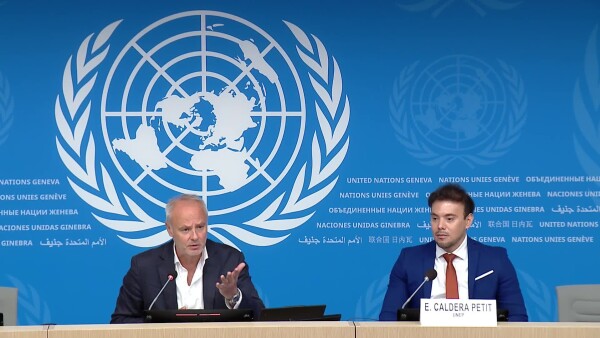
Cecilia Bailliet, Independent Expert on Human Rights and International Solidarity appointed by the United Nations Human Rights Council (HRC), outlined the new revised draft Declaration on the Right to Solidarity, which defines solidarity as an enabling right to focus on trends among civil society and to voice concern for marginalized groups all over the world. Ms. Bailliet stated that the first report on civil society and international solidarity had underscored various measures taken against groups acting in solidarity both in the physical space and in cyberspace.
While Ms. Bailliet’s second report would focus on artificial intelligence (AI) and international solidarity, further reports would address indigenous peoples and solidarities. These would be based on her visits to Inuit communities in Denmark and Greenland, and focus on the impacts of unresolved issues from the age of colonization, the denial of equal rights in private and public spaces, as well as pressures related to natural resource extraction.
Ms. Bailliet announced that the final report would be shared at the United Nations General Assembly and would deal with the infringement of the rights of solidarity actors by corporations that had not established transparent mechanisms of communication.
In answer to a question, Ms. Bailliet stated that the second report focused on AI due to civil society groups' lack of access to infrastructure, and to their marginalization by AI algorithms. This was why the report called for the UN to create a digital solidarity platform, which would serve as a forum enabling civil society groups to exchange solidarity ideas with representatives from governments and business.
David Diaz Martin, for the United Nations Human Rights Council (HRC), shared an update on the Council’s activities, which was finalizing its second week of its 56th regular session. The Council would hold its full-day discussion on human rights and women that same day, and on Monday, 1 July there would be a panel discussion on human rights and the Olympic ideal. This would include participation of the President of the International Olympic Committee, Mr. Thomas Bach. Also on 1 July, the HRC would include a panel discussion on climate change, featuring the new Special Rapporteur on Climate Change, Ms. Elisa Morgera.
Humanitarian Update from Central Gaza
Louise Wateridge, Senior Communications Officer at the United Nations Relief and Works Agency (UNRWA), joined the briefing online from central Gaza and said that she had just returned to the Gaza Strip after four weeks. Ms. Wateridge stated that in that period, conditions had deteriorated significantly, with very limited access to fuel on the ground, restricted movement, and few - if any - waste management services in operation. The living conditions were extremely dire, the weather was extremely hot, with very few resources and limited water. UNRWA was desperately seeking support and looking for help to assist Palestinian refugees in the Gaza Strip.
Answering questions, Ms. Wateridge stated that people in Gaza were hungry and malnourished after enduring 8 months of food insecurity. The physical appearance of many colleagues and local people whom Ms. Wateridge knew personally had changed due to a lack of access to sustained, healthy food, fresh fruit and vegetables, she said.
On a question about the US-backed pier, Ms.Wateridge affirmed that UNRWA had always welcomed any aid that entered the Gaza Strip but underscored that UNRWA’s position was for the entry of humanitarian aid trucks through border crossings, stating that this was both safer and more cost-efficient than any air drops or using the pier.
Daniel Johnson, for the United Nations Information Service (UNIS) in Geneva, reminded reporters of the statement by the spokesperson for United Nations Secretary-General António Guterres, on Thursday: that in spite of UN efforts to get fuel into Gaza there was still not enough reaching UN agencies inside the Strip.
In response to a question on health risks for associated with heat, Tarik Jašarević for the World Health Organization (WHO), stated that summer weather could lead to number of communicable diseases appearing in Gaza for several reasons, including water contamination, food spoilage, mosquitos and flies, dehydration and heatstroke.
WHO had recorded a number of 470,000 cases of diarrhea since the beginning of the conflict, with a majority due to lack of clean water. Mr. Jašarević emphasized that, for children under the age of 5, this combination of lack of food and water, coupled with diarrhea, could be a lethal combination.
Speaking to questions about amputations, Mr. Jašarević stated that while estimates were not available, an entire system would need to be in place for health workers to be able to save a limb, and adequate conditions were currently unavailable in Gaza with the ongoing hostilities. Consequently, if someone currently suffered an injury, they would not only risk losing their limbs and their capacity to live normally, but quite possibly their lives.
Answering a question on evacuations, Louise Wateridge of the United Nations Relief and Works Agency (UNRWA) stated that the situation was as dire as it had ever been and was getting worse every day. She called for the immediate resumption of medical evacuations. In response to the same question, Tarik Jašarević for the World Health Organization (WHO), welcomed the previous day’s evacuation of 21 patients from Gaza. Mr. Jašarević noted that this was the first evacuation since the Rafah crossing’s closure on 7 May, after which it had become difficult logistically to receive approvals and evacuate people,which meant that an estimated 2000 people had not received critical life-saving specialized health care. He echoed Ms. Wateridge’s call, emphasizing that medical evacuations must be facilitated through all possible crossings.
On a question regarding looting, Ms. Wateridge confirmed that it had been on the rise and pointed to factors such as the lack of food and supplies after 8 months of war. She also underlined that money was not being printed or distributed, and most salaries had stopped being distributed. People had nowhere to obtain money, and with limited access to humanitarian aid supplies, they were desperate. She emphasized that because of the siege on the Gaza Strip, it had become a very dangerous and lawless situation on the ground, and the only answer was to provide more aid, more food, more medicine, to the people of Gaza.
Climate Change Pounding Refugee Communities
Andrew Harper, Special Advisor on Climate Action at the UN Refugee Agency (UNHCR), opened by expressing solidarity with UN colleagues in UNRWA.
Mr. Harper stated that UNHCR had been seeing the latest iteration of climate change and how it impacts those most vulnerable in Brazil. At the same time, what was occurring in Africa, Southeast Asia, and almost every part of the world was demonstrating that extreme weather events and natural disasters were shattering many refugee and other displaced communities worldwide, worsening their plight, and, in some cases, displacing them again.
While Mr. Harper acknowledged that the impacts of climate change were affecting every society, it was often those populations that were the most vulnerable, that lacked the resources to resist, that were suffering the most.
He stressed that, when climate records were being consistently broken, there were no existing models that could accurately anticipate what the world would go through in the future, and that "all the worst-case scenarios need to be reworked." This proved challenging for UNHCR in its operations with millions of people who lived on the peripheries of society and were so reliant on external support, he said.
Mr. Harper emphasized the importance of the support from host communities, be it in Brazil, Bangladesh, Kenya, or Chad. He highlighted the need to reinforce the support for these countries, particularly as climate challenges become more evident in these areas.
Mr. Harper mentioned the UNHCR climate-resilience fund , established with the aim of finding support for forcibly displaced people fleeing from or living in climate-vulnerable countries. He stated that one displacement was occurring every second, not just due to conflict, but also due to natural disasters.
According to Mr. Harper, it was no use having early warning unless there was early action. Moreover, it was difficult to do what was required at a time when resources were so limited.
Answering questions, Mr. Harper said there had been a transition from El Niño to La Niña. He also pointed to the extremely high numbers of food insecure people in Sudan, estimated at 25 million people. He specified that this is ranked as an IPC3+-level crisis, which meant they were very food insecure, potentially moving towards a famine-type situation, at a time when flooding and other extreme weather events could also occur.
Mr. Harper pointed to the multiplier effect of human emissions causing climate change and stressed that tipping points would likely be crossed. This, coupled with other issues, such as biodiversity loss, impacts on nature, pollution, and the triple planetary crisis, all needed to be taken into account.
The full UNHCR statement is available here.
Announcements
Daniel Johnson, for the United Nations Information Service (UNIS) in Geneva, said the United Nations Secretary-General António Guterres would be launching The Sustainable Development Goals Report 2024 at 11:30am that morning. The Secretary General would be joined by Yongyi Min, Chief of the SDG Monitoring Section. The report would assess progress on the Sustainable Development Goals, 6 years before the 2030 deadline for their achievement.
On Monday, 1 July at 3:00pm, the World Intellectual Property Organization (WIPO) would hold an online launch of a report on innovation trends in the development of generative AI (GenAI). The report would be launched by Daren Tang, Director General of WIPO, and Christopher Harrison, Patent Analytics Manager of WIPO. The report would remain under embargo until Wednesday, 3 July at 10:00am.
Mr. Johnson announced that on 4 July at 2:00pm, there would be a hybrid launch of a joint International Organization for Migration (IOM), Mixed Migration Centre (MMC) and UN Refugee Agency (UNHCR) the report entitled “On this journey, nobody cares if you live or die”. Outlining risks faced by refugees and migrants on the Central Mediterranean route, the report would remain embargoed until 5 July at 10:30am.
Mr. Johnson informed that the Human Rights Committee would open its 141st session the following Monday at 10:00am.
The date of the next plenary meeting of the Conference on Disarmament would be announced at a later stage, under the Presidency of Ireland.
29 June was the International Day of the Tropics; whereas 30 June would celebrate both International Asteroid Day and the International Day of Parliamentarism.
TOPICS
- HRC David Diaz Martin with Cecilia Bailliet, Independent Expert on human rights and international solidarity:
* Urgent need for international solidarity
* Human Rights Council update
- UNRWA Louise Wateridge, Senior Communications Officer (From Central Gaza): Humanitarian update
- UNHCR Olga Sarrado & William Spindler: UN Refugee Agency sounds the alarm on climate change pounding refugee communities
Similar Stories
1
1
1
Press Conferences | UNHCR
End of UNHCR's 77th Annual Executive Committee (ExCom) meeting week
1
1
1
Press Conferences | UNICEF , IOM , UNHCR
UN Special Assistant to the Personal Envoy Office (SUDAN): Peace Initiatives and Efforts in Sudan; UNICEF: Dire situation of children in Gaza; IOM: Damaged Homes and Energy Attacks Risk Displacing Ukrainians for this winter; UNHCR: update on EXCOM week

1
1
1
Press Conferences | IOM , UNDRR
UN stresses importance of household preparedness for disaster risk reduction.
1
1
1
Statements , Press Conferences | OHCHR
1
1
1
Press Conferences | UNHCR , UNICEF , IFRC , OHCHR , UN WOMEN , IOM , OCHA , WHO
UNHCR – ExCom Meeting, UNICEF – Nepal Recovery, IFRC – Flash Floods, WHO – Mental Health, IOM – South Sudan Floods, OCHA – DRC Humanitarian aid, UNHCR – Sahel Displacement, UNICEF – Yemen Update, IOM – Gaza Shelter, UN Women – Gaza Women, OHCHR – Arrests and detentions of Syrians by Israeli force
2
1
2
Press Conferences | UNCTAD
Presentation of the Trade and Developement Report 2026
Embargoed until 9 October 2026 at 11 a.m. (Geneva Time)
UNCTAD: UNCTAD’s flagship report finds that governments increasingly use industrial, trade, financial and technology policies to pursue economic and national security objectives. Market access and the ability to move into higher-value activities now depend more heavily on technology, finance and geopolitics.
1
1
1
Press Conferences | UPU
Release of the State of the Postal Sector Report 2026
1
1
1
Press Conferences | IOM , ITU , UNECE , UNICEF , WHO , WMO
UNICEF: Ebola, DRC - children orphans or separating them from parents and caregivers; IOM: Humanitarian needs in Djibouti amid arrivals from Yemen and increased migrant movements; WHO: Darfur, scale of health needs far exceeds available resources; WMO co-sponsored Global Heat Forum, Bangkok, monthly Global Seasonal Climate Update; UNECE: UN Forum of Mayors; ITU Plenipotentiary Conference 2026; WHO: child and adolescent obesity guidelines and new global roadmap to tackle pregnancy hypertension, a leading cause of maternal mortality
1
1
1
Press Conferences | OCHA , UN WOMEN , UNHCR , WFP , WHO , WTO , UNEP
OCHA – $160M CERF allocation to 12 underfunded crises; UNHCR – 5.8M refugee children remain out of school amid funding cuts; UN Women – Middle East escalation and food security among women/girls; WHO – Gaza supplies and overall situation; WFP – Yemen food insecurity and impact on global hunger ; UNEP - First International Conference of the Global Framework on Chemicals in Geneva | 16-20 November 2026
1
1
1
Press Conferences | UNHCR , WHO
Yemen's health system nears collapse amid conflict, causing rising casualties and medicine shortages.
1
1
1
Press Conferences | HRC
Update by the Expert Mechanism to Advance Racial Justice and Equality in Law Enforcement
1
1
1
Press Conferences | WIPO , WHO , UNICEF , UNHCR , IOM , WFP , FAO
WIPO Global Innovation Index 2026 launch and press conference, WHO Composition of influenza vaccines for the 2027 Southern Hemisphere flu season, UNICEF Yemen hunger and malnutrition; UNHCR Sudan displacement into Chad; IOM Ebola and population movements in DRC; WFP emergency food assistance in Nepal; and FAO food loss and waste.