

The United Nations Office at Geneva
Multimedia Newsroom
Edited News | OHCHR
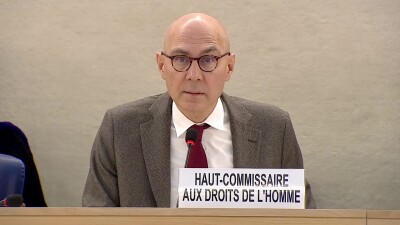
UN High Commissioner for Human Rights Volker Türk oral update on Human Rights situation in Ukraine - 19 December 2023
The UN High Commissioner for Human Rights presented to Human Rights Council the findings of the latest OHCHR's report on the situation of human rights in Ukraine, covering the period of the 1st August to the 30th of November.
“Peace is not a word that I hear very often these days. The situation in Ukraine has been added to a litany of continuous suffering, and the world’s attention seems jaded by the multiple crises that we face. I feel for the Ukrainians, who have a right to peace, and who deserve peace, in line with the UN Charter and international law. Instead, I fear that protracted and entrenched conflict will impact lives and human rights for generations to come,” Türk said.
It has been 662 days since Russia’s full-scale invasion of Ukraine. The UN Human Rights office continues to undertake extensive monitoring and documentation by our Human Rights Monitoring Mission in Ukraine (HRMMU), based on the tried and tested methodology we have developed over decades. “This documentation continues to indicate gross violations of international human rights law, serious violations of international humanitarian law, and war crimes, primarily by the forces of the Russian Federation,” Türk said.
“They include 142 cases of summary execution of civilians since February 2022, in territory controlled by Russian armed forces or occupied by the Russian Federation. On occupied territory, we have documented widespread torture and ill-treatment of detainees, including sexual violence, as well as large numbers of enforced disappearances,” he said.
“In addition, there has been extensive failure by the Russian Federation to take adequate measures to protect civilians and protected civilian objects against the effects of their attacks,” he said.
“As of 4 December, my Office has recorded and confirmed over 10,000 civilian deaths resulting from the conflict since February 2022, including more than 560 children. A further 18,500 civilians have been confirmed injured, many of them severely. The true toll is probably substantially higher,” he said.
Report A/HRC/55/CRP.2 is before you. It covers events between 1 August and 30 November this year. During this period we documented 2,440 civilians killed and injured, most of them by explosive weapons with wide area effects such as artillery shells and rockets; cluster munitions; and missiles, as well as so-called loitering munitions.
“Most of these civilians were killed in areas of Donetsk, Kharkiv, Kherson and Zaporizhzhia near the front lines of combat, and among them was a disproportionate number of older people, unwilling or unable to relocate to greater safety,” the High Commissioner stated.
Significant casualties were also documented due to missile attacks launched by the Russian Federation against targets in densely populated residential areas, often far from the frontlines. Last week's multiple missile attacks on Kyiv, which wounded over 50 people and damaged several apartment buildings, are yet another example. People across the country do not feel safe.
In addition, mines and explosive remnants of war caused over 1,000 civilian casualties since February 2022. This extensive presence of mines and explosive material, across large areas of Ukraine, threatens the lives, rights and livelihoods of Ukrainians in both the immediate and longer term.
“Russian missile attacks have also targeted grain-storage and -transport facilities, which are necessary for the export of food and constitute protected civilian objects under international humanitarian law,” he said. Such attacks threaten a critical sector of Ukraine’s economy, and deprive people in many countries of critically important food.
The report also details, over 1,300 education and health facilities have been damaged or destroyed since February 2022, more than 100 of them in this reporting period. A scant one-half of children in Ukraine are able to attend in-person classes every day.
“In territories occupied by the Russian Federation, including Crimea, we have documented patterns of arbitrary detention and enforced disappearance, by Russian armed forces, of local officials, journalists, civil society activists and other civilians. They include numerous Crimean Tatar activists,” the High Commissioner stated.
The Russian Federation has not permitted us to access any of its places of detention in these territories, impeding a complete count of these cases. Among the victims of arbitrary detention, incommunicado detention and enforced disappearance documented by UN Human Rights Office since 24 February 2022, “at least one hundred civilians died after having been taken into detention by Russian authorities. At least 39 of them appeared to have been tortured before their death: practices of torture and other cruel treatment have been widespread in places of detention in Russian-occupied territories. Many cases of torture that we have documented include sexual violence,” Türk said.
The UN Human Rights office also has no access to Ukrainian prisoners of war who have been interned in territories occupied by the Russian Federation. Many families have received no communication from them, creating deep worry about their fate. Russia has also retained Ukrainian military medical personnel, contrary to international humanitarian law.
The Office is analysing six new reported cases of Russian soldiers killing civilians in occupied territory. The Russian authorities announced the arrest of two Russian soldiers in connection with the killing of a family of nine, including two children, in Volnovakha, in Donetsk oblast. There are also indications that an investigation has been opened into a second case that we have verified, in which a couple was killed in Maly Kopani, Kherson oblast.
Under international law the report states that the occupying power must maintain the status quo, to the extent possible. However the UN Human rights office has continued to document actions by the Russian Federation to impose its own laws, as well as legal, political, and administrative structures in areas it has occupied and purported to annex, in violation of international law – even conscripting Ukrainian men to serve in the Russian military against their own people.
In the reporting period, Ukrainian authorities have continued to prosecute and convict individuals from areas that are or have been under Russian occupation. As of 30 November, some 8,600 criminal charges have been made in relation to collaboration activities or similar charges, with courts ordering, in most cases, that the accused remain in custody pending trial. Verdicts have been handed down in 941 cases. “In the view of my Office, many of these individuals were convicted for conduct that could be lawful – including, for example, work to ensure the continued functioning of social services and schools in occupied areas. I urge the Ukrainian authorities to narrow its definition of “collaboration,” to avoid any conflict with activity that is lawful under international humanitarian law,”he said.
The UN High Commissioner raised his concerns regarding freedom of religion and belief in Ukraine, given continuing action by the authorities against the Ukrainian Orthodox Church. A draft law would set out a procedure for dissolving any religious organization with ties to the Russian Federation. These proposed restrictions to the right to freedom of religion do not appear to comply with international human rights law.
“I also continue to be deeply concerned about potential safety threats at the Zaporizhzhia Nuclear Power Plant – one of the largest nuclear facilities in Europe – which continues to be occupied by Russian forces. The continued use of heavy weapons in close proximity to the site, and fears about mismanagement of its complex systems, could result in catastrophic harm to human rights,” Türk stated.
“I urge all States, especially those with influence, to call for immediate and decisive measures by both parties – and in particular, by the Russian Federation – to ensure that their personnel fully comply with international human rights and humanitarian law,” he said.
Adeding tha they must take all feasible precautions to avoid and minimise civilian harm, including through the selection of means and methods of warfare. They must cease the use of explosive weapons with wide-area effects in populated areas, and scrupulously map the location of mines. Prisoners of war must be treated in full accordance with international humanitarian law.
There must be timely and effective investigations into all allegations of violations, with due prosecution of and accountability for alleged perpetrators, including those with command responsibility. Victims have rights to remedy, reparation and support.
“The targeting of civilian infrastructure, including facilities related to grain production and export; and the practices of arbitrary detention and torture must immediately cease,” Türk said.
“Ukraine must align the "Law on Collaboration Activities” with international law, and refrain from prosecuting individuals for collaboration when their cooperation with the occupying authorities fell within international humanitarian law. It must ensure that legislation protects freedom of religion and does not discriminate against any religious community. I also urge the swift adoption of a national strategy for the protection of civilians,” he stated. Adding “I further urge both the Russian Federation and Ukraine to do everything in their power to ensure the safety and security of the operations at Ukraine’s nuclear power plants,” Türk said.
In conclusion the UN High Commissioner for Human Rights stated that there is only one solution to this tragic and far-reaching conflict: cessation by the Russian Federation of its violence against Ukraine, and a just peace, in line with the United Nations Charter and international law.
Ends
For more information and media requests, please contact:
In Geneva
Jeremy Laurence + +41 22 917 9383 / jeremy.laurence@un.org or
In Nairobi
Seif Magango - +254 788 343 897 / seif.magango@un.org
Tag and share
Twitter @UNHumanRights
Facebook unitednationshumanrights
Instagram @unitednationshumanrights
The UN High Commissioner for Human Rights presented to Human Rights Council the findings of the latest OHCHR's report on the situation of human rights in Ukraine, covering the period of the 1st August to the 30th of November.
“Peace is not a word that I hear very often these days. The situation in Ukraine has been added to a litany of continuous suffering, and the world’s attention seems jaded by the multiple crises that we face. I feel for the Ukrainians, who have a right to peace, and who deserve peace, in line with the UN Charter and international law. Instead, I fear that protracted and entrenched conflict will impact lives and human rights for generations to come,” Türk said.
It has been 662 days since Russia’s full-scale invasion of Ukraine. The UN Human Rights office continues to undertake extensive monitoring and documentation by our Human Rights Monitoring Mission in Ukraine (HRMMU), based on the tried and tested methodology we have developed over decades. “This documentation continues to indicate gross violations of international human rights law, serious violations of international humanitarian law, and war crimes, primarily by the forces of the Russian Federation,” Türk said.
“They include 142 cases of summary execution of civilians since February 2022, in territory controlled by Russian armed forces or occupied by the Russian Federation. On occupied territory, we have documented widespread torture and ill-treatment of detainees, including sexual violence, as well as large numbers of enforced disappearances,” he said.
“In addition, there has been extensive failure by the Russian Federation to take adequate measures to protect civilians and protected civilian objects against the effects of their attacks,” he said.
“As of 4 December, my Office has recorded and confirmed over 10,000 civilian deaths resulting from the conflict since February 2022, including more than 560 children. A further 18,500 civilians have been confirmed injured, many of them severely. The true toll is probably substantially higher,” he said.
Report A/HRC/55/CRP.2 is before you. It covers events between 1 August and 30 November this year. During this period we documented 2,440 civilians killed and injured, most of them by explosive weapons with wide area effects such as artillery shells and rockets; cluster munitions; and missiles, as well as so-called loitering munitions.
“Most of these civilians were killed in areas of Donetsk, Kharkiv, Kherson and Zaporizhzhia near the front lines of combat, and among them was a disproportionate number of older people, unwilling or unable to relocate to greater safety,” the High Commissioner stated.
Significant casualties were also documented due to missile attacks launched by the Russian Federation against targets in densely populated residential areas, often far from the frontlines. Last week's multiple missile attacks on Kyiv, which wounded over 50 people and damaged several apartment buildings, are yet another example. People across the country do not feel safe.
In addition, mines and explosive remnants of war caused over 1,000 civilian casualties since February 2022. This extensive presence of mines and explosive material, across large areas of Ukraine, threatens the lives, rights and livelihoods of Ukrainians in both the immediate and longer term.
“Russian missile attacks have also targeted grain-storage and -transport facilities, which are necessary for the export of food and constitute protected civilian objects under international humanitarian law,” he said. Such attacks threaten a critical sector of Ukraine’s economy, and deprive people in many countries of critically important food.
The report also details, over 1,300 education and health facilities have been damaged or destroyed since February 2022, more than 100 of them in this reporting period. A scant one-half of children in Ukraine are able to attend in-person classes every day.
“In territories occupied by the Russian Federation, including Crimea, we have documented patterns of arbitrary detention and enforced disappearance, by Russian armed forces, of local officials, journalists, civil society activists and other civilians. They include numerous Crimean Tatar activists,” the High Commissioner stated.
The Russian Federation has not permitted us to access any of its places of detention in these territories, impeding a complete count of these cases. Among the victims of arbitrary detention, incommunicado detention and enforced disappearance documented by UN Human Rights Office since 24 February 2022, “at least one hundred civilians died after having been taken into detention by Russian authorities. At least 39 of them appeared to have been tortured before their death: practices of torture and other cruel treatment have been widespread in places of detention in Russian-occupied territories. Many cases of torture that we have documented include sexual violence,” Türk said.
The UN Human Rights office also has no access to Ukrainian prisoners of war who have been interned in territories occupied by the Russian Federation. Many families have received no communication from them, creating deep worry about their fate. Russia has also retained Ukrainian military medical personnel, contrary to international humanitarian law.
The Office is analysing six new reported cases of Russian soldiers killing civilians in occupied territory. The Russian authorities announced the arrest of two Russian soldiers in connection with the killing of a family of nine, including two children, in Volnovakha, in Donetsk oblast. There are also indications that an investigation has been opened into a second case that we have verified, in which a couple was killed in Maly Kopani, Kherson oblast.
Under international law the report states that the occupying power must maintain the status quo, to the extent possible. However the UN Human rights office has continued to document actions by the Russian Federation to impose its own laws, as well as legal, political, and administrative structures in areas it has occupied and purported to annex, in violation of international law – even conscripting Ukrainian men to serve in the Russian military against their own people.
In the reporting period, Ukrainian authorities have continued to prosecute and convict individuals from areas that are or have been under Russian occupation. As of 30 November, some 8,600 criminal charges have been made in relation to collaboration activities or similar charges, with courts ordering, in most cases, that the accused remain in custody pending trial. Verdicts have been handed down in 941 cases. “In the view of my Office, many of these individuals were convicted for conduct that could be lawful – including, for example, work to ensure the continued functioning of social services and schools in occupied areas. I urge the Ukrainian authorities to narrow its definition of “collaboration,” to avoid any conflict with activity that is lawful under international humanitarian law,”he said.
The UN High Commissioner raised his concerns regarding freedom of religion and belief in Ukraine, given continuing action by the authorities against the Ukrainian Orthodox Church. A draft law would set out a procedure for dissolving any religious organization with ties to the Russian Federation. These proposed restrictions to the right to freedom of religion do not appear to comply with international human rights law.
“I also continue to be deeply concerned about potential safety threats at the Zaporizhzhia Nuclear Power Plant – one of the largest nuclear facilities in Europe – which continues to be occupied by Russian forces. The continued use of heavy weapons in close proximity to the site, and fears about mismanagement of its complex systems, could result in catastrophic harm to human rights,” Türk stated.
“I urge all States, especially those with influence, to call for immediate and decisive measures by both parties – and in particular, by the Russian Federation – to ensure that their personnel fully comply with international human rights and humanitarian law,” he said.
Adeding tha they must take all feasible precautions to avoid and minimise civilian harm, including through the selection of means and methods of warfare. They must cease the use of explosive weapons with wide-area effects in populated areas, and scrupulously map the location of mines. Prisoners of war must be treated in full accordance with international humanitarian law.
There must be timely and effective investigations into all allegations of violations, with due prosecution of and accountability for alleged perpetrators, including those with command responsibility. Victims have rights to remedy, reparation and support.
“The targeting of civilian infrastructure, including facilities related to grain production and export; and the practices of arbitrary detention and torture must immediately cease,” Türk said.
“Ukraine must align the "Law on Collaboration Activities” with international law, and refrain from prosecuting individuals for collaboration when their cooperation with the occupying authorities fell within international humanitarian law. It must ensure that legislation protects freedom of religion and does not discriminate against any religious community. I also urge the swift adoption of a national strategy for the protection of civilians,” he stated. Adding “I further urge both the Russian Federation and Ukraine to do everything in their power to ensure the safety and security of the operations at Ukraine’s nuclear power plants,” Türk said.
In conclusion the UN High Commissioner for Human Rights stated that there is only one solution to this tragic and far-reaching conflict: cessation by the Russian Federation of its violence against Ukraine, and a just peace, in line with the United Nations Charter and international law.
Ends
For more information and media requests, please contact:
In Geneva
Jeremy Laurence + +41 22 917 9383 / jeremy.laurence@un.org or
In Nairobi
Seif Magango - +254 788 343 897 / seif.magango@un.org
Tag and share
Twitter @UNHumanRights
Facebook unitednationshumanrights
Instagram @unitednationshumanrights
STORY: UN Human Rights Chief Volker Türk oral update on human rights situation in Ukraine
TRT: 06:00
SOURCE: UNTV /OHCHR
RESTRICTIONS: NONE
LANGUAGE: English/NATS
ASPECT RATIO: 16:9
DATELINE: 19 December 2023 GENEVA, SWITZERLAND
SHOTLIST
- Exteriors shot: Palais des Nations
- Various shots: Inside room podium
- Soundbite (English)— Volker Türk, High Commissioner for UN Human Rights: “Peace is not a word that I hear very often these days. The situation in Ukraine has been added to a litany of continuous suffering, and the world’s attention seems jaded by the multiple crises that we face. I feel for the Ukrainians, who have a right to peace, and who deserve peace, in line with the UN Charter and international law. Instead, I fear that protracted and entrenched conflict will impact lives and human rights for generations to come.”
- Cutaways: maps from Human Rights Monitoring Mission in Ukraine (HRMMU) report
- Soundbite (English)— Volker Türk, High Commissioner for UN Human Rights: “This documentation continues to indicate gross violations of international human rights law, serious violations of international humanitarian law, and war crimes, primarily by the forces of the Russian Federation.”
- Cutaways: maps from Human Rights Monitoring Mission in Ukraine (HRMMU) report
- Soundbite (English)— Volker Türk, High Commissioner for UN Human Rights: “They include 142 cases of summary execution of civilians since February 2022, in territory controlled by Russian armed forces or occupied by the Russian Federation. On occupied territory, we have documented widespread torture and ill-treatment of detainees, including sexual violence, as well as large numbers of enforced disappearances.”
- Cutaways: maps from Human Rights Monitoring Mission in Ukraine (HRMMU) report
- Soundbite (English)— Volker Türk, High Commissioner for UN Human Rights: “In addition, there has been extensive failure by the Russian Federation to take adequate measures to protect civilians and protected civilian objects against the effects of their attacks.”
- Cutaways: maps from Human Rights Monitoring Mission in Ukraine (HRMMU) report
- Soundbite (English)— Volker Türk, High Commissioner for UN Human Rights: “As of 4 December, my Office has recorded and confirmed over 10,000 civilian deaths resulting from the conflict since February 2022, including more than 560 children. A further 18,500 civilians have been confirmed injured, many of them severely. The true toll is probably substantially higher.”
- Cutaways: room 20
- Soundbite (English)— Volker Türk, High Commissioner for UN Human Rights: “Most of these civilians were killed in areas of Donetsk, Kharkiv, Kherson and Zaporizhzhia near the front lines of combat, and among them was a disproportionate number of older people, unwilling or unable to relocate to greater safety.”
- Cutaways: room 20
- Soundbite (English)— Volker Türk, High Commissioner for UN Human Rights: “Russian missile attacks have also targeted grain-storage and -transport facilities, which are necessary for the export of food and constitute protected civilian objects under international humanitarian law.”
- Cutaways: room 20
- Soundbite (English)— Volker Türk, High Commissioner for UN Human Rights: “In territories occupied by the Russian Federation, including Crimea, we have documented patterns of arbitrary detention and enforced disappearance, by Russian armed forces, of local officials, journalists, civil society activists and other civilians. They include numerous Crimean Tatar activists.”
- Cutaways: room 20
- Soundbite (English)— Volker Türk, High Commissioner for UN Human Rights: “At least one hundred civilians died after having been taken into detention by Russian authorities. At least 39 of them appeared to have been tortured before their death: practices of torture and other cruel treatment have been widespread in places of detention in Russian-occupied territories. Many cases of torture that we have documented include sexual violence.”
- Cutaways: room 20
- Soundbite (English)— Volker Türk, High Commissioner for UN Human Rights: “In the view of my Office, many of these individuals were convicted for conduct that could be lawful – including, for example, work to ensure the continued functioning of social services and schools in occupied areas. I urge the Ukrainian authorities to narrow its definition of “collaboration,” to avoid any conflict with activity that is lawful under international humanitarian law.”
- Cutaways: room 20
- Soundbite (English)— Volker Türk, High Commissioner for UN Human Rights: “I also continue to be deeply concerned about potential safety threats at the Zaporizhzhia Nuclear Power Plant – one of the largest nuclear facilities in Europe – which continues to be occupied by Russian forces. The continued use of heavy weapons in close proximity to the site, and fears about mismanagement of its complex systems, could result in catastrophic harm to human rights.”
- Cutaways: room 20
- Soundbite (English)— Volker Türk, High Commissioner for UN Human Rights: “I urge all States, especially those with influence, to call for immediate and decisive measures by both parties – and in particular, by the Russian Federation – to ensure that their personnel fully comply with international human rights and humanitarian law.”
- Cutaways: room 20
- Soundbite (English)— Volker Türk, High Commissioner for UN Human Rights: “The targeting of civilian infrastructure, including facilities related to grain production and export; and the practices of arbitrary detention and torture must immediately cease”
- Cutaways: room 20
- Soundbite (English)— Volker Türk, High Commissioner for UN Human Rights: “Ukraine must align the "Law on Collaboration Activities” with international law, and refrain from prosecuting individuals for collaboration when their cooperation with the occupying authorities fell within international humanitarian law. It must ensure that legislation protects freedom of religion and does not discriminate against any religious community. I also urge the swift adoption of a national strategy for the protection of civilians,”
- Cutaways: room 20
- Soundbite (English)— Volker Türk, High Commissioner for UN Human Rights:
- “I further urge both the Russian Federation and Ukraine to do everything in their power to ensure the safety and security of the operations at Ukraine’s nuclear power plants.”
Similar Stories

1
1
1
Edited News | OCHA , UNICEF , WFP
Aid agencies warned on Friday of the fast-developing humanitarian emergency inside Taiz City in Yemen, which has been encircled by de facto Houthi forces fighting government troops along the country’s west coast.

2
17
1
2
Edited News , Press Conferences , Images | OCHA , WMO
Two UN agencies teamed up on Wednesday to issue an appeal for immediate assistance to help communities already being impacted by the strongest El Niño on record.

3
16
2
2
Edited News , B-roll , Conferences , Images | UNITED NATIONS , UNOG
Sixth Consultative Meeting on Enhancing Coordination of Peace Initiatives and Efforts for Sudan

1
1
1
Edited News | UNICEF , WHO , UNHCR
Yemen war continues to force families from homes amid hunger and disease
More than 250,000 people have now fled renewed fighting in Yemen, the UN said on Tuesday, citing particular concern for those sheltering in the southwestern city of Taiz and the wider governorate, where access is “essentially blocked”.

1
1
1
Edited News | UNICEF
A little over one year since a ceasefire agreement was announced between Hamas fighters and Israel, more than 340 children have been reported killed and hundreds more injured, the UN Children’s Fund, UNICEF, said on Friday.

1
1
1
Edited News | UNICEF , IFRC
Six weeks after Nepal’s deadly flooding disaster, communities are still struggling to rebuild their lives, but they will need sustained help as global warming increases the risk of another Himalayan catastrophe, the UN Children’s Fund (UNICEF) said on Friday.

1
1
1
Edited News | WHO
In suspected Russia plague death, testing and monitoring underway – WHO
The death of a lab worker in Russia’s Siberia region has sparked concerns about plague being the cause, the UN World Health Organization (WHO) said on Tuesday, adding that it was following the situation closely.

1
1
Edited News | OHCHR , UNOG
UN Human Rights Chief Volker Türk on Friday provided and oral update to the 63rd session of the Human rights Council on Ukraine.

1
1
1
Edited News | OHCHR , UNOG
UN Human Rights Chief Volker Türk on Friday provided and oral update to the 63rd session of the Human rights Council on the human rights situation in Haiti.

1
1
1
Edited News | WHO
Repeated delays in bringing lifesaving medicines, prosthetics and more from Israel into Gaza risk having devastating consequences on Palestinians who urgently need them in the wartorn enclave, the UN World Health Organization (WHO) said on Friday. “A truck full of non-priority supplies or the right supplies arriving too late, doesn't save lives. That's the question that actually matters," said Dr Reinhilde Van De Weerdt, WHO Representative in the OPT.

1
1
1
Edited News | WHO
DRC: Early access to care and oxygen decisive for Ebola patients’ survival – WHO
In the Democratic Republic of the Congo (DRC), health workers fighting the country’s largest-ever Ebola outbreak are struggling to overcome critical challenges to patient care, the UN World Health Organization (WHO) warned on Tuesday.

1
1
1
Edited News | OCHA , UN
Civilians in Iran are continuing to feel the consequences of months of conflict and military escalation, the UN’s top official in the country has said, as loss of life, damage to civilian infrastructure and mounting economic pressures leave many facing continued uncertainty.