UNCTAD Press Conference: Report on Programme of Assistance to the Palestinian People 25 October 2023
/
40:35
/
MP4
/
2.9 GB
Teleprompter
Download Expired

Press Conferences | UNCTAD

UNCTAD Press Conference: Report on Programme of Assistance to the Palestinian People 25 October 2023

Launch of the UNCTAD report on its Programme of Assistance to the Palestinian People 2023

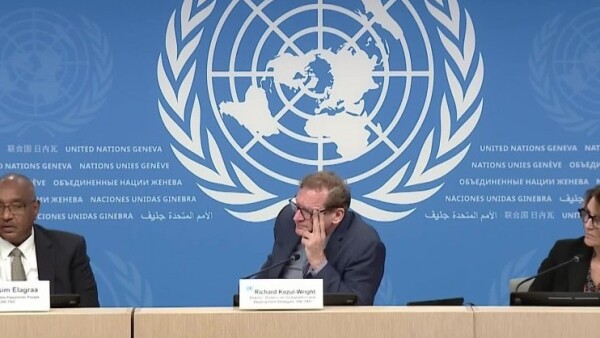
Speakers:

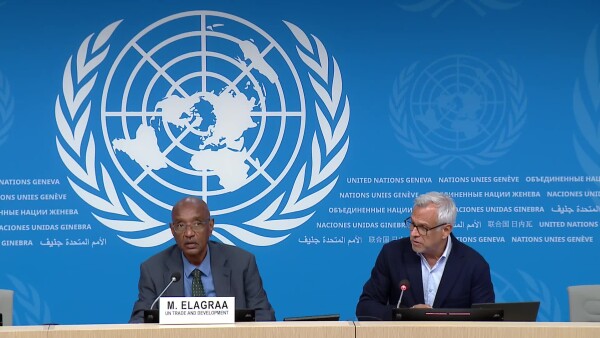
  • Richard Kozul-Wright, Director, Division on Globalization and development Strategies
  • Mutasim Elagraa, Coordinator, UNCTAD Assistance to the Palestinian People

UNCTAD PRESS RELEASE: https://mailchi.mp/unctad/palestine-report?e=5b97b4c2da

PRESS RELEASE
EMBARGO

The contents of this document and the related report must not be quoted or summarized in the print, broadcast or electronic media before

25 October 2023, 10.00 a.m. GMT

(6:00 am in New York, 12 p.m in Geneva)

UNCTAD/PRESS/PR/2023/025
Original: English

ORIGINAL: ENGLISH

PRIOR TO CURRENT CRISIS, DECADES-LONG BLOCKADE HOLLOWED GAZA’S ECONOMY, LEAVING 80% OF POPULATION DEPENDENT ON INTERNATIONAL AID

Inflation, a shrinking fiscal space, a decline in foreign aid and the build-up of debt kept the economy of the Occupied Palestinian Territory below its 2019 pre-pandemic level.

Geneva, 25 October 2023 The latest report by the United Nations Conference on Trade and Development (UNCTAD) on its assistance to the Palestinian people says 2022 was another bad year for Palestinians.

Against a backdrop of heightened political tensions, deepening dependency on the occupying Power and a stalled peace process, the Palestinian economy continued to operate below potential in 2022 as other persistent challenges intensified.

These include loss of land and natural resources to Israeli settlements, endemic poverty, a shrinking fiscal space, declining foreign aid and the build-up of public and private debt.

Economy still reeling from COVID-19 shock

Even though the Palestinian GDP grew by 3.9% in 2022, per capita real GDP was still 8.6% below its 2019 pre-pandemic level. In Gaza, real GDP per capita was 11.7% below the 2019 level and close to its lowest level since 1994.

Unemployment remained high at 24% across the Occupied Palestinian Territory, 13% in the West Bank and 45% in Gaza – with women and youth hit hardest. Poverty increased, rendering 40% of the population in need of humanitarian assistance.

With the rise in global food and energy prices, poorer households suffer disproportionately because food accounts for a greater share of their total expenditure.

Three decades after the Oslo Accords, the hoped-for convergence between the Palestinian economy and Israel’s remains obstructed by occupation policies. Instead, the two economies have diverged, with the Palestinian per capita GDP currently standing at just 8% of Israel’s.

Forced economic dependence

The report highlights the Palestinian economy’s forced dependency on Israel. Excessive production and transaction costs and barriers to trade with the rest of the world have resulted in a chronic trade deficit and a pervasive, lopsided dependence on Israel, which accounted for 72% of total Palestinian trade in 2022.

Meanwhile, lack of a national currency and reliance on the Israeli shekel leave little space for monetary policy while the strong shekel exchange rate undermines the already impaired competitiveness of Palestinian producers in domestic and foreign markets.

The dearth of jobs forces many Palestinians to seek employment in Israel and settlements. In 2022, 22.5% of employed Palestinians from the West Bank worked in Israel and settlements, where the average wage is higher. But broker fees and other associated costs account for 44% of gross pay, wiping out the premium over the average domestic wage, which indicates that search for employment in Israel and settlements is largely driven by limited employment opportunities in the domestic economy.

Over-reliance on precarious employment in Israel and settlements exposes the Palestinian economy to shocks in a volatile environment characterized by frequent crises, while lack of monetary and fiscal space leaves little room for effective policy response to shocks and crises, the report warns.

Since its birth in 1994, the Palestinian government has coped with unique and complex economic, political and social responsibilities far greater than the political and economic resources at its disposal.

In the past, donor aid helped soften the impact of occupation. However, in 2022 the Palestinian government received just $250 million in donor budget support and $300 million for development projects. This is a steep decline from a total $2 billion, or 27% of GDP in 2008, to less than 3% of GDP in 2022.

Gaza: A decade and a half of suppressed development

Since June 2007, Gaza suffered several military operations and has been under a land, sea and air closure. Gazans need permits to move in and out of the strip through two land crossing points controlled by Israel.

Restrictions on the movement of people and goods, destruction of productive assets in frequent military operations and the ban on the importation of key technologies and inputs have hollowed out Gaza’s economy.

Investment in 2022 diminished to 10.7% of Gaza’s GDP - or a meagre 1.9% of the Palestinian GDP. Between 2006 and 2022, Gaza’s real GDP per capita shrank by 27%, while its share in the Palestinian economy contracted from 31% to 17.4%.

The restrictions on movement also impede access to health and other essential services, as 80% of Gazans depend on international aid.

Living in Gaza in 2022 meant confinement in one of the most densely populated spaces in the world, without electricity half the time, and without adequate access to clean water or a proper sewage system.

It meant a 65% probability of being poor, 41% probability of dropping out of the labour force in despair, and for those looking for work, a 45% probability of being unemployed, the report concludes.

------------------

About UNCTAD

UNCTAD is the UN’s leading institution dealing with trade and development. It is a permanent intergovernmental body established by the United Nations General Assembly in 1964.

UNCTAD is part of the UN Secretariat and has a membership of 195 countries, one of the largest in the UN system. UNCTAD supports developing countries to access the benefits of a globalized economy more fairly and effectively.

We provide economic and trade analysis, facilitate consensus-building and offer technical assistance to help developing countries use trade, investment, finance and technology for inclusive and sustainable development.

------------------

Contacts: UNCTAD Communications and Information Unit,
Catherine Huissoud, +41 22 917 5549, +41 79 502 4311,
catherine.huissoud@unctad.org, http://unctad.org/press

To receive our press material, please register at:
https://unctad.org/en/Pages/RegisterJournalist.aspx.

LINK to the press release: https://mailchi.mp/unctad/palestine-report?e=5b97b4c2da

LINK to UNCTAD PDF report on its Programme of Assistance to the Palestinian People 2023: https://unctad.org/system/files/official-document/tdbex74d2_en.pdf

Documents 2
Report on UNCTAD assistance to the Palestinian people
Download Expired
Download Storyline
Download Expired

Audio Files 1
Download UNCTAD Press Conference: Report on Programme of Assistance to the Palestinian People 25 October 2023 (Continuity)
Download Expired

Similar Stories

UN Geneva Press Briefing - 18 September 2026

1

1

1

Press Conferences | IOM , OHCHR , UN WOMEN , UNFPA , UNHCR , UNOPS , WHO

UN Geneva Press Briefing - 18 September 2026 ENG FRA

UN Geneva briefing: Yemen crisis worsens, urgent aid needed across multiple sectors.

HRC - Press conference: Fact-Finding Mission on the Bolivarian Republic of Venezuela

1

1

1

Press Conferences | HRC

HRC - Press conference: Fact-Finding Mission on the Bolivarian Republic of Venezuela ENG FRA

Press conference on the latest report of the Independent International Fact-Finding Mission on the Bolivarian Republic of Venezuela to the UN Human Rights Council

OHCHR - Press conference: A Global Briefing on Transitional Justice Around the World

1

1

1

Press Conferences | OHCHR

OHCHR - Press conference: A Global Briefing on Transitional Justice Around the World ENG FRA

Victims Still Waiting: A Global Briefing on Transitional Justice Around the World


WMO - Press conference: State of Global Water Resources Report 2025 (embargo lifts 6am CET 17 Sept.)

2

1

2

Edited News , Press Conferences | WMO

WMO - Press conference: State of Global Water Resources Report 2025 (embargo lifts 6am CET 17 Sept.) ENG FRA

As world’s water reserves change, countries must prepare for a new reality: WMO

New data showing that rivers were at their lowest level for decades last year provides further evidence that the climate crisis is real and countries must act immediately to protect themselves from the increasing threat to communities and livelihoods, the UN World Meteorological Organization (WMO) said on Thursday.  
The key findings from WMO’s State of Global Water Resources 2025 report covering the hydrological cycle and extreme events in the five-year period to last year:

  • 2025 was one of driest years for river discharge in 35 years
  • Past seven years have seen abnorfmal river flows
  • Water storage on Earth’s land surface has decreased in past decade
  • Widespread glacier loss across all regions for fourth consecutive year
  • Asia and Africa are regions most affected by water-related disasters
  • Water data availability has improved, but gaps remain in hard-hit areas

Highlighting the long-term decline in the Earth’s freshwater storage and glacier melt, WMO Secretary-General Celeste Saulo explained that the planet’s water reserves used to act as a planetary “savings account” that absorbed the occasional dry season, avoiding a water crisis. “One of the central stories of the 2025 report is what is happening to that savings account? And the simple answer is that we are depleting it,” she told journalists in Geneva.

Groundwater reserves are equally stretched and have been in decline since 2014, WMO’s report states, with nearly two-thirds of monitored wells worldwide showing levels lower than the historical norm and indicating a shift “further toward deficit…not recovery”.
“At the same time, we are seeing more water-related disasters,” Ms. Saulo said, while also stressing that the currently strengthening El Niño “will increase the risk of drought in some areas, and flooding in others”. 
Glaciers disappearing

In 2025, for the fourth consecutive year, every major glaciated region on Earth lost ice mass, leading to short-term hazards including floods and long-term water insecurity, according to WMO.

Responding to a question about whether the changing global water cycle might have contributed to the deadly Nepal-China flooding disaster, Ms. Saulo explained that melting ice and rock was just one factor in the chain of events that ultimately sent a massive and deadly wall of water and debris downstream on 26 August, killing at least 1,367 people.

You asked if it could happen again? Absolutely; the problem in this region is that there’s 63,700 glaciers at the last count,” she told a Press Conference in Geneva. “Even if you’re looking with remote sensing with satellites at these glaciers, you might see some faults, you might see some slight shifting, that does not mean necessarily catastrophic collapse. So, in order to plan for this, it’s very, very difficult. But the international community is looking very hard at ways in which we can bring people together to solve some of these monitoring issues.”

Data indicates that glaciers shrank between 2023 and 2025 with cumulative losses of 1,400 gigatonnes of water – or about one third of annual fresh water needs.

Every major glacier region on Earth lost ice for the fourth consecutive year.

“All 19 glacier regions around the globe lost ice; in Central Asia, Iceland, the Russian Arctic and western Canada and the United States, it was among the three worst years on record,” said Wayne Jenkinson, WMO’s Director of Hydrology and Cryosphere.

Some regions with smaller glaciers such as Central Europe, the Caucasus, the western Canada and the United States may already have reached “peak water”, Mr. Jenkinson warned.

“After this point, the glacier gives less meltwater each year simply because there is less ice left to melt. That matters for every community downstream that relies on water during hot, dry summers,” he explained.

Narelle van der Wel, WMO’s Head of Cryosphere Monitoring, Predictions and Services, stressed that while some further glacier loss is unavoidable, the eventual scale of the decline is not predetermined.

“Some glacier loss is inevitable, but total loss of glaciers is not yet inevitable,” she said, pointing to emissions reductions as central to limiting future losses.

Preparing for moving baselines

The report does not attribute every observed change to climate change alone. WMO says pressure on water resources and natural variability also contribute.

Mr. Jenkinson said governments need to prepare for “moving baselines” as historical patterns become less reliable.

“The situation 30 years ago is not where we are today,” he said. Countries, he added, need to prepare “for those changes that have really already arrived”.

ends

UN Geneva Press Briefing - 15 September 2026

1

1

1

Press Conferences | WMO , OCHA , WHO , UNICEF , UN WOMEN , OHCHR , IOM , UNHCR

UN Geneva Press Briefing - 15 September 2026 ENG FRA

Update on Ebola from WHO and OCHA, update on the situation of children with the beginning of school in Ukraine from UNICEF, UN Women on the impact of the settlers and restrictions on women and girls in West Bank, OHCHR on the recovery of extensive human remains in Gaza, IOM and UNHCR on the new wave of displacement in Yemen 

South Sudan hunger crisis - WFP

2

1

2

Press Conferences , Edited News | WFP

South Sudan hunger crisis - WFP ENG FRA

‘Super El Niño’ and converging crises worsen hunger in South Sudan and across the region - WFP

South Sudan’s hunger crisis is becoming increasingly catastrophic as violence, extreme weather and dwindling aid leave millions without enough food, the UN World Food Programme (WFP) warned on Tuesday.

HRC - Press conference: Group of Independent Experts on Belarus

1

1

1

Press Conferences | HRC

HRC - Press conference: Group of Independent Experts on Belarus ENG FRA

Update on the human rights situation in Belarus by the UN Group of Independent Experts on the Human Rights Situation in Belarus

HRC CoI on Syria Press conference - 08 September 2026

1

1

1

Press Conferences | HRC , OHCHR

HRC CoI on Syria Press conference - 08 September 2026 ENG FRA

Update on the human rights situation in Syria by the Independent International Commission of Inquiry on the Syrian Arab Republic

UN Geneva Press Briefing - 08 September 2026

1

1

1

Press Conferences | UNOG , IOM , UN WOMEN , UNCTAD , WHO , UNECE

UN Geneva Press Briefing - 08 September 2026 ENG FRA

IOM Yemen's Western Coast displacement; UN WOMEN on Gaza; UNCTAD Strait of Hormuz disruptions impacts; WHO Ebola logistics in DRC; WHO smoking and infertility; UNECE Data centres and energy.

UN Geneva Press Briefing - 04 September 2026

1

1

1

Press Conferences | UNITAR , WMO

UN Geneva Press Briefing - 04 September 2026 ENG FRA

UNITAR: GA resolution on the merger of the United Nations System Staff College into the United Nations Institute for Training and Research; WMO: Air Quality and Climate Bulletin released; WHO: Ukraine update

WMO Press conference: El Niño Update

2

2

2

Press Conferences , Edited News | WMO

WMO Press conference: El Niño Update ENG FRA

Powerful El Niño heightens extreme-weather risks through 2027, as countries brace for impact - WMO

Fuelled by extraordinarily warm waters across the tropical Pacific Ocean, the El Niño climate pattern is expected to intensify in the coming months. Forecasters are almost certain that it will persist through February next year, with unusually warm conditions expected across the globe.

UN Geneva Press Briefing - 01 September 2026

1

1

1

Press Conferences | IFRC , UN WOMEN , WFP , WHO , WMO , OCHA

UN Geneva Press Briefing - 01 September 2026 ENG FRA

UN WOMEN/IFRC: Update on the impact of the floods in Nepal, WFP: Food assistance in the West Bank, WHO: Gaza’s rehabilitation needs and continued spread of diseases