

The United Nations Office at Geneva
Multimedia Newsroom
Press Conferences | OHCHR , UNICEF , UNHCR , OCHA , WHO , UNOG , WFP , UNCTAD , WMO
UNOG Bi-weekly press briefing 01 May 2020
International Labour Day
Alessandra Vellucci, for the United Nations Information Service in Geneva (UNIS), informed that the United Nations Secretary-General had published a statement to mark on the International Day of Labour, noting that, this year, with the COVID-19 pandemic unfolding around them, people around the world were truly seeing workers who too often toiled unseen. “As we seek to build back better in the wake of this pandemic, the wellbeing of people must be at the centre of economic and social policies with a special focus on who are being furthest left behind,” the Secretary-General had said. The full statement is available here.
COVID-19 pandemic
- Supply chain logistics
Amer Daoudi, COVID-19 Corporate Response Director and Senior Director of Operations for the World Food Programme (WFP) said a WFP-contracted Boeing 757 cargo flight had departed the newly-established Global Humanitarian Response Hub in Liège, Belgium, late on Thursday, carrying almost 16 metric tons of medical cargo and personal protective equipment like masks and gloves on behalf of UNICEF and the International Committee of the Red Cross and destined for Burkina Faso and Ghana. WFP was setting up the logistics backbone for global COVID-19 efforts, rolling out a global hub-and-spokes system of air links to dispatch vital medical and humanitarian cargo and transport health workers to the front lines of the pandemic. Global Humanitarian Response Hubs located close to where medical supplies were manufactured in Liège, Dubai, and China would link to regional hubs in Ethiopia, Ghana, Malaysia, Panama, Dubai, and South Africa, where a fleet of smaller aircraft would be on standby to move cargo and personnel into priority countries. A press release is available here.
Responding to questions, Mr. Daoudi said that there were no flights from Geneva and Rome, as commercial alternatives had been found for these cities. Where there were commercial alternatives, WFP stood down, he explained.
- Displaced people’s access to social safety nets
Andrej Mahecic, for the United Nations Refugee Agency (UNHCR), said the Agency was alarmed at the increasingly desperate situation of those forcibly displaced by conflicts and violence, particularly in low and middle-income countries, which currently shelter more than 85 per cent of the world’s refugees. Across the Middle East and North Africa alone, UNHCR and its partners had received over 350,000 calls from refugees and internally displaced people since lockdowns and other public health measures came into force in many countries in March. The majority asked for urgent financial assistance to cover their daily existential needs. Across all major refugee operations and despite challenges, UNHCR was working to provide emergency assistance including cash-based assistance, secure shelter spaces and to ensure the inclusion of refugees in national public health responses, in social safety nets and any assistance plans. Urgent action was required to help the most vulnerable refugees and internally displaced persons, especially where they had no access to state-run social protection schemes. A briefing note is available here.
Responding to a question on UNHCR’s appeal for funds to respond to the COVID-19 pandemic, Mr. Mahecic said a revision of the Global Humanitarian Appeal, launched by the UN a few weeks ago, was upcoming, but so far the response had been generous.
- Backlog in vaccine shipments
Marixie Mercado, for the United Nations Children’s Fund (UNICEF), said UNICEF was calling for support to unlock a massive backlog in vaccine shipments due to unprecedented logistical constraints related to COVID-19 mitigation measures including lockdowns in some countries. As of 1 May, dozens of countries were at risk of stock-out due to delayed vaccine shipments. At most risk were 26 countries that were difficult to reach due to limited commercial and cargo options. Disruptions in routine immunization, particularly in countries with weak health systems, could lead to disastrous outbreaks in 2020 and well beyond. UNICEF was working to find solutions with manufacturers and partners, including WHO, GAVI, the vaccine alliance, the Pan American Health Organization and the Bill and Melinda Gates Foundation. UNICEF and was appealing to governments, the private sector, the airline industry, and others, to free up freight space at affordable cost for these life-saving vaccines.
Responding to questions, Ms. Mercado said it was possible to carry out immunization campaigns despite the pandemic. It was currently being done in the Democratic Republic of Congo, for instance, in compliance with measures to avoid the spread of the COVID-19.
Tarik Jašarević, for the World Health Organization (WHO), added that WHO had issued guidance on the provision of immunization services during the COVID-19 pandemic.
- March smuggling tragedy survivors’ return to Ethiopia
Paul Dillon, for the International Organization for Migration (IOM), recalled that the remains of 64 migrants from Ethiopia had been found locked in a container at the back of a truck, discovered on 24 March near Tete, Mozambique after crossing over the Malawi-Mozambique border. This week, 11 youthful survivors had returned to Ethiopia, thanks to coordination by the governments of Ethiopia and Mozambique, assisted by IOM and the European Union-IOM Joint Initiative for Migrant Protection and Reintegration in the Horn of Africa. After the discovery by Mozambican authorities, officials of the Mozambican National Migration Service, had brought the survivors to a hospital in Tete, where the young men had been treated for dehydration and exhaustion. They had spent a required quarantine period as part of Mozambique’s COVID-19 prevention measures. IOM Mozambique had contacted the Ethiopian Consulate in Pretoria, South Africa, and IOM had provided translation services between the Consulate, the migrants and the local authorities, and worked to facilitate their voluntary return to Ethiopia. A press release is available here.
- Two incidents highlight plight of stranded migrants in Africa
Paul Dillon, for the International Organization for Migration (IOM), said over 1,330 Nigeriens were currently stranded in Burkina Faso after fleeing clashes in Diebougou, a gold mining region in that country’s south. Fearful of retaliation, with travel impeded due to national restrictions, and lacking resources to pursue their journeys, the men had fled the mining area by foot and bicycle, trying to reach Ouagadougou, Burkina Faso’s capital, hoping later to reach Niamey, Niger’s capital. On 1 May, IOM would begin assisting those who expressed their wish to go back to Niger with voluntary return. In Chad, almost 2,000 stranded students were receiving assistance from IOM to return home safely from Cameroon. Cameroon was among the African countries most affected by the coronavirus. In a bid to curb the contagion, it had closed its land borders on 18 March. IOM believed thousands remain stranded in the country’s northern regions, where universities had large numbers of Chadian students.
- Other matters
Responding to questions, Rupert Colville, for the Office of the High Commissioner for Human Rights (OHCHR), said quite a few countries had been acting the recommendation that countries consider reducing their prison population. Iran, but also Somalia, Kenya, DRC and other African countries had released prisoners, for instance. The individuals released had been detained for minor offences. The OHCHR was not suggesting that people convicted of serious crimes be simply released, but rather that they should be protected from COVID-19.
Responding to questions, Tarik Jašarević, for the World Health Organization (WHO) said the WHO’s Emergency Committee had met yesterday, as per normal procedure, and would make an announcement later today. The WHO did not have information on the global number of health workers affected by COVID-19 as countries did not systematically report such cases.
Alessandra Vellucci, for the United Nations Information Service in Geneva (UNIS), said that the Secretary-General had launched a Policy Brief on the impact of COVID-19 on older persons. The brief, its key messages and the text of the video message had been distributed and could be found here. This brief would be followed by an analysis of the consequences of COVID-19 for persons with disabilities and the impacts on mental health.
Flash floods in Yemen
Jens Laerke, for Office for the Coordination of Humanitarian Affairs (OCHA), said that in Yemen, torrential rains and flooding since mid-April have affected nearly 150,000 people and damaged houses and shelters, washed out roads and bridges, contaminated water supplies and cut access to basic services such as electricity. Also shelters for internally displaced people had been flooded. Conditions were hardest for thousands of families already displaced who had lost shelter, food rations and household supplies. According to WHO, there were six confirmed COVID-19 cases in Yemen. The Humanitarian Coordinator had recently warned that the virus may spread quickly because of the low levels of general immunity, high levels of acute vulnerability and a fragile health system. Yemen remained the largest humanitarian operation in the world, reaching more than 13 million people each month.
Responding to questions, Mr. Laerke said there were massive funding problems. Several critical programmes were critical at risk of closing down in the weeks and months to come if OCHA did not received a significant boost of funding.
Alessandra Vellucci, for the United Nations Information Service in Geneva (UNIS), said the Secretary-General had spoken at length about the situation in Yemen during a press briefing yesterday. A transcript of this press briefing is available here.
Lebanon – concerns about violent protests
Rupert Colville, for the Office of the High Commissioner for Human Rights (OHCHR), said the Office was concerned by the renewed violence that had erupted in Lebanon this week, claiming the life of one protester and leaving dozens of other civilians and law enforcement officers injured, as well as causing significant damage and destruction to public and private property. The Office was calling on everyone to exercise utmost restraint, to refrain from violence against other people, and to respect property, and reminded law enforcement officers that they had an obligation to abide by international norms and standards on the use of force, particularly the principles of legality, necessity and proportionality. It was also urging demonstrators not to resort to violence, and stress that the right to peaceful assembly protected non-violent gatherings. The full statement is available here.
Nepal – amnesties connected to 1996-2006 internal conflict
Rupert Colville, for the Office of the High Commissioner for Human Rights (OHCHR), said the Office hoped the Nepal Supreme Court’s decision to stand by its ruling against amnesties for serious human rights violations committed during the decade-long armed conflict would provide an opportunity to revitalise the country’s long-stalled transitional justice process in line with international norms and its international commitments. The Office was calling on the Government of Nepal to take the Supreme Court’s decision as an opportunity to change course and pursue a truly fair and transparent transitional process that would win the trust of key stakeholders. The process must be truly consultative, with the rights and interests of victims firmly at the centre. The full statement is available here.
Ozone hole over the Arctic
Clare Nullis, for World Meteorological Organization (WMO), said depletion of the ozone layer, the shield that protects life on Earth from harmful levels of ultraviolet radiation, had reached an unprecedented level over large parts of the Arctic this spring. This phenomenon had been caused by the continuing presence of ozone-depleting substances in the atmosphere and a very cold winter in the stratosphere. The ozone hole had closed in April with an increase in stratospheric temperatures which had culminated in an influx of ozone-rich air from the lower atmosphere. The depletion would have been even worse if it had not been for a successful international agreement called the Montreal Protocol on Substances that Deplete the Ozone Layer. This had led to a phaseout of substances such as chlorofluorocarbons (CFCs). But they remained in the atmosphere for several decades and their concentrations were still high enough to cause severe ozone destruction. The full statement is available here.
UNCTAD announcements
Catherine Huissoud, for the United Nations Conference on Trade and Development (UNCTAD), said UNCTAD would publish a Special Issue of its regular Investment Policy Monitor that not only documented and analysed how investment policies responded to the crisis, but also looked at how they could help fighting the pandemic and its effects.
Ms. Huissoud also said that on 5 May, UNCTAD would publish a report on the Blue Economy with news on fisheries. Related documentation will be sent to the journalists soon.
Similar Stories
1
1
1
Press Conferences | UN WOMEN , WFP , WHO
UN WOMEN: Sudan Women and girls one year after the fall of El Fasher; increasing drone attacks across the country; WFP: DRC - Ebola spreads to eighth DRC province as WFP delivers food, builds treatment centres and keeps supplies moving; WHO - Update on Ebola (Bundibugyo Virus Disease)
1
12
1
1
Press Conferences , Images | UNOG
Closing Press Conference following the Sixth Consultative Meeting on Enhancing Coordination of Peace Initiatives and Efforts in Sudan

2
17
1
2
Edited News , Press Conferences , Images | OCHA , WMO
Two UN agencies teamed up on Wednesday to issue an appeal for immediate assistance to help communities already being impacted by the strongest El Niño on record.
1
1
1
Press Conferences | CITES
Wildlife trade and conservation policy discussions at the 81st meeting of the CITES Standing Committee (SC81)
1
1
1
Press Conferences | UNHCR , UNCTAD , WMO , OCHA , UNICEF , WHO
UNHCR Hungary’s 1956 Refugee Crisis: 70 Years On, UNCTAD World Investment Forum 2026, Doha, WMO Greenhouse Gas Bulletin and Climate Update for COP31, OCHA Afghanistan: Malnutrition, Girls’ Education and Recovery, UNICEF Yemen: Child Malnutrition and Unsafe Water in Taiz, WHO Inequalities in Noncommunicable Diseases and Risk Factors
1
1
1
Press Conferences | UNHCR
End of UNHCR's 77th Annual Executive Committee (ExCom) meeting week
1
1
1
Press Conferences | UNICEF , IOM , UNHCR
UN Special Assistant to the Personal Envoy Office (SUDAN): Peace Initiatives and Efforts in Sudan; UNICEF: Dire situation of children in Gaza; IOM: Damaged Homes and Energy Attacks Risk Displacing Ukrainians for this winter; UNHCR: update on EXCOM week
1
1
1
Press Conferences | IOM , UNDRR
UN stresses importance of household preparedness for disaster risk reduction.
1
1
1
Statements , Press Conferences | OHCHR
1
1
1
Press Conferences | UNHCR , UNICEF , IFRC , OHCHR , UN WOMEN , IOM , OCHA , WHO
UNHCR – ExCom Meeting, UNICEF – Nepal Recovery, IFRC – Flash Floods, WHO – Mental Health, IOM – South Sudan Floods, OCHA – DRC Humanitarian aid, UNHCR – Sahel Displacement, UNICEF – Yemen Update, IOM – Gaza Shelter, UN Women – Gaza Women, OHCHR – Arrests and detentions of Syrians by Israeli force
2
1
2
Press Conferences | UNCTAD
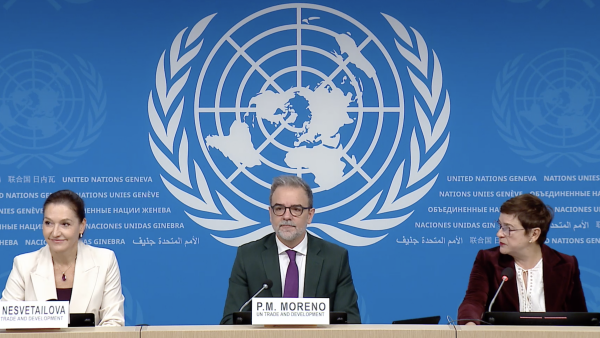
Presentation of the Trade and Developement Report 2026
Embargoed until 9 October 2026 at 11 a.m. (Geneva Time)
UNCTAD: UNCTAD’s flagship report finds that governments increasingly use industrial, trade, financial and technology policies to pursue economic and national security objectives. Market access and the ability to move into higher-value activities now depend more heavily on technology, finance and geopolitics.
1
1
1
Press Conferences | UPU
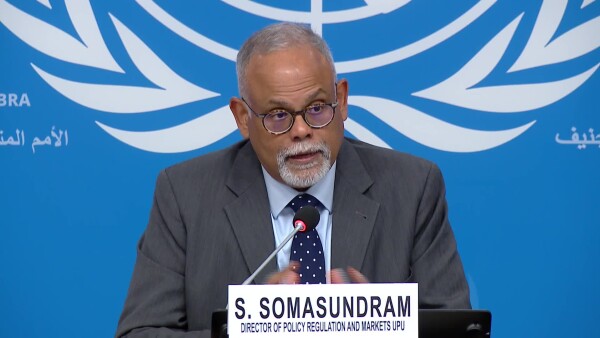
Release of the State of the Postal Sector Report 2026