

The United Nations Office at Geneva
Multimedia Newsroom
Press Conferences | FAO , OCHA , OHCHR , UNCTAD , UNHCR , WHO
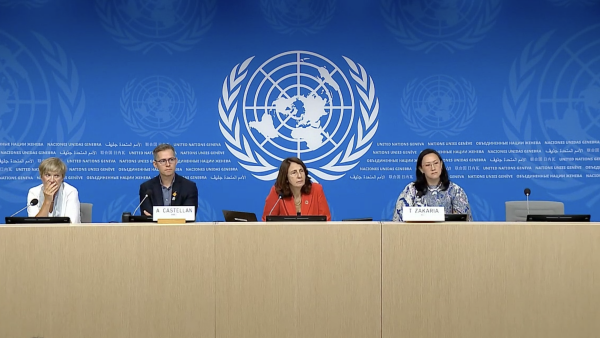
Bi-weekly press briefing - 15 August 2023
PRESS BRIEFING BY THE UNITED NATIONS INFORMATION SERVICE
Situation in Sudan After Four Months of War
William Spindler for United Nations High Commissioner for Refugees (UNHCR) said since the start of the conflict in Sudan on 15 April, over 4.3 million people had been forced to flee. This included over 900,000 refugees and asylum-seekers who fled to neighbouring countries, and 195,000 South Sudanese forced to return to South Sudan. Within Sudan, over 3.2 million people had been internally displaced, including more than 187,000 refugees already residing in the country at the start of the crisis.
As people continued to flee, displacement sites within Sudan and in neighbouring countries were rapidly becoming overcrowded. UNHCR was doing everything within its means to provide lifesaving assistance wherever it had access. Together with partners, it was providing hot meals, clean water, healthcare and core relief items and shelter to the newly displaced in Sudan and in neighbouring countries. UNHCR was also providing essential protection, including specialised services, to refugee children, survivors of gender-based violence, psychosocial support and mental health care to help families recover from trauma.
UNHCR urgently appealed for more donor support to be able to assist and protect conflict-affected populations. It also reiterated its calls for safe access for humanitarian workers so that lifesaving aid could reach all those in desperate need, and for the safety of civilians, including refugees and displaced people, to be respected.
Margaret Harris for the World Health Organization (WHO) said the conflict in Sudan had had devastating impacts on people’s lives, their health and wellbeing.
About 67 per cent of hospitals were out of service in most affected areas. In these four months, WHO had verified 53 attacks on health care, which had killed 11 people, injured 38, and along with other disruptions, had denied access to care for tens of thousands of people.
Many renal dialysis centres had closed, putting thousands at risk. Ongoing outbreaks of measles, malaria and dengue were difficult to control in a context of insecurity, population displacement and non-functional laboratories. More than 40 per cent of the country faced hunger, and about a third of children under five were chronically malnourished, making them even more vulnerable to disease. Measles and malnourishment equalled a death sentence for children under five.
The public health situation in the Darfurs was particularly worrisome; the escalation of the conflict had led to over 350,000 people fleeing into Chad, many with trauma wounds. Many hospitals were reportedly inaccessible, and insecurity prevented humanitarian aid from being safely delivered.
WHO was working with health authorities and humanitarian partners to support health care where possible, delivering 200 tons of medical supplies to hospitals and clinics in 14 states, with more on the way. These included supplies for trauma care, treatment for hypertension, diabetes and other chronic diseases to treat more than 130,000 people over three months. These supplies needed to get in. Nutrition stabilization centres had been supplied to help treat 26,000 severely malnourished children.
WHO was also working with partners to re-establish disease surveillance and to respond to ongoing outbreaks, including acute watery diarrhoea, malaria and measles. Together with the UN Population Fund, WHO was further working to ensure that women and girls had access to essential sexual, reproductive and maternal health care, including emergency obstetric and neo-natal care.
The world was ignoring the dire needs. WHO’s emergency appeal to assist the Sudanese people was only 20 per cent funded. Additional financial resources were needed to scale up operations.
WHO’s ability to provide assistance also depended on guarantees by parties to the conflict for safe access and humanitarian space. It called on them to fulfil their obligations so that humanitarian agencies could serve those most in need and the most vulnerable.
Ultimately, the people of Sudan needed peace.
Elizabeth Throssell for the United Nations Office of the High Commissioner for Human Rights (OHCHR) said the UN High Commissioner for Human Rights Volker Türk said today the “disastrous, senseless” war in Sudan – borne out of a wanton drive for power – had resulted in thousands of deaths, the destruction of family homes, schools, hospitals and other essential services, massive displacement, as well as sexual violence, in acts which could amount to war crimes.
The UN human rights office has reasonable grounds to believe that the Sudan Armed Forces (SAF) and the Rapid Support Forces (RSF) has committed serious violations of international law during the ongoing conflict, now entering its fifth month, including violations of international humanitarian law and human rights law, and perpetrators must be held accountable, Mr. Türk said.
Mr. Türk also expressed grave concerns that the chaotic situation, mired in impunity, was ripe for exploitation by other opportunistic armed actors and militia groups – and the violence could escalate further as a result.
It was difficult to establish an exact number of casualties due to the intensity of the fighting and the fact that the remains of many of those killed had not been collected, identified or buried. However, tentative figures indicated that more than 4,000 people had so far been killed, including hundreds of civilians.
The UN human rights office had also received 32 credible reports of sexual violence against 73 victims, including 28 incidents of rape. Men in RSF uniforms were implicated in at least 19 incidents as perpetrators. The actual number of cases was likely much higher.
The High Commissioner had repeatedly called on senior officials to stress that there was zero tolerance for sexual violence. Perpetrators needed to be held accountable and such violence needed to be clearly and unequivocally condemned.
He called on all parties to the conflict to immediately stop the fighting, resume political talks, comply with their legal obligations under international humanitarian law, protect civilians from military activities and to allow urgent, unimpeded humanitarian access.
He was also calling on the international community to increase political and economic pressure on the parties to the conflict to stop the fighting immediately, and to provide increased support to humanitarian organisations, who were responding to the crises caused by the conflict.
Daniel Johnson, Chief a.i. UNTV, Radio and Webcast, United Nations Information Service (UNIS) in Geneva said that on Friday, 18 August, the UN Office at Geneva would commemorate World Humanitarian Day, which fell on Saturday, 19 August. The Secretary-General’s message for the day said that, compared to that 20 years ago, when the Canal Hotel bombing occurred in Iraq, the number of people receiving humanitarian aid had increased tenfold to 250 million.
Laila Baker, Regional Director for Arab States, United Nations Population Fund (UNFPA), said UNFPA was very concerned that as the conflict continued, the battle lines were hardening, making it ever more difficult to reach the millions of people who needed urgent humanitarian assistance.
It was also very concerned about the status of sexual and reproductive health in Sudan. The disintegration of the social fabric was leaving many women and adolescent girls at risk for the lack of health care.
Over 2.6 million women and girls required humanitarian assistance. Around 260,000 were currently pregnant, and almost 100,000 were expecting to give birth over the next three months. Without critical health services, their lives and those of their children, the future generation, were severely at risk. UNFPA was working with partners to reinstate hospitals and medical facilities, and ensure medical supplies reached women and girls in need.
The UNFPA’s second main concern was the increase in gender-based violence, including sexual violence in conflict, a war crime and a crime against humanity. Allegations of sexual violence needed to be investigated, prioritising the rights and safety of survivors.
Treatment and counselling service providers had reported a 50 per cent increase in gender-based violence since the start of the conflict, and reported cases were just the tip of the iceberg. Sexual violence was severely underreported, limiting survivors’ access to medical counselling and legal services, resulting in untold suffering and impunity for the perpetrators. These crimes against humanity needed to be investigated and the perpetrators be brought to justice.
Sudan’s women and girls were in dire need of life-saving aid. They needed health facilities protected so that they could give birth safely. Survivors of sexual violence needed to be provided with rape kits, and the general population, especially women and girls, needed psychosocial support as they lived in crowded, untenable circumstances.
UNFPA was severely underfunded. To maintain its services, the Fund was appealing for 28.9 million USD to cover its sexual and reproductive health and gender-based violence services. It was currently at 8.45 million USD, leaving a funding gap of 20.45 million USD. Almost four million women were hence at risk, with a lack of health services and support services for victims of gender-based violence.
UNFPA was counting on the support of the international community to help bring this situation to an end.
Adam Yao, Deputy Representative in Sudan, Food and Agriculture Organization (FAO), said the food security situation in the Sudan called for urgent attention and scaled up, coordinated action. About 20.3 million people – or over 42 per cent of the population – were facing high levels of acute food insecurity. Hardest-hit areas included Khartoum, South and West Kordofan and parts of Darfur. Mr. Yao experienced the dire needs of the destitute and affected communities when he visited various regions for FAO’s emergency seed distribution campaign.
Since the conflict began four months ago, the swift collaboration between UN agencies, led by the United Nations Office for the Coordination of Humanitarian Affairs (OCHA), had enhanced collective humanitarian support. FAO was close to reaching its target of about one million farmers across 17 states through emergency crop seed distributions. So far, FAO had supported over 650,000 farmers, which the agency believed would contribute to the 2023 November harvest to meet the cereal needs of millions of people across the country.
Part of distribution activities included joining forces with UNHCR to support host communities in Alsalam and Algabalian localities in White Nile State, who recently welcomed 144,000 new refugees in addition to the existing thousands of internally displaced persons in the region. In this joint effort, FAO reached 52,500 farmers with 537 tons of seeds. This partnership emphasised the collective commitment to provide vital support to those most in need.
Looking ahead, FAO planned to reach 1.3 million pastoralists to ensure the protection of their livestock, a key productive asset. Strong rural livelihoods were an efficient local solution and the best defence against hunger. FAO was committed to supporting Sudan's rural communities. This was especially pertinent in a context where about two out of three people lived in rural areas and rely on agriculture for food and income.
Resources were scarce, but strategic investments could make the difference. Currently FAO’s funding gap was about USD 65 million. It was appealing for more robust donor support to reach more people.
Agriculture was the lifeline of rural people. It could bring hope and curb food insecurity.
Jens Laerke for the United Nations Office for the Coordination of Humanitarian Affairs (OCHA) said principals of the Inter-Agency Standing Committee had just issued a statement marking four months of war in Sudan.
These leaders of global humanitarian organizations warned that the war was destroying people’s lives and their homeland and violating their basic human rights. They called on the parties to the conflict to end the fighting, protect civilians and give humanitarian organizations unfettered access to all people in need in all areas of Sudan.
They reminded the fighting parties that attacking civilians, looting humanitarian supplies, targeting aid workers and hospitals or blocking aid could amount to war crimes and crimes against humanity. They also called on the international community to better fund the two appeals for Sudan and the region, which combined were just over a quarter funded.
In a message to the people of Sudan, they pledged to remain committed to providing humanitarian supplies and services, not least through supporting local Sudanese responders.
The full statement is on the IASC website.
In response to questions, Mr. Laerke said that UN political staff based in Sudan were in daily contact with the warring parties. They had given commitments that they would respect international and humanitarian law but did not seem to be respecting these commitments. The situation was defined by the principals of the Inter-Agency Standing Committee as a “war”.
The humanitarian appeal for Sudan required over 2.5 billion USD in funding. It had currently received around 650 million, making it 25.4 per cent funded as of today. There were two appeals for the Sudan crisis; one was implemented within Sudan, the other applied to neighbouring countries hosting refugees.
Some aid was getting through to Khartoum and Darfur, including food assistance. However, the situation was chaotic and changed every day. OCHA and other UN agencies did not have the access to all areas of Sudan that they needed.
Ms. Baker said UNFPA did not document sexual or gender-based violence investigate cases, rather it provided medical support and counselling to survivors of sexual violence. Other UN agencies investigated cases of alleged violence.
Humanitarian aid was not restricted to food aid; it also included aid for victims of sexual and gender-based violence. Making sure people had access to shelters for victims of sexual violence was a precarious task in Sudan. There had been a 900 per cent increase in sexual and gender-based violence in conflict areas, where increased funding was urgently needed.
UNFPA suspected that there was an enormous amount of underreporting of gender-based violence. Accessibility to support services was a primary focus for the agency. Closed shelters needed to be reinstated, and there needed to be clinical management of rape kits and increased follow-up for counselling services.
Stigmatisation for sexual violence was not restricted to Sudan—it happened all over the world. There was a reluctance to report due to this stigmatisation. UNFPA was working to ensure all women exposed to sexual violence had access to safe treatment and support, but its access to medical services and support centres in Sudan was currently inhibited.
Ms. Throssell said OHCHR was documenting cases of alleged human rights violations. Perpetrators of gender-based violence needed to be held accountable and the message that such violence was not tolerated needed to be passed on to combatants.
OHCHR was sharing information on violations with authorities with a view to holding perpetrators to account. The Independent Expert on the situation of human rights in the Sudan would be giving an extensive update on the situation in the upcoming session of the Human Rights Council.
Mr. Spindler said survivors of sexual and gender-based violence were fleeing to refugee reception facilities in neighbouring countries, where supplies were limited. Survivors in refugee camps had shared stories of being subjected to gender-based violence and rape.
Children faced the risk of early marriage as parents attempted to shield them from sexual and gender-based violence. Children in refugee camps also faced a heightened risk of mental health problems, and of falling victim to forced labour and human trafficking. Many children were fleeing without parents, increasing their risk of abuse. UNHCR’s programmes to support these children were underfunded, which made their situation even more precarious.
UNHCR was rushing to create new camps to move refugees away from unsafe border areas, including in Chad. There were 280,000 refugees currently in Egypt. In the past, there were lengthy waits for people to cross the border into Egypt, but the current situation was unclear.
UNHCR’s response appeal was 31 per cent funded; it was calling for 556 million USD.
Second Anniversary of Taliban Takeover of Afghanistan
Elizabeth Throssell for the Office of the High Commissioner for Human Rights (OHCHR) said today marked two years since the Taliban takeover of Afghanistan. In a statement, the UN High Commissioner for Human Rights Volker Türk reminded the de facto authorities that Afghanistan, as a State, had obligations under international law to respect, uphold and promote the rights of all people without discrimination.
OHCHR remained deeply troubled by the human rights situation, in particular the severe restrictions imposed on women and girls, whose rights to access education and work, their freedom of movement and participation in daily and public life had been eroded by a series of discriminatory edicts issued since the takeover.
UN human rights staff continued to work in Afghanistan monitoring, documenting and advocating on a range of human rights issues, including the rights of women and girls, fundamental freedoms, the protection of civilians in armed conflict and the rights of detainees. They were engaging with the de facto authorities on these issues and stressing their obligations under international human rights law. They had met with de facto security agencies on individual cases of human rights violations and visited prisons to meet detainees.
The High Commissioner called on the international community not to forget the people of Afghanistan, who in addition to facing severe limitations on their human rights, were living through a dire humanitarian and economic situation. There were no Afghans who remained untouched in some way by the violence and conflict of the past four decades. Victims and their families continued to seek justice, accountability and much needed, life-saving support.
It was not too late to change the trajectory of the country nor for the Taliban to change its policies based on the understanding that the respect and protection of human rights were essential for the prosperity, cohesion and stability of the nation. The people of Afghanistan had the right to a peaceful and harmonious future and the Taliban, as the de facto authorities, had the obligation to ensure that this right was realised.
Margaret Harris for the World Health Organization (WHO) said WHO was very concerned by the humanitarian health emergency in Afghanistan. About 28.8 million people needed humanitarian aid, an increase from 18.4 million people prior to August 2021. 14 million people, including 7.5 million children and three million women needed health assistance. There were 9.5 million people with little or no access to even basic health services. 20 per cent of the population were suffering from mental health problems, and four million from drug addiction and associated disorders. 875,000 children were suffering from severe acute malnutrition.
The broader humanitarian crisis limited the capacity of the health care system and health services. Most health care facilities had poor infrastructure and there were fewer qualified health care workers due to immigration limits, limits on women’s employment and reduced funds to pay salaries and keep facilities open.
William Spindler for the United Nations High Commissioner for Refugees (UNHCR) said there were important challenges with aid delivery in Afghanistan. UN and non-governmental organizations’ operations had been affected by restrictions, including bans on female national staff. UN agencies at the frontline of aid delivery had borne the brunt of many of the restrictions and were organising operational huddles to discuss how to overcome them.
While challenges persisted, UNHCR and its partners remained committed to staying the course in Afghanistan and finding ways to address challenges and continue to serve those in need, especially women and girls.
Daniel Johnson, Chief a.i. UNTV, Radio and Webcast, United Nations Information Service (UNIS) in Geneva said Gordon Brown, the United Nations Special Envoy for Global Education and a leading light in the “Education Cannot Wait” initiative, was speaking in New York today, 15 August, at the noon briefing, 6 p.m. Geneva time, to announce that Education Cannot Wait was launching a campaign with Afghan girls and women to amply their voices and needs.
Mr. Johnson said he had interviewed Somaya Faruqi, one of the inspirational Global Champions of Education Cannot Wait. Ms. Faruqi said the situation in Afghanistan was taking an immense toll on girls’ mental health and rates of suicide for girls had gone up in the last two years. It was more urgent than ever to act now, she said.
In response to questions, Dr. Harris said WHO had an extensive presence in Afghanistan and worked closely with the health system in the country.
Ms. Throssell said the de-facto authorities had international human rights obligations, including the need to respect women and girls’ right to education. The prosperity of the country depended on respecting the rights of women and girls. The Universal Declaration of Human rights was universal; which was why OHCHR was strongly advocating for it. OHCHR staff were working extremely hard for the people of Afghanistan, but there were huge challenges. Staff on the ground were monitoring and documenting human rights abuses and doing their best to respond to the needs of women and girls.
On alleged censorship of a political candidate in Mexico, Ms. Throssell said that OHCHR staff on the ground had been following the situation closely. Political discourse needed to be carried out freely and respectfully. Citizens needed to be allowed to disagree and freely choose who would represent them.
Jordan Cybercrime Law Concerns
Elizabeth Throssell for the United Nations Office of the High Commissioner for Human Rights (OHCHR) said there was no doubt that cybercrime needed to be addressed and regulated head-on. However, OHCHR had serious concerns about a new cybercrime law that was shortly due to take effect in Jordan.
The new law unduly restricted and criminalised online activities by individuals and organisations. It imposed penalties for publishing content that could offend law enforcement officials. This could potentially silence criticism and undermine public accountability. It also penalised circumvention of IP addresses and allowed the removal or the blocking of content by the authorities without appropriate judicial oversight.
Among the broad and vaguely defined cyber offences in the legislation were “promoting, instigating aiding or inciting immorality”, “character assassination”, “inciting sedition or undermining national unity” and “contempt for religions”. These formulations targeted the content of online expression, were open to wide interpretation and failed to comply with international human rights law requirements of legality, legitimate aim, necessity and proportionality for restrictions on the right to freedom of expression.
The law set out prison terms ranging from one week to three years, and fines from some 423 US dollars to 105,000 US dollars (300 to 75,000 Jordanian dinars), depending on the offence.
OHCHR’s concerns about the law were all the greater given increased intimidation, harassment and arrest of activists amid the ever-shrinking civic space in Jordan. The previous Cybercrime Law of 2015, which this legislation replaced, had been used to arrest numerous human rights activists and journalists on “defamation” charges. One recent case was that of satirical journalist Ahmed Hassan Al-Zoubi, who on 9 August was given a one-year prison sentence under the current law for publishing a Facebook post last December that criticised the authorities’ handling of a truck drivers’ strike.
OHCHR recognised the need for States to take steps to combat cybercrime, but protecting security online and ensuring online freedoms needed to be treated as complementary goals.
A strategy against cybercrimes needed to be based on international human rights law and be clear and focused on core cybercrimes, and avoid establishing offences based on the content of online expression.
The swift passage of the legislation – presented to Parliament on 15 July, passed on 2 August and approved by the King on 12 August - raised concerns about transparency and participation.
OHCHR urged the Jordanian authorities to reconsider this legislation with a view to ensuring compliance with international human rights law, including the International Covenant on Civil and Political Rights, which was in force for Jordan.
It also urged the authorities to draw on available expertise, including from IT specialists, legal experts and relevant civil society organisations, as well as the UN human rights office, to develop legislation that addressed legitimate cyber threats while safeguarding fundamental human rights.
Announcements
Catherine Huissoud for the United Nations Conference on Trade and Development (UNCTAD) said that a press conference would be held on Wednesday, 16 August at 10 a.m. in Nairobi (9 a.m. Geneva time) with UNCTAD Secretary-General Rebeca Grynspan to launch the “Economic Development in Africa Report 2023”. The embargo lifts at 11 a.m. Geneva time (12 noon in Nairobi).
Daniel Johnson, Chief a.i. UNTV, Radio and Webcast, United Nations Information Service (UNIS) in Geneva said the Committee on the Elimination of Racial Discrimination was currently in its 110th session, and would begin tomorrow afternoon the review of the report of Namibia.
The Committee on the Rights of Persons with Disabilities, which opened yesterday its 29th session, being held from 14 August to 8 September, would begin this afternoon its review of the report of Malawi.
Similar Stories
1
1
1
Statements , Press Conferences | OHCHR
1
1
1
Press Conferences | UNHCR , UNICEF , IFRC , OHCHR , UN WOMEN , IOM , OCHA , WHO
UNHCR – ExCom Meeting, UNICEF – Nepal Recovery, IFRC – Flash Floods, WHO – Mental Health, IOM – South Sudan Floods, OCHA – DRC Humanitarian aid, UNHCR – Sahel Displacement, UNICEF – Yemen Update, IOM – Gaza Shelter, UN Women – Gaza Women, OHCHR – Arrests and detentions of Syrians by Israeli force
2
1
2
Press Conferences | UNCTAD
Presentation of the Trade and Developement Report 2026
Embargoed until 9 October 2026 at 11 a.m. (Geneva Time)
UNCTAD: UNCTAD’s flagship report finds that governments increasingly use industrial, trade, financial and technology policies to pursue economic and national security objectives. Market access and the ability to move into higher-value activities now depend more heavily on technology, finance and geopolitics.
1
1
1
Press Conferences | UPU
Release of the State of the Postal Sector Report 2026
1
1
1
Press Conferences | IOM , ITU , UNECE , UNICEF , WHO , WMO
UNICEF: Ebola, DRC - children orphans or separating them from parents and caregivers; IOM: Humanitarian needs in Djibouti amid arrivals from Yemen and increased migrant movements; WHO: Darfur, scale of health needs far exceeds available resources; WMO co-sponsored Global Heat Forum, Bangkok, monthly Global Seasonal Climate Update; UNECE: UN Forum of Mayors; ITU Plenipotentiary Conference 2026; WHO: child and adolescent obesity guidelines and new global roadmap to tackle pregnancy hypertension, a leading cause of maternal mortality
1
1
1
Press Conferences | OCHA , UN WOMEN , UNHCR , WFP , WHO , WTO , UNEP
OCHA – $160M CERF allocation to 12 underfunded crises; UNHCR – 5.8M refugee children remain out of school amid funding cuts; UN Women – Middle East escalation and food security among women/girls; WHO – Gaza supplies and overall situation; WFP – Yemen food insecurity and impact on global hunger ; UNEP - First International Conference of the Global Framework on Chemicals in Geneva | 16-20 November 2026
1
1
1
Press Conferences | UNHCR , WHO
Yemen's health system nears collapse amid conflict, causing rising casualties and medicine shortages.
1
1
1
Press Conferences | HRC
Update by the Expert Mechanism to Advance Racial Justice and Equality in Law Enforcement
1
1
1
Press Conferences | WIPO , WHO , UNICEF , UNHCR , IOM , WFP , FAO
WIPO Global Innovation Index 2026 launch and press conference, WHO Composition of influenza vaccines for the 2027 Southern Hemisphere flu season, UNICEF Yemen hunger and malnutrition; UNHCR Sudan displacement into Chad; IOM Ebola and population movements in DRC; WFP emergency food assistance in Nepal; and FAO food loss and waste.
2
1
2
Press Conferences | UNCTAD
Gaza reconstruction needs reach $71.5 billion as Palestinian economy and public finances face severe strain. Latest UNCTAD report documents the loss of decades of development gains, economic collapse in Gaza and tightening economic constraints in the West Bank.
The report identifies three immediate priorities: transferring withheld Palestinian revenues, safeguarding the banking system and aligning reconstruction support with the documented scale of damage and economic losses.
1
1
1
Press Conferences | HRC
Press conference on the situation of human rights in Nicaragua by the UN Group of Human Rights Experts
1
1
1
Press Conferences | ITU , UNHCR , WHO , WMO
YEMEN - UNHCR: Escalating conflict in Yemen could fuel more displacement, refugee movement
CLIMATE - WHO / WMO: Health and Climate impact of El Niño