

The United Nations Office at Geneva
Multimedia Newsroom
Press Conferences | FAO , ITU , OHCHR , UNHCR , WHO , WMO
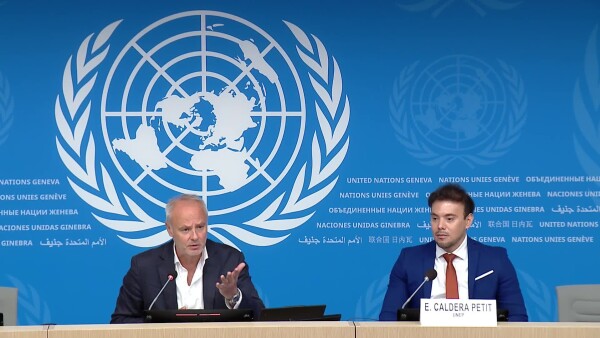
Bi-weekly Press Briefing - 07 July 2023
PRESS BRIEFING BY THE UNITED NATIONS INFORMATION SERVICE
7 July 2023
Humanitarian response in Ukraine and ongoing challenges to returning refugees
Shabia Mantoo for the United Nations High Commissioner for Refugees (UNHCR) said Karolina Lindholm Billing would give an update on the Agency’s humanitarian response as well as her visits to regions affected by the destruction of the Kakhovka dam as well as the Agency’s position on voluntary returns. The fourth edition of the report “Lives on Hold: Intentions and Perspectives of Refugees from Ukraine” issued recently showed that the vast majority of people displaced planned to return home, some intended to remain in their host countries for lack of security, access to basic services, housing and livelihood opportunities in Ukraine.
Karolina Lindholm Billing, the Agency’s representative to Ukraine spoke from Kyiv, noting that the report was an important source in understanding the needs of refugees and internally displaced persons. 76 percent of refugees and 82 percent of internally displaced persons planned or hoped to return with around 15 percent planning to return in the next three months. The main obstacle to return was the continuing armed conflict, intense fighting in frontline areas but also missile and drone strikes in Kyiv, Dnipro and Lviv. The latter recently suffered a strike on a civilian area resulting in 10 deaths and more than 40 persons injured. It was essential therefore that all returns were voluntary and not forced. Obstacles or enablers to return were access to basic services, livelihoods, housing and education services, which were at the heart of humanitarian efforts. The UNHCR contributed to this process through protection services, legal aid to recover identity documents, housing repairs and a pilot pre-fabricated house programme. A survey found that there was a high interest to return to the northern regions and the Agency had therefore prioritized these areas resulting in around 1,800 house repairs and assistance provided to 27,000 persons in identification document recovery. In Kharkiv, 500 households had been helped to repair their homes. In total over 13,000 housing repairs and more than 240,000 legal aid services had been provided.
The destruction of the Kakhovka Dam made the Agency’s work more challenging, however. Following a visit to the Mykolaiv and Kherson regions. Ms. Billing visited civilian’s homes which were damaged to their foundations by intense flooding—and following shelling in some cases in Kherson. While the people she visited had already been traumatized by the conflict, they expressed worry at the urgency to rebuild their homes before winter. Conversely, following a Wednesday visit to Nikopol, Ms. Billing witnessed an acute water shortage as the reservoir which provided water to hundreds of thousands of people was totally empty. The layers of needs in Ukraine caused by the international armed conflict and then the destruction of the dam were immense and required immediate and long-term support from the international community.
In reply to questions, Ms. Mantoo noted that the majority of Ukrainian refugees continued to access safety in host countries, to which the Agency had issued a non-return advice. Refugees were not being forced to return and continued to enjoy access to protection in Europe. Information on refugees in Russian territory would be provided after the brief.
Use of cluster munitions in the war in Ukraine
In response to questions, Marta Hurtado, for the Office of the United Nations High Commissioner for Human Rights, said that cluster munitions scattered small bomblets over a wide area; many of them did not immediately explode and could maim and kill people years after a conflict had ended. The use of such munitions had to cease. The Office would urge the Russian Federation and Ukraine to join the Convention on Cluster Munitions to effectively ban their use.
Update on the crisis in Jenin
Tamara Alrifai for the United Nations Relief and Works Agency for Palestine Refugees in the Near East (UNWRA) said that the Israeli military operation in Jenin on 4-5 July was the most intense in over two decades. Twelve Palestinians were killed, including four children, and over 140 injured, with some in critical condition. For many of the camp’s residents, it brought back horrific memories from 2002 when the camp witnessed one of the most severe rounds of violence during the second intifada. The Jenin refugee camp sustained significant damage. The streets were full of rubble and electricity and water were cut in most parts of the camp. Some 900 houses were damaged, many beyond repair. Nearly 500 families left the camp during the military operation, most of whom stayed with family or friends.
Jenin was one of 19 camps for Palestine refugees across the West Bank, housing refugees who fled or were forced to leave their homes in 1948, and have, since then become refugees in the absence of a political solution between Israel and Palestine. The camp was very densely populated with nearly 23,000 refugees registered in less than half a square kilometer. UNRWA did not manage it but offered basic services to its inhabitants through four schools, one health center and other social protection and assistance. As a result of the fighting this week, the Agency set up a temporary health facility because the UNRWA health centre—the only one in the camp—was severely damaged during the military operation.
UNRWA was working rapidly to support residents and the local authorities. Its priorities were to restore basic services in the camp and support those families whose homes were damaged with emergency cash assistance. Further, it was critical to re-open the four UNRWA schools which provided education to 1,700 children and a health service where residents could get primary care, as well as UNWRA minor buildings. Reopening schools was a top priority for UNRWA—both for educational and psychological purposes. UNRWA had 90 staff in the camp, most of whom were residents. They were undertaking damage and needs assessments that will inform the coming UNRWA response, which would include the delivery of cash assistance to families most impacted, psychological first aid, primary health care and support to local authorities with restoration of basic services.
UNRWA needed the support of its partners and donors to help rebuild and rehabilitate its structures and the homes of Palestinian refugees. One donor, the United Arab Emirates, had already pledged funding. UNRWA was calling on donors to step in, especially as the Agency faced huge financial challenges made far worse by the recent crisis in Jenin. Expressing the gravity of the situation, Ms. Alrifai recalled that in such a densely populated camp, the cemetery was full and people did not know what to do with their dead.
Alessandra Vellucci, Director of the United Nations Information Service (UNIS) in Geneva recalled the declaration of UN Secretary-General Guterres saying he was deeply disturbed by the violence in the occupied West Bank. He condemned all acts of violence against civilians including acts of terror. He called on Israel to abide by its obligations to international law including the duty to exercise restraint and exercise proportional force and to preserve human right. Israel had legitimate security concerns, but escalation was not the answer. Restoring hope of the Palestinian people in a meaningful political process leading to a two-state solution and an end to the occupation was an essential contribution to Israel’s own security.
Monthly update on global food commodity prices
Maximo Torero, Chief Economist for the Food and Agriculture Organization of the United Nations (FAO) presented the Organization’s monthly report on food prices. The benchmark index of international food commodity prices declined again in June, led by price decreases for all major cereals and most types of vegetable oils with the price of sugar falling the most. The price of meat prices remained unchanged. The Index had fallen below the March 2022 peak by 23.4 percent, which was not a return to former prices, but a positive downward trend. However, the Index looked at commodity prices and not wholesale prices.
Food prices had yet to reflect the falling prices while prices in retail and wholesale prices. Food price inflation in poorer countries continued to increase whereas high income countries, vertical transmission was slow, but taking place, and prices could decrease accordingly in those countries. Consumers would still face significant prices. Fertilizer prices had also declined, as well as nitrogen and ammonia. Similarly, low-income countries did not see decreased prices, particularly in sub-Saharan Africa. The Organization also published its “Crop Prospects and Food Situation Report” showing that 45 countries needed food assistance 33 countries in Africa, 9 in Asia, 2 in Latin America and the Caribbean, and one in Europe.
On 12 July, the Organization would launch its State of Food Security and Nutrition in the World report. The full report was available here.
Responding to questions, Mr. Torero said that the Black Sea Grain Initiative moved 32 million metric tons of grain throughout the world which had helped enormously to lower the food prices since the March 2022 peak. The date of the renewal was 17 July, a critical time as it was the start of the harvest in Ukraine. If the Initiative was not renewed, there would be spike in prices. The FAO hoped and expected the initiative to be renewed and it was important to do so as grain had to flow from Ukraine to maintain food security for the world and also for Ukrainian farmers’ living. A non-renewal would affect the price of wheat and coarse grains and consequently, food security.
Militarization of public security in Honduras
Marta Hurtado, for the Office of the United Nations High Commissioner for Human Rights (OHCHR) expressed deep concern by the militarization of public security in Honduras. The state of emergency introduced in December 2022 as part of the country’s efforts to tackle extortion and organized crime enabled the military police to carry out public security with national police; this departed from the right to freedom by allowing security and armed forced to carry out arrests without a warrant. On 21 June, the authorities had also announced that the command and control of the prison system was being transferred to the military police, a decision that came in the wake of a violent incident at the national women’s prison in the town of Tamara, where 46 female inmates were killed. Since then, military police operations have been carried out in all prisons across Honduras. Those allegedly associated with gangs had been beaten by military police, had their food and water rationed or were subjected to sleep deprivation which could amount to ill-treatment. The Office urged the authorities to ensure that there was internal and independent external oversight of military operations in prisons, as well as of the military’s control of the prisons system, to prevent human rights violations. Allegations of unnecessary or disproportionate use of force had to be promptly investigated.
The full text of the statement was available here.
Human Rights Council
Pascal Sim, on behalf of the Human Rights Council (HRC) said the Council was addressing item 6 on its agenda dedicated to the Universal Periodic Review and adopted final outcome documents on Argentina, Czechia, Gabon and Ghana. Today it would consider the reports of Peru, Guatemala, Benin, Republic of Korea, Switzerland and Zambia. It would conclude the discussion on this item with Pakistan, Japan and Sri Lanka.
On Monday afternoon, the Council would hear from Francesca Albanese, the Special Rapporteur on the Palestinian Territories Occupied Since 1967, her first time speaking before the Council.
Time permitting, the Council would also hear from Ashwini K.P., Special Rapporteur on Racism, who would present a report on her mandate and another on Combatting Nazism and Neo-Nazism. It was also her first time speaking before the Council.
The Council would hold an urgent open debate to “discuss the alarming rise in premeditated and public acts of religious hatred as manifested by current desecration of the Holy Quran in some European and other countries” on Tuesday 11 July at 3 p.m., which would be broadcast live. This urgent debate was convened at the request of Pakistan on behalf of several members of the Organization for Islamic Cooperation. A draft resolution on countering religious hatred and incitement to violence could be found on the Council’s extranet webpage.
Thirty draft resolutions had been tabled for the end of this Session. Eleven concerned mandate renewals; one was on Colombia, requesting the High Commissioner to designate an expert to identity obstacles to the implementation of the 2019 peace agreement.
In response to questions. Mr. Sim said that the list of speakers for the urgent debate was not finalized but a representative from the Office of the UN High Commissioner for Human Rights and a panel expert would be present.
Announcements
David Hirsch for the International Telecommunication Union announced from the Artificial Intelligence for Good Global summit, that the Humanoid Robot press conference would open at 12 p.m.
Clare Nullis, for the World Meteorological Organization (WMO), addressed alerts on a level three heat wave in Switzerland. More generally, new information on the record land and sea surface temperatures was available on the WMO’s website. It was important to bear in mind that these temperatures were at the start of the El Nino weather phenomenon. There would be a technical briefing with the Chief, Climate Monitoring and the Chief, World Climate Research Programme of WMO to talk about record land temperatures and amounts of arctic ice.
Responding to questions, Ms. Nullis said that an ocean expert might also be present during the briefing. This briefing would be held in response to the large number of media inquiries.
Christian Lindmeier of the World Health Organization (WHO) announced that today at 3 p.m. there would be a press briefing on the prevention of and response to sexual misconduct. Further there would be a report on the risk assessment of aspartame, the food additive. The results would be made public on the morning of 14 July. There would be an embargoed press briefing Wednesday 12 July at 2 p.m.
The Human Rights Committee would continue its 138th session next Monday 10 July at 3 p.m. with its review of Colombia. Countries under review during the session also included Brazil, Uganda, Cyprus, Burundi, Lesotho and the State of Palestine—the latter country’s first review. The review of Somalia had been postponed.
The Committee Against Torture would open its 77th session next Monday, 10 July at 10 a.m. with the review of Switzerland. Other countries under review for this session were New Zealand, Romania and Spain.
The Conference on Disarmament would begin on 31 July, the third and last part of its 2023 annual session.
The State of Food Security and Nutrition in the World report 2023 would be discussed at a hybrid press conference with representatives of the Food and Agricultural Organization, the World Food Programme, the World Health Organization, the United Nations Children’s Fund (UNICEF) and the International Fund for Agricultural Development (IFAD) on 12 July 2023 at 3:30 p.m.
The Joint United Nations Programme on HIV/AIDS (UNAIDS) would hold a hybrid press conference on Thursday, 13 July at 2 p.m. to present its Global AIDS update 2023.
Similar Stories
2
17
1
2
Edited News , Press Conferences | OCHA , WMO
Two UN agencies teamed up on Wednesday to issue an appeal for immediate assistance to help communities already being impacted by the strongest El Niño on record.
1
1
1
Press Conferences | CITES
Wildlife trade and conservation policy discussions at the 81st meeting of the CITES Standing Committee (SC81)
1
1
1
Press Conferences | UNHCR , UNCTAD , WMO , OCHA , UNICEF , WHO
UNHCR Hungary’s 1956 Refugee Crisis: 70 Years On, UNCTAD World Investment Forum 2026, Doha, WMO Greenhouse Gas Bulletin and Climate Update for COP31, OCHA Afghanistan: Malnutrition, Girls’ Education and Recovery, UNICEF Yemen: Child Malnutrition and Unsafe Water in Taiz, WHO Inequalities in Noncommunicable Diseases and Risk Factors
1
1
1
Press Conferences | UNHCR
End of UNHCR's 77th Annual Executive Committee (ExCom) meeting week
1
1
1
Press Conferences | UNICEF , IOM , UNHCR
UN Special Assistant to the Personal Envoy Office (SUDAN): Peace Initiatives and Efforts in Sudan; UNICEF: Dire situation of children in Gaza; IOM: Damaged Homes and Energy Attacks Risk Displacing Ukrainians for this winter; UNHCR: update on EXCOM week
1
1
1
Press Conferences | IOM , UNDRR
UN stresses importance of household preparedness for disaster risk reduction.
1
1
1
Statements , Press Conferences | OHCHR
1
1
1
Press Conferences | UNHCR , UNICEF , IFRC , OHCHR , UN WOMEN , IOM , OCHA , WHO
UNHCR – ExCom Meeting, UNICEF – Nepal Recovery, IFRC – Flash Floods, WHO – Mental Health, IOM – South Sudan Floods, OCHA – DRC Humanitarian aid, UNHCR – Sahel Displacement, UNICEF – Yemen Update, IOM – Gaza Shelter, UN Women – Gaza Women, OHCHR – Arrests and detentions of Syrians by Israeli force
2
1
2
Press Conferences | UNCTAD
Presentation of the Trade and Developement Report 2026
Embargoed until 9 October 2026 at 11 a.m. (Geneva Time)
UNCTAD: UNCTAD’s flagship report finds that governments increasingly use industrial, trade, financial and technology policies to pursue economic and national security objectives. Market access and the ability to move into higher-value activities now depend more heavily on technology, finance and geopolitics.
1
1
1
Press Conferences | UPU
Release of the State of the Postal Sector Report 2026
1
1
1
Press Conferences | IOM , ITU , UNECE , UNICEF , WHO , WMO
UNICEF: Ebola, DRC - children orphans or separating them from parents and caregivers; IOM: Humanitarian needs in Djibouti amid arrivals from Yemen and increased migrant movements; WHO: Darfur, scale of health needs far exceeds available resources; WMO co-sponsored Global Heat Forum, Bangkok, monthly Global Seasonal Climate Update; UNECE: UN Forum of Mayors; ITU Plenipotentiary Conference 2026; WHO: child and adolescent obesity guidelines and new global roadmap to tackle pregnancy hypertension, a leading cause of maternal mortality
1
1
1
Press Conferences | OCHA , UN WOMEN , UNHCR , WFP , WHO , WTO , UNEP
OCHA – $160M CERF allocation to 12 underfunded crises; UNHCR – 5.8M refugee children remain out of school amid funding cuts; UN Women – Middle East escalation and food security among women/girls; WHO – Gaza supplies and overall situation; WFP – Yemen food insecurity and impact on global hunger ; UNEP - First International Conference of the Global Framework on Chemicals in Geneva | 16-20 November 2026