

The United Nations Office at Geneva
Multimedia Newsroom
PRESS BRIEFING BY THE UNITED NATIONS INFORMATION SERVICE
27 June 2023
Arbitrary detention of civilians in the Ukraine conflic
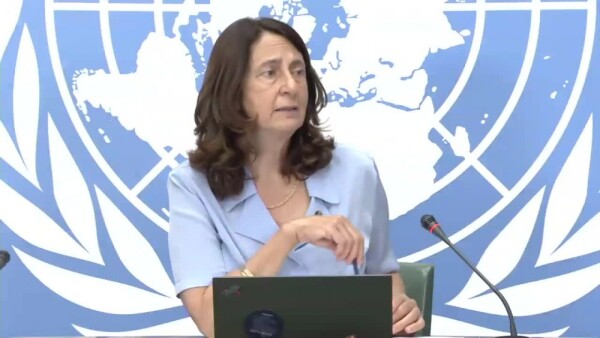
Matilda Bogner, Head of the United Nations Human Rights Monitoring Mission in Ukraine, speaking from Uzhgorod, said that the report that the OHCHR was releasing today focused on arbitrary detention of civilians in the context of the Russia’s large-scale attack on Ukraine. It covered 15 months from February 2022 to May 2023. The findings were based on 1,136 interviews with victims, witnesses, and others, 274 site visits, and 70 visits to official places of detention run by Ukrainian authorities. OHCHR had documented over 900 cases of arbitrary detention of civilians, including children, and elderly people, the vast majority of which had been perpetrated by the Russian Federation. Ukraine had given the Mission unimpeded confidential access to official places of detention and detainees, with one exception. The Russian Federation had not granted such access, despite requests.
From the beginning of its armed attack, Russia had begun to detain civilians in areas that it occupied. It had carried out what appeared in some cases to be security detentions, but in a manner that had not protected civilians or complied with international law. OHCHR had documented 864 individual cases of arbitrary detention by Russia, many of which also amounted to enforced disappearances. Many civilian detainees had been held incommunicado, in unofficial places of detention, often in deplorable conditions. OHCHR Mission had documented the summary execution of 77 civilians while they had been arbitrarily detained by Russia.
Russian armed forces, law enforcement and penitentiary authorities engaged in widespread torture and ill-treatment of civilian detainees. Most of those we interviewed said they had been tortured and ill-treated, and in some cases subjected to sexual violence. Torture was used to force victims to confess to helping Ukrainian armed forces, compel them to cooperate with the occupying authorities, or intimidate those with pro-Ukrainian views.
Going to Ukraine, Ms. Bogner stated that legislative amendments passed in Ukraine the previous year, and practices by Ukrainian security forces, had resulted in an environment conducive to arbitrary detention. OHCHR had documented 75 cases of arbitrary detention by Ukrainian security forces, mostly of people suspected of conflict-related offences. A significant proportion of those cases had also amounted to enforced disappearance, perpetrated mainly by the Security Service of Ukraine. OHCHR had documented that over half of those arbitrarily detained had been subjected to torture or ill-treatment by the Ukrainian security forces.
Speaking of accountability, Ms. Bogner said that the OHCHR was not aware of any investigations by Russian authorities into arbitrary detention, enforced disappearance, torture or ill-treatment perpetrated by its own forces in Ukraine. OHCHR was also not aware of any completed criminal investigations by Ukrainian authorities into its own security forces for such violations.
Finally, OHCHR’s report contained recommendations to the Russian Federation and Ukraine, urging them to release anyone who is arbitrarily detained and to fully comply with provisions of international law that govern the treatment and protection of conflict-related civilian detainees. OHCHR also reminded the Russian Federation that security detention of civilians might only be used as an exceptional measure, and of their obligation to facilitate regular communication between detainees and their families. Ms. Bogner reiterated the request to the Russian Federation to grant United Nations human rights monitors full and unfettered access to all areas of Ukraine which it occupied.
Her full statement can be read here.
Responding to numerous questions, Ms. Bogner said that the OHCHR considered the Wagner Group to be part of the Russian Armed Forces as they operated under their overall control. No cases of arbitrary detention of civilians by the Wagner Group as such had been recorded in this report, while they had been recorded in the past. Ms. Bogner said that the numbers provided in the OHCHR report were only those that could be documented and verified; real numbers were likely to be much higher. Torture and ill treatment by the Russian forces seemed to be of systematic nature; more than half of those detained by Ukraine had also reported having been exposed to torture or ill treatment. OHCHR had tried to visit the 87 arbitrarily detained Russian sailors, but they had not been given an access or an explanation. They had eventually been exchanged as prisoners of war.
Replying to other questions, Ms. Bogner said that the OHCHR Mission had not documented any summary executions of civilian detainees by the Ukrainian forces. OHCHR continued and would continue to request access to the Russian places of detention, stressed Ms. Bogner. She explained that the majority of the 864 documented cases of arbitrary detention had been held in the areas where they had been detained; about a quarter had been transferred to other places in Russia. She confirmed that it was indeed a war crime to execute a civilian in detention.
Elizabeth Throssell, for the Office of the High Commissioner for Human Rights (OHCHR), informed that Ms. Bogner would soon be finishing her mission in Ukraine and would soon become the head of the OHCHR Central Asia Regional Office.
Difficulties in aid delivery amid escalating conflict in Sudan
Raouf Mazou, Assistant High Commissioner for Operations at the United Nations Refugee Agency (UNHCR), who had travelled to Sudan the previous week, said that the UNHCR was increasingly alarmed over growing humanitarian needs among those affected by the crisis in Sudan. Over two and a half million people had been displaced by the conflict since 15 April, with more than 560,000 people seeking safety in neighbouring countries.
Access to Darfur was limited, and the information coming out of that region was worrying; many of those fleeing Darfur were injured. The host populations, especially in Chad, themselves living in difficult conditions, were nonetheless welcoming, said Mr. Mazou. Egypt had received more than half of all Sudanese refugees. Looking at the trends, it was expected that many more Sudanese would go to Egypt. It was hoped that the possibility would continue for Sudanese to work and have access to services in Egypt without visa. South Sudanese refugees were also returning from Sudan to their country, even if South Sudan remained very fragile.
Border countries and regions should be commended for their support to refugees, stressed Mr. Mazou. He reminded that the UN and partners called for over USD 3 billion to help millions in Sudan and those fleeing to neighbouring countries, while the pledging event in Geneva the previous week had raised USD 1.5 billion in pledges.
Full statement is available here.
Answering questions from the media, Mr. Mazou stated that an intensification of the ethnic conflict was underway in Darfur. Chad currently hosted 245,000 refugees and needed the help of the international community. Initial estimates of the numbers of people to be displaced would certainly be exceeded, and not only in the case of Chad. All countries of asylum should be reminded of their international obligation to keep their borders open, but the international community had a duty to support them generously and consistently. Efforts were underway to move those people in border areas before those areas became inaccessible because of rains. Some refugees, however, preferred to stay close to the border, so that they could return home faster when the situation improved. Mr. Mazou stressed that it was paramount that the international community did not forget this crisis and that the humanitarian appeal be fully funded; the urgency of the situation could not be emphasized enough. All refugee situations around the world merited support.
Impact of improvised explosive devices on civilians in Afghanistan
Elizabeth Throssell, for the Office of the High Commissioner for Human Rights (OHCHR), said that improvised explosive devices, or IEDs, remained a significant concern in Afghanistan, characterized by a rise in attacks on places of worship and against the minority Hazara community, according to a report released today by the UN Assistance Mission in Afghanistan (UNAMA).
While there had been an overall decline in civilian casualties since the Taliban takeover, the report documented 3,774 civilian casualties between 15 August 2021 and 30 May 2023. Three quarters of those had been caused by indiscriminate IEDs in populated areas, including places of worship, schools, and markets.
The number of civilian casualties because of IED attacks carried out by the self-identified “Islamic State in Iraq and the Levant – Khorasan Province”, or ISIL-KP, had significantly increased in the immediate aftermath of the Taliban takeover on 15 August 2021. Suicide attacks, carried out both by ISIL-KP and other actors, had been the leading cause of IED-related civilian harm. Such attacks on civilians and civilian objects were reprehensible and had to stop.
Human Rights Council
Pascal Sim, for the Human Rights Council (HRC), informed that today the the President of the Human Rights Council, Ambassador Václav Bálek had appointed Ariela Peralta Distefano of Uruguay as a member of the Group of Human Rights Experts on Nicaragua.
Today at noon, the Council would hold an interactive dialogue with the new Special Rapporteur on Education, Farida Shaheed, after which the Council would hear from Ian Fry, Special Rapporteur on the promotion and protection of human rights in the context of climate change. The following day, the HRC would discuss trafficking of persons, human rights and international solidarity, and the right to freedom of assembly or expression. After that, the Council would reconvene on 30 June, as 29 June was a UN holiday (Eid al Adha).
Announcements
Alessandra Vellucci, for the United Nations Information Service in Geneva, informed that on 28 June at 12 p.m. noon, there would be a hybrid briefing to provide an update on the humanitarian situation in the north-east of Nigeria. Matthias Schmale, Humanitarian Coordinator in Nigeria, will brief the media.
The Human Rights Committee was concluding this morning the review of the report of Brazil. This afternoon, it would begin the review of the report of Uganda.
The Conference on Disarmament was having this morning a plenary public meeting at 10 a.m., the first under the presidency of Germany.
Today, the international community celebrated the importance of micro, small, and medium enterprises. This year, the Day focused on galvanizing MSMEs worldwide by supporting women and youth entrepreneurship and resilient supply chains, and the Secretary-General’s message call everyone to support these important economic actors.
Ms. Vellucci informed that on an exceptional basis, there would be no regular press briefing on 30 June.
Similar Stories
1
1
1
Press Conferences | UNHCR
End of UNHCR's 77th Annual Executive Committee (ExCom) meeting week
1
1
1
Press Conferences | UNICEF , IOM , UNHCR
UN Special Assistant to the Personal Envoy Office (SUDAN): Peace Initiatives and Efforts in Sudan; UNICEF: Dire situation of children in Gaza; IOM: Damaged Homes and Energy Attacks Risk Displacing Ukrainians for this winter; UNHCR: update on EXCOM week
1
1
1
Press Conferences | IOM , UNDRR
UN stresses importance of household preparedness for disaster risk reduction.
1
1
1
Statements , Press Conferences | OHCHR
1
1
1
Press Conferences | UNHCR , UNICEF , IFRC , OHCHR , UN WOMEN , IOM , OCHA , WHO
UNHCR – ExCom Meeting, UNICEF – Nepal Recovery, IFRC – Flash Floods, WHO – Mental Health, IOM – South Sudan Floods, OCHA – DRC Humanitarian aid, UNHCR – Sahel Displacement, UNICEF – Yemen Update, IOM – Gaza Shelter, UN Women – Gaza Women, OHCHR – Arrests and detentions of Syrians by Israeli force
2
1
2
Press Conferences | UNCTAD
Presentation of the Trade and Developement Report 2026
Embargoed until 9 October 2026 at 11 a.m. (Geneva Time)
UNCTAD: UNCTAD’s flagship report finds that governments increasingly use industrial, trade, financial and technology policies to pursue economic and national security objectives. Market access and the ability to move into higher-value activities now depend more heavily on technology, finance and geopolitics.
1
1
1
Press Conferences | UPU
Release of the State of the Postal Sector Report 2026
1
1
1
Press Conferences | IOM , ITU , UNECE , UNICEF , WHO , WMO
UNICEF: Ebola, DRC - children orphans or separating them from parents and caregivers; IOM: Humanitarian needs in Djibouti amid arrivals from Yemen and increased migrant movements; WHO: Darfur, scale of health needs far exceeds available resources; WMO co-sponsored Global Heat Forum, Bangkok, monthly Global Seasonal Climate Update; UNECE: UN Forum of Mayors; ITU Plenipotentiary Conference 2026; WHO: child and adolescent obesity guidelines and new global roadmap to tackle pregnancy hypertension, a leading cause of maternal mortality
1
1
1
Press Conferences | OCHA , UN WOMEN , UNHCR , WFP , WHO , WTO , UNEP
OCHA – $160M CERF allocation to 12 underfunded crises; UNHCR – 5.8M refugee children remain out of school amid funding cuts; UN Women – Middle East escalation and food security among women/girls; WHO – Gaza supplies and overall situation; WFP – Yemen food insecurity and impact on global hunger ; UNEP - First International Conference of the Global Framework on Chemicals in Geneva | 16-20 November 2026
1
1
1
Press Conferences | UNHCR , WHO
Yemen's health system nears collapse amid conflict, causing rising casualties and medicine shortages.
1
1
1
Press Conferences | HRC
Update by the Expert Mechanism to Advance Racial Justice and Equality in Law Enforcement
1
1
1
Press Conferences | WIPO , WHO , UNICEF , UNHCR , IOM , WFP , FAO
WIPO Global Innovation Index 2026 launch and press conference, WHO Composition of influenza vaccines for the 2027 Southern Hemisphere flu season, UNICEF Yemen hunger and malnutrition; UNHCR Sudan displacement into Chad; IOM Ebola and population movements in DRC; WFP emergency food assistance in Nepal; and FAO food loss and waste.