

The United Nations Office at Geneva
Multimedia Newsroom
PRESS BRIEFING BY THE UNITED NATIONS INFORMATION SERVICE
26 May 2023
Humanitarian support in Ukraine
Jens Laerke for the United Nations Office for the Coordination of Humanitarian Affairs (OCHA) said as the war raged on in Ukraine, with devastating impact on communities particularly in the east and south, OCHA and humanitarian partners continued to reach more people with assistance. By the end of April, it had reached 5.4 million people this year, around 800,000 people more than the total number assisted by the end of March. More than 60 per cent of those reached were women and girls.
Assistance included cash to more than 2.1 million people and food for 3.5 million people, while nearly three million gained access to health services and medicines. Other types of assistance included access to clean water and hygiene products, emergency shelter, education services for children and protection services, including prevention of gender-based violence and support to survivors.
Hundreds of humanitarian organizations were involved in this effort, working with local groups and community-based volunteers, who played a vital role in getting the assistance delivered. The escalating war was taking a heavy toll on civilians who lived close to the front lines—people who could not go back to their homes, and people across the country living under almost daily threats of attacks.
Mine contamination was also a threat to farmers trying to return to their farms and humanitarians delivering assistance. This was particularly concerning in the agricultural regions of Kharkiv, Mykolaiv and Kherson, where dozens of mine-related accidents were being reported every month.
Assistance to areas under Russian military control remained extremely limited. This year, because of the worsening security situation and shifts in the front lines, humanitarian partners had lost access to almost 60,000 people in around 40 towns and villages close to the front lines in the Donetsk, Kharkiv and Luhansk regions.
In response to questions, Mr. Laerke said OCHA had provided support and cash assistance to around 60,000 people in Russian Federation-controlled territories. An increase in assistance was required.
Birgitte Bischoff Ebbesen, Regional Director for Europe, International Federation of Red Cross and Red Crescent Societies (IFRC), said this week marked 11,000 hours since the conflict in Ukraine escalated. More than one year in, millions of people were still being directly affected by the war, and needs were growing and changing. IFRC was calling for significant new investment to address these needs. Now was not the time to scale back.
Many inside Ukraine lacked access to basics such as water, energy and medical care. Many were unable to return to their homes, pay their rent or access medical care. Millions of people were staying outside of the country in places where they may not be able to speak the language. People displaced inside Ukraine were facing a lack of income and increased stress. IFRC had noted deteriorating mental health conditions during psychological support activities. Those outside of the country were struggling financially, many with mounting debts. 41 per cent of people receiving support from IFRC were relying on it to survive. Language barriers made it hard to get a job and access healthcare and education. Psychosocial support was vital for these people.
IFRC had been providing support to millions of people suffering from the consequences of the conflict in 54 countries. It had reached around 17 million people with basic relief items such as food, water and blankets, and had also been providing millions with shelter, medical support and cash assistance.
IFRC had extended its humanitarian aid operation to at least the end of 2025, and had expanded its emergency appeal from Ukraine and surrounding countries to 18 countries on the European continent. Further, it had increased its Emergency Appeal from CHF 550 to 800 million. Every hour, people were suffering from the conflict. IFRC would continue to support Ukrainians inside and outside the country, and called on the international community’s cooperation. IFRC could not do it alone.
In response to questions, Ms. Ebbesen said areas of Ukraine that had been impacted by attacks urgently needed humanitarian aid. Need for aid was still very present, and the IFRC was working to provide it. IFRC was also helping people to sustain their lives in non-conflict zones. It had provided 3.6 million people with cash assistance.
World Meteorological Congress update
Clare Nullis for World Meteorological Organization (WMO) said the World Meteorological Congress, WMO’s top decision-making body, was continuing its quadrennial session. The top strategic priority was the Early Warnings for All initiative. Many interventions had stressed the need to save lives from increasingly extreme weather. The Early Warnings for All initiative was the subject of a high-level dialogue at the start of this week. There would be a public-private sector Open Consultative Platform, “PPE for EW4All”, which would engage the private sector, including big tech companies. The resolution on Early Warnings for All was expected to be approved next week.
The Congress had so far approved several important resolutions, including a new Global Greenhouse Gas Watch. It also gave overwhelming backing to the new WMO Information System 2.0, which was the framework for Earth Systems (meteorological, hydrological, climate and ocean) data sharing in the 21st century. It was based on the principle that no Member should be left behind.
An accompanying hydrological assembly was being held today and Saturday. On Monday, discussions would switch to water and the cryosphere, given that climate change was leading to more water-related hazards and threatened long-term water insecurity as glaciers retreated. On Wednesday 31 May, WMO’s top prize would be awarded to an Australian scientist, Dr. Sue Barrell, for her outstanding contribution to meteorology. The appointment of the WMO Secretary-General and election of Presidents, Vice Presidents and Executive Council would take place Thursday 1 June. The session was closed to the media, but the outcomes would be announced via social media and press release.
The full agenda is here.
In response to questions, Ms. Nullis said that elections for the Secretary-General, Presidents and Vice-Presidents would start at 9 a.m. It was unclear when the elections would finish. The Secretary-General represented the World Meteorological Organization within the larger UN system, and was active in promoting its mandate. Ms. Nullis was not aware of any claims of “influence peddling” in the voting process. There were currently four official candidates for the Secretary-General, but other candidates could emerge before voting began.
Hurricane season forecast
Ms. Nullis also said that last night, the United States National Oceanic and Atmospheric Administration (NOAA) released a prediction of near-normal hurricane activity in the Atlantic this year. NOAA was forecasting a range of 12 to 17 total named storms. Of those, five to nine could become hurricanes, including one to four major hurricanes (category 3, 4 or 5; with winds of 178 kmh/111 mph or higher).
The Atlantic hurricane season lasted from 1 June to 30 November. It was expected to be less active this year than recent years, due to competing factors. However, it took only one major hurricane’s landfall to wipe out years of development and destroy livelihoods.
Answering a question on extreme weather conditions in India, Ms. Nullis said that extreme weather conditions had been a focus of the World Meteorological Conference. India was no stranger to extremely high temperatures ahead of the monsoon season. India and Pakistan had been ahead of the curve in preparing high temperature response plans and early warning systems. The India Meteorological Department had predicted near-normal conditions for this year’s monsoon season.
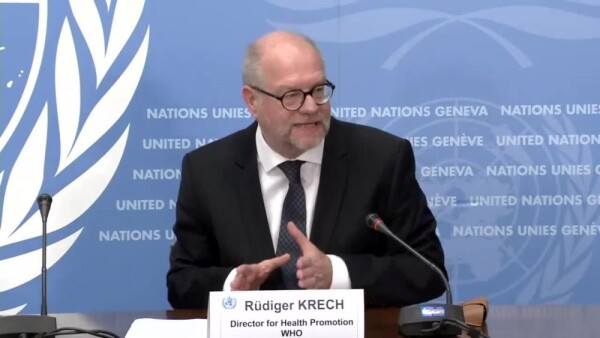
World No Tobacco Day 2023
Rüdiger Krech, Director for Health Promotion, World Health Organization (WHO), said a record 349 million people faced acute food insecurity. This was up from 135 million in 2019, tripling over four years. These people were largely living in 79 countries, of which 30 were on the African continent. 124 countries grew tobacco as a cash crop covering an estimated 3.2 million hectares of land. Approximately 200,000 hectares of land were cleared every year for tobacco farming globally. Tobacco farming land had increased in Africa over the past three years by 18.9 per cent. Tobacco farming accounted for five per cent of total deforestation.
The myth of tobacco farming’s economic importance needed to be urgently dispelled. Tobacco farming contributed less than one per cent of global gross domestic product. It was only more than five per cent in Malawi. Profits went largely to global tobacco companies.
The tobacco industry kept farmers in a cycle of dependency. The tobacco industry advanced the costs of expensive fertilisers, seed and pesticides, which were then deducted from payments to farmers at the end of the season. Though this process, farmers ended up in debt to transnational tobacco companies or intermediary traders. Companies often contracted small farmers to grow tobacco at prices and qualities determined by the buyer. Companies “under-graded” the quality of tobacco leaves to reduce the payments made to farmers. They also determined the cost of the seeds, pesticides and fertilisers they provided. This made tobacco growth unprofitable and put farmers in debt that they needed to repay.
The World Health Organization, together with the World Food Programme (WFP) and the Food and Agriculture Organization (FAO), was using the purchasing power of the UN system to help farmers to get out of this trap. New partners to the initiative included the United Nations Capital Development Fund (UNCDF) and the United Nations Convention to Combat Desertification. FAO helped farmers to develop the capacity to switch to another crop that was suitable to the environment, and trained farmers in growing the new crop. WFP procured the harvest from the farmers, and the UNCDF provided microcredit for paying off debts to the tobacco industry. As profits from other crops were three times higher, farmers were able to quickly pay back credit and thrive. The initiative was helping farmers to switch to crops that benefited their community.
The initiative was first launched in a county in Kenya, where 15 per cent of tobacco farmers moved out straight away. Farmers saw this as a viable alternative. The shift meant that children could go to school instead of growing tobacco. 1.3 million children were working in tobacco fields.
Tobacco growers had a nicotine intake equivalent to smoking 50 cigarettes a day and developed “green-leaf syndrome”. World Health Organization was interested in improving the health of tobacco farmers. There were plans to move the initiative to Zambia, then to countries in Asia and South America, where big tobacco farms were located. World Health Organization predicted that around 5,000 farmers would join the initiative by the end of the year.
In response to questions, Mr. Krech said “The World Needs Food, Not Tobacco” was the official slogan for the campaign.
Local communities in Kenya were also trading and purchasing the new, locally-grown produce. WHO was advocating for local production and consumption. There was significant food insecurity across the world, and this initiative could help to address the issue. This was not solely an African issue—the tobacco grown in Africa was purchased around the world. Tobacco farmers needed help to get out of their dependency on tobacco companies. Smokers should think about this issue for both their own benefit and the benefit of growers.
Announcements
Rosalind Yarde for the International Labour Organization (ILO) said on Wednesday, 31 May 2023 at 11:30 a.m., ILO would hold a virtual press conference to launch the “11th ILO Monitor on the labour impact of economic and geopolitical crises”. Speakers included Gilbert Houngbo, ILO Director-General. The report provided the latest data on the impact of multiple crises on workers and businesses worldwide, and provided an overview of global and regional unemployment, the impact of rising debt levels, inflation and interest rates on labour markets. The report also analysed social protection policy gaps in developing countries, with a focus on pensions.
The International Labour Conference (ILC) would be held in Geneva from 5 to 16 June. This would be the first ILC with Mr. Houngbo as Director-General. The Conference would address issues such as apprenticeships, social protection, environmental protection and occupational safety and health. There would be a two-day World of Work Summit on 14 and 15 June, at which a number of Heads of State would attend. Discussions during the Summit would focus on the establishment of a global coalition for social justice, which would advance social and economic progress for the most vulnerable and marginalised people.
Christian Lindmeier for the World Health Organization (WHO) provided an update on the World Health Assembly. Tomorrow, 26 May at 1 p.m., a roundtable on the 20th anniversary of WHO’s Framework Convention on Tobacco Control would be held.
Yesterday at the Assembly, progress and challenges in women, children and adolescent health had been discussed. The WHO Director-General’s report expressed alarm that maternal mortality rates had stagnated since 2016, and that 54 countries were on not track to meet the Sustainable Development Goal target for infant mortality and 63 were not on track to meet the target for neo-natal mortality. Levels of violence against women and girls remained alarmingly high, and mental health challenges presented an increasing threat for adolescents. All member States had acknowledged major progress by World Health Organization in preventing and tackling sexual misconduct. They welcomed the new policy and three-year strategy for preventing and tackling sexual misconduct, encouraged the organization to continue to its momentum in this regard. The Director-General said that World Health Organization was focusing on changing the organizational culture, having safe and trusted reporting mechanisms, ensuring swift and credible investigations, and following a victim and survivor-centred approach.
Today, Executive Board elections were on the agenda. Committee A would discuss universal health coverage, the prevention of control of non-communicable diseases, substandard and falsified medical products, and strengthening rehabilitation and health systems, among other topics. Committee B would hold discussions on the health of refugees and migrants, the traditional WHO medical strategy, and a health trust fund for small island developing States. Outside of the Committees, a high-level panel discussion on restoring essential immunisations would also be held, as well as a discussion on artificial intelligence and mental health.
In response to questions, Mr. Lindmeier said the resolution on rehabilitation was expected to be voted on in the afternoon today. This year’s elections for the Executive Board featured 10 places up for election. Ballots were secret.
Rolando Gómez, Chief of the Press and External Relations Section at the United Nations Information Service (UNIS) in Geneva, said the United Nations Secretary-General António Guterres had welcomed the arrest of Fulgence Kayishema in South Africa for allegedly committing genocide and crimes against humanity in Rwanda in 1994, following a warrant for his arrest by the International Criminal Tribunal for Rwanda.
Mr. Guterres said, “Mr. Kayishema’s apprehension sends a powerful message that those who are alleged to have committed such crimes cannot evade justice and will eventually be held accountable, even more than a quarter of a century later.” The Secretary-General's thoughts today were first and foremost with the victims of Mr. Kayishema’s alleged crimes, the victims of other serious international crimes, and their families. Ending impunity was essential for peace, security and justice.
The Deputy Secretary-General Amina Mohammed was in Geneva for a very short visit to brief member States on preparations for the Sustainable Development Goals Summit taking place at UN headquarters in September this year, and on the results of the UN development system reform. She would also meet with UN agency heads and officials to build on the outcomes of the recent UN SDG and Chief Executive Board Meeting held in Nairobi. Ms. Mohammed would then travel to Lisbon to attend the opening session of the World Intellectual Property Organization (WIPO) Conference entitled “Thinking about Industrial Property, Sustainability and the Future of the Planet” and to meet with leaders and stakeholders. She would return to UN headquarters on Wednesday, 31 May.
Today, 26 May, at 5 p.m., the Committees on the Rights of the Child and on the Elimination of Discrimination against Women would close their 93rd and 85th sessions, respectively. The Committee on the Rights of the Child had reviewed the reports of Finland, France, Jordan, Sao Tome and Principe, Türkiye and United Kingdom, and the Committee on the Elimination of Discrimination against Women had reviewed the reports of China (including Hong Kong and Macao), Germany, Iceland, Sao Tome and Principe, Slovakia, Spain, Timor Leste and Venezuela.
Yesterday marked the start of the Week of Solidarity with the Peoples of Non-Self-Governing Territories. There were territories “whose people have not yet attained a full measure of self-government.” Today, there were 17 non-self-governing territories remaining under the purview of the Special Committee on Decolonization. The Secretary-General had been calling on countries to find practical ways of implementing the decolonization process.
Monday, 29 May was the International Day of United Nations Peacekeepers. In his message for the day, Secretary-General António Guterres honoured the extraordinary contributions UN peacekeepers made to international peace and security. This year’s commemoration was particularly significant as it was celebrating 75 years of peacekeeping. Peacekeepers provided support for communities rocked by conflict across the globe. The UN Office at Geneva would hold a small commemorative event on Wednesday, 31 May to mark the day.
Wednesday, 31 May was World No Tobacco Day.
Similar Stories
1
1
1
Press Conferences | IOM , ITU , UNECE , UNICEF , WHO , WMO
UNICEF: Ebola, DRC - children orphans or separating them from parents and caregivers; IOM: Humanitarian needs in Djibouti amid arrivals from Yemen and increased migrant movements; WHO: Darfur, scale of health needs far exceeds available resources; WMO co-sponsored Global Heat Forum, Bangkok, monthly Global Seasonal Climate Update; UNECE: UN Forum of Mayors; ITU Plenipotentiary Conference 2026; WHO: child and adolescent obesity guidelines and new global roadmap to tackle pregnancy hypertension, a leading cause of maternal mortality
1
1
1
Press Conferences | OCHA , UN WOMEN , UNHCR , WFP , WHO , WTO , UNEP
OCHA – $160M CERF allocation to 12 underfunded crises; UNHCR – 5.8M refugee children remain out of school amid funding cuts; UN Women – Middle East escalation and food security among women/girls; WHO – Gaza supplies and overall situation; WFP – Yemen food insecurity and impact on global hunger ; UNEP - First International Conference of the Global Framework on Chemicals in Geneva | 16-20 November 2026
1
1
1
Press Conferences | UNHCR , WHO
Yemen's health system nears collapse amid conflict, causing rising casualties and medicine shortages.
1
1
1
Press Conferences | HRC
Update by the Expert Mechanism to Advance Racial Justice and Equality in Law Enforcement
1
1
1
Press Conferences | WIPO , WHO , UNICEF , UNHCR , IOM , WFP , FAO
WIPO Global Innovation Index 2026 launch and press conference, WHO Composition of influenza vaccines for the 2027 Southern Hemisphere flu season, UNICEF Yemen hunger and malnutrition; UNHCR Sudan displacement into Chad; IOM Ebola and population movements in DRC; WFP emergency food assistance in Nepal; and FAO food loss and waste.
2
1
2
Press Conferences | UNCTAD
Gaza reconstruction needs reach $71.5 billion as Palestinian economy and public finances face severe strain. Latest UNCTAD report documents the loss of decades of development gains, economic collapse in Gaza and tightening economic constraints in the West Bank.
The report identifies three immediate priorities: transferring withheld Palestinian revenues, safeguarding the banking system and aligning reconstruction support with the documented scale of damage and economic losses.
1
1
1
Press Conferences | HRC
Press conference on the situation of human rights in Nicaragua by the UN Group of Human Rights Experts
1
1
1
Press Conferences | ITU , UNHCR , WHO , WMO
YEMEN - UNHCR: Escalating conflict in Yemen could fuel more displacement, refugee movement
CLIMATE - WHO / WMO: Health and Climate impact of El Niño
1
1
1
Press Conferences | HRC , OHCHR
Mariana Katzarova discusses human rights in Russia as a UN Special Rapporteur.
1
1
1
Press Conferences | IOM , OHCHR , UN WOMEN , UNFPA , UNHCR , UNOPS , WHO
UN Geneva briefing: Yemen crisis worsens, urgent aid needed across multiple sectors.
1
1
1
Press Conferences | HRC
Press conference on the latest report of the Independent International Fact-Finding Mission on the Bolivarian Republic of Venezuela to the UN Human Rights Council
1
1
1
Press Conferences | OHCHR
Victims Still Waiting: A Global Briefing on Transitional Justice Around the World