

The United Nations Office at Geneva
Multimedia Newsroom
Press Conferences | IOM , OCHA , OHCHR , UNEP , UNHCR , WFP , WHO
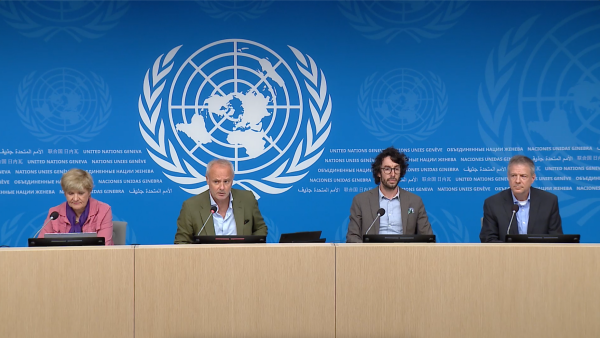
Bi-Weekly Press Briefing 09 May 2023
PRESS BRIEFING BY THE UNITED NATIONS INFORMATION SERVICE
9 May 2023
Humanitarian situation in Sudan
Rolando Gómez, speaking for the United Nations Information Service, said a message had been received last night by United Nations Secretary General Antonio Guterres, in which he strongly condemned the looting of the main compound of the World Food Programme (WFP) in Khartoum over the weekend. This was the latest violation of humanitarian facilities since the start of the crisis, which was in its fourth week. Most, if not all, United Nations agencies and its humanitarian partners had been impacted by large-scale looting. The Secretary-General reiterated the need for parties to protect and respect humanitarian workers and facilities, including hospitals. Civilians and civilian infrastructure must be protected in order to save lives. The needs of the Sudanese people, who were caught up in a humanitarian catastrophe, must come first.
Paul Dillon, speaking for the International Organization for Migration, said the number of internally displaced persons in Sudan had more than doubled in the last week, and more than 700,000 people were now internally displaced by the fighting. Last Tuesday, the figure stood at 340,000, and prior to the commencement of the fighting an estimated 3.7 million were already internally displaced within the country. There were increases in internally displaced persons in many areas, including the capital, where clashes were continuing. The IOM had stock of non-food items in six warehouses around the country, but to date had been unable to deliver to those in need. The fighting must end, and humanitarian workers must be allowed to deliver to those in need before the situation spiraled further out of control.
Rolando Gómez noted the Human Rights Council would hold a special session on Sudan on 11 May to address: “the human rights impact of the ongoing conflict in Sudan”, starting at 10 am Geneva time, and webcast live. A draft resolution had been circulated among States but had not been tabled yet. The first informal on this special session was scheduled today at 12:30 pm. An organizational meeting for this special session would take place this afternoon at 3 pm.
Responding to a question on where internally displaced persons were going, Mr. Dillon said the data was currently preliminary and being analysed, and a comprehensive report would be released later. However, they were moving into multiple States, including the White Nile State and Khartoum State. The decisions to move were influenced by many different factors, including whether there was conflict in the area. However, it was difficult to get cash money in the country, and fuel was very expensive.
Isheeta Sumra, speaking for the World Food Programme (WFP), responding to a question on who were the perpetrators of the looting of humanitarian warehouses, said the WFP was working for the protection of all humanitarian workers and premises. There was currently no information on who was looting- the food, vehicles and assets looted from WFP were meant for the response for the people of Sudan, and thus directly hurt them.
Tariq Jašarević, speaking for the World Health Organisation (WHO), said that, since 15 April, WHO has verified 28 attacks on health leading to 8 deaths and 18 injuries. More reports are under verification. Seventeen of these attacks have affected laboratories. The attacks included looting, obstruction of access to health care, violent attacks using weapons, and the forced occupation of facilities.
The looting was affecting healthcare facilities, undermining the ability of the Sudanese to access healthcare. WHO condemned these attacks. The latest casualty figures from the Ministry of Health were 604 deaths and 5,127 injuries, however, some States were not reporting figures. WHO was on the ground and continued to support the delivery of health and humanitarian services.
Olga Sarrado, speaking for the United Nations Refugee Agency (UNHCR), responding to a request for updated figures on how many people had left Sudan for neighbouring countries, said 150,000 was the latest figure, but this would be updated later today.
Continuing cycle of violence in Haiti
Ravina Shamdasani, speaking for the Office of the High Commissioner for Human Rights, said High Commissioner for Human Rights Volker Türk was warning against a never–ending cycle of violence in Haiti, as gangs continued to inflict extreme cruelty, and vigilantes took matters into their own hands. Haitians required support now. The international community should implement a time-bound, specialized and human rights-compliant support force, with a comprehensive action plan to assist Haiti's institutions. In the month of April alone, more than 600 people were killed in a new wave of extreme violence that hit several districts across the capital, according to information gathered by the Human Rights Service of the United Nations Integrated Office in Haiti (BINUH). This followed the killing of at least 846 people in the first three months of 2023, in addition to 393 injured and 395 kidnapped during that period – a 28 per cent increase in violence on the previous quarter. Overwhelmed by the ever-increasing insecurity, Haiti was seeing a worrying increase in mob killings and lynchings of alleged gang members, with at least 164 of these murders documented in April.
Some 1,346 people had been killed in total so far, with many injuries and kidnappings. Haiti was seeing a worrying increase in mob killings and lynchings of alleged gang members. The State should tackle gang violence, but it did not have the capacity to respond. The violence was not only becoming more intense and frequent, but spreading, as gangs extended areas under their control. Among other modus operandi used by gangs, snipers indiscriminately shot people on the street, and others were burned alive on public transport. The Government, with support for the international community, must do its utmost to provide its people with access to clean water, food, health and shelter. There must be an urgent, robust response.
Rolando Gómez, speaking for the United Nations Information Service, said the Security Council met yesterday and issued a statement on the situation, expressing their concern on the situation and condemning the human rights violations taking place.
Iran: worrying increase in the number of executions
Ravina Shamdasani, for the Office of the High Commissioner for Human Rights (OHCHR), said that High Commissioner Volker Türk had expressed concern on the high number of executions: over ten people were put to death each week in Iran and called on authorities to follow the lead of most other States and to abolish the death penalty or halt all executions. Over 209 had been executed so far this year, mostly for drug trafficking offences, and many from minorities. Iran was on the same track as last year where over 580 people were executed: an abominable record, said Mr. Türk. At least 45 people, including 22 from the Baluch minority, were executed in the last 14 days alone. “Imposing the death penalty for drug offences is incompatible with international human rights norms and standards,” Mr. Türk had said. The Human Rights Committee, the body responsible for the authoritative interpretation of the Covenant, was clear on prohibiting imposition of the death penalty for any but the “most serious crimes” – crimes of extreme gravity, involving intentional killing, and drug offences did not meet this threshold. The High Commissioner urged the Iranian authorities to establish a moratorium on executions with a view to abolishing the death penalty.
In response to a question on executions for the crime of blasphemy, Ms. Shamdasani said the problem was that blasphemy was a broad term, and international law did not permit executions for such a broad and ill-defined term, as it was open to abuse and arbitrary application of the penalty. There were also concerns about a discriminatory ethnic element of these executions. With a system with a frequent lack of respect for due process, and allegations of lack of access to lawyers, among other violations, this compounded the possibility of serious miscarriages of justice.
Answering a question on what could be done through international pressure to reverse this trend, Ms. Shamdasani said if this trend continued, it would represent one of the highest rates of the application of the death penalty since 2015. The Office of the High Commissioner for Human Rights tried to use many means to influence Governments to ensure their compliance with international human rights law. The Office would continue to engage with the Government and to speak out, being public about its concerns. There were pressures within and without the country, and the Office encouraged all of those with influence to urge the Iran Government to respect their commitments under international law.
Responding to further questions on other issues, Ms. Shamdasani said that with regard to Nicaragua, the situation was getting worse, and the Office was very concerned, particularly with regard to arbitrary detention of human rights defenders, Government critics and others, and the Office was continuing to monitor the situation. On Cuba, the Office was following the situation. With regard to the termination by the United States of its Title 42, the High Commissioner had issued a release on United States border actions forming a risk to fundamental human rights, and he had stressed that the right to seek asylum was a human right. Concern remained for the United States’ application of measures to try to prevent people to access the border and its impact on their right to asylum.
Olga Sarrado, speaking for the United Nations Refugee Agency (UNHCR), said that the High Commissioner had consistently raised objections with the United States on the situation, and called on the United States to restore access to asylum. The efforts made by the authorities to look into new pathways for those in the region were welcomed, but this expansion could not replace a State’s duties to provide access to asylum.
Hunger alert in Nigeria
Jens Laerke, speaking for the Office for the Coordination of Humanitarian Affairs (OCHA), said with regard to the hunger alert in north-east Nigeria that he had spoken about at the press briefing on 5 May, the United Nations and its partners were today putting out a targeted response plan asking for USD 396 million to stave off acute malnutrition among children and help people get through the upcoming lean season when food is typically short. 4.3 million people in the Borno, Adamawa and Yobe states risked severe hunger from June to August, and child malnutrition was expected to rise with some 700,000 children at risk of severe wasting. If more funding did not arrive, humanitarian organizations would only be able to reach about 300,000 of these at-risk people. In 2023, the total admissions of complicated malnutrition cases across the northeastern states were nearly 4,300 between January and March, an increase of 23 per cent compared to the same period in 2022. Early funding could help pull food insecure households back from the brink.
Lack of progress in achieving improvements in Maternal Health
Tariq Jašarević, speaking for the World Health Organisation (WHO), said that two press releases had been issued yesterday on the Conference in Maternal Health currently happening in South Africa, which aimed to revive progress for the survival of women and newborns. A new report had been released on maternal and child survival, as had a report on the promising results for an innovative trial aiming to tackle post-birth hemorrhaging. Another report would be issued later today on the prevalence of pre-term births globally, and a press conference would be held at 2 pm Geneva time on this latter report. A press release on the first-ever framework on reducing anemia was also coming out.
Allisyn Moran, Unit Head for Maternal Health at the WHO, said with regard to the Conference in South Africa, together with other UN agencies, WHO had today released a new report, which outlined progress to date against global targets, and which found that gains in tackling maternal and newborn deaths and preventing stillbirths had stalled for eight years - since 2015. This was deeply concerning. Over 4.5 million women and babies died every year in pregnancy, childbirth or the first weeks after birth - equivalent to 1 death every 7 seconds - mostly from preventable or treatable causes.
While these trends pre-dated the pandemic, COVID-19 related service disruptions and funding diversions, rising poverty, and worsening humanitarian crises were intensifying pressures on already overstretched maternity and newborn health services. Funding shortfalls and underinvestment in primary healthcare risked further devastating survival prospects. More and smarter investments in primary healthcare were needed now so that every woman and baby - no matter where they lived - had the best chance of health and survival. WHO was calling for universal access to quality and respectful, affordable healthcare before, during, and after childbirth. More skilled and motivated health workers, especially midwives, were needed. There needed to be a greater focus on equity. Subnational planning and investments were crucial. There must be investment to ensure that women and babies got the healthcare they needed, when they needed it.
World Environment Day
Alejandro Laguna, speaking for United Nations Environment Programme, said this year’s World Environment Day, held annually on 5 June, would be the 50th occurrence. UNEP had decided that this year’s theme would focus for the second time on solutions for plastic pollution. Shortly before 5 June, there would be a meeting of the Intergovernmental Negotiating Committee to develop an international legally binding instrument on plastic pollution, including in the marine environment, which would hopefully be in place by the end of 2024. The amount of plastic waste entering rivers, lakes and seas could nearly triple to 37 million tons per year by 2040. A new report would be released on how the world could end plastic pollution and establish a circular economy. It was a solutions-oriented report, with means for Governments and businesses to end plastic pollution by 2040.
UNEP would be holding a special event on the 5 June at Environment House in Geneva to celebrate the Day. It would also hold a specific event in Kyrgyzstan, visiting a sacred lake and different project sites that were trying to establish new practices, new recycling plans, and others. A media event would take place in Athens, Greece, on 27 May, focusing on plastic waste created by the fishing industry, and further information would be available later.
Responding to a question on environmentalists in Mexico who had denounced an ecocide in the south-east of the country due to the construction of a train link, Mr. Laguna said this type of event was taken very seriously by UNEP. The environmental defenders program had been created in response to such situations several years ago. The work of anyone who defended the environment was very much appreciated, respected, and admired by UNEP.
Reintegration of Syria in the Arab League
Jenifer Fenton, speaking for the Office of the Special Envoy of the Secretary General for Syria, responding to a question on the decision of the Arab League to reintegrate Syria, said the United Nations was aware of the League of Arab States Council’s foreign minister-level resolution on 7 May to this effect. The Secretary-General hoped that the regional engagement could help to unlock progress to move forward the UN-facilitated political process in line with Security Council resolution 2254 (2015). Like the Secretary-General, the Special Envoy Mr. Geir O. Pedersen also believed that the region had a vital role to play in the search for a political solution to the conflict. The Special Envoy had long stressed that there was no military solution to the conflict and what was needed was a genuine political process that involved everyone, and he continued to stress the need to address protection concerns for civilians, advance the file of the detained, abducted and missing, put in place conditions for safe, dignified, and voluntary refugee return, and ease the suffering and hardship of the Syrian people. He also stressed the importance of the Constitutional Committee resuming its work in Geneva as soon as possible.
Responding to a question on the next meeting of the Constitutional Committee, Ms. Fenton said that Mr. Pedersen had told the Security Council that this was an important juncture. There was renewed international attention on Syria, and this was very important if it could act as a circuit breaker and move the political process forward.
Announcements
Rolando Gómez, speaking for the United Nations Information Service, said Secretary-General Antonio Guterres had arrived in Madrid yesterday where he met with the President of the Government of Spain, Pedro Sánchez Pérez-Castejón. The Secretary-General and the President of the Government discussed the war in Ukraine, as well as the situations in the Middle East, Afghanistan, and Western Sahara. The Secretary-General briefed the President of the Government on the United Nations’ ongoing efforts to extend, expand and improve the Black Sea Initiative, as well as to remove remaining obstacles to the exports of Russian food products and fertilizers.
This morning, a short while ago, the Secretary-General received the Carlos V European Award. Upon receiving this recognition, Mr. Guterres delivered remarks, which had been streamed on UN webcast and would shortly be available.
On human rights, the Human Rights Council was currently holding the Universal Periodic Review session. This morning it had reviewed the human rights situation on Israel, and this afternoon it would address Liechtenstein.
The Committee Against Torture would close on 12 May its 76th session, and issue its concluding observations on the six countries reviewed: Colombia, Brazil, Luxembourg, Slovakia, Kazakhstan and Ethiopia.
The Committee on the Elimination of Discrimination Against Women had opened on 8 May its 85th session and was today reviewing the report of Timor-Leste.
The Committee on the Rights of the Child had also opened on 8 May its 93rd session, and today would review of the report of France.
There would be a press conference on 12 May at 12 noon to mark the closing of the 16th meeting of the Conference of the Parties to the Basel Convention (BC COP-16), 11th meeting of the Conference of the Parties to the Rotterdam Convention (RC COP-11), and 11th meeting of the Conference of the Parties to the Stockholm Convention (SC COP-11).
Similar Stories
1
12
1
1
Press Conferences , Images | UNOG
Closing Press Conference following the Sixth Consultative Meeting on Enhancing Coordination of Peace Initiatives and Efforts in Sudan

2
17
1
2
Edited News , Press Conferences | OCHA , WMO
Two UN agencies teamed up on Wednesday to issue an appeal for immediate assistance to help communities already being impacted by the strongest El Niño on record.
1
1
1
Press Conferences | CITES
Wildlife trade and conservation policy discussions at the 81st meeting of the CITES Standing Committee (SC81)
1
1
1
Press Conferences | UNHCR , UNCTAD , WMO , OCHA , UNICEF , WHO
UNHCR Hungary’s 1956 Refugee Crisis: 70 Years On, UNCTAD World Investment Forum 2026, Doha, WMO Greenhouse Gas Bulletin and Climate Update for COP31, OCHA Afghanistan: Malnutrition, Girls’ Education and Recovery, UNICEF Yemen: Child Malnutrition and Unsafe Water in Taiz, WHO Inequalities in Noncommunicable Diseases and Risk Factors

1
1
1
Press Conferences | UNHCR
End of UNHCR's 77th Annual Executive Committee (ExCom) meeting week

1
1
1
Press Conferences | UNICEF , IOM , UNHCR
UN Special Assistant to the Personal Envoy Office (SUDAN): Peace Initiatives and Efforts in Sudan; UNICEF: Dire situation of children in Gaza; IOM: Damaged Homes and Energy Attacks Risk Displacing Ukrainians for this winter; UNHCR: update on EXCOM week

1
1
1
Press Conferences | IOM , UNDRR
UN stresses importance of household preparedness for disaster risk reduction.
1
1
1
Statements , Press Conferences | OHCHR
1
1
1
Press Conferences | UNHCR , UNICEF , IFRC , OHCHR , UN WOMEN , IOM , OCHA , WHO
UNHCR – ExCom Meeting, UNICEF – Nepal Recovery, IFRC – Flash Floods, WHO – Mental Health, IOM – South Sudan Floods, OCHA – DRC Humanitarian aid, UNHCR – Sahel Displacement, UNICEF – Yemen Update, IOM – Gaza Shelter, UN Women – Gaza Women, OHCHR – Arrests and detentions of Syrians by Israeli force
2
1
2
Press Conferences | UNCTAD
Presentation of the Trade and Developement Report 2026
Embargoed until 9 October 2026 at 11 a.m. (Geneva Time)
UNCTAD: UNCTAD’s flagship report finds that governments increasingly use industrial, trade, financial and technology policies to pursue economic and national security objectives. Market access and the ability to move into higher-value activities now depend more heavily on technology, finance and geopolitics.
1
1
1
Press Conferences | UPU
Release of the State of the Postal Sector Report 2026
1
1
1
Press Conferences | IOM , ITU , UNECE , UNICEF , WHO , WMO
UNICEF: Ebola, DRC - children orphans or separating them from parents and caregivers; IOM: Humanitarian needs in Djibouti amid arrivals from Yemen and increased migrant movements; WHO: Darfur, scale of health needs far exceeds available resources; WMO co-sponsored Global Heat Forum, Bangkok, monthly Global Seasonal Climate Update; UNECE: UN Forum of Mayors; ITU Plenipotentiary Conference 2026; WHO: child and adolescent obesity guidelines and new global roadmap to tackle pregnancy hypertension, a leading cause of maternal mortality