

The United Nations Office at Geneva
Multimedia Newsroom
PRESS BRIEFING BY THE UNITED NATIONS INFORMATION SERVICE
28 April 2023
Situation in Sudan
Alessandra Vellucci, for the United Nations Information Service (UNIS), said that the Secretary-General was deeply grateful to the Government of France for its vital assistance in safely transporting more than 400 UN personnel and their dependents out of Sudan. He also thanked the authorities in Saudi Arabia, Chad, Kenya, and Uganda for facilitating the arrival of UN colleagues and their families. The Secretary-General had also thanked many other Member States, including the United States, Jordan, Sweden, Germany, the United Kingdom, and Canada, who had assisted in ensuring the safe transport of UN personnel. The Secretary-General had reiterated his call to the parties to the conflict to respect the cease-fire.
Matthew Saltmarsh, for the United Nations Refugee Agency (UNHCR), said that the situation remained deeply concerning inside the country and in neighboring countries. UNHCR was working with partners to deploy wherever needed, and as soon as possible. Given the sheer scale of the country, with its seven international seven borders, and the speed with which the situation was evolving, precise numbers of refugees and internally displaced people were hard to establish. UNHCR was ready to take a more active role, whenever and wherever possible.
Axel Bisschop, UNHCR Representative in Sudan, speaking from Port Sudan, said that the conflict had caused a devastating impact on the population, including the already displaced people who had been at the margins of society even before the conflict. There were some areas which were worse off than the others; in the Darfur, Khartoum, and North Kordofan, UNHCR had had to temporarily stop its programmes due to safety concerns. In several other states, UNHCR maintained its offices and was delivering assistance to the degree possible. In the refugee camps in the White Nile, the Blue Nile, Qadarif and Kassala, there was an influx of displaced people, mainly South Sudanese, Ethiopian, and Eritrean refugees.
The biggest challenge was how to secure that food distribution would continue; UNHCR was cooperating on this with the rest of the UN and local partners, particularly UNICEF and the WFP in this regard. The biggest challenge was Darfur, which had already experienced significant intercommunal conflict and displacement. Intercommunal violence was increasing, and there were fears of a repetition of the situation observed in recent years. UNHCR was to remain in the country, it remained committed to protecting refugees, displaced populations, and host communities in Sudan. It would continue to do all that it could working with communities and will scale up when possible.
Full statement can be read here.
Ravina Shamdasani, for the Office of the High Commissioner for Human Rights (OHCHR), stated that two weeks after the eruption of violence between the Rapid Support Forces and the Sudanese Armed Forces, imposing fear, deprivation, trauma and suffering on the civilian population, the human rights situation in Sudan continued to dramatically deteriorate. Hundreds of thousands of people had fled their homes to find places of greater safety, at any cost, and faced abuses en route. Thousands remained trapped in residential areas where fighting had taken place, facing air strikes, shelling, and use of heavy weapons, trying to use any period of calm to reach places of relative safety.
Ms. Shamdasani also said that it was deeply alarming that inmates had been released from, or escaped from, a number of prisons. OHCHR was very worried about the prospect of further violence, amid a generalized climate of impunity. OHCHR called on the parties to immediately end hostilities, and in particular to halt hostilities in residential areas and the targeting of civilian population and infrastructure. The protection of civilians had to be paramount.
Full OHCHR statement is available here.
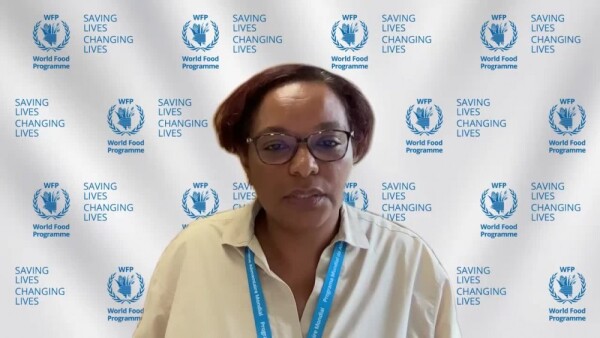
Brenda Kariuki, World Food Programme (WFP) Regional Communications Officer for East Africa, connecting from Nairobi, stated that the WFP humanitarian operations were currently impossible given the intensity of the fighting in many parts of the country. WFP was calling on the parties to stop the fighting, establish a humanitarian ceasefire and allow aid agencies to deliver much needed help, without which millions more people could plunge into hunger. The consequences of the crisis could be long-term on both Sudan and its neighbours; for example, the prices of the food basket in the northern states of South Sudan, bordering Sudan, had already increased significantly. For the WFP, safety and security of its staff was a priority, but the organization remained ready to continue with its much-needed activities as soon as the conditions on the ground allowed. Up to 4,000 metric tons of food meant for vulnerable people had been looted from the WFP warehouses, and a number of WFP vehicles had been stolen. Ms. Kariuki warned that the conflict would push additional millions into hunger. WFP’s leadership team continued to monitor the situation and plan next steps from Port Sudan.
More information about the WFP activities in Sudan can be found here.
Responding to questions, Ms. Shamdasani said that the OHCHR was very concerned about reported prison breaks in Sudan, given that impunity had been a long-standing issue in the country. Some war criminals might now be at large, which was disconcerting. Since 24 April, OHCHR had observed clashes between different communities in Sudan, leading to the death toll of almost 100 people. Ms. Shamdasani said that the fighting was continuing, even if the ceasefire had helped decrease its intensity. OHCHR had the figure of 512 people killed, according to the Sudanese Ministry of Health, but it was feared that this was a serious underestimate.
Christian Lindmeier, for the World Health Organization (WHO), said that as of today, there had been 25 verified attacks on health care causing the death of 8 people and injured 18 others.
Ms. Vellucci clarified that not all UN staff had left the country; parts of the UN team had relocated to Port Sudan and were continuing to work from there. Mr. Bisschop added that in Darfur, relocations from other regions were underway, so it was difficult to provide definite numbers yet. The international staff had been evacuated, but national staff were still there, and in contact with the local community leaders.
He explained, responding to another question, that there had been 3.7 million IDPs in the country prior to the fighting, in 73 IDP camps. Some 1.1 million refugees were present in the country, mostly in the Blue Nile state, the White Nile state, Kassala, and Qadarif. UNHCR had warehouses in all locations; some were hard to access, some had been looted, but there was still a lot of aid inside the country. Darfur was the biggest challenge, reiterated Mr. Bisschop. Ms. Kariuki added that it was now difficult to say how much food was left in the warehouses, given the recent looting.
Ms. Vellucci reminded that the 2023 Humanitarian Response Plan for Sudan was currently only 13.9 percent funded.
Announcements
Ravina Shamdasani, for the Office of the High Commissioner for Human Rights (OHCHR), informed that the High Commissioner would be visiting Addis Ababa and Nairobi in the coming days. The mission to Addis would include meeting with the African Union chairperson, civil society, and Ethiopia’s Human Rights Commission, among others. After that, he would attend the Central Executive Board meeting in Nairobi and brief the Security Council from Nairobi on 3 May.
Alessandra Vellucci, for the United Nations Information Service (UNIS), informed that the Deputy Secretary-General was on her way to Africa, first to Nairobi to attend the 2023 Ibrahim Governance Weekend, and deliver the keynote address at the Leadership Ceremony. She would attend other high-level events, including a meeting of the Africa Europe Foundation Women Leaders Network. On 30 April, the DSG would depart to Addis Ababa to engage in a high-level strategic dialogue with senior officials of the African Union as part of the outcomes from the 2022 AU-UN Conference. Ms. Mohammed would then return to Nairobi to chair the bi-yearly meeting of the United Nations Sustainable Development Group. In both Kenya and Ethiopia, the Deputy Secretary-General would meet with senior government officials, the UN country teams and other stakeholders. Finally, on 5 May, the DSG would proceed to the United Kingdom to attend the coronation of King Charles III, on behalf of the Secretary General.
Ms. Vellucci informed that today at 1:30 pm, the Committee on the Elimination of Racial Discrimination would present its findings on Argentina, Niger, Philippines, Portugal, Russian Federation, and Tajikistan. The Committee would close its 109th session at 4 pm today.
The Committee Against Torture would conclude this afternoon the review of the report of Slovakia.
On 1 May at 12 noon, there would be a hybrid briefing on the occasion of the opening of the 16th meeting of the Conference of the Parties to the Basel Convention, 11th meeting of the Conference of the Parties to the Rotterdam Convention and 11th meeting of the Conference of the Parties to the Stockholm Convention.
Finally, Ms. Vellucci informed that on 30 April the international community would mark the Jazz Day, on the occasion of which there would be an all-star global concert that could be followed online from 10 pm Geneva time.
Similar Stories
1
1
1
Press Conferences | UN WOMEN , WFP , WHO
UN WOMEN: Sudan Women and girls one year after the fall of El Fasher; increasing drone attacks across the country; WFP: DRC - Ebola spreads to eighth DRC province as WFP delivers food, builds treatment centres and keeps supplies moving; WHO - Update on Ebola (Bundibugyo Virus Disease)
1
12
1
1
Press Conferences , Images | UNOG
Closing Press Conference following the Sixth Consultative Meeting on Enhancing Coordination of Peace Initiatives and Efforts in Sudan

2
17
1
2
Edited News , Press Conferences , Images | OCHA , WMO
Two UN agencies teamed up on Wednesday to issue an appeal for immediate assistance to help communities already being impacted by the strongest El Niño on record.
1
1
1
Press Conferences | CITES
Wildlife trade and conservation policy discussions at the 81st meeting of the CITES Standing Committee (SC81)
1
1
1
Press Conferences | UNHCR , UNCTAD , WMO , OCHA , UNICEF , WHO
UNHCR Hungary’s 1956 Refugee Crisis: 70 Years On, UNCTAD World Investment Forum 2026, Doha, WMO Greenhouse Gas Bulletin and Climate Update for COP31, OCHA Afghanistan: Malnutrition, Girls’ Education and Recovery, UNICEF Yemen: Child Malnutrition and Unsafe Water in Taiz, WHO Inequalities in Noncommunicable Diseases and Risk Factors
1
1
1
Press Conferences | UNHCR
End of UNHCR's 77th Annual Executive Committee (ExCom) meeting week
1
1
1
Press Conferences | UNICEF , IOM , UNHCR
UN Special Assistant to the Personal Envoy Office (SUDAN): Peace Initiatives and Efforts in Sudan; UNICEF: Dire situation of children in Gaza; IOM: Damaged Homes and Energy Attacks Risk Displacing Ukrainians for this winter; UNHCR: update on EXCOM week
1
1
1
Press Conferences | IOM , UNDRR
UN stresses importance of household preparedness for disaster risk reduction.
1
1
1
Statements , Press Conferences | OHCHR
1
1
1
Press Conferences | UNHCR , UNICEF , IFRC , OHCHR , UN WOMEN , IOM , OCHA , WHO
UNHCR – ExCom Meeting, UNICEF – Nepal Recovery, IFRC – Flash Floods, WHO – Mental Health, IOM – South Sudan Floods, OCHA – DRC Humanitarian aid, UNHCR – Sahel Displacement, UNICEF – Yemen Update, IOM – Gaza Shelter, UN Women – Gaza Women, OHCHR – Arrests and detentions of Syrians by Israeli force
2
1
2
Press Conferences | UNCTAD
Presentation of the Trade and Developement Report 2026
Embargoed until 9 October 2026 at 11 a.m. (Geneva Time)
UNCTAD: UNCTAD’s flagship report finds that governments increasingly use industrial, trade, financial and technology policies to pursue economic and national security objectives. Market access and the ability to move into higher-value activities now depend more heavily on technology, finance and geopolitics.
1
1
1
Press Conferences | UPU
Release of the State of the Postal Sector Report 2026