

The United Nations Office at Geneva
Multimedia Newsroom
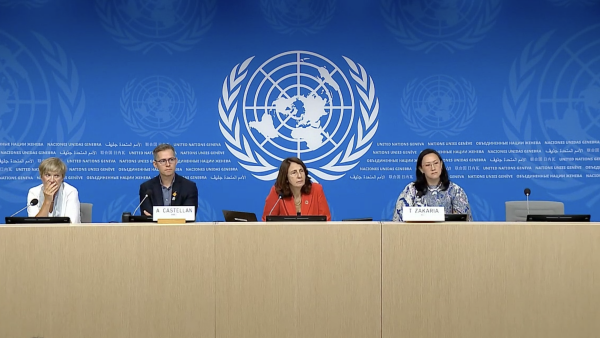
PRESS BRIEFING BY THE UNITED NATIONS INFORMATION SERVICE
31 March 2023
Cholera and other health emergencies in Mozambique multiplied by Cyclone Freddy
Dr. Severin von Xylander, World Health Organization (WHO) Representative in Mozambique, speaking from Maputo, said that there were multiple health emergencies happening in Mozambique at the same time: cholera, cyclone Freddy and its floods, polio, Covid-19, and a protracted humanitarian crisis in the North, mainly in Cabo Delgado with 0.5m displaced people. The compound effect of those crises was overwhelming.
Cyclone Freddy had destroyed over 132,000 homes and 184,000 people were displaced. In the cyclonic destruction path, 163 health facilities had damaged, jeopardizing access to routine care. The floods caused by the cyclone’s freak pattern were now receding, but access to safe water and sanitation was still challenging. About one-third of crops had been destroyed, and cholera cases were being reported from an increasing number of affected districts. In the coming weeks, the number of malaria cases would drastically increase, and the already high malnutrition rate would go further up. Dr. von Xylander said that, while cholera outbreaks regularly occurred in Mozambique, with almost 21,000 cases and 95 deaths, this was the largest outbreak in more than a decade. Over 715,000 people had already been vaccinated using the single-dose strategy, and a second campaign had just been launched in Quelimane, the most affected city, targeting 410,000 people. A humanitarian flash appeal had been issued on 30 March, informed Mr. von Xylander.
Update on the humanitarian response in Türkiye
Jens Laerke, for the Office for the Coordination of Humanitarian Affairs (OCHA), informed that, almost two months after the devastating earthquakes, UN agencies and humanitarian partners had reached more than 4.1 million people in Türkiye with basic household items including for cooking, sleeping, heating, and clothes. Almost three million people had been reached with emergency food assistance, and more than 700,000 people had received support to improve their living spaces. In addition, 1.6 million people had received water, sanitation, and hygiene assistance, and nearly one million liters of drinking water had been delivered. The humanitarian organizations had also supported the Ministry of Health with 4.6 million vaccine doses, 16 mobile health clinics, as well as medicines and medical supplies for reproductive health and trauma care. The USD one billion Flash Appeal was currently 27 percent funded, and the largest donors were the USA, Kuwait, the European Commission, the UN Emergency Fund, and Saudi Arabia.
Responding to questions, Mr. Laerke said that this was a rolling response. The first three weeks had focused on search-and-rescue, which was followed by the humanitarian emergency phase. After that, a reconstruction phase would commence; a recent Brussels conference had raised billions of euros towards that goal.
Situation of the global health workforce
Jim Campbell, Director, Health Workforce, at the World Health Organization (WHO), said that around the world the volume of emergencies to which the UN system was responding was overwhelming. All of that inevitably had an impact on national health systems and health workers. Question could be asked if we were in the middle of a global health workforce crisis. Halfway through the Sustainable Development Agenda and three years since the start of the COVID-19 pandemic, mortality among health workers, partly due to COVID-19, burnouts and mental health burden were notable. The health workforce was exhausted and in short supply in relation to the massive needs.
The following week, the WHO would be convening ministers from around the world together with international partners, national civil society and health professionals at the Fifth Global Forum on Human Resources for Health. The objective was to look at the diagnostic and what action could be taken to address today’s long-standing underinvestment in the health workforce, and to try to reset for the second half of Agenda 2030, thus keeping alive the ambition of “health for all: by 2030. Christian Lindmeier, also for the WHO, added that limited media spaces would be available for the meeting next week, but the meeting could also be followed online.
Migrant deaths in Ciudad Juárez, Mexico
Responding to questions about the tragedy in Ciudad Juárez, northern Mexico, in which 39 migrants had died in a fire, Olga Sarrado, for the United Nations Refugee Agency (UNHCR), said that this tragedy should have been prevented. People had died under the custody of state agents. UNHCR hoped that the investigation would be swiftly concluded and accountability established. Mexico’s asylum system was overstretched, said Ms. Sarrado, and it needed additional support. This was only the latest in a series of many similar incidents, and long-term, region-tailored solutions ought to be found.
Rolando Gómez, for the United Nations Information Service (UNIS), reminded that the Secretary-General conveyed his condolences to the families and loved ones of the deceased and wished a swift recovery to those injured. He called for a thorough investigation of this event and reiterated his commitment to work with the authorities of countries where mixed movements of people occur to establish safer, more regulated, and more organized migration routes.
Human Rights Council
Pascal Sim, for the Human Rights Council (HRC), said that this morning, the Council was continuing an interactive dialogue on the report of the Independent Expert on the situation of human rights in Mali. After that, the Council would hold an interactive dialogue with the High Commissioner for Human Rights on the findings of OHCHR report on the situation of human rights in Ukraine. From 3 pm, there would be a High-level interactive dialogue to assess developments in the situation of human rights in the Central African Republic, to be followed by an interactive dialogue on the report of the High Commissioner on technical assistance and capacity-building for South Sudan.
Mr. Sim informed that on 3 April, the Council would conclude its dialogue with the Fact-Finding Mission on Libya, whose mandate was ending today. In the afternoon, the Council would start to take action on 43 draft resolutions, before it closes on 4 April in the evening.
Announcements
Christian Lindmeier, for the World Health Organization (WHO), informed that on 3 April at 1:30 pm, there would be an embargoed briefing on new data on infertility prevalence. The estimates would highlight the magnitude of the issue and possible ways to address.
Speaking about events on the occasion of the WHO’s 75th anniversary, Mr. Lindmeier informed that from 3 April until 1 May, there would be a photo exhibition “Picturing Health” at Quai Wilson in Geneva. WHO’s regular press conference would take place on 6 April in the afternoon; media were welcome to the WHO premises. On 8 April, at 7:30 pm, a “healing arts” concert would take place in the Victoria Hall in Geneva.
David Hirsch, for the International Telecommunication Union (ITU), said that the ITU would hold a hybrid press conference from CICG on 6 April at 1 pm on the progress of discussions leading to the World Radio Conference 2023, which would take place in Dubai from 20 November to 15 December 2023. More information is available here.
Rolando Gómez, for the United Nations Information Service (UNIS), informed that today at 12:45 pm, in the stake out area behind Room XX, Ambassador Michèle Taylor, Permanent Representative of the United States of America to the United Nations Human Rights Council, would address the UN High Commissioner for Human Rights’ report on Ukraine
Mr. Gómez said that the Committee on Enforced Disappearances would conclude its 24th session at 5:40 pm today, when it would issue its concluding observations on the four countries reviewed during the session: Zambia, Argentina, Germany, and Costa Rica. On 4 April at 2 pm, the Committee would present its findings.
The Committee on the Protection of the Rights of All Migrant Workers and Members of their Families was concluding this morning its review of the report of the Philippines and would continue this afternoon its review of the report of El Salvador.
Mr. Gómez reminded of the statement by the Secretary-General on Myanmar, in which he shared deep concern by reports that the Union Election Commission, appointed by the military in Myanmar, had dissolved 40 opposition parties, including the National League for Democracy.
Mr. Gómez said that 30 March was the first-ever Zero Waste Day; 2 April would be the World Autism Awareness Day; and 4 April – International Day for Mine Awareness and Assistance in Mine Action.
Similar Stories
1
1
1
Statements , Press Conferences | OHCHR
1
1
1
Press Conferences | UNHCR , UNICEF , IFRC , OHCHR , UN WOMEN , IOM , OCHA , WHO
UNHCR – ExCom Meeting, UNICEF – Nepal Recovery, IFRC – Flash Floods, WHO – Mental Health, IOM – South Sudan Floods, OCHA – DRC Humanitarian aid, UNHCR – Sahel Displacement, UNICEF – Yemen Update, IOM – Gaza Shelter, UN Women – Gaza Women, OHCHR – Arrests and detentions of Syrians by Israeli force
2
1
2
Press Conferences | UNCTAD
Presentation of the Trade and Developement Report 2026
Embargoed until 9 October 2026 at 11 a.m. (Geneva Time)
UNCTAD: UNCTAD’s flagship report finds that governments increasingly use industrial, trade, financial and technology policies to pursue economic and national security objectives. Market access and the ability to move into higher-value activities now depend more heavily on technology, finance and geopolitics.
1
1
1
Press Conferences | UPU
Release of the State of the Postal Sector Report 2026
1
1
1
Press Conferences | IOM , ITU , UNECE , UNICEF , WHO , WMO
UNICEF: Ebola, DRC - children orphans or separating them from parents and caregivers; IOM: Humanitarian needs in Djibouti amid arrivals from Yemen and increased migrant movements; WHO: Darfur, scale of health needs far exceeds available resources; WMO co-sponsored Global Heat Forum, Bangkok, monthly Global Seasonal Climate Update; UNECE: UN Forum of Mayors; ITU Plenipotentiary Conference 2026; WHO: child and adolescent obesity guidelines and new global roadmap to tackle pregnancy hypertension, a leading cause of maternal mortality
1
1
1
Press Conferences | OCHA , UN WOMEN , UNHCR , WFP , WHO , WTO , UNEP
OCHA – $160M CERF allocation to 12 underfunded crises; UNHCR – 5.8M refugee children remain out of school amid funding cuts; UN Women – Middle East escalation and food security among women/girls; WHO – Gaza supplies and overall situation; WFP – Yemen food insecurity and impact on global hunger ; UNEP - First International Conference of the Global Framework on Chemicals in Geneva | 16-20 November 2026
1
1
1
Press Conferences | UNHCR , WHO
Yemen's health system nears collapse amid conflict, causing rising casualties and medicine shortages.
1
1
1
Press Conferences | HRC
Update by the Expert Mechanism to Advance Racial Justice and Equality in Law Enforcement
1
1
1
Press Conferences | WIPO , WHO , UNICEF , UNHCR , IOM , WFP , FAO
WIPO Global Innovation Index 2026 launch and press conference, WHO Composition of influenza vaccines for the 2027 Southern Hemisphere flu season, UNICEF Yemen hunger and malnutrition; UNHCR Sudan displacement into Chad; IOM Ebola and population movements in DRC; WFP emergency food assistance in Nepal; and FAO food loss and waste.
2
1
2
Press Conferences | UNCTAD
Gaza reconstruction needs reach $71.5 billion as Palestinian economy and public finances face severe strain. Latest UNCTAD report documents the loss of decades of development gains, economic collapse in Gaza and tightening economic constraints in the West Bank.
The report identifies three immediate priorities: transferring withheld Palestinian revenues, safeguarding the banking system and aligning reconstruction support with the documented scale of damage and economic losses.
1
1
1
Press Conferences | HRC
Press conference on the situation of human rights in Nicaragua by the UN Group of Human Rights Experts
1
1
1
Press Conferences | ITU , UNHCR , WHO , WMO
YEMEN - UNHCR: Escalating conflict in Yemen could fuel more displacement, refugee movement
CLIMATE - WHO / WMO: Health and Climate impact of El Niño