

The United Nations Office at Geneva
Multimedia Newsroom
Press Conferences | FAO , OHCHR , UNHCR , UNICEF , WFP , WMO
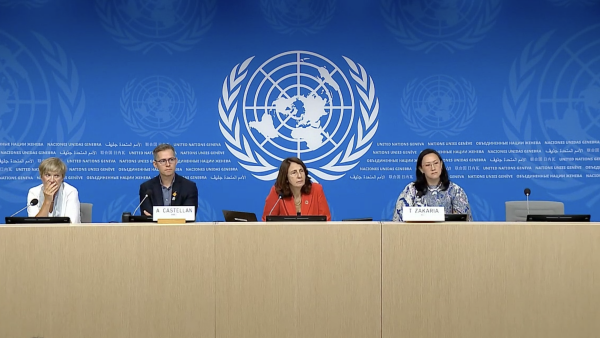
Bi-Weekly Press Briefing 17 March 2023
PRESS BRIEFING BY THE UNITED NATIONS INFORMATION SERVICE
17 March 2023
Cyclone Freddy in Malawi
Paul Turnbull, World Food Programme (WFP) Country Director in Malawi, speaking from Blantyre, said that on 12 March Freddy had hit Malawi, leading to heavy rains and flooding. Six-month worth of rain had fallen in just six days, leading to a very serious situation, stressed Mr. Turnbull. Several rivers and water bodies had already been on high levels even before Freddy. A state of natural disaster had now been declared in the southern region. Some 326 deaths had been reported, and over 500,000 people were believed to have been affected. Farms had been flooded just as farmers had been getting ready for harvest. A massive destruction of crops could be observed in the regions where most people relied on agriculture. Thousands of children might miss out on school for weeks before the situation normalized; many of those children relied on their one school meal, supported by the WFP, during the lean season. The Electricity Generation Company WAS experiencing unstable generation due to Cyclone Freddy and had temporarily shut down all major hydroelectric power stations.
WFP and partners were working to complete full assessments, but they could not wait for final results; 130,000 people were to be receive emergency support this month; WFP also provided trucks and boats for humanitarian delivery and search and rescue, as well as helicopters to make emergency food deliveries possible. Malawi would need significant support in the near future as 2023 would be a very difficult year for the country.
Full press release can be read here.
Alert on central Sahel
John James, for the United Nations Children’s Fund (UNICEF), warned about the accelerating crisis in Burkina Faso, Mali, and Niger, where ten million children needed immediate assistance, two times more than in 2020. While attention was elsewhere, the situation in the region was worsening at an alarming pace. More than 8,300 schools in the three countries were now closed due to the violence and insecurity, said Mr. James. In Burkina Faso, almost a quarter of all schools were now closed; in Niger, that number was close to a third. The armed conflict had become increasingly brutal. Some of the armed groups that operated across vast swathes of Mali, Burkina Faso, and increasingly in Niger employed tactics that included blockading towns and villages and sabotaging water networks. For example, 58 water points had been attacked in Burkina Faso in 2022, up from 21 in 2021 and three in 2020. UNICEF-supported water trucks had been burned, and water storage facilities destroyed.
Mr. James emphasized that the scale of the crisis in the central Sahel and, increasingly, in neighbouring coastal countries urgently required a stronger humanitarian response as well as long-term flexible investment in resilient essential social services. International actors ought to be working to strengthen communities, working with and through local organisations and mobile solutions for hard-to-reach areas. UNICEF urged all parties to the conflict to fulfil their fundamental moral and legal obligations toward children under international humanitarian and human rights law, which included ending attacks on children and the services they relied on.
UNICEF children alert is available here.
Humanitarian crisis in North Kiwu
Alyona Synenko, for the International Committee of the Red Cross (ICRC), speaking from Nairobi, informed that the humanitarian crisis in North Kivu (Democratic Republic of the Congo) was escalating, as the armed conflict between the M23 Movement and the Congolese army had intensified, with devastating consequences for civilians. The fighting, which had previously been confined to Rutshuru territory, had now spread to Masisi, causing hundreds of thousands of people to flee. Many people moved back and forth between their homes and displacement sites constantly adapting to security conditions that can quickly deteriorate.
What was extremely concerning, stressed Ms. Synenko, was that the conflict was nearing densely populated urban areas, and the ICRC continuously reminded all parties that they had to respect international humanitarian law and take every feasible precaution to protect civilians and civilian objects. According to estimates, that there were now more than 300,000 displaced people in Goma. ICRC had been providing first aid, improving access to water and sanitation, and helping people who lost contact with their loved ones get back in touch.
Violence sends families fleeing from Las Anod
Alyona Synenko, for the International Committee of the Red Cross (ICRC), speaking from Nairobi, stated that, since violence had erupted in Las Anod, the capital of Somaliland’s Sool region, in early February, at least 150 people had been killed and hundreds more wounded. It was estimated that almost 200,000 people had been displaced. Majority of the families lived in camps for displaced people in the neighbouring towns. The wave of displacement came against a backdrop of one of the worst droughts the region had experienced.
Together with the Somali Red Crescent Society, the ICRC had been responding to the humanitarian needs caused by the violence, while also calling for restraint and unimpeded access to people affected by the clashes. A team of ICRC staff was currently in Las Anod assessing the humanitarian needs of the population affected by the violence. So far, close to 4,000 displaced families had been registered for cash support.
Some 100,000 people were estimated to have arrived from Somalia to Ethiopia so far, said Olga Sarrado, for the United Nations Refugee Agency (UNHCR), in a response to a question.
Human rights report on Belarus
Elizabeth Throssell, for the Office of the High Commissioner for Human Rights (OHCHR), said that High Commissioner Türk urged the Government of Belarus to end the systematic repression of perceived critics and immediately release all detainees held on political grounds, in a new report which concluded gross human rights violations were being committed across the country.
The report, covering the period from 1 May 2020 to 31 December 2022, documented widespread and systematic violations of international human rights law, including unlawful deprivation of life and numerous cases of arbitrary deprivation of liberty, torture, and ill-treatment, as well as sexual and gender-based violence, violations of the rights to freedom of expression, peaceful assembly and association, and the denial of due process and equal protection of the law.
“Our report paints an unacceptable picture of impunity and the near-total destruction of civic space and fundamental freedoms in Belarus. The Government owes it to its people to bring a halt to this mass repression and to conduct impartial and transparent investigations to ensure that those responsible for grave violations are held accountable,” said High Commissioner Türk.
The report urged UN Member States to consider working towards accountability through national proceedings based on accepted principles of extraterritorial and universal jurisdiction.
OHCHR regretted that the Government of Belarus had thus far been unwilling to engage with the mandate, which was part of the problem, said Ms. Throssell in response to questions. OHCHR did not have access to Belarus so their teams could not visit political prisoners.
Human Rights Council
Pascal Sim, for the Human Rights Council (HRC), said that today the HRC would hear presentations of several reports under item 3 of the agenda – protection and promotion of all human rights. On 20 March, four country situations would be discussed: Myanmar, Iran, Democratic People’s Republic of Korea, and Ukraine. The Commission of Inquiry on the Occupied Palestinian Territories would hold its public hearings at the Palais des Nations starting 20 March; the hearings would be webcast live at UNTV.
Black Sea Grain Initiative
Replying to questions on the expiry of the Black Sea Grain Initiative, Alessandra Vellucci, for the United Nations Information Service (UNIS), stressed that there were three parties to this agreement; positions had been expressed, and the discussions were ongoing. The United Nations Secretary-General signed on as a witness to the agreement. The most important thing was to ensure its continuity and integrity, which was critical for global food security. The UN would not speculate about possible outcomes but continue to remain engaged at all levels.
Announcements
Alessandra Vellucci, for the United Nations Information Service (UNIS), said that on 20 March at 1 pm, there would be a hybrid press conference by the Special Rapporteur on the situation of human rights in Myanmar, Thomas H. Andrews.
On 21 March at 2 pm, there would be a hybrid press conference by Javaid Rehman, Special Rapporteur on the Islamic Republic of Iran.
The Human Rights Committee would have a public meeting on 21 March, devoted to the follow-up of its concluding observations and views.
The Committee on the Rights of Persons with Disabilities was reviewing today the report of Togo.
The Committee on Enforced Disappearances would open on 20 March its 24th session, during which it would review the reports of Zambia, Argentina, Germany, and Costa Rica.
Finally, Ms. Vellucci informed that on 20 March would commemorate the International Day of Happiness and the International Day of the French Language. On the latter occasion, there would be a Ciné-ONU screening of the Tunisian film “Sous les figures” in Cinerama Empire in Geneva on 23 March at 6:30 pm.
Similar Stories
1
1
1
Statements , Press Conferences | OHCHR
1
1
1
Press Conferences | UNHCR , UNICEF , IFRC , OHCHR , UN WOMEN , IOM , OCHA , WHO
UNHCR – ExCom Meeting, UNICEF – Nepal Recovery, IFRC – Flash Floods, WHO – Mental Health, IOM – South Sudan Floods, OCHA – DRC Humanitarian aid, UNHCR – Sahel Displacement, UNICEF – Yemen Update, IOM – Gaza Shelter, UN Women – Gaza Women, OHCHR – Arrests and detentions of Syrians by Israeli force
2
1
2
Press Conferences | UNCTAD
Presentation of the Trade and Developement Report 2026
Embargoed until 9 October 2026 at 11 a.m. (Geneva Time)
UNCTAD: UNCTAD’s flagship report finds that governments increasingly use industrial, trade, financial and technology policies to pursue economic and national security objectives. Market access and the ability to move into higher-value activities now depend more heavily on technology, finance and geopolitics.
1
1
1
Press Conferences | UPU
Release of the State of the Postal Sector Report 2026
1
1
1
Press Conferences | IOM , ITU , UNECE , UNICEF , WHO , WMO
UNICEF: Ebola, DRC - children orphans or separating them from parents and caregivers; IOM: Humanitarian needs in Djibouti amid arrivals from Yemen and increased migrant movements; WHO: Darfur, scale of health needs far exceeds available resources; WMO co-sponsored Global Heat Forum, Bangkok, monthly Global Seasonal Climate Update; UNECE: UN Forum of Mayors; ITU Plenipotentiary Conference 2026; WHO: child and adolescent obesity guidelines and new global roadmap to tackle pregnancy hypertension, a leading cause of maternal mortality
1
1
1
Press Conferences | OCHA , UN WOMEN , UNHCR , WFP , WHO , WTO , UNEP
OCHA – $160M CERF allocation to 12 underfunded crises; UNHCR – 5.8M refugee children remain out of school amid funding cuts; UN Women – Middle East escalation and food security among women/girls; WHO – Gaza supplies and overall situation; WFP – Yemen food insecurity and impact on global hunger ; UNEP - First International Conference of the Global Framework on Chemicals in Geneva | 16-20 November 2026
1
1
1
Press Conferences | UNHCR , WHO
Yemen's health system nears collapse amid conflict, causing rising casualties and medicine shortages.
1
1
1
Press Conferences | HRC
Update by the Expert Mechanism to Advance Racial Justice and Equality in Law Enforcement
1
1
1
Press Conferences | WIPO , WHO , UNICEF , UNHCR , IOM , WFP , FAO
WIPO Global Innovation Index 2026 launch and press conference, WHO Composition of influenza vaccines for the 2027 Southern Hemisphere flu season, UNICEF Yemen hunger and malnutrition; UNHCR Sudan displacement into Chad; IOM Ebola and population movements in DRC; WFP emergency food assistance in Nepal; and FAO food loss and waste.
2
1
2
Press Conferences | UNCTAD
Gaza reconstruction needs reach $71.5 billion as Palestinian economy and public finances face severe strain. Latest UNCTAD report documents the loss of decades of development gains, economic collapse in Gaza and tightening economic constraints in the West Bank.
The report identifies three immediate priorities: transferring withheld Palestinian revenues, safeguarding the banking system and aligning reconstruction support with the documented scale of damage and economic losses.
1
1
1
Press Conferences | HRC
Press conference on the situation of human rights in Nicaragua by the UN Group of Human Rights Experts
1
1
1
Press Conferences | ITU , UNHCR , WHO , WMO
YEMEN - UNHCR: Escalating conflict in Yemen could fuel more displacement, refugee movement
CLIMATE - WHO / WMO: Health and Climate impact of El Niño