

The United Nations Office at Geneva
Multimedia Newsroom
Press Conferences | IOM , OHCHR , UNDP , UNECE , UNHCR , UNICEF , WMO
Bi-Weekly Press Briefing 07 March 2023
PRESS BRIEFING BY THE UNITED NATIONS INFORMATION SERVICE
7 March 2023
Earthquakes in Türkiye and Syria
Louisa Vinton, for the United Nations Development Programme (UNDP), speaking from Gaziantep, described scenes on the ground in the region as “apocalyptic”. The death toll had now exceeded 46,000 people, and some 2.7 million had been displaced. The needs remained vast, yet the resources were still scarce. Of the USD 1 billion requested under the UN flash appeal for Türkiye on 16 February, only 9.6 percent had been funded as of today, with zero contributions so far towards early recovery efforts. “Now is the time for international solidarity,” stressed Ms. Vinton.
Assessments of damages and recovery costs were still under way, but the financial toll of the earthquakes was certain to be high. A rapid satellite-based assessment published by the World Bank on 27 February had estimated physical damages at USD 34.2 billion, with recovery likely to double this sum. A longer-term needs assessment being led by the Strategy and Budget Office of the Presidency with support from UNDP, the World Bank and the European Union was underway; the damages alone would amount to over USD 100 billion, said Ms. Vinton.
UNDP had committed a total of USD 1.8 million towards five initiatives that, though modest in scale, should pave the way for larger undertakings: supporting three emerging “container cities” by supplying sanitation and waste management facilities for residents; “mobile day care centers” in Hatay, Adiyaman and Kahramanmaras; working with a local women’s cooperative to set up a mobile kitchen to deliver hot meals to vulnerable persons while purchasing food from local farmers; providing advisory support to small businesses and targeted vocational training to help those who had lost livelihoods get back on their feet; and providing equipment and expertise to help safeguard the irreplaceable cultural heritage monuments damaged in the earthquakes. Further information about UNDP’s activities in the wake of the earthquakes can be found here.
Asbestos was a big concern and was being rapidly removed, said Ms. Vinton in response to a question.
Support needed for Rohingya refugees and Bangladeshi hosts
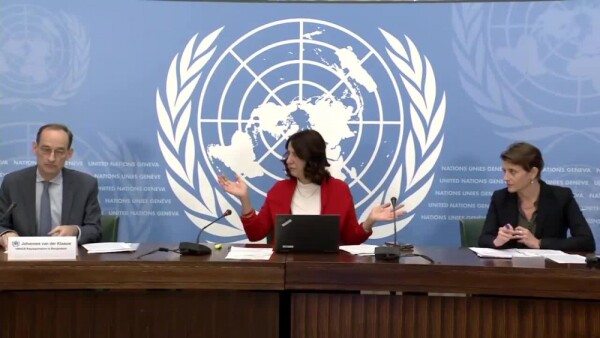
Johannes van der Klaauw, United Nations Refugee Agency (UNHCR) Representative in Bangladesh, said that the annual joint response plan for 2023 had been launched today. The launch came in the wake of a massive fire in the Cox’s Bazar refugee camp two days before, which affected 16,000 refugees. Continuous humanitarian and development support were desperately needed for the one million Rohingya refugees living in congested conditions; the USD 876 million budget would cover the needs of close to the one million refugees, as well as half a million Bangladeshis living nearby who were affected by the refugee presence. It became increasingly difficult to receive adequate funding, given all the concurrent crises in the world. The situation of Rohingya had become a protracted crisis, with the last large influx of Rohingya going back to 2017. Women and children were 75 percent of the refugee population, informed Mr. van der Klaauw, and malnutrition was widespread in the camps.
This situation should not be forgotten, as it was one of the largest displacement situations in the world, and the refugees were still fully dependent on humanitarian aid. Investments ought to be made into making the refugees more self-sustainable and self-reliant, which could be achieved through education and skills development. Mr. van der Klaauw emphasized that the solution to this crisis lay in Myanmar, as the refugees were keen to return to their home state of Rakhine in Myanmar; however, the prospects for that were currently grim. Diplomatic efforts in this regard had to be intensified, as that was the only sustainable, long-term solution. Natural disasters were quite frequent in the Cox’s Bazar area, he said, and disaster risk management and emergency response had to be adequately addressed and were part of the new appeal.
Full statement is available here.
Abdusattor Esoev, Bangladesh Chief of Mission at the International Organization for Migration (IOM), speaking from Bangkok, stated that, as the Rohingya refugee response entered the sixth year, the IOM was appealing for USD 125 million to support 1.4 million Rohingya refugees and host communities in need in Bangladesh’s Cox’s Bazar District.
“The ongoing crises and disasters around the world should not make us forget the needs of Rohingya refugees and the response in Bangladesh,” said António Vitorino, IOM Director General.
IOM statement is available here.
Newly arrived Somali refugees in Ethiopia
Mamadou Dian Balde, United Nations Refugee Agency (UNHCR) Representative in Ethiopia, connecting from Addis Abeba, said that some 100,000 Somalis had arrived in Ethiopia’s Doolo Zone in the Somali region in the past four weeks to escape clashes and insecurity in the city of Laascaanood, in Sool region. Most of them were women, children, and elderly.
They were in urgent need of food, nutrition screening, water, shelter, medical care, and relief items. The refugees were arriving in a remote area, heavily affected by drought; it took UNHCR teams and partners two days of driving on dry, sandy roads to reach those newly arrived from Laascaanood. Despite those challenges, the Ethiopian Government and local communities had kept their doors open and welcomed these families, sharing what they had with them. The newly arriving families were saying that they wanted peace and to be able to go home. Until this was possible, support for this emergency response was critical. Conditions for their safe return ought to be created as soon as possible.
More details can be found here.
Cholera outbreak in Malawi
Rudolf Schwenk, United Nations Children’s Fund (UNICEF) Representative in Malawi, speaking from Lilongwe, said that Malawi was experiencing the deadliest cholera outbreak in its history. The resources were limited, the health system was overburdened, and health workers were stretched to their limits. The outbreak had affected over 50,000 people and led to over 1,500 deaths, of whom almost 200 children.
The conditions had been likely caused by two tropical storms in 2022, combined with chronic underfunding on water and sanitation infrastructure, and a disruption of cholera prevention campaigns due to COVID-19. Without immediate, adequate action, it was feared that the outbreak would worsen. Malawi was prone to further natural One in two children in the country were in humanitarian need, with high numbers of acutely malnourished children; 62,000 of them were expected to be severely malnourished. A severely malnourished child, informed Mr. Schwenk, was 11 times more likely to die of cholera than a well-nourished child. Together with the WHO and partners, UNICEF was working with the Government to control the transmission and provide life-saving drugs and safe water. As a result of those efforts, there was now a downward trend in infections, but more had to be done. To prevent future cholera outbreaks, the country needed to be strongly supported with investments in water, hygiene, and sanitation.
More information about UNICEF’s work in Malawi can be found here.
Tropical cyclone Freddy in Mozambique
Clare Nullis, for the World Meteorological Organization (WMO), said that tropical cyclone Freddy was not going to make a direct impact on Malawi, but it would nonetheless bring more heavy rainfall to the south of the country. Freddy was continuing its incredible and dangerous journey and could become the longest tropical cyclone on record. Ms. Nullis reminded that Freddy had developed off the North Australian coast on 6 February, crossed the South Indian Ocean from Australia and made landfall in Madagascar on 21 February and Mozambique on 24 February. Since then, it had weakened, but was tracking over Mozambique and Zimbabwe with heavy rains and flooding. It had then gone back over the Mozambique channel, hit Madagascar again, and was now heading back in the direction of Mozambique.
Freddy would bring more heavy rain to Madagascar, Mozambique, and Zimbabwe. There were warnings of heavy rains; Freddy could possibly make landfall as a tropical cyclone at the end of the week, but the forecast was still too uncertain to be able to precise timing and exposed areas. The total death toll over the past month had been 21; the fact that the toll was not higher was a testimony that there had been good forecasts and warnings, and that people had listened to them.
Ms. Nullis said that, once the cyclone had come to an end, the WMO Weather and Climate Extremes evaluation committee would set up an investigation, as Freddy could set a new record as the longest lasting tropical cyclone.
2023 SDGs UNECE regional progress report
Jean Rodriguez, for the United Nations Economic Commission for Europe (UNECE), informed that the 4th SDG status report released today showed that progress towards the SDGs was slowing in the region. The report painted a sobering picture, finding that the region was on track to achieve only 21 targets by 2030, down from 26 targets the year before.
UNECE’s 56 countries hosted 16 percent of the world’s population, accounted for 41.4 percent of the world’s GDP at purchasing power parity, and 83 percent of total Official Development Assistance. Thus, the impact of the situation in the region was also felt outside of the region. UNECE Executive Secretary Olga Algayerova commented: “The Sustainable Development Agenda was designed to lead us on a path towards a better world. But right now, the world, and our region, is in many ways worse off than it was back in 2015. What’s more, our region is now further away from fulfilling the Goals than it was a year ago.”
Mr. Rodriguez said that, for example, the relative cost of healthcare for households was increasing in most countries in the UNECE region, as the pandemic put stress on health systems and highlighted gaps in public health capacities. Progress towards shared responsibility within the household and family was also very slow. The share of women participating in political and economic life was increasing in nearly every country in the region, but women remained underrepresented in leadership and decision-making positions. Mr. Rodriguez also said that the share of renewable energy was increasing, and energy efficiency was improving, but not quickly enough to meet 2030 targets. On the other hand, data availability for monitoring SDGs was improving: progress for the UNECE region could now be measured towards 115 of the 169 targets, up from 105 targets the previous year, but the region still needed to intensify investment in statistical capacity.
The Report would inform the discussions at the forthcoming Regional Forum on Sustainable Development, to be held at the Palais des Nations in Geneva on 29-30 March.
Human Rights Council
Pascal Sim, for the Human Rights Council (HRC), informed that the HRC was currently holding an interactive dialogue with the Group of Human Rights Experts on Nicaragua, which would be followed by a presentation of report by the Commission on Human Rights in South Sudan. At 12:30 today, there would be an oral update by the High Commissioner for Human Rights, Volker Türk, on the activities of his Office and recent human rights developments around the globe, followed by the reports of the High Commissioner on Human Rights on the activities of his office in Colombia, Guatemala and Honduras, and the question of human rights in Cyprus. The day would end with the general debate on High Commissioner’s global update and country reports. In the following days, the Council would discuss child victims and survivors of sales and exploitation of children, right to housing, right to food, albinism, environment, and freedom of religion.
Mr. Sim reminded that today at 1:30 pm, the UN Commission on Human Rights in South Sudan would present its latest report. Speakers would be Andrew Clapham and Barney Afako, Expert Members of the Commission.
Announcements
Alessandra Vellucci, for the United Nations Information Service (UNIS), informed that, as of 13 March, Rolando Gomez would take over as a temporary Chief of the Press and External Relations Section at UNIS.
Ms. Vellucci informed that Geir O. Pedersen, UN Special Envoy for Syria, would hold a hybrid press conference on 8 March at 2:30 pm to provide an update on the situation in Syria.
On 13 March at 1 pm, the Independent International Commission of Inquiry on the Syrian Arab Republic would launch its new report. Speakers would be Paulo Pinheiro, Chair, Hanny Megally and Lynn Welchman, Commissioners.
On 13 March at 4:30 pm, there would be a press conference of the Special Rapporteur on the promotion and protection of human rights and fundamental freedoms while countering terrorism, Fionnuala Ní Aoláin.
The Committee on the Rights of Persons with Disabilities, in its 28th session, which had started on 6 March, was reviewing the reports of Angola, Georgia, Tunisia, Peru, Argentina, and Togo. Today, the Committee was holding today general discussion on article 11 of the Convention, related to situations of risk and humanitarian emergencies.
The Human Rights Committee was concluding this afternoon its review of the report of Peru.
Finally, Ms. Vellucci informed that the International Women’s Day, 8 March, this year would be marked under the theme DigitALL: Innovation and technology for gender equality. In his message, the Secretary-General stressed that investing in women uplifted all people, communities, and countries. A theater performance on sexism in workplace, organized by UN Women, would be held at the mezzanine of the Palais des Nations in Geneva on 8 March from 2 to 3 pm.
Similar Stories
1
1
1
Press Conferences | WMO , UNHCR , WHO , ILO
WMO: Greenhouse Gas Bulletin; UNHCR: As attacks intensify UNHCR urges support for war ravaged Ukrainians; WHO: Clinical trials in DRC: vaccines and beyond; ILO: New global and regional estimates on domestic work, informality and working conditions
1
1
1
Press Conferences | UN WOMEN , WFP , WHO
UN WOMEN: Sudan Women and girls one year after the fall of El Fasher; increasing drone attacks across the country; WFP: DRC - Ebola spreads to eighth DRC province as WFP delivers food, builds treatment centres and keeps supplies moving; WHO - Update on Ebola (Bundibugyo Virus Disease)
1
12
1
1
Press Conferences , Images | UNOG
Closing Press Conference following the Sixth Consultative Meeting on Enhancing Coordination of Peace Initiatives and Efforts in Sudan

2
17
1
2
Edited News , Press Conferences , Images | OCHA , WMO
Two UN agencies teamed up on Wednesday to issue an appeal for immediate assistance to help communities already being impacted by the strongest El Niño on record.
1
1
1
Press Conferences | CITES
Wildlife trade and conservation policy discussions at the 81st meeting of the CITES Standing Committee (SC81)
1
1
1
Press Conferences | UNHCR , UNCTAD , WMO , OCHA , UNICEF , WHO
UNHCR Hungary’s 1956 Refugee Crisis: 70 Years On, UNCTAD World Investment Forum 2026, Doha, WMO Greenhouse Gas Bulletin and Climate Update for COP31, OCHA Afghanistan: Malnutrition, Girls’ Education and Recovery, UNICEF Yemen: Child Malnutrition and Unsafe Water in Taiz, WHO Inequalities in Noncommunicable Diseases and Risk Factors
1
1
1
Press Conferences | UNHCR
End of UNHCR's 77th Annual Executive Committee (ExCom) meeting week
1
1
1
Press Conferences | UNICEF , IOM , UNHCR
UN Special Assistant to the Personal Envoy Office (SUDAN): Peace Initiatives and Efforts in Sudan; UNICEF: Dire situation of children in Gaza; IOM: Damaged Homes and Energy Attacks Risk Displacing Ukrainians for this winter; UNHCR: update on EXCOM week
1
1
1
Press Conferences | IOM , UNDRR
UN stresses importance of household preparedness for disaster risk reduction.
1
1
1
Statements , Press Conferences | OHCHR
1
1
1
Press Conferences | UNHCR , UNICEF , IFRC , OHCHR , UN WOMEN , IOM , OCHA , WHO
UNHCR – ExCom Meeting, UNICEF – Nepal Recovery, IFRC – Flash Floods, WHO – Mental Health, IOM – South Sudan Floods, OCHA – DRC Humanitarian aid, UNHCR – Sahel Displacement, UNICEF – Yemen Update, IOM – Gaza Shelter, UN Women – Gaza Women, OHCHR – Arrests and detentions of Syrians by Israeli force
2
1
2
Press Conferences | UNCTAD
Presentation of the Trade and Developement Report 2026
Embargoed until 9 October 2026 at 11 a.m. (Geneva Time)
UNCTAD: UNCTAD’s flagship report finds that governments increasingly use industrial, trade, financial and technology policies to pursue economic and national security objectives. Market access and the ability to move into higher-value activities now depend more heavily on technology, finance and geopolitics.