

The United Nations Office at Geneva
Multimedia Newsroom
Human Rights Council
Rolando Gomez, for the Human Rights Council, reminded that the Council would suspend its current session as of this afternoon, in order to help stop the spread of the coronavirus. That was deemed a responsible action to take at this time. All draft resolutions would be considered by the Council when it resumes its session, but it was not clear when that would be. Today, the Council had adopted the Universal Periodic Review reports, and was currently discussing racial discrimination. In the afternoon, the appointment of the 19 mandate holders would be announced, and a number of other mandates would be exceptionally extended. Responding to a question, Mr. Gomez confirmed that this was the first time the Council had been suspended under such circumstances.
Situation in Idlib, Syria
Alessandra Vellucci, for the UN Information Service (UNIS), quoted the statement by the UN Secretary-General who said that the brutal conflict in Syria had exacted an unconscionable human cost and caused a humanitarian crisis of monumental proportions. The steps to end the suffering of the Syrian people were well known, but had to be realized. The 5 March Additional Protocol to the Memorandum on Stabilization of the Situation in the Idlib De-Escalation Area agreed between Russia and Turkey had to lead to a lasting cessation of hostilities that paved the way to a permanent ceasefire nation-wide. The parties also had to return to the UN-facilitated political process mandated by resolution 2254 (2015), which remained the only viable path to end the conflict and offer lasting peace to the Syrian people.
The Secretary-General’s statement on Syria is available here.
Jens Laerke, for the Office for the Coordination of Humanitarian Affairs (OCHA), said that the overall level of violence had come down, but Idlib was still not a safe place to be, as the conflict entered its tenth year. Risk of death and injury of explosive remnants had increased over the past month. At least nine hundred and sixty thousand people, most of them women and children, had been displaced since December, stressed Mr. Laerke. Of those, some 320,000 were staying in camps, 360,000 people were living with host families and rented homes; and some IDPs were even sheltering under trees. Aid workers reported incidents of exploitation of displaced women and girls. The displacement crisis and precarious conditions had a particularly adverse effect on women and girls.
Elisabeth Byrs, for the World Food Programme (WFP), stated that the WFP in February had provided aid to 4.3 million people around the country, thus preventing them from slipping further into hunger and poverty. WFP was working to provide food to all people in need in the areas where there was humanitarian access. The number of food-insecure people in Syria stood at 7.9 million, a 22 percent increase in only one year. WFP’s nutrition, resilience and school meals programmes were helping vulnerable families to improve their nutrition and food security. In February, added Ms. Byrs, the WFP had provided school meals and snacks to nearly one million children. In addition, the WFP had also provided nutritional supplies to 147,000 pregnant and nursing mothers for the prevention of acute malnutrition.
Responding to a question, Mr. Laerke said that regrettably there was very little protection for displaced women and children in northwest Syria. Protection started, first and foremost, with all the fighting parties sticking to the rules of the international humanitarian law. Mr. Laerke reminded that, prior to the latest escalation, Idlib had already been hosting displaced populations from elsewhere in Syria. There was simply not enough land to host all the displaced people and build appropriate camps for them. More than 960,000 people had been displaced since December, reminded Mr. Laerke; that was the fastest-growing displacement crisis since the war had started in Syria.
Mozambique, one year after Idai
Elisabeth Byrs, for the World Food Programme (WFP), said that one year after Cyclone Idai
had devastated much of central Mozambique, limited funding for essential reconstruction was preventing many of the hardest-hit people from getting back on their feet. In the weeks after the strongest storm to ever hit the country, the WFP’s emergency assistance had kick-started the recovery of the 1.8 million people. But many others, who were still struggling today, faced a bleak and uncertain future.
Ms. Byrs stressed that the WFP needed USD 91 million to fully implement rehabilitation programs for the Idai victims. That included support for the communities in the south of the country. Malnutrition in Mozambique was a chronic problem. An outbreak of pellagra, a disease caused by the vitamin B deficiency, had also been spotted. In February, the WFP had been forced to halve its food rations.
WFP press release can be found here.
South Sudan
Babar Baloch, for the United Nations Refugee Agency (UNHCR), informed that UNHCR with its partners was jointly appealing for USD 1.3 billion this year to address the vast humanitarian needs of refugees fleeing seven years of unrest and conflict in South Sudan. Africa’s largest refugee population was from South Sudan; 83 percent of them were women and children. Funding was urgently need to provide life-saving assistance, while renewed support was necessary for all five major refugee hosting countries – Uganda, Sudan, Kenya, Ethiopia, the Democratic Republic of the Congo, and the Central African Republic.
Responding to a question, Mr. Baloch said that the transitional unity government had brought a new dawn for the people of South Sudan, but many displaced and refugees were still waiting to see if the new structures would bring long-lasting peace to all parts of the country.
Full UNHCR press release can be read here.
Burkina Faso
Babar Baloch, for the United Nations Refugee Agency (UNHCR), stated that insecurity in Burkina Faso was forcing an ever-growing number to flee their homes. They were looking for safety in the country or fleeing to Mali as refugees. Some 14,000 people had fled their homes in Burkina Faso in the last 17 days, bringing the total internally displaced to over 780,000. For its part, Burkina Faso hosted over 25,000 refugees from Mali, but many were choosing to return despite facing insecurity there. Mr. Baloch pointed out that there had been worrying incidents of violence this month around Dori, also in the North East.
UNHCR press release can be found here.
COVID-19
Tarik Jašarević, for the World Health Organization (WHO), said that the next press conference on COVID19 would take place at 4 p.m. today; it would be a virtual conference. The WHO staff today were telecommuting to test business continuity should they be required to work from home in the future. Journalists could watch the live broadcast, get the broadcast quality signal, and dial in to ask questions.
Responding to a question, Mr. Jašarević said that basic public health measures: doing basic epidemiological work, contact tracing, and social distancing had been proven to be efficient. On international travel and trade, the WHO advised against restrictions, but individual countries might feel that it could help slow down the spread of the virus. WHO provided technical advice and recommendations, but each country made their own respective decisions based on their respective assessments. In Wuhan, for example, the travel restriction – putting the whole city under a lockdown – had worked.
Babar Baloch, for the United Nations Refugee Agency (UNHCR), said that there had been no reported cases of COVID19 infections among refugees and internally displaced persons. UNHCR had launched an appeal for USD 33 million to boost preparedness of refugee communities. Mr. Baloch had no details regarding possible testing of refugees.
Dashboard to track regional progress on SDGs
Jean Rodriguez, for the United Nations Economic Commission for Europe (UNECE), informed that UNECE was launching a dashboard to track regional progress on SDGs, one week ahead of the Regional Forum on Sustainable Development for the UNECE Region, which was still on track, in a reduced format. With data for eighty regionally-relevant indicators across all 17 goals, users could see snapshots of where countries stood for each indicator, view differences between women and men, compare countries, etc. Mr. Rodriguez explained that global indicators were classified by an inter-agency group into three tiers, according to the extent to which there were internationally agreed concepts and methodology, combined with actual data availability.
Dashboard for SDGs can be opened here.
Geneva announcements
Fernando Puchol, for the World Trade Organization (WTO), informed that the Director-General was consulting with WTO members on how to proceed with revised arrangements for the Twelfth Ministerial Conference, which was due to take place in Kazakhstan in June. Mr. Puchol reminded that all meetings at the WTO were suspended until at least 20 March. The WTO staff member who was infected with COVID19 was recovering well.
Alessandra Vellucci, for the United Nations Information Service in Geneva, informed that the Human Rights Committee was holding this morning a public meeting devoted to the review of its General Comment on the Right of Peaceful Assembly.
Ms. Vellucci said that the Conference on Disarmament – whose first part of the 2020 session was due to end in two weeks (27 March) – had decided not to hold the two CD plenary meetings scheduled for 17 March and 24 March.
* * *
The webcast for this briefing is available here: http://bit.ly/unog130320
Similar Stories
1
1
1
Press Conferences | UNHCR
End of UNHCR's 77th Annual Executive Committee (ExCom) meeting week
1
1
1
Press Conferences | UNICEF , IOM , UNHCR
UN Special Assistant to the Personal Envoy Office (SUDAN): Peace Initiatives and Efforts in Sudan; UNICEF: Dire situation of children in Gaza; IOM: Damaged Homes and Energy Attacks Risk Displacing Ukrainians for this winter; UNHCR: update on EXCOM week
1
1
1
Press Conferences | IOM , UNDRR
UN stresses importance of household preparedness for disaster risk reduction.
1
1
1
Statements , Press Conferences | OHCHR
1
1
1
Press Conferences | UNHCR , UNICEF , IFRC , OHCHR , UN WOMEN , IOM , OCHA , WHO
UNHCR – ExCom Meeting, UNICEF – Nepal Recovery, IFRC – Flash Floods, WHO – Mental Health, IOM – South Sudan Floods, OCHA – DRC Humanitarian aid, UNHCR – Sahel Displacement, UNICEF – Yemen Update, IOM – Gaza Shelter, UN Women – Gaza Women, OHCHR – Arrests and detentions of Syrians by Israeli force
2
1
2
Press Conferences | UNCTAD
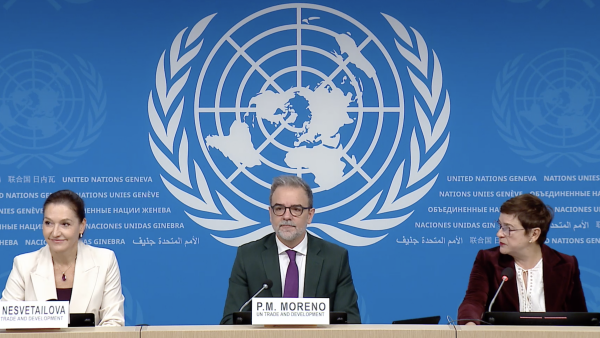
Presentation of the Trade and Developement Report 2026
Embargoed until 9 October 2026 at 11 a.m. (Geneva Time)
UNCTAD: UNCTAD’s flagship report finds that governments increasingly use industrial, trade, financial and technology policies to pursue economic and national security objectives. Market access and the ability to move into higher-value activities now depend more heavily on technology, finance and geopolitics.
1
1
1
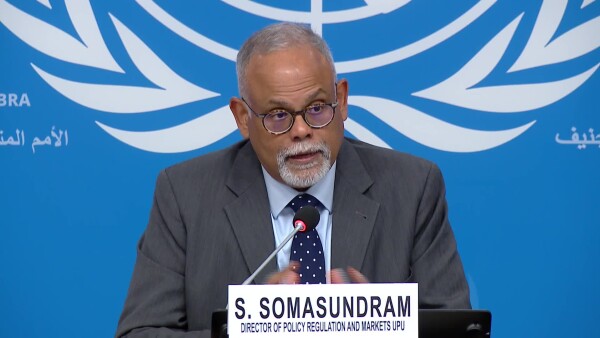
Press Conferences | UPU
Release of the State of the Postal Sector Report 2026
1
1
1
Press Conferences | IOM , ITU , UNECE , UNICEF , WHO , WMO
UNICEF: Ebola, DRC - children orphans or separating them from parents and caregivers; IOM: Humanitarian needs in Djibouti amid arrivals from Yemen and increased migrant movements; WHO: Darfur, scale of health needs far exceeds available resources; WMO co-sponsored Global Heat Forum, Bangkok, monthly Global Seasonal Climate Update; UNECE: UN Forum of Mayors; ITU Plenipotentiary Conference 2026; WHO: child and adolescent obesity guidelines and new global roadmap to tackle pregnancy hypertension, a leading cause of maternal mortality
1
1
1
Press Conferences | OCHA , UN WOMEN , UNHCR , WFP , WHO , WTO , UNEP
OCHA – $160M CERF allocation to 12 underfunded crises; UNHCR – 5.8M refugee children remain out of school amid funding cuts; UN Women – Middle East escalation and food security among women/girls; WHO – Gaza supplies and overall situation; WFP – Yemen food insecurity and impact on global hunger ; UNEP - First International Conference of the Global Framework on Chemicals in Geneva | 16-20 November 2026
1
1
1
Press Conferences | UNHCR , WHO
Yemen's health system nears collapse amid conflict, causing rising casualties and medicine shortages.
1
1
1
Press Conferences | HRC
Update by the Expert Mechanism to Advance Racial Justice and Equality in Law Enforcement
1
1
1
Press Conferences | WIPO , WHO , UNICEF , UNHCR , IOM , WFP , FAO
WIPO Global Innovation Index 2026 launch and press conference, WHO Composition of influenza vaccines for the 2027 Southern Hemisphere flu season, UNICEF Yemen hunger and malnutrition; UNHCR Sudan displacement into Chad; IOM Ebola and population movements in DRC; WFP emergency food assistance in Nepal; and FAO food loss and waste.