

The United Nations Office at Geneva
Multimedia Newsroom
PRESS BRIEFING BY THE UNITED NATIONS INFORMATION SERVICE
25 November 2022
UN Women launches #16Days of Activism against Gender-Based Violence Campaign in Geneva
Alessandra Vellucci, Director of the United Nations Information Service (UNIS) in Geneva, stressed the importance of speaking up during these 16 days against gender-based violence.
Ms. Vellucci quoted Secretary-General António Guterres, who said in a message to mark the International Day for the Elimination of Violence against Women, that “Violence against women and girls is the most pervasive human rights violation in the world. Now is the time for transformative action that ends violence against women and girls. This year’s theme — “UNITE: Activism to End Violence Against Women and Girls” — means standing with activists around the world who are calling for change and supporting survivors of violence.
Mr. Guterres called on governments to increase funding by 50 per cent to women’s rights organizations and movements by 2026. He concluded by saying, “Let’s take a stand and raise our voices in support of women’s rights. Let’s proudly declare: We are all feminists. Let’s consign violence against women and girls to the history books.”
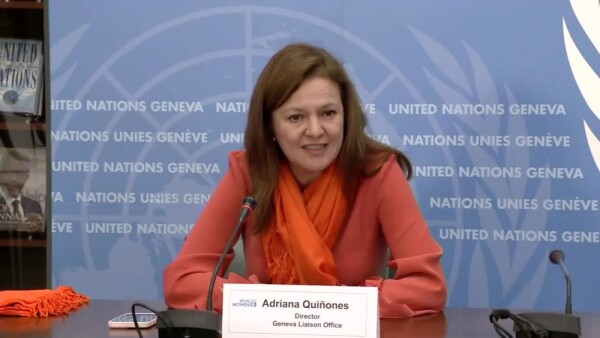
Adriana Quiñones, Director a.i. of UN Women Liaison Office Geneva, said that she was thrilled to today launch the #16Days of Activism against Gender-Based Violence campaign in Geneva in person for the first time in two years.
Today, the International Day for the Elimination of Violence against Women, there would be an interactive event at the Place des Nations organised by the Permanent Mission of the European Union and UN Women between 11:45 a.m. and 12:15 p.m. Representatives from permanent missions, United Nations agencies and civil society organisation would spray “NO” onto a map of the world to show their commitment to ending violence against women and girls.
For the next 16 days, UN Women had a programme with more that 10 activities to raise awareness about the need to end gender-based violence, with a special focus on human rights defenders. Orange, which represents a “new beginning”, continued to be the colour of the campaign.
Today, UN Women was launching a report on femicide prepared with the United Nations Office on Drugs and Crime. The report showed that 81,000 women and girls were intentionally killed last year. Some 56 per cent were killed by intimate partners or members of their family. Many victims still went uncounted. UN Women called on governments around the world to show their solidarity by increasing funding for women’s rights organisations, promoting women’s participation in decision-making roles, and strengthening protections against gender-based violence.
On Monday, 28 November at 9:30 a.m., UN Women would also launch its Expert recommendations on Women Human Rights Defenders at risk in migration contexts and at a hybrid press conference at UNOG.
In addition, UN Women in Geneva was supporting Soroptimist International’s #ReadTheSigns campaign, which focused on the prevention of violence in partnerships. The campaign sought to raise awareness about signs of violent and toxic behaviours that victims and family members should be aware of.
In response to a question on femicides in Mexico, Ms. Quiñones said that there had been important efforts in this country, including the order of investigation of every disappearance or death of a woman as a femicide. However, the situation in Mexico was still very dramatic. UN Women had a “Spotlight Initiative” specialising on femicide in five countries in Latin America, including Mexico. Implementing the Belém do Pará Convention was important, as it promoted access to justice. There had been a welcome improvement in the reporting of gender-based violence. UN Women was working with the Mexican Government and other UN agencies to address this issue.
Jens Laerke for United Nations Office for the Coordination of Humanitarian Affairs (OCHA) said OCHA was fully behind the #16Days campaign. Gender-based violence was particularly accentuated in humanitarian crises. Funding for gender-based violence projects was woefully low, and more support was needed.
Situation in Ukraine
Jens Laerke for United Nations Office for the Coordination of Humanitarian Affairs (OCHA) said that according to this morning’s reports from Kyiv, 50 per cent of the capital was without electricity and people living in higher floors of multistorey buildings were without water. Yesterday, there were reports that 15 out of Ukraine’s 24 Oblasts faced electricity outages. The day before, a wave of attacks on energy infrastructure had left millions across the country without electricity. These power outages came on top of scheduled cuts. Ukraine was turning increasingly cold, without power, without steady water supply and without heating.
OCHA was supporting the delivery of generators to critical facilities such as hospitals and schools. Nearly 400 generators had already been delivered by UN agencies, and thousands more were in the pipeline. The Government had set up thousands of heating points across the country, and OCHA was providing supplies to these facilities.
OCHA continued to stress that, according to international humanitarian law, critical infrastructure must be protected from harm.
In response to questions, Mr. Laerke said that the winterisation plan started in late August. OCHA could not project how long the war would last, but had made preparations to ensure that it could provide support throughout winter. OCHA was in Ukraine to help authorities coordinate the humanitarian response and provide needed supplies such as generators.
Mr. Laerke said that a flash fundraising drive conducted by OCHA had concluded, and OCHA thanked all those who had donated. However, needs within Ukraine were increasing, and it was likely that OCHA would conduct another fundraising drive soon.
Violaine Des Rosiers, Operations Manager in Ukraine for the International Federation of Red Cross and Red Crescent Societies (IFRC), speaking from Kyiv, said the situation in the country was very difficult. Nine months had passed since the start of the conflict. A third of Ukraine’s population had been displaced, and there was a flux of population coming in and out of the country. The IFRC was helping the population to face the winter. There was an increase in humanitarian need caused by attacks on infrastructure, including in the west of Ukraine. Housing and health infrastructure had been damaged, and there had been power and water cuts. IFRC had procured winterisation items. 30 trucks were now entering the country with food parcels, heating supplies and generators. IFRC expected that more people would need support over the next few months. A host family programme had been established, which would provide housing, heating and electricity to half a million Ukrainians.
In response to questions, Ms. Des Rosiers said that IFRC was not mandated to file complaints on the actions of parties to the conflict, but it was working on raising awareness of international humanitarian law and sensitising the different parties to the conflict to their obligations.
Over five million people in Ukraine had lost their jobs. IFRC expected that there would be an increase in population movement in the next few months. Ukrainian Red Cross had resumed activities in Kherson, providing basic aid and services to the population. Humanitarian assistance was reaching those areas.
Also answering questions from the media, Ms. Des Rosiers said that strikes on health facilities and other critical infrastructure were continuing. Power cuts affecting hospitals in the west of the country had led to more people being cut off from medical services. The IFRC was providing mobile health clinics, and infrastructure support and generators to medical centres.
Margaret Harris for World Health Organization (WHO) said that WHO was also supplying generators and medical supplies to affected regions. There had so far been 711 attacks on Ukrainian health care, killing 100 people and injuring 129 ones. Of these attacks, 626 had directly impacted health facilities. Despite the level of destructions, the Ukrainian health care system continued to function. However, there were barriers to access, typified by these attacks. WHO and Ukrainian health care workers were working to continue to provide access to health care.
Shabia Mantoo for United Nations High Commissioner for Refugees (UNHCR) said that around one third of Ukrainians had been forced from their homes and over 6.5 million people were internally displaced. There had not been a marked increase in border crossings, but UNHCR was preparing for an increase in both internally displaced persons and border crossings. UNHCR was prioritising providing winterisation support.
Accelerated Humanitarian Operations in Northern Ethiopia
Claude Jibidar, World Food Programme (WFP) Representative and Country Director in Ethiopia, said that all four road corridors had been reopened. WFP and partners had delivered over 2,400 metric tons of food, medical, nutrition and other lifesaving supplies to Ethiopia’s Tigray region. The WFP-led Logistics Cluster has facilitated the transportation of 250 metric tons of humanitarian cargo into Tigray, including medical items via air.
For the first time ever, the United Nations Humanitarian Air Service (UNHAS) was conducting regular weekly flights to transport passengers and humanitarian cargo into Shire airport in Tigray. WFP has also received federal clearances for passenger flights to resume to Mekelle, and regular UNHAS flights to Mekelle would resume today. There had been progress, and Mr. Jibidar commended all members of the Government and other stakeholders who had contributed to it.
WFP had delivered food to over 100,000 people in Mai Tsebri in the north-western zone, and also reached 540,000 people in Mekelle, including internally displaced persons. It also continued to deliver food assistance in people directly affected by the conflict in neighbouring Afar and Amhara regions, providing uninterrupted assistance to 650,000 people in Afar and 675,000 people in the Amhara region.
After two years of conflict, the needs were enormous in Tigray, Amhara and Afar. Across Ethiopia as a whole, 22 million people needed food assistance, which included 9.8 million people in the drought-affected southern and south-eastern parts of the country. Four consecutive failed rainy seasons had caused crop failures, millions of livestock deaths and left 2.2 million children acutely malnourished.
The crisis situation would not come immediately to an end through a peace treaty. WFP’s latest Emergency Food Security assessment of the situation in Tigray, published in August, found 5.4 million people - 90 percent of the region – in need of food assistance. 7 million and 1.2 million people respectively required immediate food assistance in Amhara and Afar. One-third of children were malnourished.
Additional funding was needed to support both the immediate and long-term needs of people affected by conflict and climate shocks. WFP was aiming to reach over 11 million people in Ethiopia with humanitarian assistance over the next six months but was facing a funding shortfall of US$422 million. Mr. Jibidar called on all stakeholders to provide funding assistance.
Announcements
Rosalind Yarde for International Labour Organization (ILO) said that ILO would publish the latest edition of its Global Wage Report on Wednesday, 30 November. The report, entitled “The Impact of Wages on Purchasing Power”, provided an overview of how the severe inflationary crisis, combined with a slowdown in global economic growth, had affected real monthly wages across the world. The report underlined measures to ease the impact of the cost-of-living crisis on households. There would be a virtual press briefing on Wednesday, 30 November at 2:30 p.m., at which findings would be presented by Manuela Tomei, Assistant Director General for Governance, Rights and Dialogue, and Rosalia Vazquez-Alvarez, Econometrician and Wage Specialist.
Alessandra Vellucci, Director of the United Nations Information Service (UNIS) in Geneva, announced that World Meteorological Organization (WMO) would hold a hybrid press conference at 2:30 p.m. on Tuesday, 29 November to announce the release of the State of Global Water Resources 2021 report. Speaking would be Professor Petteri Taalas, WMO Secretary-General, and Dr. Stefan Uhlenbrook, Director (hydrology).
OCHA would hold a press conference to announce the launch of the 2023 Global Humanitarian Overview, which was under embargo until 1 December 2022, 6 a.m. CET. Speaking would be Martin Griffiths, OCHA Under-Secretary-General for Humanitarian Affairs and Emergency Relief Coordinator.
Similar Stories
1
1
1
Press Conferences | UN WOMEN , WFP , WHO
UN WOMEN: Sudan Women and girls one year after the fall of El Fasher; increasing drone attacks across the country; WFP: DRC - Ebola spreads to eighth DRC province as WFP delivers food, builds treatment centres and keeps supplies moving; WHO - Update on Ebola (Bundibugyo Virus Disease)
1
12
1
1
Press Conferences , Images | UNOG
Closing Press Conference following the Sixth Consultative Meeting on Enhancing Coordination of Peace Initiatives and Efforts in Sudan

2
17
1
2
Edited News , Press Conferences , Images | OCHA , WMO
Two UN agencies teamed up on Wednesday to issue an appeal for immediate assistance to help communities already being impacted by the strongest El Niño on record.
1
1
1
Press Conferences | CITES
Wildlife trade and conservation policy discussions at the 81st meeting of the CITES Standing Committee (SC81)
1
1
1
Press Conferences | UNHCR , UNCTAD , WMO , OCHA , UNICEF , WHO
UNHCR Hungary’s 1956 Refugee Crisis: 70 Years On, UNCTAD World Investment Forum 2026, Doha, WMO Greenhouse Gas Bulletin and Climate Update for COP31, OCHA Afghanistan: Malnutrition, Girls’ Education and Recovery, UNICEF Yemen: Child Malnutrition and Unsafe Water in Taiz, WHO Inequalities in Noncommunicable Diseases and Risk Factors
1
1
1
Press Conferences | UNHCR
End of UNHCR's 77th Annual Executive Committee (ExCom) meeting week
1
1
1
Press Conferences | UNICEF , IOM , UNHCR
UN Special Assistant to the Personal Envoy Office (SUDAN): Peace Initiatives and Efforts in Sudan; UNICEF: Dire situation of children in Gaza; IOM: Damaged Homes and Energy Attacks Risk Displacing Ukrainians for this winter; UNHCR: update on EXCOM week
1
1
1
Press Conferences | IOM , UNDRR
UN stresses importance of household preparedness for disaster risk reduction.
1
1
1
Statements , Press Conferences | OHCHR
1
1
1
Press Conferences | UNHCR , UNICEF , IFRC , OHCHR , UN WOMEN , IOM , OCHA , WHO
UNHCR – ExCom Meeting, UNICEF – Nepal Recovery, IFRC – Flash Floods, WHO – Mental Health, IOM – South Sudan Floods, OCHA – DRC Humanitarian aid, UNHCR – Sahel Displacement, UNICEF – Yemen Update, IOM – Gaza Shelter, UN Women – Gaza Women, OHCHR – Arrests and detentions of Syrians by Israeli force
2
1
2
Press Conferences | UNCTAD
Presentation of the Trade and Developement Report 2026
Embargoed until 9 October 2026 at 11 a.m. (Geneva Time)
UNCTAD: UNCTAD’s flagship report finds that governments increasingly use industrial, trade, financial and technology policies to pursue economic and national security objectives. Market access and the ability to move into higher-value activities now depend more heavily on technology, finance and geopolitics.
1
1
1
Press Conferences | UPU
Release of the State of the Postal Sector Report 2026