

The United Nations Office at Geneva
Multimedia Newsroom
PRESS BRIEFING BY THE UNITED NATIONS INFORMATION SERVICE
18 November 2022
Call for a ban on forced returns to eastern Democratic Republic of the Congo
Elizabeth Tan, Director of International Protection, United Nations Refugee Agency (UNHCR), said that UNHCR had updated its return advisory for the Democratic Republic of the Congo, reiterating its call for a ban on forced returns to the eastern provinces of North Kivu, South Kivu and Ituri. It also called on States to grant refugees access to their territory and treat them in accordance with the 1969 Organization of African Unity Convention Governing the Specific Aspects of Refugee Problems in Africa and the 1951 Convention relating to the Status of Refugees.
UNHCR was concerned about a rise in attacks on civilians, including those residing in sites for displaced people in the east of the country, which had resulted in over 1,000 deaths since February 2022. The situation was being further exacerbated by escalating armed conflict. Since 20 October 2022, 188,000 people had been newly displaced by fighting between the M23 rebel group and the Congolese Army, adding to the estimated 5.6 million internally displaced persons in the country. The advisory against forced returns to the affected provinces would remain in effect until conditions improved sufficiently to allow for safe and dignified returns.
The full briefing note can be found here.
In response to questions from journalists, Ms. Tan said that, in addition to the tense security situation, the provision of humanitarian assistance was complicated by the fact that most of the people were in makeshift shelters rather than in established, organized camps. UNHCR was not aware of any forced returns having taken place; the aim of the update was to remind States of their obligations in respect of refugees.
UNHCR at COP27
Andrew Harper, Special Advisor on Climate Action to the United Nations High Commissioner for Refugees, said that one of UNHCR’s key goals had been to ensure representation at COP27 for traditionally unrepresented populations, namely refugees, internally displaced persons and stateless persons. While it had been successful on that score, those populations, who were typically poorly protected by their national governments and most vulnerable to the impacts of climate change, still had to be taken into account in the negotiations. They had been removed in the draft outcome document in favour of the general, yet insufficient, category of migrants.
The discussions on loss and damage, while promising, would be meaningless without financing that was commensurate with the challenges and needs on the ground. Without funds being disbursed in a timely and pragmatic manner, the populations most at risk would be unable to deal with the rapidly accelerating impacts of the climate of emergency. That acceleration, in the form of, inter alia, a fifth failed rainy season in the Horn of Africa, mass displacement due to food insecurity and flooding, and the loss of millions of heads of cattle, was already occurring at 1.2°C above the pre-industrial average. The compound and overlapping nature of the climate crisis and its impact needed to be acknowledged in the outcome document.
To continue to block the legitimate request of developing States for financial support – many of which had also been generously hosting refugees for decades – would be logically unsound, strategically misguided and ethically indefensible.
Replying to journalists, Mr. Harper said that, while expectations had been low going into COP27, it was significant that the concept of loss and damage had been placed on the agenda and that UNHCR had been able to bring the voices and physical presence of certain populations to the Conference. He was heartened by the unity among the Group of 77 in refusing to allow the need for a climate facility or funding mechanism to be ignored. However, the countries most at risk from climate hazards, some of which, like Mozambique, were providing excellent protection to refugees despite severe challenges, had actually seen a reduction in funding and were being left to their own devices. The progression of climate change as the world rapidly exceeded the goal of 1.5°C warming would be chaotic, with no one – least of all developing countries already struggling to cope with the day-to-day – able to anticipate the consequences. Money should not be placed ahead of human rights and yet it was happening the world over.
Alessandra Vellucci, for the United Nations Information Service, drew attention to the statements made by the Secretary-General at COP27 in support of an ambitious and credible agreement on loss and damage and financial support to developing countries.
Reintegration of food and fertilizers into the global markets
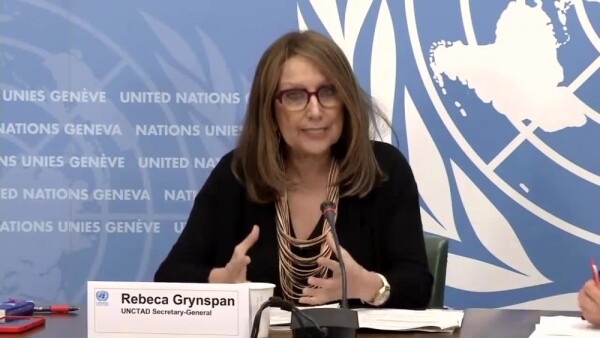
Rebeca Grynspan, Secretary-General of the United Nations Conference on Trade and Development (UNCTAD) said that she was very pleased at the recent extension of the Black Sea Grain Initiative. However, more remained to be done, particularly in terms of the fertilizer crunch caused by insufficient volume and high costs.
Replying to questions from journalists, Ms. Grynspan said that, while food and fertilizers were exempt from sanctions, the knock-on effects of the sanctions and their differing interpretations tended to cause bottlenecks in the trade and export of such products. Accordingly, it had been clarified that the services associated with the export of food and fertilizers from the Russian Federation, such as insurance, were also exempt from sanctions. A platform would be set up so that insurance companies would no longer have to conduct their due diligence on a case-by-case basis.
The European Union sanctions regime was more complex due to how the regulatory and executive functions were divided between the European Commission and the member States, giving rise to varied interpretations. There had nonetheless been progress on a few important questions, namely, whether the transport of food and fertilizer from the Russian Federation through the European territory towards third countries was authorized, whether the ban on transacting with the Russian Maritime Register of Shipping precluded Russian vessels from accessing European ports and what the legal status of the frequently asked questions forum was.
There were currently some 300,000 tons of Russian fertilizer stranded in European ports. A first shipment, which was categorized as a humanitarian donation from the Russian Federation, was scheduled to leave the Netherlands on 21 November for delivery to Malawi, via Mozambique. The World Food Programme was responsible for the land transport of the cargo. The next shipment would hopefully be sent to West Africa. France had been instrumental in enabling the fertilizer to be moved and was covering some of the costs.
Naturally, it would be helpful on several fronts if the Black Sea Grain Initiative was extended for longer periods of time rather than simply rolled over for 120 days at a time; however, such an extension would have to be negotiated in the framework of the Joint Coordination Centre. In that connection, she drew attention to the joint statement of the European Union, the United States and the United Kingdom of 14 November concerning global food security and the sanctions.
It was vital to scale up the Initiative, but only the private sector was in a position to do so. Accordingly, the United Nations was striving to create the necessary conditions by bringing together the private sector, including traders and shipping companies, and regulators to promote better understanding of the practical difficulties stemming from the sanctions.
Furthermore, no additional demands had been made of the United Nations beyond what had been included in the initial memorandum of understanding between the Organization and the Russian Federation, which had not been granted any concessions in order to remain a party to the Initiative. There was no need for a separate agreement on the ammonia pipeline, as the matter was covered under the Initiative. SG Grynspan was optimistic that both Ukraine and the Russian Federation were interested in negotiating a resumption of exports through the pipeline.
UNCTAD announcements
Catherine Huissoud, for the United Nations Conference on Trade and Development (UNCTAD), announced that on Tuesday, 22 November, at 9.30 a.m., UNCTAD would hold a hybrid press conference to launch the UNCTAD report on Palestine to the UN General Assembly (under embargo until 6 p.m. on 22 November). Mr. Mutasim Elagraa, Economist, would be speaking.
UNCTAD would also be holding a hybrid press conference on Wednesday, 23 November, at 1.30 p.m., on the publication of the Review of Maritime Transport 2022 (under embargo until 7 a.m. on 29 November). Speakers would include Ms. Rebeca Grynspan, UNCTAD Secretary-General, and Ms. Shamika Sirimanne, Director, Division on Technology and Logistics.
Ebola outbreak in Uganda
In response to a question, Tarik Jašarević, for the World Health Organization (WHO), said that there had been 141 confirmed cases of Ebola in Uganda and 22 probable cases, including 55 confirmed and 22 probable deaths; 73 patients had recovered. Trials of three vaccines for the Sudan strain of the virus were set to begin shortly.
Announcements
Alessandra Vellucci, for the United Nations Information Service, said that the Committee against Torture would be concluding its review of the report of El Salvador that afternoon. The seventy-fifth session would close on Friday, 25 November.
She also said that the Committee on the Elimination of Racial Discrimination was concluding its review of the report of Bahrain and would be reviewing the reports of Botswana (21–22 November), Georgia (23–24 November) and Jamaica (24–25 November).
Ms. Vellucci announced that on Monday, 21 November, at 11 a.m., the World Intellectual Property Organization (WIPO) would hold a virtual press conference to launch the World Intellectual Property Indicators (WIPI) 2022 report under embargo until noon on 21 November), which looked at the global trends in use of intellectual property tools and at how innovative and creative activity had stood up under the pressures of the COVID-19 pandemic. Speakers would include Mr. Marco Aleman, Assistant Director General, IP and Innovation Ecosystems Sector, and Mr. Carsten Fink, Chief Economist.
She also announced that UN-Women, in cooperation with the United Nations Office at Geneva and the Permanent Mission of the European Union, would be holding a live tagging event (#OrangeTheWorld) on the Place des Nations to kickstart the 2022 16 Days of Activism against Gender-based Violence campaign, whose programme of activities would be published shortly.
Ms. Vellucci drew attention to the Secretary-General’s statements on the occasion of World Toilet Day on 19 November, as well as World Day of Remembrance for Road Traffic Victims and Africa Industrialization Day on 20 November.
She recalled that the annual media accreditation process had begun; journalists were urged to apply before the end of the year.
Similar Stories
1
1
1
Press Conferences | UN WOMEN , WFP , WHO
UN WOMEN: Sudan Women and girls one year after the fall of El Fasher; increasing drone attacks across the country; WFP: DRC - Ebola spreads to eighth DRC province as WFP delivers food, builds treatment centres and keeps supplies moving; WHO - Update on Ebola (Bundibugyo Virus Disease)
1
12
1
1
Press Conferences , Images | UNOG
Closing Press Conference following the Sixth Consultative Meeting on Enhancing Coordination of Peace Initiatives and Efforts in Sudan

2
17
1
2
Edited News , Press Conferences , Images | OCHA , WMO
Two UN agencies teamed up on Wednesday to issue an appeal for immediate assistance to help communities already being impacted by the strongest El Niño on record.
1
1
1
Press Conferences | CITES
Wildlife trade and conservation policy discussions at the 81st meeting of the CITES Standing Committee (SC81)
1
1
1
Press Conferences | UNHCR , UNCTAD , WMO , OCHA , UNICEF , WHO
UNHCR Hungary’s 1956 Refugee Crisis: 70 Years On, UNCTAD World Investment Forum 2026, Doha, WMO Greenhouse Gas Bulletin and Climate Update for COP31, OCHA Afghanistan: Malnutrition, Girls’ Education and Recovery, UNICEF Yemen: Child Malnutrition and Unsafe Water in Taiz, WHO Inequalities in Noncommunicable Diseases and Risk Factors
1
1
1
Press Conferences | UNHCR
End of UNHCR's 77th Annual Executive Committee (ExCom) meeting week
1
1
1
Press Conferences | UNICEF , IOM , UNHCR
UN Special Assistant to the Personal Envoy Office (SUDAN): Peace Initiatives and Efforts in Sudan; UNICEF: Dire situation of children in Gaza; IOM: Damaged Homes and Energy Attacks Risk Displacing Ukrainians for this winter; UNHCR: update on EXCOM week
1
1
1
Press Conferences | IOM , UNDRR
UN stresses importance of household preparedness for disaster risk reduction.
1
1
1
Statements , Press Conferences | OHCHR
1
1
1
Press Conferences | UNHCR , UNICEF , IFRC , OHCHR , UN WOMEN , IOM , OCHA , WHO
UNHCR – ExCom Meeting, UNICEF – Nepal Recovery, IFRC – Flash Floods, WHO – Mental Health, IOM – South Sudan Floods, OCHA – DRC Humanitarian aid, UNHCR – Sahel Displacement, UNICEF – Yemen Update, IOM – Gaza Shelter, UN Women – Gaza Women, OHCHR – Arrests and detentions of Syrians by Israeli force
2
1
2
Press Conferences | UNCTAD
Presentation of the Trade and Developement Report 2026
Embargoed until 9 October 2026 at 11 a.m. (Geneva Time)
UNCTAD: UNCTAD’s flagship report finds that governments increasingly use industrial, trade, financial and technology policies to pursue economic and national security objectives. Market access and the ability to move into higher-value activities now depend more heavily on technology, finance and geopolitics.
1
1
1
Press Conferences | UPU
Release of the State of the Postal Sector Report 2026