

The United Nations Office at Geneva
Multimedia Newsroom
Libya talks
Alessandra Vellucci, for the United Nations Information Service (UNIS), drew attention to the statement by the Special Adviser to the Secretary-General at the conclusion of the high-level meeting on the constitutional track of Libya, in which Ms. Williams had stated that the presidents of the House of Representatives and High Council of State had met in Geneva on 28 and 29 June 2022. The two chambers had reached unprecedented consensus on a number of long-standing issues, including: the designation of the headquarters and distribution of seats for the two chambers of the legislative authority; division of responsibilities among the President, Prime Minister, Cabinet and local government; the specific form of decentralization; and a revenue allocation mechanism for the different levels of government. Despite the progress in negotiations, disagreement persisted on the eligibility requirements for the candidates in the first presidential elections, and while the progress secured during rounds of consultations in Cairo and Geneva was significant, it remained insufficient as a basis to move forward on comprehensive national elections. Ms. Williams urged the two chambers to overcome the pending disagreement as soon as possible and continued to urge all actors and parties in Libya against taking any precipitous action; calm and stability must be maintained. United Nations good offices would remain available to provide all support necessary in reaching a sound agreement that met the aspirations of the Libyan people and brought an end to the country’s long period of transition. She would draft a full report on the proceedings and present her recommendations on alternative ways forward to the Secretary-General.
Human Rights Council update
Rolando Gomez, for the Human Rights Council, said that today the Council would continue its consideration and adoption of the reports by the Working Group on the Universal Periodic Review. The urgent debate on the human rights of women and girls in Afghanistan would begin at noon with opening remarks by the High Commissioner for Human Rights, the Special Rapporteur on the situation of human rights in Afghanistan and Fawzia Koofi, the first woman Vice-President of Afghanistan. The draft resolution on Afghanistan was not scheduled for consideration until the following week.
Monday, 4 July would begin with a panel on the participation of women in decision-making and the elimination of violence against women, followed by more reports by the Working Group on the Universal Periodic Review. Some 23 draft resolutions were expected to be considered at the current session.
Also on 4 July, at noon, the Human Rights Council would be holding a hybrid press conference at which the report of the Independent Fact-Finding Mission on Libya would be presented by: Mohamed Auajjar, Chair of the Fact-Finding Mission; Tracy Robinson, member of the Fact-Finding Mission; and Chaloka Beyani, member of the Fact-Finding Mission. A second report, on the events in Tarhunah, would also be presented.
UNDP Announcements
Sarah Bel, for the United Nations Development Programme (UNDP), said that on Wednesday, 6 July, at 2 p.m., UNDP would be holding a hybrid press conference to present a new publication entitled Tackling the Cost-of-Living Crisis: Policy Responses to Mitigate Poverty and Vulnerability around the World (under embargo until Thursday, 7 July, at 6 a.m.). Speakers would include: Achim Steiner, UNDP Administrator, and George Gray Molina, UNDP Senior Economist. The report would also be discussed during the high-level political forum on sustainable development on 7 July, from 1.30 to 3 p.m. To register, click here.
Ms. Bel also said that UNDP would take part in the Lugano conference on Ukraine reconstruction and that she would be the media focal point.
Alessandra Vellucci, for the United Nations Information Service (UNIS), added that, while the Lugano conference was being organized by the Swiss authorities, the UN were participating. Media enquiries could be addressed to kommunikation@eda.admin.ch
Impact of food insecurity on health in the Horn of Africa
Dr. Sophie Maes, World Health Organization (WHO) Incident Manager for the Horn of Africa, joining from Nairobi, said that WHO was intensifying its response in the Horn of Africa, with a focus on Djibouti, Somalia, the Sudan, South Sudan, Ethiopia, Kenya and Uganda, where malnutrition rates were rising due to acute food insecurity. Children and pregnant and lactating women were especially vulnerable. Although the priority was on providing food, health should not be neglected, as malnourishment and disease tended to exacerbate each other. In addition, there was a lack of clean water and people were leaving their homes in search of food, water and pasture for their animals, thus causing their living conditions to deteriorate. The region was also seeing a spike in disease outbreaks, including of measles, cholera, acute diarrhea, meningitis and hepatitis E, at a time when the population had reduced access to health care and were forced to make difficult choices between buying food and seeking medical care.
WHO had raised the situation to a grade 3 emergency, had released $60 million from the contingency fund for emergencies and had installed an incident management system in Nairobi. It would focus on ensuring that severely malnourished children who were sick got the care they needed, that life-saving supplies of drugs and equipment were available, that disease outbreaks were detected and responded to without delay and that gaps in access to health care were identified so that WHO could coordinate with partners to address the problem. WHO was counting on journalists to make the issue more visible.
In response to a question, Dr. Maes said that many of the countries in the Horn of Africa were
facing the worse drought in 40 years. There had been four consecutive failed rainy seasons and it was feared that the next one would also fail. At the same time, some areas were experiencing devastating floods. The climate problems were compounded by the lingering effects of the coronavirus disease pandemic and the high food and fuel prices exacerbated by the war in Ukraine.
Announcements
Alessandra Vellucci, for the United Nations Information Service (UNIS), said that the Conference on Disarmament was holding the last public plenary meeting of the second part of the 2022 session at 10 a.m., still under the presidency of Ambassador Paul Empole Efambe of the Democratic Republic of the Congo.
Ms. Vellucci also said that the Human Rights Committee was concluding its review of the report of Uruguay, while the eighty-second session of the Committee on the Elimination of Discrimination against Women would close that afternoon, at 5 p.m.
Ms. Vellucci announced the following hybrid press conferences:
On Friday, 1 July, at noon, the Office for the Coordination of Humanitarian Affairs (OCHA) would provide an update on the humanitarian situation in Lebanon. The speaker would be Najat Rochdi, Deputy Special Coordinator for Lebanon, United Nations Resident Coordinator and Humanitarian Coordinator for Lebanon.
On Monday, 4 July, at 1.30 p.m., the Committee on the Elimination of Discrimination against Women would present its findings on Portugal, Türkiye, Azerbaijan, Namibia, the United Arab Emirates, Morocco, Mongolia and the Plurinational State of Bolivia. Speakers would include: Ana Peláez Narváez, Vice-Chair of the Committee; Rhoda Reddock, Member of the Committee; and Lia Nadaraia, Member of the Committee.
Similar Stories
1
1
1
Press Conferences | UN WOMEN , WFP , WHO
UN WOMEN: Sudan Women and girls one year after the fall of El Fasher; increasing drone attacks across the country; WFP: DRC - Ebola spreads to eighth DRC province as WFP delivers food, builds treatment centres and keeps supplies moving; WHO - Update on Ebola (Bundibugyo Virus Disease)
1
12
1
1
Press Conferences , Images | UNOG
Closing Press Conference following the Sixth Consultative Meeting on Enhancing Coordination of Peace Initiatives and Efforts in Sudan

2
17
1
2
Edited News , Press Conferences , Images | OCHA , WMO
Two UN agencies teamed up on Wednesday to issue an appeal for immediate assistance to help communities already being impacted by the strongest El Niño on record.
1
1
1
Press Conferences | CITES
Wildlife trade and conservation policy discussions at the 81st meeting of the CITES Standing Committee (SC81)
1
1
1
Press Conferences | UNHCR , UNCTAD , WMO , OCHA , UNICEF , WHO
UNHCR Hungary’s 1956 Refugee Crisis: 70 Years On, UNCTAD World Investment Forum 2026, Doha, WMO Greenhouse Gas Bulletin and Climate Update for COP31, OCHA Afghanistan: Malnutrition, Girls’ Education and Recovery, UNICEF Yemen: Child Malnutrition and Unsafe Water in Taiz, WHO Inequalities in Noncommunicable Diseases and Risk Factors
1
1
1
Press Conferences | UNHCR
End of UNHCR's 77th Annual Executive Committee (ExCom) meeting week
1
1
1
Press Conferences | UNICEF , IOM , UNHCR
UN Special Assistant to the Personal Envoy Office (SUDAN): Peace Initiatives and Efforts in Sudan; UNICEF: Dire situation of children in Gaza; IOM: Damaged Homes and Energy Attacks Risk Displacing Ukrainians for this winter; UNHCR: update on EXCOM week

1
1
1
Press Conferences | IOM , UNDRR
UN stresses importance of household preparedness for disaster risk reduction.
1
1
1
Statements , Press Conferences | OHCHR
1
1
1
Press Conferences | UNHCR , UNICEF , IFRC , OHCHR , UN WOMEN , IOM , OCHA , WHO
UNHCR – ExCom Meeting, UNICEF – Nepal Recovery, IFRC – Flash Floods, WHO – Mental Health, IOM – South Sudan Floods, OCHA – DRC Humanitarian aid, UNHCR – Sahel Displacement, UNICEF – Yemen Update, IOM – Gaza Shelter, UN Women – Gaza Women, OHCHR – Arrests and detentions of Syrians by Israeli force
2
1
2
Press Conferences | UNCTAD
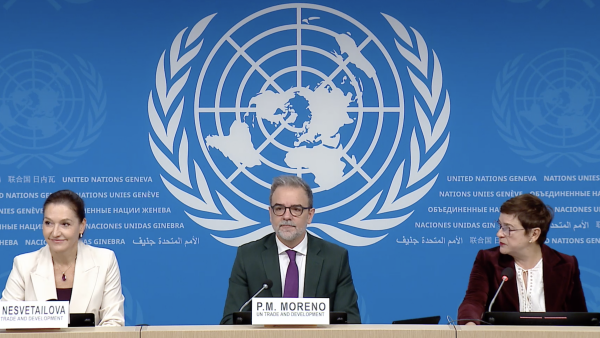
Presentation of the Trade and Developement Report 2026
Embargoed until 9 October 2026 at 11 a.m. (Geneva Time)
UNCTAD: UNCTAD’s flagship report finds that governments increasingly use industrial, trade, financial and technology policies to pursue economic and national security objectives. Market access and the ability to move into higher-value activities now depend more heavily on technology, finance and geopolitics.
1
1
1
Press Conferences | UPU
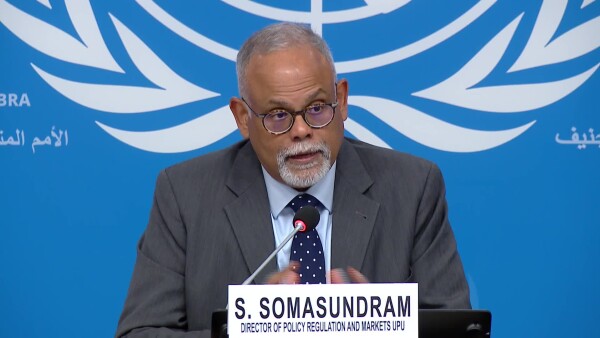
Release of the State of the Postal Sector Report 2026