

The United Nations Office at Geneva
Multimedia Newsroom
Discussion on Libyan Draft Constitutional Framework for Elections at the Palais des Nations
Mr. LeBlanc reported that the Secretary-General’s Special Adviser for Libya, Stephanie Williams, had announced that the Speaker of the House of Representatives, Aguila Saleh, and the President of the High Council of State Khaled, Al-Mishri, would meet at the UN Office at Geneva on 28-29 June to discuss the draft constitutional framework for elections, in light of the outcome of the joint committee held last week. More information on this meeting would be provided as it came to hand.
Floods in Bangladesh
Sheldon Yett, for United Nations Children’s Fund (UNICEF), said that the situation in Bangladesh had deteriorated rapidly over the last week. Some 3.5 million children were in urgent need of safe drinking water, a staggering two million more children than just a few days ago. Huge areas were completely underwater and disconnected from safe drinking water and food supplies.
Children needed help immediately. Cases of diarrhoea and other deadly diseases were rising steadily, with 2,700 cases recorded as of Tuesday this week. Over 40,000 water points and almost 50,000 toilets had been damaged.
About 90 per cent of health facilities in Sylhet division had been inundated, and child immunization services had been interrupted. Over 5,000 schools and learning centres had been submerged. At least 15 children had tragically lost their lives. Hundreds of children were in urgent need of treatment, which had been interrupted.
UNICEF and partners were supporting the Government to respond to the situation. More than 1.7 million water purification tablets had been delivered, as well as 9,000 water containers and thousands of hygiene kits for women and adolescent girls. UNICEF was helping children who were lost in the chaos to reunite with their families. It was also supporting children living with disabilities to access life-saving services.
UNICEF was urgently seeking 2.5 million USD in funding for this emergency response.
In response to questions, Mr. Yett said that flooding was making malnutrition worse, but it was hard to connect deaths from malnutrition to floods. However, the affected area had one of the highest malnutrition rates in Bangladesh.
Earthquake in Afghanistan
Mohamed Ayoya, for United Nations Children’s Fund (UNICEF), said that the earthquake that struck in the early hours of 22 June in the Afghan provinces of Khost and Paktika was a tragic reminder of challenges facing the people of Afghanistan.
As of late last night, at least 1,036 people were reported killed and more than 1,643 reported injured. At least 121 of these deaths were children and 67 of those injured were children. Verification was ongoing, and UNICEF expected numbers to climb as the search and rescue operations continued.
Bermal District, in Paktika province, reportedly had the highest number of casualties. Several thousand homes were destroyed and/or damaged.
Children and adolescents were extremely vulnerable and at high-risk of family separation, emotional and psychological distress, abuse and exploitation, and other forms of violence.
UNICEF and partners were working alongside the de facto authorities around the clock to gather information and deliver lifesaving supplies on the ground. A team of 14 UNICEF extenders and nine UNICEF-supported mobile health and nutrition teams (MHNTs) had been on the ground in earthquake-affected areas since 22 June, assessing damage and providing critical medical care.
It had dispatched 500 health care kits, 45 acute watery diarrhoea (AWD) kits, 3,000 hygiene kits, 980 winter kits, 200 emergency family kits, soaps and water purification tablets, tents, blankets, warm clothes, and tarpaulins.
UNICEF, in coordination with partners, was rapidly preparing a multi-sectoral response covering health, water, sanitation, hygiene, child protection, nutrition, education, social mobilization, and including a cash component.
Shabia Mantoo, for United Nations High Commissioner for Refugees (UNHCR), said that UNHCR, the UN Refugee Agency, had rushed tons of relief items and several expert staff to support relief efforts in the southeastern parts of Afghanistan hit by Wednesday’s deadly earthquake.
The items included shelter and household supplies, consisting of 600 tents, 4,200 blankets, 1,200 jerry cans, 1,200 buckets, 1,200 plastic sheets, 600 kitchen sets and 1,200 solar lamps.
The relief supplies were delivered from UNHCR’s stockpiles in Kabul and loaded onto nine trucks on Thursday. They would support some 4,200 survivors in Giyan, Bermal, Zerok, and Nika districts in Paktika province and Spera District in Khost province, which had seen hundreds of casualties and thousands of homes destroyed or damaged.
UNHCR deployed staff who would help arrange shelters for people who had been left homeless by the devastation. UNHCR teams were establishing three supply hubs in Giyan, Bermal and Spera districts so that humanitarian support arriving from Kabul could be swiftly shifted to the communities affected by the earthquake. More support is urgently needed to avert a subsequent humanitarian disaster in the affected areas. There is also a serious risk of waterborne diseases.
Full press release here.
Christian Lindmeier, for World Health Organization (WHO), said that WHO been requested to support the de facto disaster management authority in assessing and responding to immediate needs.
WHO had teams on the ground supporting the response for all health emergencies. Surge staff had also been deployed, including neurosurgeons, doctors, nurses and trauma management officers that would support the hospital care for the injured. It had also deployed emergency officers and disease control officers to enhance surveillance for infectious diseases, and health cluster coordinators to coordinate the response of health partners.
A shipment of 9.8 tonnes of medicine and medical supplies had reached the affected Paktita, Khost and Paktia provinces. It included 30 emergency health kits and 50 surgical health kits sufficient for 5,400 surgeries and medical treatments covering 36,000 people for the next three months.
Eight ambulances and two mobile health teams had also been sent to support transport of victims and bodies from the scene to the nearest hospital.
WHO was also working on deploying mental health and psychosocial support experts to provide emergency counselling to affected families. Teams were continuing our work on disease outbreak preparedness and response, including for acute watery diarrhoea and measles.
In response to questions, Ms. Mantoo said that UNHCR started deploying staff and supplies in affected areas immediately after the earthquake. It had previously raised concerns about the humanitarian situation in Afghanistan, and the earthquake was compounding this.
Mr. Ayoya said that UNICEF was extremely concerned about child protection on the ground. Afghanistan authorities were appealing for support from the international community. A high-level mission would travel to the region tomorrow.
Killing of Journalist in Occupied Palestinian Territory
Ravina Shamdasani, for Office of the High Commissioner for Human Rights (OHCHR), said it was deeply disturbing that Israeli authorities had not conducted a criminal investigation more than six weeks after the killing of journalist Shireen Abu Akleh and injury of her colleague, Ali Sammoudi, in Jenin on 11 May 2022.
The UN Human Rights Office had concluded its independent monitoring into the incident. All information gathered was consistent with the finding that the shots that killed Abu Akleh and injured her colleague Ali Sammoudi came from Israeli Security Forces and not from indiscriminate firing by armed Palestinians, as initially claimed by Israeli authorities. The Office had found no information suggesting that there was activity by armed Palestinians in the immediate vicinity of the journalists.
The UN High Commissioner for Human Rights, Michelle Bachelet, continued to urge Israeli authorities to open a criminal investigation into Abu Akleh’s killing and into all other killings and serious injuries by Israeli forces in the West Bank and in the context of law enforcement operations in Gaza. Since the beginning of the year, the Office had verified that Israeli Security Forces had killed 58 Palestinians in the West Bank, including 13 children.
Ms. Shamdasani said that international human rights law required prompt, thorough, transparent, independent and impartial investigation into all use of force resulting in death or serious injury.
In response to questions, Ms. Shamdasani said that Israeli authorities had issued a statement that continued to cast doubt on whether the shots came from Israeli Security Forces. The Office had visited the place of the shooting, consulted with experts, and interviewed people who were on the scene, and based on this rigorous monitoring had concluded that the shots came from Israeli Security Forces.
Plans to Dissolve National Centre for the Prevention of Torture in Kyrgyzstan
Ravina Shamdasani, for Office of the High Commissioner for Human Rights (OHCHR), said that the UN Rights Office was alarmed by measures under way in Kyrgyzstan to dissolve the National Centre for the Prevention of Torture and transfer its functions to the Kyrgyz Institute of the Ombudsman. We urge the government to halt this plan which risks weakening Kyrgyzstan’s efforts to prevent torture.
The Office encouraged the Kyrgyz Government to maintain the National Centre against Torture as an independent and separate National Preventive Mechanism, as required under international law, and to provide it with the necessary resources for it to continue to effectively carry out its mandate.
It also called on the Government to take steps to bring the Ombudsman’s Institute in compliance with internationally recognised standards for independence, plurality and accountability for National Human Rights Institutions, known as the Paris Principles.
In response to questions on the Julian Assange extradition case, Ms. Shamdasani said that the Office called for the right for due process proceedings to be respected, and for all extradition proceedings to ensure the principle of non-refoulement.
Update on Monkeypox
Christian Lindmeier, for World Health Organization (WHO), said that the emergency committee on Monkeypox was deliberating on their statement, and would either hold a press briefing or release a statement later today or tomorrow.
In response to a question, Mr. Lindmeier said that there were currently over 3,200 confirmed cases of monkeypox in 48 countries.
Announcements
Rolando Gomez, for the Human Rights Council, said that the Council would convene an "urgent debate" during its current regular session to address the human rights of women and girls in Afghanistan. This urgent debate had been requested through a letter sent to the Council President last night by the permanent representatives of the European Union and France. The meeting was expected to take place on Friday, 1 July.
A briefing had been held this morning with the first ever Special Rapporteur on Climate Change, Ian Fry. Mr. Fry presented his first report to the Council yesterday, which spelled out his mandate.
Today, the Council heard from the Special Rapporteur on the human rights of migrants, Felipe González Morales, addressing human rights violations at international borders, and this was followed by an interactive discussion. At noon, the Council heard from the Special Rapporteur on international solidarity, Obiora C. Okafor. His report addressed international solidarity and extraterritorial application of human rights. This afternoon, Special Rapporteur on freedom of expression and opinion Irene Khan would present her report on media freedom and the safety of journalists in the digital age. A report on her recent visit to Hungary would also be presented. Later today, the Special Rapporteur on extreme poverty, Professor Olivier De Schutter, would present his report on the non-take-up of rights in the context of social protection.
On Monday, the Council would hold a two-part panel discussion on women and girls, and hear a presentation from the Special Rapporteur on the human rights of internally-displaced persons. Various informal consultations were being held to prepare draft resolutions that would be deliberated on the last two days of the session, 7 and 8 July.
In response to questions, Mr. Gomez said that an urgent debate was effectively a special session of the Human Rights Council held within one of its regular sessions. To date, seven urgent debates had been held (the most recent on Ukraine on 4 March 2022). For an urgent debate to be convened, at least one Council member needed to submit a request for it to take place. In this case, several States had expressed support for the urgent debate requested.
Catherine Huissoud, for United Nations Conference on Trade and Development (UNCTAD), said that UNCTAD was participating in the 2022 United Nations Ocean Conference taking place from 27 June to 1 July 2022.
The UNCTAD delegation would be led by UNCTAD Secretary-General Rebeca Grynspan in Lisbon, where she would join Secretary-General Antonio Guterres.
UNCTAD was promoting a "Blue Deal" for global trade, investment and innovation as a means to create a sustainable and resilient ocean economy that benefited all. UNCTAD was supporting developing countries to improve their trade policies to ensure the sustainable use of the ocean, seas and coasts for economic growth and improve livelihoods and jobs, while preserving the health of the ocean ecosystem.
More details here.
Three events would be organized by UNCTAD at the Conference: on fisheries, aquaculture and seafood; on developing a sustainable ocean economy; and on achieving sustainable ocean trade.
UNCTAD was also preparing three reports: one on the war in Ukraine and its effects on maritime trade logistics; on lessons learned so far from the COVID-19 pandemic, to be released today at midday; and the Global Trade Update, to be published on Monday.
In response to questions on the reopening of wheat exports from Ukraine, Mr. LeBlanc said that discussions were ongoing at various levels and information would be provided by the United Nations as it came to hand.
Rhéal LeBlanc, Chief of the Press and External Relations Section at the United Nations Information Service (UNIS) in Geneva announced that on Friday, 24 June at 12 p.m., United Nations Mine Action Service (UNMAS) would hold a press briefing entitled Responding to Emergency – The Impact of Humanitarian Mine Action. Speakers were Dr. Katrine Finsnes, Weapon Contamination Medical Advisor, International Committee of the Red Cross (ICRC), Paul Heslop, Chief of Mine Action Programme, UNMAS Afghanistan, Yuliia Samus, Communication Team Leader, UNDP Ukraine, Mr Callum Peebles, Head of Region, Central Asia – Afghanistan, and Tom Dibb, Ukraine Response Manager, The HALO Trust.
On Tuesday, 28 June at 3 p.m., United Nations Office for the Coordination of Humanitarian Affairs (OCHA), would hold a hybrid press briefing to update on the humanitarian situation in Syria. Imran Riza, United Nations Resident Coordinator and Humanitarian Coordinator in Syria, would be speaking.
On Wednesday, 29 June at 10 a.m., UN Women would hold a briefing on Government responses to COVID-19: lessons on gender equality for a world in turmoil. Speakers from UN Women were Adriana Quiñones, Director, Geneva Liaison Office, and Laura Turquet, Policy Advisor and Deputy Chief of Research and Data.
On Friday, 1 July at 12 p.m., OCHA would provide an update on the humanitarian situation in Lebanon. Speaking would be Najat Rochdi, Deputy Special Coordinator for Lebanon, United Nations Resident Coordinator and Humanitarian Coordinator for Lebanon.
On Friday, 1 July at 1:30 p.m., the Human Rights Council would hold a presentation of the report of the Independent Fact-Finding Mission on Libya. Mohamed Auajjar, Chair of the Fact-Finding Mission, as well as Tracy Robinson and Chaloka Beyani, members of the Mission, would be speaking.
The Committee on the Elimination of Discrimination against Women (82nd session, 13 June to 1 July), was concluding this morning its review of the report of Mongolia and would conclude this afternoon its review of the report of Bolivia.
The Human Rights Committee would open next Monday, 27 June, at 10am, its 135th session (Palais Wilson, 27 June to 27 July), during which it would review the reports of the Russian Federation, Luxembourg, Uruguay, Ireland, Georgia, Hong Kong [China] and Macao [China]. On Monday 18 July afternoon, the Committee would have a public informal meeting with States Parties.
The Conference on Disarmament would hold next Tuesday at 10am its next public plenary meeting, the first one under the presidency of Ambassador Paul Empole Efambe of the Democratic Republic of the Congo.
Today, the Secretary-General would be launching his Action Agenda on Internal Displacement. The launch would be live streamed on UN Web TV. At the noon briefing in New York, Robert Piper, the Secretary-General’s special adviser on solutions to internal displacement, would be briefing on the launch of this action agenda.
At 1:30 p.m. in New York, there would be a hybrid briefing by the Commissioner-General of the United Nations Relief and Works Agency for Palestine Refugees in the Near East (UNRWA), Philippe Lazzarini.
Similar Stories
1
1
1
Press Conferences | UNHCR , WHO
Yemen's health system nears collapse amid conflict, causing rising casualties and medicine shortages.
1
1
1
Press Conferences | HRC
Update by the Expert Mechanism to Advance Racial Justice and Equality in Law Enforcement
1
1
1
Press Conferences | WIPO , WHO , UNICEF , UNHCR , IOM , WFP , FAO
WIPO Global Innovation Index 2026 launch and press conference, WHO Composition of influenza vaccines for the 2027 Southern Hemisphere flu season, UNICEF Yemen hunger and malnutrition; UNHCR Sudan displacement into Chad; IOM Ebola and population movements in DRC; WFP emergency food assistance in Nepal; and FAO food loss and waste.
2
1
2
Press Conferences | UNCTAD
Gaza reconstruction needs reach $71.5 billion as Palestinian economy and public finances face severe strain. Latest UNCTAD report documents the loss of decades of development gains, economic collapse in Gaza and tightening economic constraints in the West Bank.
The report identifies three immediate priorities: transferring withheld Palestinian revenues, safeguarding the banking system and aligning reconstruction support with the documented scale of damage and economic losses.
1
1
1
Press Conferences | HRC
Press conference on the situation of human rights in Nicaragua by the UN Group of Human Rights Experts
1
1
1
Press Conferences | ITU , UNHCR , WHO , WMO
YEMEN - UNHCR: Escalating conflict in Yemen could fuel more displacement, refugee movement
CLIMATE - WHO / WMO: Health and Climate impact of El Niño
1
1
1
Press Conferences | HRC , OHCHR
Mariana Katzarova discusses human rights in Russia as a UN Special Rapporteur.
1
1
1
Press Conferences | IOM , OHCHR , UN WOMEN , UNFPA , UNHCR , UNOPS , WHO
UN Geneva briefing: Yemen crisis worsens, urgent aid needed across multiple sectors.
1
1
1
Press Conferences | HRC
Press conference on the latest report of the Independent International Fact-Finding Mission on the Bolivarian Republic of Venezuela to the UN Human Rights Council
1
1
1
Press Conferences | OHCHR
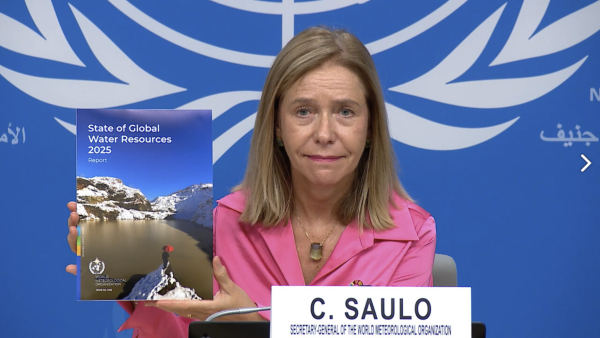
Victims Still Waiting: A Global Briefing on Transitional Justice Around the World
2
1
2
Edited News , Press Conferences | WMO
As world’s water reserves change, countries must prepare for a new reality: WMO
New data showing that rivers were at their lowest level for decades last year provides further evidence that the climate crisis is real and countries must act immediately to protect themselves from the increasing threat to communities and livelihoods, the UN World Meteorological Organization (WMO) said on Thursday.
The key findings from WMO’s State of Global Water Resources 2025 report covering the hydrological cycle and extreme events in the five-year period to last year:
- 2025 was one of driest years for river discharge in 35 years
- Past seven years have seen abnorfmal river flows
- Water storage on Earth’s land surface has decreased in past decade
- Widespread glacier loss across all regions for fourth consecutive year
- Asia and Africa are regions most affected by water-related disasters
- Water data availability has improved, but gaps remain in hard-hit areas
Highlighting the long-term decline in the Earth’s freshwater storage and glacier melt, WMO Secretary-General Celeste Saulo explained that the planet’s water reserves used to act as a planetary “savings account” that absorbed the occasional dry season, avoiding a water crisis. “One of the central stories of the 2025 report is what is happening to that savings account? And the simple answer is that we are depleting it,” she told journalists in Geneva.
Groundwater reserves are equally stretched and have been in decline since 2014, WMO’s report states, with nearly two-thirds of monitored wells worldwide showing levels lower than the historical norm and indicating a shift “further toward deficit…not recovery”.
“At the same time, we are seeing more water-related disasters,” Ms. Saulo said, while also stressing that the currently strengthening El Niño “will increase the risk of drought in some areas, and flooding in others”.
Glaciers disappearing
In 2025, for the fourth consecutive year, every major glaciated region on Earth lost ice mass, leading to short-term hazards including floods and long-term water insecurity, according to WMO.
Responding to a question about whether the changing global water cycle might have contributed to the deadly Nepal-China flooding disaster, Ms. Saulo explained that melting ice and rock was just one factor in the chain of events that ultimately sent a massive and deadly wall of water and debris downstream on 26 August, killing at least 1,367 people.
“You asked if it could happen again? Absolutely; the problem in this region is that there’s 63,700 glaciers at the last count,” she told a Press Conference in Geneva. “Even if you’re looking with remote sensing with satellites at these glaciers, you might see some faults, you might see some slight shifting, that does not mean necessarily catastrophic collapse. So, in order to plan for this, it’s very, very difficult. But the international community is looking very hard at ways in which we can bring people together to solve some of these monitoring issues.”
Data indicates that glaciers shrank between 2023 and 2025 with cumulative losses of 1,400 gigatonnes of water – or about one third of annual fresh water needs.
Every major glacier region on Earth lost ice for the fourth consecutive year.
“All 19 glacier regions around the globe lost ice; in Central Asia, Iceland, the Russian Arctic and western Canada and the United States, it was among the three worst years on record,” said Wayne Jenkinson, WMO’s Director of Hydrology and Cryosphere.
Some regions with smaller glaciers such as Central Europe, the Caucasus, the western Canada and the United States may already have reached “peak water”, Mr. Jenkinson warned.
“After this point, the glacier gives less meltwater each year simply because there is less ice left to melt. That matters for every community downstream that relies on water during hot, dry summers,” he explained.
Narelle van der Wel, WMO’s Head of Cryosphere Monitoring, Predictions and Services, stressed that while some further glacier loss is unavoidable, the eventual scale of the decline is not predetermined.
“Some glacier loss is inevitable, but total loss of glaciers is not yet inevitable,” she said, pointing to emissions reductions as central to limiting future losses.
Preparing for moving baselines
The report does not attribute every observed change to climate change alone. WMO says pressure on water resources and natural variability also contribute.
Mr. Jenkinson said governments need to prepare for “moving baselines” as historical patterns become less reliable.
“The situation 30 years ago is not where we are today,” he said. Countries, he added, need to prepare “for those changes that have really already arrived”.
ends
1
1
1
Press Conferences | WMO , OCHA , WHO , UNICEF , UN WOMEN , OHCHR , IOM , UNHCR
Update on Ebola from WHO and OCHA, update on the situation of children with the beginning of school in Ukraine from UNICEF, UN Women on the impact of the settlers and restrictions on women and girls in West Bank, OHCHR on the recovery of extensive human remains in Gaza, IOM and UNHCR on the new wave of displacement in Yemen