

The United Nations Office at Geneva
Multimedia Newsroom
Press Conferences | OCHA , OHCHR , UNCTAD , UNOG , WFP , WHO
Bi-Weekly Press Briefing 14 June 2022
Food security crisis in Latin America and the Caribbean
Lola Castro, World Food Programme Regional Director in Latin America and the Caribbean, spoke about the looming food crisis in the region. The climate crisis had been compounded by COVID-19, and most recently by the war in Ukraine. The region was experiencing a very high food inflation; the poorest of the poor could not access food. Many countries were importing more cereals than they were producing locally, she said. The cost of moving one ton of food had also gone significantly up because of the price of fuel, which was particularly affecting small island states in the Caribbean. Most countries in Latin America and the Caribbean were experiencing the shrinking fiscal space, which limited the possibility of social transfers. Migrant caravans were now active across the whole South American continent, with people taking perilous paths aiming to reach the United States. In Latin America some 15 per cent of the people had expressed intention to migrate, while in Central America that number went up to 43 per cent.
Unless the root causes were addressed, an even larger mass migration would be seen, stressed Ms. Castro. WFP was working with the governments to increase shock preparedness and responsiveness and cooperating with smallholder farmers to increase local production. Bringing back some traditional cereal crops to the region would also help and decrease the overdependence on the three globally leading cereals.
Responding to questions, Ms. Castro confirmed that the WFP was present in Brazil, but its activities there were different from the rest of the region. She explained that the whole region would also be affected by the lack of fertilizers and their price increase. WFP aimed to provide assistance – food or cash – to some eight million people in the 13 countries of the region where it was working. WFP was increasing the percentage of food it was buying from small local farmers. While Latin America was not importing that much food directly from Ukraine, the region was being affected by the global availability and prices of food.
Food assistance in South Sudan suspended
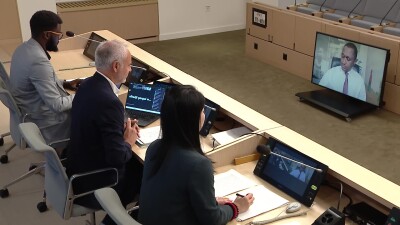
Adeyinka Badejo-Sanogo, World Food Programme Acting Country Director in South Sudan, speaking from Juba, stated that the WFP was extremely worried about having to suspend food distributions to some families and communities because of the funding gaps it was experiencing. The current dire situation was caused by the continuing subnational conflict, the climate crisis, and the severe economic shocks compounded by the pandemic and the war in Ukraine. An estimated 8.3 million people, including internally displaced persons and refugees, would endure acute severe hunger during the lean season this year. Acute malnutrition was noted across the country; it was the highest recorded malnutrition level in last five years. Since mid-April, the WFP had taken a painful step to suspend food assistance to 1.7 million people; the Programme currently had resources to support 4.4 million people. WFP was “taking away from the hungry to feed the starving,” explained Ms. Badejo-Sanogo.
Acute levels of hunger were likely to increase as the lean season proceeded. School meal programmes were also being affected by the WFP cuts. Many families were using extreme copying strategies such as selling off productive assets or child labour. Ms. Badejo-Sanogo said that 200,000 people had been newly displaced this year. Moreover, some 600,000 people were estimated to be in the path of flood waters and would be potentially displaced. WFP urgently needed USD 426 million for the next six months to avert the bad situation becoming even worse; donors were urged to keep South Sudan on their radar amidst other crises in the world.
More information is available here.
Launch of public fundraising campaign for the SAFER tanker
Jens Laerke, for the Office for the Coordination of Humanitarian Affairs (OCHA), said that the UN Resident and Humanitarian Coordinator for Yemen, David Gressly, was today launching a social media campaign to raise funds to respond to the stranded Safer tanker off the coast of Yemen. The tanker was holding four times the amount of oil spilled during the 1989 Exxon disaster. The UN had raised three-quarters of the money needed to start the operation, and was now trying to raise the remaining money from individuals and private companies.
Human Rights Council
Rolando Gomez, for the Human Rights Council (HRC), stated that the 50th session of the Council had begun on 13 June with the global update by the High Commissioner Michelle Bachelet. Today, the Council was holding an interactive discussion with the Commission of Inquiry on the Occupied Palestinian Territories and Israel. Around 11 a.m. today, Ms. Bachelet would provide an oral update on Myanmar, and around 12 noon, an interactive dialogue on the global update by the High Commissioner would continue. On 15 June in the morning, a panel discussion would be held on the situation of the Rohingya, while at noon a commemorative meeting would mark the 50th regular session of the HRC; the President of the General Assembly and the UN High Commissioner for Human Rights would speak, among others.
Mr. Gomez stated that today at 1:30 p.m., there would be a presentation of the report of the UN Independent International Commission of Inquiry on the Occupied Palestinian Territory, including East Jerusalem, and in Israel. Speakers would be Navi Pillay, Chair of the Commission of Inquiry; and Commission Members Miloon Kothari and Chris Sidoti.
The Commission of Inquiry on Ukraine would hold a press conference in Kyiv on 15 June, following their first visit to the country. The Commission would provide an oral update to the Council in September.
In response to a question about Michelle Bachelet’s successor, Mr. LeBlanc said that the recruitment process was underway, and the Secretary-General would submit the next UN High-Commissioner for Human Rights for approval by the General Assembly, once a suitable candidate was identified. An announcement would be made in due time.
Red Cross Red Crescent statutory meetings in Geneva
Benoit Carpentier, for the International Federation of Red Cross and Red Crescent Societies (IFRC), informed that the statutory meetings of the Movement would commence at Palexpo in Geneva on 19 June. The General Assembly and the Council of Delegates would bring together more than 180 national societies. A new IFRC President would be elected on 19 June. The meetings would be closed to media, but the media were welcome to come and interview participating delegations. A press conference with the newly elected President would be held in Palexpo on 20 June at 11 a.m.
Announcements
Catherine Huissoud, for the United Nations Conference on Trade and Development (UNCTAD), informed that on 15 June UNCTAD would hold a hybrid meeting in Room XXIV to present its contribution to the 2022 Financing for Sustainable Development Report, issued by the Secretary-General's Inter-Agency Task Force on Financing for Development. Rebeca Grynspan, Secretary-General of UNCTAD, and Liu Zhenmin, Head of UN DESA, would make opening remarks, followed by presentations from panelists.
Ms. Huissoud also informed that the Trade and Development Board would welcome UNCTAD’s member states and partners from 20 June until 1 July, in hybrid form in Room XIX. UNCTAD Secretary General would open the session at around 10 a.m. updating member states on the work of the organization. The programme would be accessible online.
Finally, Ms. Huissoud reminded that the UNCTAD Secretary-General Rebeca Grynspan and UN High Commissioner for Human Rights Michelle Bachelet had issued an open letter to Ministers attending MC12 at WTO urging them to align their policies and actions to achieve food security.
Benoit Carpentier, for the International Federation of Red Cross and Red Crescent Societies (IFRC), stated that, working together with a network of big cities from across the world, the IFRC was launching the Heat Action Day at 2:30 p.m. today.
Christian Lindmeier, for the World Health Organization (WHO), informed that on 16 June at 2 p.m., there would be a hybrid press conference by the World Health Organization to launch the World Mental Health Report: Transforming Mental Health for All, which was WHO’s largest analysis of world mental health since the turn of the century. The report, under embargo until 17 June, would be presented by Dévora Kestel, Director, Mental Health and Substance Use, WHO; and Mark Van Ommeren, Head, Mental Health Unit, WHO.
Today’s press briefing by the WHO Director-General on COVID-19, monkeypox and other health issues would be held at 3 p.m., informed Mr. Lindmeier.
A briefing on explosive weapons in populated areas would be held on 16 June at 11 am, informed Jens Laerke, for the Office for the Coordination of Humanitarian Affairs (OCHA).
At the end, Mr. LeBlanc stated that the Committee on the Elimination of Discrimination against Women (CEDAW), now in its 82nd session, was beginning this morning its review of the report of Portugal and would begin this afternoon the review of the report of Türkiye.
The Conference on Disarmament was having this morning a public plenary meeting, still under of the Democratic People’s Republic of Korea.
Today at 5:30 p.m., there would be a Ciné-ONU screening of the documentary “In the Shadow of the Sun” on the plight of people living with albinism in Tanzania. The screening would be followed by a panel discussion.
Similar Stories
1
1
1
Press Conferences | UNHCR
End of UNHCR's 77th Annual Executive Committee (ExCom) meeting week
1
1
1
Press Conferences | UNICEF , IOM , UNHCR
UN Special Assistant to the Personal Envoy Office (SUDAN): Peace Initiatives and Efforts in Sudan; UNICEF: Dire situation of children in Gaza; IOM: Damaged Homes and Energy Attacks Risk Displacing Ukrainians for this winter; UNHCR: update on EXCOM week
1
1
1
Press Conferences | IOM , UNDRR
UN stresses importance of household preparedness for disaster risk reduction.
1
1
1
Statements , Press Conferences | OHCHR
1
1
1
Press Conferences | UNHCR , UNICEF , IFRC , OHCHR , UN WOMEN , IOM , OCHA , WHO
UNHCR – ExCom Meeting, UNICEF – Nepal Recovery, IFRC – Flash Floods, WHO – Mental Health, IOM – South Sudan Floods, OCHA – DRC Humanitarian aid, UNHCR – Sahel Displacement, UNICEF – Yemen Update, IOM – Gaza Shelter, UN Women – Gaza Women, OHCHR – Arrests and detentions of Syrians by Israeli force
2
1
2
Press Conferences | UNCTAD
Presentation of the Trade and Developement Report 2026
Embargoed until 9 October 2026 at 11 a.m. (Geneva Time)
UNCTAD: UNCTAD’s flagship report finds that governments increasingly use industrial, trade, financial and technology policies to pursue economic and national security objectives. Market access and the ability to move into higher-value activities now depend more heavily on technology, finance and geopolitics.
1
1
1
Press Conferences | UPU
Release of the State of the Postal Sector Report 2026
1
1
1
Press Conferences | IOM , ITU , UNECE , UNICEF , WHO , WMO
UNICEF: Ebola, DRC - children orphans or separating them from parents and caregivers; IOM: Humanitarian needs in Djibouti amid arrivals from Yemen and increased migrant movements; WHO: Darfur, scale of health needs far exceeds available resources; WMO co-sponsored Global Heat Forum, Bangkok, monthly Global Seasonal Climate Update; UNECE: UN Forum of Mayors; ITU Plenipotentiary Conference 2026; WHO: child and adolescent obesity guidelines and new global roadmap to tackle pregnancy hypertension, a leading cause of maternal mortality
1
1
1
Press Conferences | OCHA , UN WOMEN , UNHCR , WFP , WHO , WTO , UNEP
OCHA – $160M CERF allocation to 12 underfunded crises; UNHCR – 5.8M refugee children remain out of school amid funding cuts; UN Women – Middle East escalation and food security among women/girls; WHO – Gaza supplies and overall situation; WFP – Yemen food insecurity and impact on global hunger ; UNEP - First International Conference of the Global Framework on Chemicals in Geneva | 16-20 November 2026
1
1
1
Press Conferences | UNHCR , WHO
Yemen's health system nears collapse amid conflict, causing rising casualties and medicine shortages.
1
1
1
Press Conferences | HRC
Update by the Expert Mechanism to Advance Racial Justice and Equality in Law Enforcement
1
1
1
Press Conferences | WIPO , WHO , UNICEF , UNHCR , IOM , WFP , FAO
WIPO Global Innovation Index 2026 launch and press conference, WHO Composition of influenza vaccines for the 2027 Southern Hemisphere flu season, UNICEF Yemen hunger and malnutrition; UNHCR Sudan displacement into Chad; IOM Ebola and population movements in DRC; WFP emergency food assistance in Nepal; and FAO food loss and waste.