

The United Nations Office at Geneva
Multimedia Newsroom
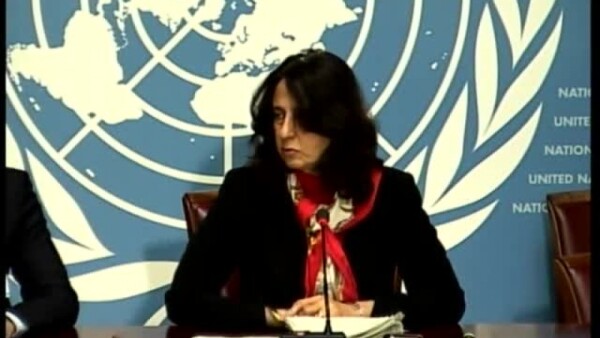
Alessandra Vellucci, Director of the United Nations Information Service (UNIS), chaired the briefing, which was attended by the spokespersons for the United Nations Support Mission in Libya (UNSMIL), the World Health Organization (WHO), the United Nations Children’s Fund (UNICEF), the Office for the Coordination of Humanitarian Affairs (OCHA), the Office of the High Commissioner for Human Rights (OHCHR), and the Office of the Special Envoy for Syria (OSE).
The topics addressed were: continuation of the Libyan talks in Geneva; situation in northwest Syria; killings of civilians in Cameroon; and plastic and electronic waste.
Libyan talks
Alessandra Vellucci, for the United Nations Information Service (UNIS), introduced Jean El-Alam, the spokesperson for the United Nations Support Mission in Libya (UNSMIL). Mr. El-Alam said that the military talks were continuing in Geneva today. The Special Envoy for Libya and head of UNSMIL, Ghassan Salamé, would hold a press stakeout in Hall XIV at 1 p.m. today. Mr. El-Alam shared his contacts with the press corps: alamj@un.org, 00 41 77 98 194 50, and for WhatsApp: 00 218 91 220 7565.
Syria
Alessandra Vellucci, for the United Nations Information Service (UNIS), informed that the UN Special Envoy for Syria, Geir O. Pedersen, would brief the Security Council on Wednesday at 4 p.m. CET. The briefing would be webcast.
Rupert Colville, for the Office of the High Commissioner for Human Rights (OHCHR), said that the High Commissioner expressed her horror at the level of violence in Syria. Since 1 January 2020, since the beginning of the Syrian Government’s military offensive in the northwest Syria, 299 civilian deaths had been recorded in that region. Around 93 percent of those deaths had been caused by the Syrian Government and its allies. In addition, 10 medical facilities and 19 educational facilities had either been directly hit or affected by strikes close by. Several incidents in which displacement camps had been hit were also recorded. The High Commissioner was calling on the Syrian Government and its allies to respect international humanitarian law and to allow for an unimpeded passage of civilians. OHCHR was alarmed at the failure of diplomacy which should protect civilians; impunity for violations of international humanitarian law was condemned.
Full High Commissioner’s statement can be read here.
Marixie Mercado, for the United Nations Children’s Fund (UNICEF), said that over half a million children had been forcibly displaced in northwest Syria since 1 December 2019. At least 77 children had been killed or injured in January alone: 28 killed and 49 injured. Those were verified casualties, so the true numbers were very likely higher. There were about 4 million people living in the northwest, a little over 2 million of them children. Virtually every child – up to 1.8 million required humanitarian assistance. With partners, UNICEF continued delivering lifesaving support and reaching children with winter clothes and blankets, safe water, hygiene kits, and screening and treatment for malnutrition. All actors needed to comply with the international humanitarian law, stressed Ms. Mercado.
UNICEF press release can be found here, and the new pictures from North-West Syria here.
Tarik Jašarević, for the World Health Organization (WHO), informed that as of today, 74 health facilities had suspended services in Idleb and Aleppo since 1 December 2019, thus directly decreasing civilian access to health care. Out of nearly 550 health facilities in Syria‘s northwest, roughly half were operational. Of great concern was the wellbeing and survival of more than half a million children, out of the nearly 900,000 people that had been displaced. Children were particularly prone to hypothermia and respiratory tract infections.
Despite the fluid situation on the ground, the WHO planned to go ahead with polio immunization in March. There had been six recorded attacks on health facilities in northwest Syria thus far in 2020. In January, eight truck loads from the WHO had helped the WHO assist more than 100,000 people in need, informed Mr. Jašarević. In coming days, the WHO would be sending essential medicine and supplies, across the border from Turkey to Syria - for trauma, intensive and surgical care to Idleb and Aleppo governorates, in addition to drugs for non-communicable diseases and primary health care. The urgently needed supplies would allow health facilities to maintain basic health services.
Responding to a question, Mr. Colville said that it was difficult to say who was responsible for each individual attack. Some of those attacks, by either States or non-State actors, might constitute war crimes; both States and non-State actors were bound by the Geneva Conventions. The sheer quantity of aerial attacks on schools and hospitals suggested that not all of them could be accidental. An estimated 93 percent of casualties were attributed to the attacks by the Syrian Government and its allies, and 82 percent of all casualties came as a result of the air attacks. A number of inquiries were underway. Mr. Jašarević, in response to another question, explained that the WHO was distributing health supplies through local partners; the WHO was not crossing into the Idleb region.
Jens Laerke, for the Office for the Coordination of Humanitarian Affairs (OCHA), underlined that the UN was only allowed to bring aid from across the Turkish-Syrian border, and not from within Syria. This was the largest displacement crisis yet seen in the Syrian conflict.
Jenifer Fenton, for the Office of the Special Envoy for Syria (OSE), reiterated that the conditions for civilians in the northwest were insufferable. The Constitutional Committee could be an important door opener, but by itself it might not be sufficient to end the Syrian conflict. The Committee had been created in an agreement of the Government and the opposition, Ms. Fenton reminded.
Killings in Cameroon
Alessandra Vellucci, for the United Nations Information Service (UNIS), read the statement of the Spokesperson of the UN Secretary-General, in which he expressed deep concern over reports about the killing of civilians, including children, in an attack on the village of Ngarbuh in the North-West Region of Cameroon on 14 February. The Secretary-General called on armed actors to refrain from attacks against civilians and to respect international humanitarian and international human rights law.
The Secretary-General’s statement can be found here.
Jens Laerke, for the Office for the Coordination of Humanitarian Affairs (OCHA), informed that on 14 February, armed men had killed over 20 civilians, including children, in the village of Ngarbuh, Donga Mantung division, North-West region, according to reports from trusted sources to the United Nations in Cameroon. At least nine houses had been burned in the village and the attack resulted in the displacement of 600 to 700 people. In the North-West and South-West regions, civilians were bearing the brunt of the violence and living in constant fear. A total of 2.3 million people urgently needed food, shelter, non-food items, and protection because of the crisis in the North-West and South-West. Some 1.7 million of those in need remained within the two regions. The other 600,000 had fled to the littoral, West and Center regions, said Mr. Laerke. For 2020, the humanitarian community had initially estimated a financial need of over USD 317 million.
Rupert Colville, for the Office of the High Commissioner for Human Rights (OHCHR), stated that the attack on 14 February on a village in Cameroon which had left 23 people dead, the majority of them children, was a shocking episode in the ongoing crisis that had afflicted the country’s North-West and South-West regions for the previous three years. OHCHR urged the authorities to ensure that the investigation was independent, impartial and thorough, and that those responsible were held fully to account. The attack was the latest deadly incident in Cameroon’s North-West and South-West regions where hundreds of thousands of people had been displaced by clashes between security and defence forces and armed separatist groups.
Full OHCHR statement can be found here.
Plastic and electronic waste
Charles Avis, for the Secretariats of the Basel, Rotterdam and Stockholm conventions (BRSMEAS), stated that publicly available projections showed that by 2050 there would be 12 billion tons of plastic waste in landfills or directly in the environment around the world. In addition, by 2050, 12 million tons of electronic waste would be produced every year. Certain types of plastic waste had been brought into the Basel Convention on the Transboundary Movement of Hazardous Waste since the last Conference of Parties in May 2019. A plastic waste partnership, with more than 150 members from various sectors, had been developed over the past year, and was continuing to build up; its first meeting would take place in two weeks. A key date was 1 January 2021, when the amendments to the Basel Convention would become effective and many types of plastic waste would formally become subject of the Convention.
Mr. Avis further said that electronic waste was the fastest growing type of waste in the world, and included mobile phones, televisions, fridges, etc. Burning plastic waste emitted the most harmful organic pollutants into the atmosphere, he warned. Finally, Mr. Avis informed that this afternoon, a massive open online course on e-waste would be launched. More information on the Basel Convention could be found here.
Geneva announcements
Alessandra Vellucci, for the United Nations Information Service in Geneva, said that the Committee on the Elimination of Discrimination Against Women was reviewing today the report of Afghanistan, to be followed by Bulgaria, Moldova, and Kiribati.
Ms. Vellucci further said that the Conference on Disarmament would announce later the date of its next public plenary meeting (which would be the first one under the presidency of Argentina).
On Wednesday, 19 February at 9.30 a.m. in Press Room 1, Ambassador Elisabeth Tichy-Fisslberger (Austria), President of the Human Rights Council, would hold a press conference on the upcoming 43rd session.
On Monday, 24 February at 2.30 p.m. in Press Room 1, the United Nations Conference on Trade and Development (UNCTAD) would present its new study: Brexit Beyond Tariffs: The role of Non-Tariff Measures and the impact on Developing Countries.
Similar Stories
1
12
1
1
Press Conferences , Images | UNOG
Closing Press Conference following the Sixth Consultative Meeting on Enhancing Coordination of Peace Initiatives and Efforts in Sudan

2
17
1
2
Edited News , Press Conferences | OCHA , WMO
Two UN agencies teamed up on Wednesday to issue an appeal for immediate assistance to help communities already being impacted by the strongest El Niño on record.
1
1
1
Press Conferences | CITES
Wildlife trade and conservation policy discussions at the 81st meeting of the CITES Standing Committee (SC81)
1
1
1
Press Conferences | UNHCR , UNCTAD , WMO , OCHA , UNICEF , WHO
UNHCR Hungary’s 1956 Refugee Crisis: 70 Years On, UNCTAD World Investment Forum 2026, Doha, WMO Greenhouse Gas Bulletin and Climate Update for COP31, OCHA Afghanistan: Malnutrition, Girls’ Education and Recovery, UNICEF Yemen: Child Malnutrition and Unsafe Water in Taiz, WHO Inequalities in Noncommunicable Diseases and Risk Factors
1
1
1
Press Conferences | UNHCR
End of UNHCR's 77th Annual Executive Committee (ExCom) meeting week
1
1
1
Press Conferences | UNICEF , IOM , UNHCR
UN Special Assistant to the Personal Envoy Office (SUDAN): Peace Initiatives and Efforts in Sudan; UNICEF: Dire situation of children in Gaza; IOM: Damaged Homes and Energy Attacks Risk Displacing Ukrainians for this winter; UNHCR: update on EXCOM week
1
1
1
Press Conferences | IOM , UNDRR
UN stresses importance of household preparedness for disaster risk reduction.
1
1
1
Statements , Press Conferences | OHCHR
1
1
1
Press Conferences | UNHCR , UNICEF , IFRC , OHCHR , UN WOMEN , IOM , OCHA , WHO
UNHCR – ExCom Meeting, UNICEF – Nepal Recovery, IFRC – Flash Floods, WHO – Mental Health, IOM – South Sudan Floods, OCHA – DRC Humanitarian aid, UNHCR – Sahel Displacement, UNICEF – Yemen Update, IOM – Gaza Shelter, UN Women – Gaza Women, OHCHR – Arrests and detentions of Syrians by Israeli force
2
1
2
Press Conferences | UNCTAD
Presentation of the Trade and Developement Report 2026
Embargoed until 9 October 2026 at 11 a.m. (Geneva Time)
UNCTAD: UNCTAD’s flagship report finds that governments increasingly use industrial, trade, financial and technology policies to pursue economic and national security objectives. Market access and the ability to move into higher-value activities now depend more heavily on technology, finance and geopolitics.
1
1
1
Press Conferences | UPU
Release of the State of the Postal Sector Report 2026
1
1
1
Press Conferences | IOM , ITU , UNECE , UNICEF , WHO , WMO
UNICEF: Ebola, DRC - children orphans or separating them from parents and caregivers; IOM: Humanitarian needs in Djibouti amid arrivals from Yemen and increased migrant movements; WHO: Darfur, scale of health needs far exceeds available resources; WMO co-sponsored Global Heat Forum, Bangkok, monthly Global Seasonal Climate Update; UNECE: UN Forum of Mayors; ITU Plenipotentiary Conference 2026; WHO: child and adolescent obesity guidelines and new global roadmap to tackle pregnancy hypertension, a leading cause of maternal mortality