

The United Nations Office at Geneva
Multimedia Newsroom
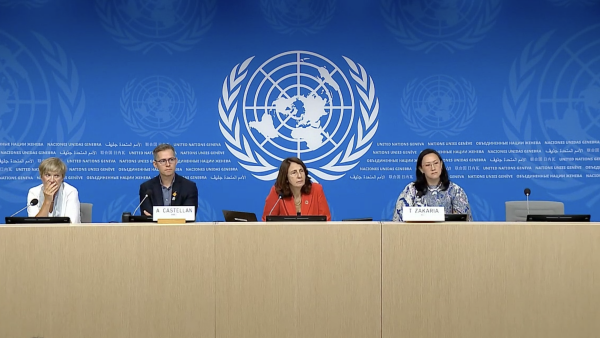
Rhéal LeBlanc, Chief of the Press and External Relations Section at the United Nations Information Service (UNIS), chaired the briefing, which was attended by the spokespersons for the World Health Organization (WHO), the World Food Programme (WFP), the International Organization for Migration (IOM), the United Nations Conference on Trade and Development (UNCTAD), and the Office of the Special Envoy for Syria (OSE).
Situation in Idlib, Syria
Elisabeth Byrs, for the World Food Programme (WFP), said that the WFP continued to provide emergency food assistance to people in desperate need in northwest Syria despite escalating hostilities, which earlier this week caused a 24-hour break in distributions. Heavy bombardments in the city of Atareb over the previous couple of days spurred significant population displacement. So far, airstrikes and armed clashes in northwest Syria had displaced nearly 800,000 people, 80 percent of whom were women and children. Families were moving north towards already overcrowded camps near the Syria-Turkey border. More than 140,000 people had been displaced in a single week, between 2 and 9 February. Since 1 January, the WFP had provided emergency ready-to-eat food rations to more than 300,000 displaced people; that food could be eaten without cooking and was light to carry.
The full press release can be read here.
Replying to questions from journalists, Ms. Byrs emphasized that the situation was dramatic, and was made even worse by the freezing temperatures. She informed that the trucks carrying humanitarian aid across the Turkish-Syrian border had recommenced their movement after a 24-hour hiatus. The food security situation was very difficult, and people spent, on average, 75 percent of their income on food.
In response to a question from a journalist, Jenifer Fenton, for the Office of the Special Envoy for Syria (OSE), emphasized an urgent need for de-escalation of the hostilities in the northeast, a sustained ceasefire and unrestricted humanitarian access to affected populations. The Special Envoy was continuing to engage with all concerned parties on de-escalation.
Migrant flows into Yemen
Paul Dillon, for the International Organization for Migration (IOM), stated that, in 2019, on average 11,500 people had boarded vessels each month from the Horn of Africa to Yemen, making it the busiest maritime migration route on earth. Over 138,000 people had crossed the Gulf of Aden to Yemen in 2019. Nearly 90 percent of those arriving to Yemen in 2019 had intended to continue on to Saudi Arabia; approximately 92 percent of the people making the journey were Ethiopian nationals, while the rest were Somalis. Migrants appeared undeterred by either the conflict in Yemen or the Gulf’s strict immigration policies for undocumented migrants.
The most effective protection mechanism for migrants remained the establishment of legal pathways for migration. IOM was committed to supporting all authorities along the eastern route to better manage migration, ensuring the safety and dignity of migrants.
Mr. Dillon, responding to a question, said that there had been fewer than 60 recorded deaths on that route in 2019.
COVID-19
Fadéla Chaib, for the World Health Organization (WHO), informed that a press conference on COVID-19 would take place today at 4 p.m. The speakers would be WHO’s leading experts Dr. Mike Ryan and Dr. Sylvie Briand. Ms. Chaib said that all questions would be addressed at today’s press conference.
Geneva announcements
Catherine Huissoud, for the United Nations Conference on Trade and Development (UNCTAD), informed about an upcoming analysis - “Impact of Brexit in the field of Non-Tariff Measures in developed and developing countries”. The analysis looked into two scenarios – with and without a trade agreement of the United Kingdom and the European Union. The analysis would be shared with the media, under embargo, before the end of the following week, and there would be a press conference to present the report on 24 February at 2 p.m.
Fadéla Chaib, for the World Health Organization (WHO), informed that an important new report on children, prepared by the WHO, the United Nations Children’s Fund (UNICEF), and the Lancet, entitled “Future for the World’s Children?” would be presented through a virtual press briefing on 17 February at 2 p.m. The report, prepared by more than 40 experts, included new recommendations, including commercial marketing targeting children with harmful products, climate and its impact on children’s futures. The report would be under embargo until 19 February.
Rhéal LeBlanc, for the United Nations Information Service (UNIS), informed that today, 14 February at 1.00 p.m. in Room III, the Working Group on Enforced or Involuntary Disappearances would brief the media on its just completed 120th session.
On Wednesday, 19 February at 9.30 a.m. in Press Room 1, Ambassador Elisabeth Tichy-Fisslberger of Austria, President of the Human Rights Council, would brief the press on the upcoming 43rd session of the Council.
Mr. LeBlanc further said that the Committee on the Elimination of Discrimination against Women was reviewing today the report of Eritrea.
The Conference on Disarmament was holding this morning a public plenary meeting, the last one under the presidency of Algeria.
The Committee on Economic, Social and Cultural Rights would open next Monday its 67th session (17 February-6 March, Palais Wilson) during which it would review the reports of Guinea, Belgium, Ukraine, Benin and Norway.
Mr. LeBlanc also informed that the United Nations Development Fund (UNDP) had launched Mission 1.5 as an online platform that educated people on climate action and connected them with their governments and policymakers. The Mission 1.5 game was available at mission1point5.org and could be played by people in every country in the world, in Arabic, Chinese, English, French, Russian and Spanish.
Similar Stories

1
1
1
Statements , Press Conferences | OHCHR

1
1
1
Press Conferences | UNHCR , UNICEF , IFRC , OHCHR , UN WOMEN , IOM , OCHA , WHO
UNHCR – ExCom Meeting, UNICEF – Nepal Recovery, IFRC – Flash Floods, WHO – Mental Health, IOM – South Sudan Floods, OCHA – DRC Humanitarian aid, UNHCR – Sahel Displacement, UNICEF – Yemen Update, IOM – Gaza Shelter, UN Women – Gaza Women, OHCHR – Arrests and detentions of Syrians by Israeli force

2
1
2
Press Conferences | UNCTAD
Presentation of the Trade and Developement Report 2026
Embargoed until 9 October 2026 at 11 a.m. (Geneva Time)
UNCTAD: UNCTAD’s flagship report finds that governments increasingly use industrial, trade, financial and technology policies to pursue economic and national security objectives. Market access and the ability to move into higher-value activities now depend more heavily on technology, finance and geopolitics.

1
1
1
Press Conferences | UPU
Release of the State of the Postal Sector Report 2026
1
1
1
Press Conferences | IOM , ITU , UNECE , UNICEF , WHO , WMO
UNICEF: Ebola, DRC - children orphans or separating them from parents and caregivers; IOM: Humanitarian needs in Djibouti amid arrivals from Yemen and increased migrant movements; WHO: Darfur, scale of health needs far exceeds available resources; WMO co-sponsored Global Heat Forum, Bangkok, monthly Global Seasonal Climate Update; UNECE: UN Forum of Mayors; ITU Plenipotentiary Conference 2026; WHO: child and adolescent obesity guidelines and new global roadmap to tackle pregnancy hypertension, a leading cause of maternal mortality
1
1
1
Press Conferences | OCHA , UN WOMEN , UNHCR , WFP , WHO , WTO , UNEP
OCHA – $160M CERF allocation to 12 underfunded crises; UNHCR – 5.8M refugee children remain out of school amid funding cuts; UN Women – Middle East escalation and food security among women/girls; WHO – Gaza supplies and overall situation; WFP – Yemen food insecurity and impact on global hunger ; UNEP - First International Conference of the Global Framework on Chemicals in Geneva | 16-20 November 2026
1
1
1
Press Conferences | UNHCR , WHO
Yemen's health system nears collapse amid conflict, causing rising casualties and medicine shortages.
1
1
1
Press Conferences | HRC
Update by the Expert Mechanism to Advance Racial Justice and Equality in Law Enforcement
1
1
1
Press Conferences | WIPO , WHO , UNICEF , UNHCR , IOM , WFP , FAO
WIPO Global Innovation Index 2026 launch and press conference, WHO Composition of influenza vaccines for the 2027 Southern Hemisphere flu season, UNICEF Yemen hunger and malnutrition; UNHCR Sudan displacement into Chad; IOM Ebola and population movements in DRC; WFP emergency food assistance in Nepal; and FAO food loss and waste.
2
1
2
Press Conferences | UNCTAD
Gaza reconstruction needs reach $71.5 billion as Palestinian economy and public finances face severe strain. Latest UNCTAD report documents the loss of decades of development gains, economic collapse in Gaza and tightening economic constraints in the West Bank.
The report identifies three immediate priorities: transferring withheld Palestinian revenues, safeguarding the banking system and aligning reconstruction support with the documented scale of damage and economic losses.
1
1
1
Press Conferences | HRC
Press conference on the situation of human rights in Nicaragua by the UN Group of Human Rights Experts
1
1
1
Press Conferences | ITU , UNHCR , WHO , WMO
YEMEN - UNHCR: Escalating conflict in Yemen could fuel more displacement, refugee movement
CLIMATE - WHO / WMO: Health and Climate impact of El Niño