

The United Nations Office at Geneva
Multimedia Newsroom
Press Conferences | UNHCR , OCHA , WHO , UNOG , UNITED NATIONS , WFP
Bi-Weekly Press Briefing 11 February 2022
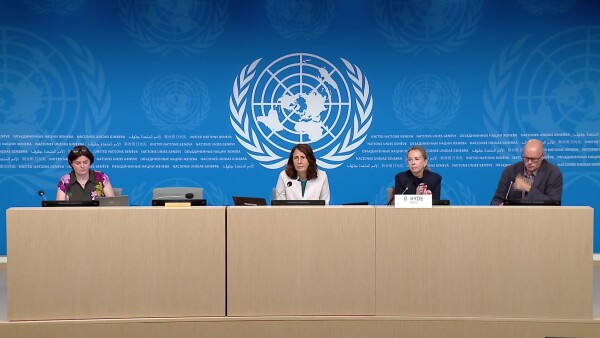
Alessandra Vellucci, Director of the United Nations Information Service in Geneva, chaired the hybrid press briefingwhich was attended by the spokespersons of the World Food Programme, the Office for the Coordination of Humanitarian Affairs, the United Nations Refugee Agency, and the World Health Organization.
Displacement in Myanmar
Matthew Saltmarsh, for the United Nations Refugee Agency (UNHCR), stated that the UNHCR was stepping up its emergency response to assist hundreds of thousands of internally displaced people in Myanmar as their number had crossed the 800,000 mark - doubling since February 2021.
Security was deteriorating rapidly across the country as fighting and armed conflict intensified with no sign of abating. UNHCR forecast an accelerating trend of displacements in the coming weeks and months. UNHCR and partners were scaling up operations and deploying additional resources to support as many of the displaced as possible, complementing local community responses.
Humanitarian access in many parts of Myanmar remained restricted due to insecurity, roadblocks and challenges in obtaining access approvals. As a result, host communities and local responders continued to play a leading role in assisting displaced populations, demonstrating solidarity with each other by donating what they could. UNHCR had been working with UN agencies, local partners and communities to assist those affected wherever possible, including displaced and stateless populations and host communities. Mr. Saltmarsh stressed that some 600,000 stateless Rohingya in Rakhine State, including some 148,000 displaced in camps, villages and displacement sites, also remained highly vulnerable and require humanitarian support.
UNHCR remained committed to providing critical humanitarian assistance to those in need and calls for full, safe and unhindered humanitarian access across Myanmar, so that no disruption to lifesaving work occurs for local, national, and international aid agencies. A total of USD 56.7 million was needed to ensure adequate humanitarian assistance and support vulnerable communities.
Full statement can be found here.
Responding to questions, Mr. Saltmarsh said that the UNHCR dealt with the military based on the humanitarian imperative: it was all about getting access and ensuring that humanitarian staff could work freely. UNHCR had some 200 staff on the ground. Access to the Rakhine State had been sporadic; life there was extremely difficult with a largely stateless population. Mr. Saltmarsh specified that there were some 918,000 displaced Rohingya in Bangladesh and over 800,000 internally displaced Rohingya in Myanmar.
Alessandra Vellucci, for the United Nations Information Service (UNIS), recalled that the United Nations on the ground had called for the respect of the freedom of expression and freedom of the press, and had urged the military to release detained journalists. According to UNESCO, as of 9 February at least 146 journalists had been arrested in Myanmar since the coup, a third of whom were still believed to being detention.
Aid delivery to Tigray
Christian Lindmeier, for the World Health Organization (WHO), stated that a shipment of medical supplies was arriving to Mekelle today. However, fuel and cash necessary to continue operations were still missing. WHO was concerned about the lack of fuel necessary to transport the newly arrived aid, because without fuel, medicines could not reach communities in need. It was hoped that this issue could be resolved shortly with the support of national authorities and international partners.
Jens Laerke, for the Office for the Coordination of Humanitarian Affairs (OCHA), added that the lack of fuel and cash had been an issue for a long time. Operational humanitarian agencies were not allowed to bring in fuel to Tigray, he explained. In northern Ethiopia there were two problems: active fighting and restrictions, which adversely affected delivery of aid and supplies. Humanitarian agencies were running out of fuel as no fuel had been allowed to enter Tigray since August 2021, with an exception of two WFP trucks. Every week, 200,000 litres of fuel was needed to run operations at full scale, he explained.
Alessandra Vellucci, for the UN Information Service, reminded about the visit to Ethiopia this week by the UN Deputy Secretary-General Amina Mohammed.
Outbreak of Lassa Fever in the United Kingdom
Christian Lindmeier, for the World Health Organization (WHO), said that two people in the same family had been diagnosed with Lassa Fever in England; they had recently returned from west Africa. He explained that Lassa Fever was an acute viral hemorrhagic illness caused by Lassa virus and was transmitted through exposure to food or household items contaminated with urine or feces of infected rats. Person-to-person infection could happen, but the virus did not spread easily. Most people would make full recovery, but severe illness could develop in certain individuals. Lassa Fever was endemic in a number of western African countries. The overall case fatality was one percent, and it went up to 15 percent for those hospitalized.
Measles outbreak in Afghanistan
Christian Lindmeier, for the World Health Organization (WHO), said that there was a sharp rise in measles cases in Afghanistan. The disease had been endemic in the country for a while, but cases had been rising sharply since summer 2021. 35 319 suspected cases of measles and 156 deaths have been reported in Afghanistan from 1 January 2021 to 29 January 2022. Of these, 3221 cases were laboratory confirmed. Ninety-one percent of these cases and 97% of these deaths were in children under five years-old.
The rapid rise of cases in January suggested that the number of deaths was likely to rise in the coming weeks. Malnutrition weakened immunity, making people – especially children – more vulnerable to measles. It was an extremely contagious viral disease, and it was particularly dangerous for unvaccinated, malnourished young children, explained Mr. Lindmeier. WHO and partners were strengthening their measles outbreak response. The best way to protect children from measles was for countries to step immunization efforts and ensure that at least 95 percent of children receive two doses of vaccines.
Answering to journalists’ questions, Mr. Lindmeier said vitamin A supplements had been provided to some 8.5 million children in November 2021. A larger measles vaccination campaign, aiming to reach 3.5 million children nationwide, was to start in May, or earlier, if possible.
Humanitarian response in Madagascar after Cyclone Batsirai
Jens Laerke, for the Office for the Coordination of Humanitarian Affairs (OCHA), informed that emergency response teams, including a ten-person UN Disaster Assessment and Coordination team, had deployed to Madagascar to support the emergency response in the hardest-hit areas. At least 94 people had died in the disaster, the Government’s disaster management agency reported this morning, and more than 116,200 people had been affected, including nearly 30,800 people displaced. Those numbers continued to change as more information became available.
The cyclone’s wind and rains had also destroyed, damaged, or flooded more than 18,000 houses and 4,500 classrooms; about 70 health centres had been damaged. UN agencies and NGOs were already providing relief in support of the Government-led response and delivering food, water and sanitation, health supplies and protection services, while needs assessments continued in the most-affected districts in the south-east of the country.
More details on the humanitarian response can be found here.
Tomson Phiri, for the World Food Programme (WFP), said that the WFP, along with the Government of Madagascar, was providing food, logistics and IT assistance and an airlink to support relief operations in the districts of Mananjary and Manakara badly affected by Cyclone Batsirai.
WFP had so far distributed 10,000 hot meals in cyclone shelters in Manakara; some 8.7 metric tons of prepositioned food had been distributed to displaced people in Manakara and 3.4 metric tons had been distributed in Vohipeno. Another 5.2 metric tons would be distributed over the coming days, and around 160 metric tons of food was being transported to Mananjary. Cash distributions for nearly 1,400 households were ongoing in Farafangana.
Mr. Phiri added that the WFP was supporting the government in its rapid assessment including an aerial survey. The UN Humanitarian Air Service was conducting special flights in coordination with OCHA to assess the impact of the cyclone. WFP would also provide road transport to partners between Manakara and Mananjary to enable relief efforts.
More information is available here.
Announcements
Christian Lindmeier, for the World Health Organization (WHO), informed that Dr. Tedros, WHO Director-General, was on a high-level visit to Cape Town, South Africa, to inspect the mRNA vaccine technology transfer hub. Press release is available here.
Mr. Lindmeier also informed about coming into effect of WHO’s new International Classification of Diseases (ICD-11), which provided a common language for health care professionals around the world. In 2019, WHO Member States had committed to using this ICD for mortality and morbidity reporting from 2022. ICD-11 was entirely digital and accessible to all. Over 90 countries and numerous health care providers had provided inputs. ICD-11 included new chapters on traditional medicine and addictive gaming disorders, explained Mr. Lindmeier. More information can be found here.
Jens Laerke, for the Office for the Coordination of Humanitarian Affairs (OCHA), announced that Joyce Msuya of Tanzania had started as OCHA’s new Assistant Secretary-General for Humanitarian Affairs and Deputy Emergency Relief Coordinator. Ms. Msuya brought more than 20 years’ experience in international development and finance with diverse assignments in Africa, Asia, and Latin America. Full announcement is here.
Alessandra Vellucci, for the United Nations Information Service (UNIS), informed that the Committee on the Rights of the Child would conclude this afternoon its 89th session, during which it had reviewed the reports of the Netherlands and Madagascar.
The Committee on the Elimination of Discrimination against Women was reviewing today the report of Uganda.
The Committee on Economic, Social and Cultural Rights would open on 14 February its 71st session, during which it would review the reports of the Democratic Republic of the Congo, Belarus, Czechia, Serbia, Uzbekistan, and Bahrain. The session would last until 4 March.
Today was the International Day of Women and Girls in Science, for which the Secretary-General’s message had been shared.
Similar Stories
1
1
1
Press Conferences | CITES
Wildlife trade and conservation policy discussions at the 81st meeting of the CITES Standing Committee (SC81)
1
1
1
Press Conferences | UNHCR , UNCTAD , WMO , OCHA , UNICEF , WHO
UNHCR Hungary’s 1956 Refugee Crisis: 70 Years On, UNCTAD World Investment Forum 2026, Doha, WMO Greenhouse Gas Bulletin and Climate Update for COP31, OCHA Afghanistan: Malnutrition, Girls’ Education and Recovery, UNICEF Yemen: Child Malnutrition and Unsafe Water in Taiz, WHO Inequalities in Noncommunicable Diseases and Risk Factors
1
1
1
Press Conferences | UNHCR
End of UNHCR's 77th Annual Executive Committee (ExCom) meeting week
1
1
1
Press Conferences | UNICEF , IOM , UNHCR
UN Special Assistant to the Personal Envoy Office (SUDAN): Peace Initiatives and Efforts in Sudan; UNICEF: Dire situation of children in Gaza; IOM: Damaged Homes and Energy Attacks Risk Displacing Ukrainians for this winter; UNHCR: update on EXCOM week
1
1
1
Press Conferences | IOM , UNDRR
UN stresses importance of household preparedness for disaster risk reduction.
1
1
1
Statements , Press Conferences | OHCHR
1
1
1
Press Conferences | UNHCR , UNICEF , IFRC , OHCHR , UN WOMEN , IOM , OCHA , WHO
UNHCR – ExCom Meeting, UNICEF – Nepal Recovery, IFRC – Flash Floods, WHO – Mental Health, IOM – South Sudan Floods, OCHA – DRC Humanitarian aid, UNHCR – Sahel Displacement, UNICEF – Yemen Update, IOM – Gaza Shelter, UN Women – Gaza Women, OHCHR – Arrests and detentions of Syrians by Israeli force
2
1
2
Press Conferences | UNCTAD
Presentation of the Trade and Developement Report 2026
Embargoed until 9 October 2026 at 11 a.m. (Geneva Time)
UNCTAD: UNCTAD’s flagship report finds that governments increasingly use industrial, trade, financial and technology policies to pursue economic and national security objectives. Market access and the ability to move into higher-value activities now depend more heavily on technology, finance and geopolitics.
1
1
1
Press Conferences | UPU
Release of the State of the Postal Sector Report 2026
1
1
1
Press Conferences | IOM , ITU , UNECE , UNICEF , WHO , WMO
UNICEF: Ebola, DRC - children orphans or separating them from parents and caregivers; IOM: Humanitarian needs in Djibouti amid arrivals from Yemen and increased migrant movements; WHO: Darfur, scale of health needs far exceeds available resources; WMO co-sponsored Global Heat Forum, Bangkok, monthly Global Seasonal Climate Update; UNECE: UN Forum of Mayors; ITU Plenipotentiary Conference 2026; WHO: child and adolescent obesity guidelines and new global roadmap to tackle pregnancy hypertension, a leading cause of maternal mortality
1
1
1
Press Conferences | OCHA , UN WOMEN , UNHCR , WFP , WHO , WTO , UNEP
OCHA – $160M CERF allocation to 12 underfunded crises; UNHCR – 5.8M refugee children remain out of school amid funding cuts; UN Women – Middle East escalation and food security among women/girls; WHO – Gaza supplies and overall situation; WFP – Yemen food insecurity and impact on global hunger ; UNEP - First International Conference of the Global Framework on Chemicals in Geneva | 16-20 November 2026
1
1
1
Press Conferences | UNHCR , WHO
Yemen's health system nears collapse amid conflict, causing rising casualties and medicine shortages.