

The United Nations Office at Geneva
Multimedia Newsroom
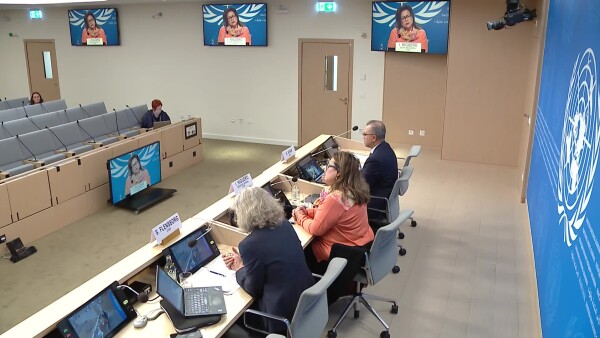
Rhéal LeBlanc, Chief of the Press and External Relations Section at the United Nations Information Service (UNIS), chaired the briefing, which was attended by the spokespersons for the Office of the Special Envoy for Syria (OSE), the Office for the Coordination of Humanitarian Affairs (OCHA), the World Health Organization (WHO), the United Nations Refugee Agency (UNHCR), and the United Nations Economic Commission for Europe (UNECE).
Libyan military talks
Rhéal LeBlanc, for the United Nations Information Service (UNIS), informed about this morning’s press stakeout by Ghassan Salamé, Special Representative of the United Nations Secretary-General and Head of the United Nations Support Mission in Libya, on the occasion of the start of a meeting in Geneva of the 5+5 Libyan Joint Military Commission. Mr. Salamé had said it was the very first time senior military officers from both sides of the Libyan conflict were meeting. The talks were very important to discuss how to consolidate the truce agreed to in early January and move towards a more permanent ceasefire. A transcript of the press stakeout would be sent out shortly. In response to questions, Mr. LeBlanc said Mr. Salamé had said the meeting was expected to last at least until Thursday. He had also expressed the hope that political talks could be held in Geneva within weeks.
Situation in Idlib, Syria
Jenifer Fenton, for the Office of the Special Envoy for Syria, said that the Special Envoy, Geir O. Pedersen, was alarmed by the continued and further escalation of violence in Syria’s northwest, the consequences of which were devastating and the price the civilians were paying was high. Hundreds of thousands of civilians were displaced, and their numbers continued to swell. The most vulnerable – women, children, and the elderly – were particularly affected. Any attacks on civilian objects, which continued to be reported, were unacceptable. There needed to be strict respect of rules, respect of civilians and civilian objects, and observance of the principles of proportionality and distinction. There was an urgent need for a renewed focus on finding a political solution, facilitated by the United Nations.
Jens Laerke, for the Office for the Coordination of Humanitarian Affairs (OCHA), informed that the UN and humanitarian partners were scaling up their response for hundreds of thousands of people displaced in northwest Syria. Since 1 December 2019, some 520,000 people had been displaced from their homes, the majority of them women and children. They urgently needed shelter, food, medicine, and, not least, protection. An additional 280,000 people from urban centres on the M4/M5 highway axis were at imminent risk of displacement if ongoing military operations continued. The humanitarian community had a plan in place to address up to 800,000 people in need in northwest Syria over the next six months; USD 336 million was needed for the implementation of those emergency humanitarian programs. There were no safe places in Idlib, with bombs falling everywhere and anywhere, staff from the ground reported. The scale of the crisis was overwhelming and the available aid was not enough.
Responding to a question, Mr. Laerke said that information from the OHCHR showed that from 20 to 30 January there had been 83 verified civilian deaths in Idlib.
Tarik Jašarević, for the World Health Organization (WHO), said that 53 health facilities had ceased operations in northwest Syria the previous month. Not all of them had been destroyed; some had been abandoned due to population movements. In January, two separate attacks on healthcare facilities had taken place, claiming 10 lives and leading to numerous injuries. There were fears of outbreaks of measles, polio, and diarrhoea. About two months of supplies of essential medicines had been positioned on both sides of the Syria-Turkey border. The current gap for funding for the health needs in northwest Syria was USD 8.6 million.
Venezuelans in Colombia
Shabia Mantoo, for the United Nations Refugee Agency (UNHCR), informed that UNHCR welcomed the Colombian Government’s announcement of the creation of two new special stay permits that sought to benefit more than 100,000 Venezuelans, by allowing them to stay and work in the country.
Colombia was host to more than 1.6 million Venezuelans, of whom more than half lacked a regular status. Many of them faced difficulties accessing essential services, such as health, education, and employment. UNHCR protection monitoring exercises indicated that access to the labour market remained a top priority among Venezuelans in Colombia.
The full UNHCR statement can be read here.
Any such measures by countries in the region were commendable, said Ms. Mantoo in a response to a question. Refugees and the hosting countries needed more support from the international community.
Geneva announcements
Jean Rodriguez, for the United Nations Economic Commission for Europe (UNECE), informed about a press conference on road safety on 7 February at 3 p.m., Press Room I. Ahead of the Ministerial Conference, the UNSG’s Special Envoy for Road Safety, Jean Todt, and UNECE Executive Secretary Olga Algayerova would make a call for a paradigm shift in Road safety for 2030.
Despite some progress during the Decade of Action, over 3,700 people died on the roads every day, or 1.3 million per year; in addition, between 20 and 50 million were injured every year. The magnitude of the problem should not be forgotten. The Ministerial Conference, to take place in Stockholm 19-20 February, was a wakeup call for the paradigm shift before 2030.
Tarik Jašarević, for the World Health Organization (WHO), informed that, on the occasion of World Cancer Day, 4 February, the WHO would be shortly sending out information on cancer situations per country.
He informed that on 5 February at 1 p.m., the WHO Independent High-level Commission on Noncommunicable Diseases would be publishing its recommendations. Meanwhile, the WHO Executive Board was continuing its meetings, which would all be webcast. A new Director for Europe had been elected, while the Director for Africa had been reappointed, stated Mr. Jašarević.
A press conference on the new Coronavirus with Dr. Sylvie Briand of the WHO would take place in Press Room III at 11:30 a.m. today.
On 5 February, at 10 a.m. UNHCR would be releasing its 2019 resettlement data, in Press Room I. Grainne O’Hara, Director of UNHCR Division of International Protection, would present the data.
On 5 February, at 11 a.m., the US Permanent Mission would hold a press briefing in Press Room I on “Venezuela: Threats to Free and Fair Elections in 2020”.
Mr. LeBlanc also informed that the Conference on Disarmament held its public plenary this morning, under the presidency of Algeria.
The Committee on the Rights of the Child would be closing its 83rd session on 7 February, when it would issue its concluding observations on the six countries reviewed during this session: Belarus, Costa Rica, Hungary, Rwanda, State of Palestine, and Austria.
The first screening of Ciné-ONU for 2020 would take place at Cinerama Empire at 7 p.m. today, when “The Accountant of Auschwitz” would be shown, to be followed by a discussion on accountability with Catherine Marchi-Uhel and Nicholas Koumjian, who head the independent investigative mechanisms on Syria and Myanmar, respectively.
The full list of upcoming meetings and press conferences at UN Geneva can be found here.
Similar Stories
1
1
1
Press Conferences | WMO , UNHCR , WHO , ILO
WMO: Greenhouse Gas Bulletin; UNHCR: As attacks intensify UNHCR urges support for war ravaged Ukrainians; WHO: Clinical trials in DRC: vaccines and beyond; ILO: New global and regional estimates on domestic work, informality and working conditions
1
1
1
Press Conferences | UN WOMEN , WFP , WHO
UN WOMEN: Sudan Women and girls one year after the fall of El Fasher; increasing drone attacks across the country; WFP: DRC - Ebola spreads to eighth DRC province as WFP delivers food, builds treatment centres and keeps supplies moving; WHO - Update on Ebola (Bundibugyo Virus Disease)
1
12
1
1
Press Conferences , Images | UNOG
Closing Press Conference following the Sixth Consultative Meeting on Enhancing Coordination of Peace Initiatives and Efforts in Sudan

2
17
1
2
Edited News , Press Conferences , Images | OCHA , WMO
Two UN agencies teamed up on Wednesday to issue an appeal for immediate assistance to help communities already being impacted by the strongest El Niño on record.
1
1
1
Press Conferences | CITES
Wildlife trade and conservation policy discussions at the 81st meeting of the CITES Standing Committee (SC81)
1
1
1
Press Conferences | UNHCR , UNCTAD , WMO , OCHA , UNICEF , WHO
UNHCR Hungary’s 1956 Refugee Crisis: 70 Years On, UNCTAD World Investment Forum 2026, Doha, WMO Greenhouse Gas Bulletin and Climate Update for COP31, OCHA Afghanistan: Malnutrition, Girls’ Education and Recovery, UNICEF Yemen: Child Malnutrition and Unsafe Water in Taiz, WHO Inequalities in Noncommunicable Diseases and Risk Factors

1
1
1
Press Conferences | UNHCR
End of UNHCR's 77th Annual Executive Committee (ExCom) meeting week

1
1
1
Press Conferences | UNICEF , IOM , UNHCR
UN Special Assistant to the Personal Envoy Office (SUDAN): Peace Initiatives and Efforts in Sudan; UNICEF: Dire situation of children in Gaza; IOM: Damaged Homes and Energy Attacks Risk Displacing Ukrainians for this winter; UNHCR: update on EXCOM week

1
1
1
Press Conferences | IOM , UNDRR
UN stresses importance of household preparedness for disaster risk reduction.

1
1
1
Statements , Press Conferences | OHCHR

1
1
1
Press Conferences | UNHCR , UNICEF , IFRC , OHCHR , UN WOMEN , IOM , OCHA , WHO
UNHCR – ExCom Meeting, UNICEF – Nepal Recovery, IFRC – Flash Floods, WHO – Mental Health, IOM – South Sudan Floods, OCHA – DRC Humanitarian aid, UNHCR – Sahel Displacement, UNICEF – Yemen Update, IOM – Gaza Shelter, UN Women – Gaza Women, OHCHR – Arrests and detentions of Syrians by Israeli force

2
1
2
Press Conferences | UNCTAD
Presentation of the Trade and Developement Report 2026
Embargoed until 9 October 2026 at 11 a.m. (Geneva Time)
UNCTAD: UNCTAD’s flagship report finds that governments increasingly use industrial, trade, financial and technology policies to pursue economic and national security objectives. Market access and the ability to move into higher-value activities now depend more heavily on technology, finance and geopolitics.